




Branding and Strategy
The consumer trends 2027 reports from Euromonitor, NIQ, McKinsey, Deloitte, Mintel, and Edelman describe one buyer. This buyer expects prices and platforms to stay unstable and has already changed habits to match. NIQ’s Consumer Outlook guide to 2027 says households now make lasting decisions on the assumption that uncertainty will persist, instead of waiting for conditions to settle.
This article covers eight shifts in consumer trends 2027 that recur across those sources, with the figures behind each one and what a marketing team can do about it. It is written for marketing leaders at consumer brands and at tech companies that sell to consumers, and for anyone planning a 2027 budget. Teams that already follow marketing trends for 2026 will recognize several of these shifts, now backed by newer data.
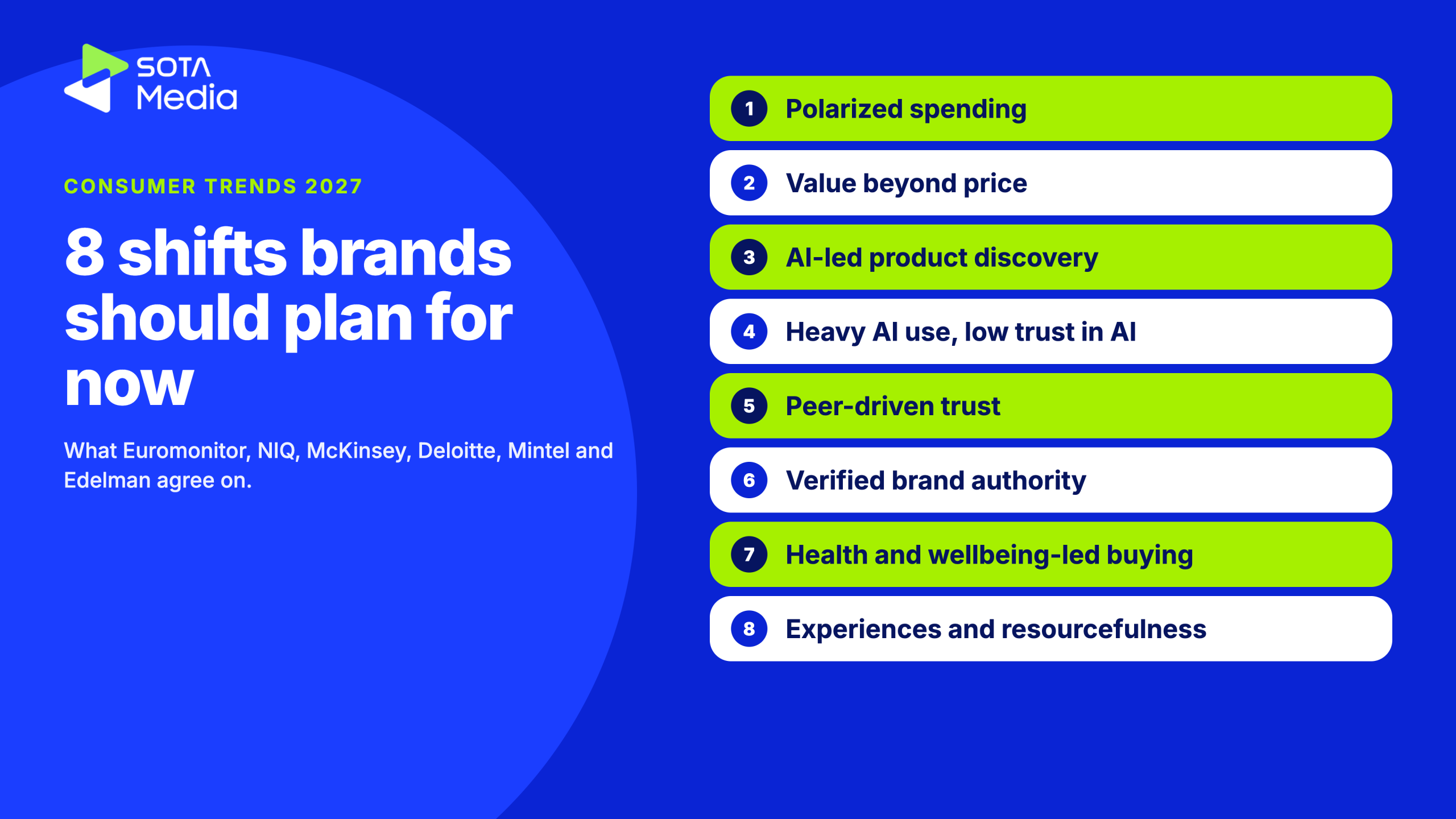
Shift 1: Spending is polarizing, as consumers either trade down to value or trade up to premium and mainstream brands get squeezed in the middle
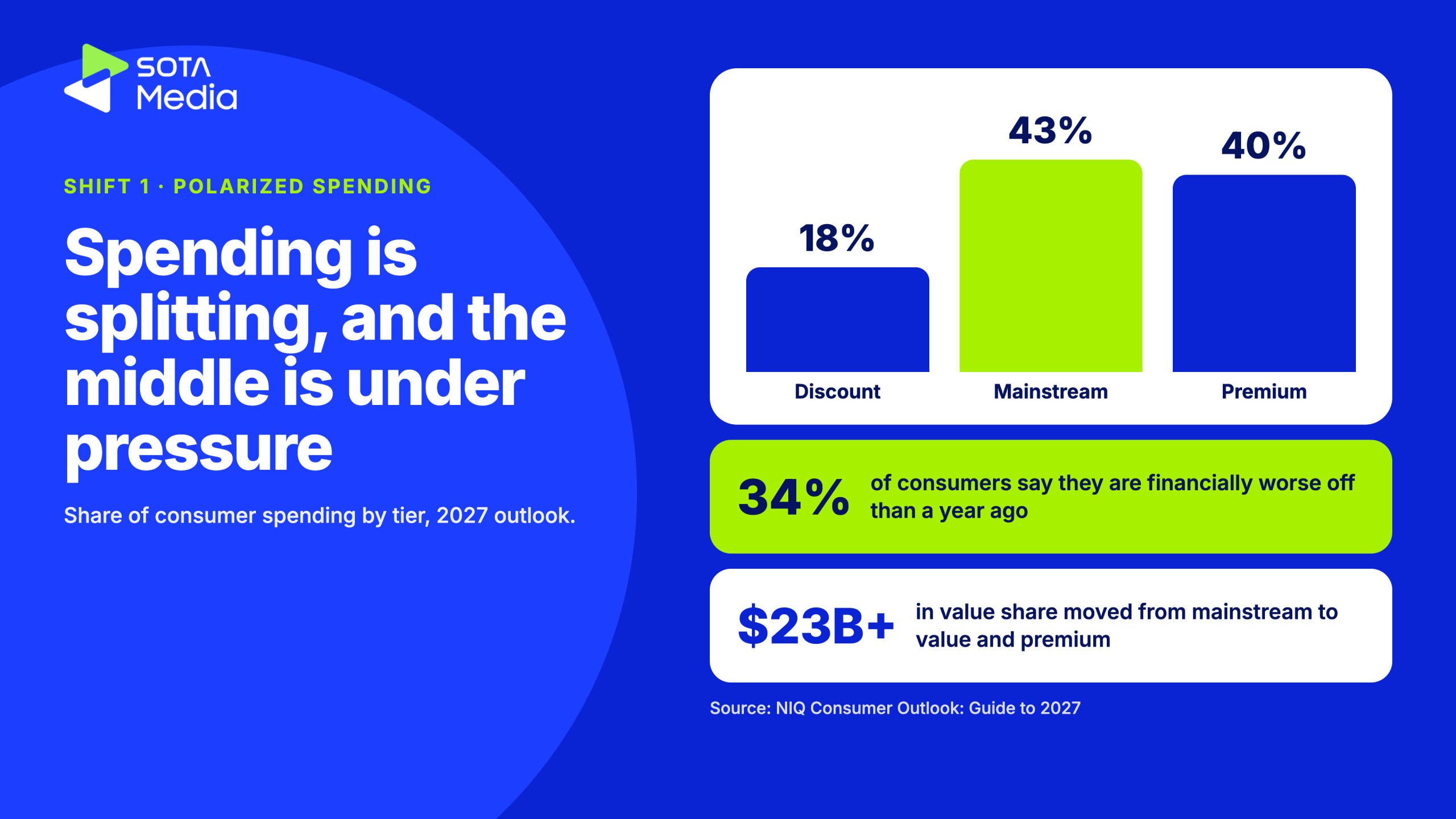
The Consumer Trends 2027 data shows households sorting into two groups.
NIQ found that 34% of global consumers say they are financially worse off than a year ago, and that more than $23 billion in value share has moved from mainstream-priced consumer packaged goods to value and premium alternatives. By price tier, discount products hold 18% of market share, mainstream 43%, and premium 40%. Mainstream is still the largest tier, and it is the one under pressure.
McKinsey points the same way: more than three-quarters of consumers continue to trade down in some form. Deloitte’s 2026 Global Retail Industry Outlook, a survey of 330 retail leaders, found that 40% of consumers show deal-driven or cost-conscious habits, and nearly 70% of leaders call that a structural change rather than a response to inflation.
In the consumer trends 2027 picture, a brand in the middle with no clear reason to cost more has the weakest position. Decide whether each product is the value choice or the upgrade, then price and message it that way.
Shift 2: Value now means quality and reliability as well as price, so shoppers stay with brands they already trust
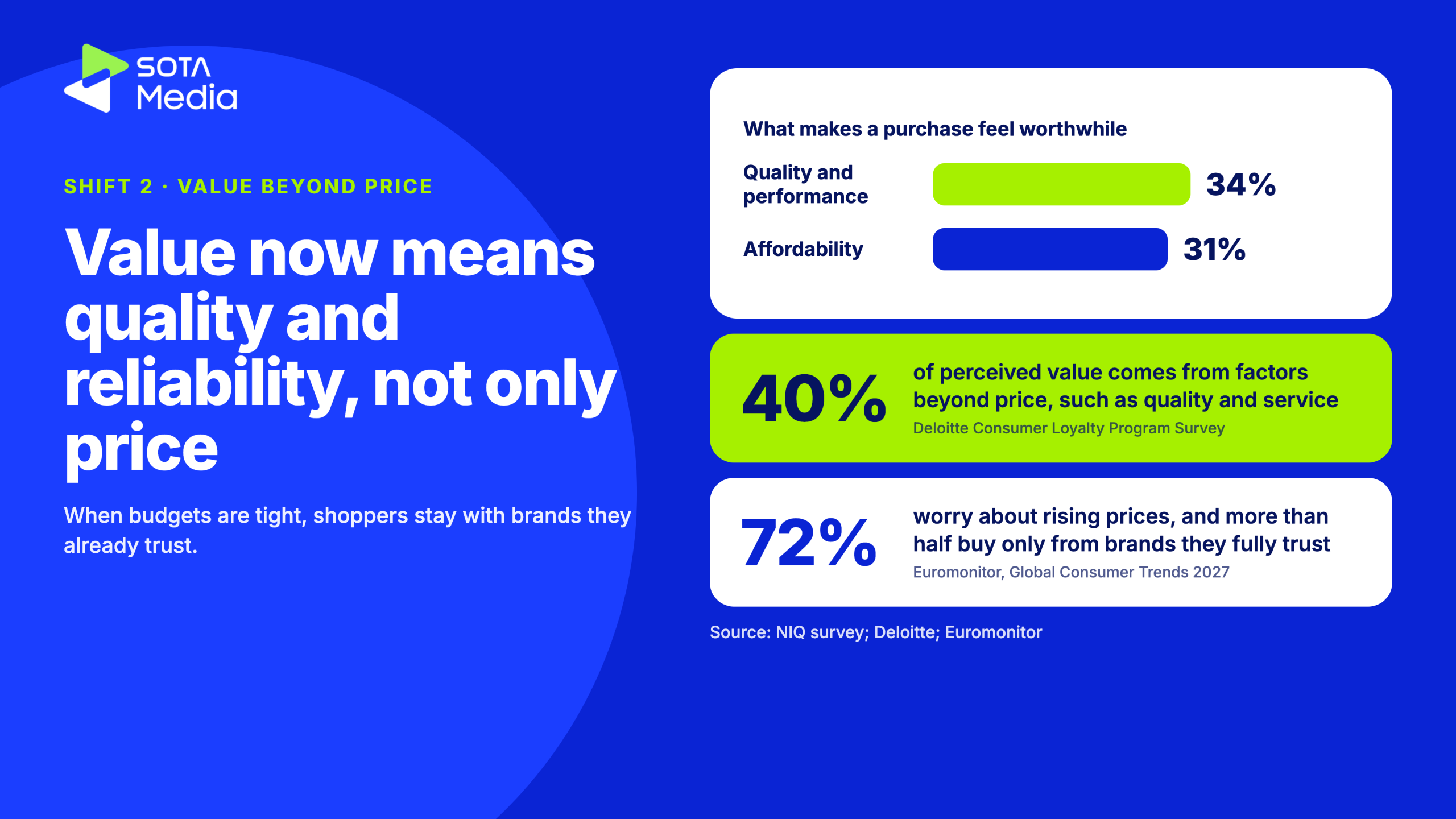
Price is no longer the only test of a good purchase.
In NIQ’s survey, quality and performance (34%) edged out affordability (31%) as the main measure of whether a purchase feels worthwhile. Deloitte reports, from its Consumer Loyalty Program Survey, that 40% of consumers’ perception of value comes from factors beyond price, such as quality and service.
Euromonitor’s Global Consumer Trends 2027, published on November 4, 2026, calls this behavior Shelf Assured. More than half of consumers buy only from brands they fully trust, and 72% worry about rising prices. When budgets are tight, a failed purchase costs more, so shoppers stay with products that have worked before.
For brands, this part of consumer trends 2027 puts reviews, guarantees, return policies, and consistent product quality inside the marketing budget instead of leaving them to operations.
Shift 3: AI assistants and AI search are becoming the starting point for product research and shopping decisions
AI tools are now a normal part of researching a purchase, and the Consumer Trends 2027 data shows the habit spreading.
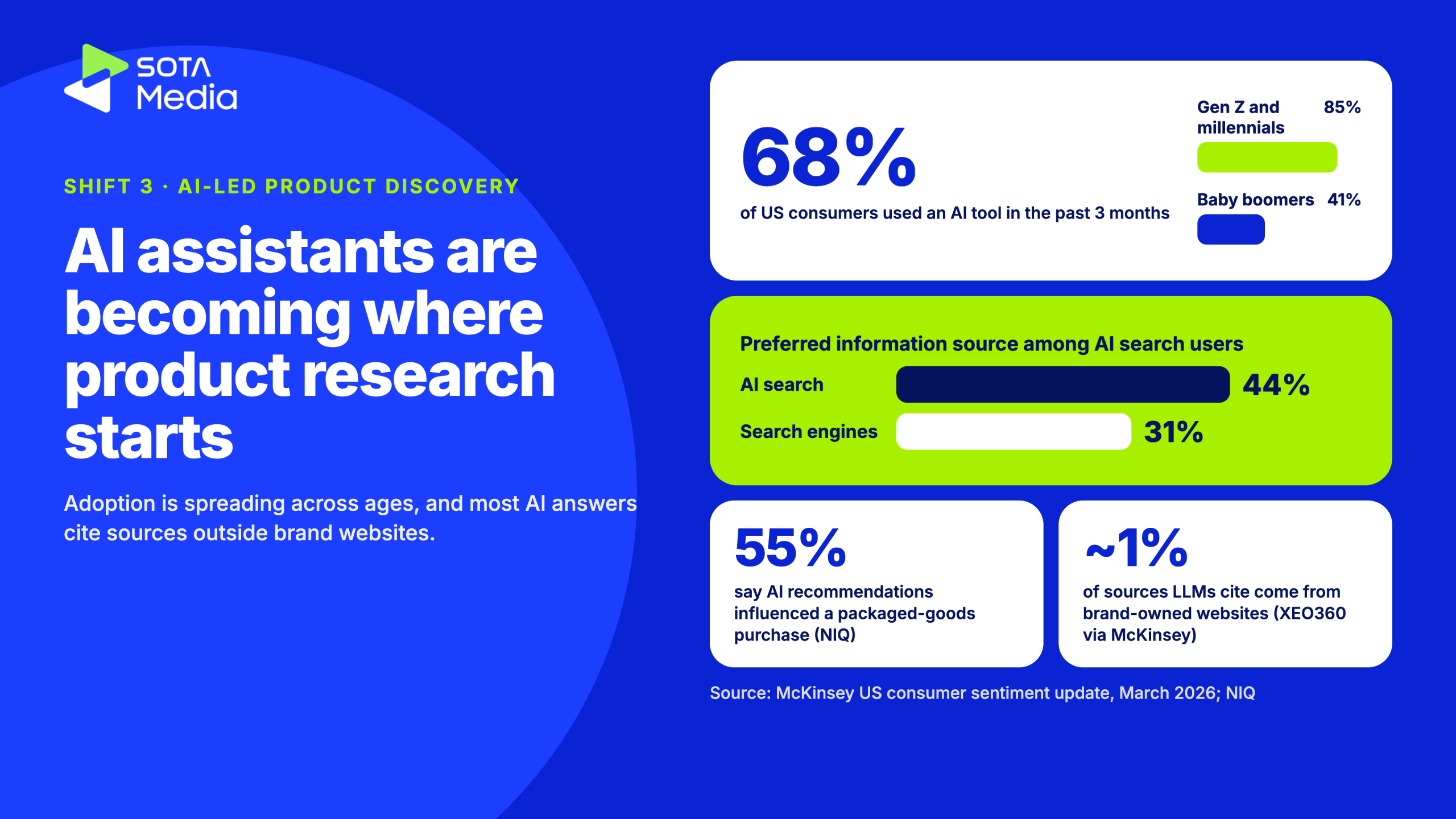
In McKinsey’s US consumer sentiment update, 68% of US respondents had used at least one AI tool in the past three months as of March 2026. Adoption was 85% among Gen Z and millennials and 41% among baby boomers. Among AI search users, 44% named it their most preferred information source, ahead of search engines at 31%.
NIQ reports that 55% of consumers say AI recommendations have influenced their consumer packaged goods purchases, and 27% already use AI shopping assistants. Deloitte’s retail leaders expect more: half expect today’s multi-step shopping journey to collapse into a single AI-driven interaction by 2027, and 81% believe generative AI will weaken brand loyalty by then.
The visibility problem is concrete. McKinsey cites data from XEO360 showing that only about 1% of the sources large language models cite come from brand-owned websites, so most come from third parties.
A brand that relies on its own site to explain itself will be missing from many AI answers. Reviews, publisher coverage, and community discussion deserve the same attention as the website, which is why AI visibility now sits next to search in any consumer trends 2027 plan.
Shift 4: Consumers use AI heavily but still doubt it, so they check its recommendations somewhere else before buying
Heavy use has not produced trust.
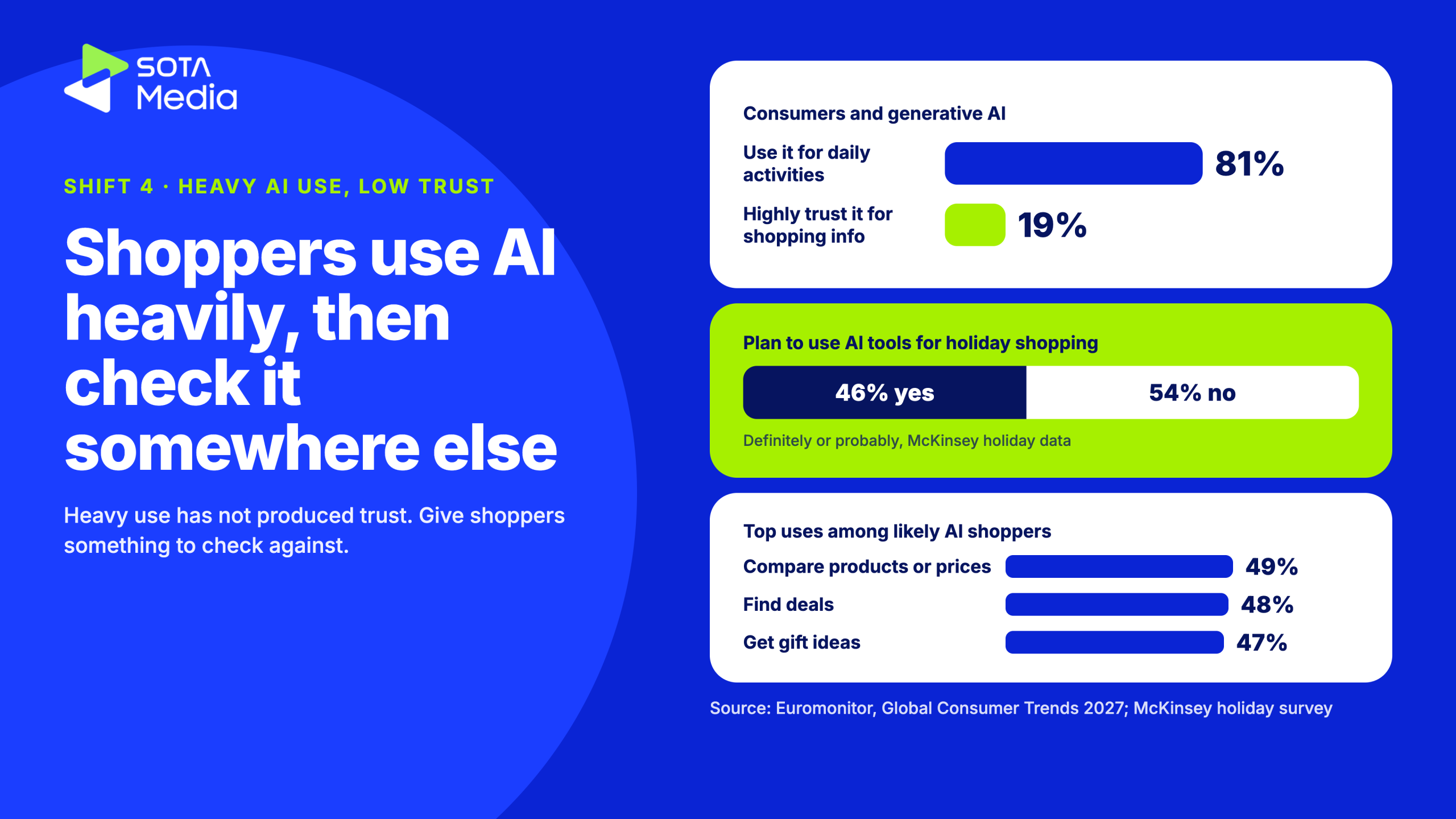
Euromonitor found that 81% of consumers use generative AI to help with daily activities, but only 19% consider it a highly trustworthy source of shopping information. It calls this trend Reluctant Reliance. McKinsey’s holiday data shows the same split: 46% of US consumers said they would definitely or probably use AI tools for holiday shopping, and 54% said they probably or definitely would not.
Shoppers use AI to narrow their options and then check the result somewhere else. Among likely AI users in McKinsey’s survey, the top uses were comparing products or prices (49%), finding deals (48%), and getting gift ideas (47%).
Consumer trends 2027 reward brands that give them something to check against, such as clear specifications, real customer reviews, and pricing that matches what the AI assistant reported.
Shift 5: Trust is moving away from institutions and paid ads toward friends, family, and people who resemble the buyer
Trust is moving toward people the buyer knows or resembles, a pattern that runs through the Consumer Trends 2027 research.
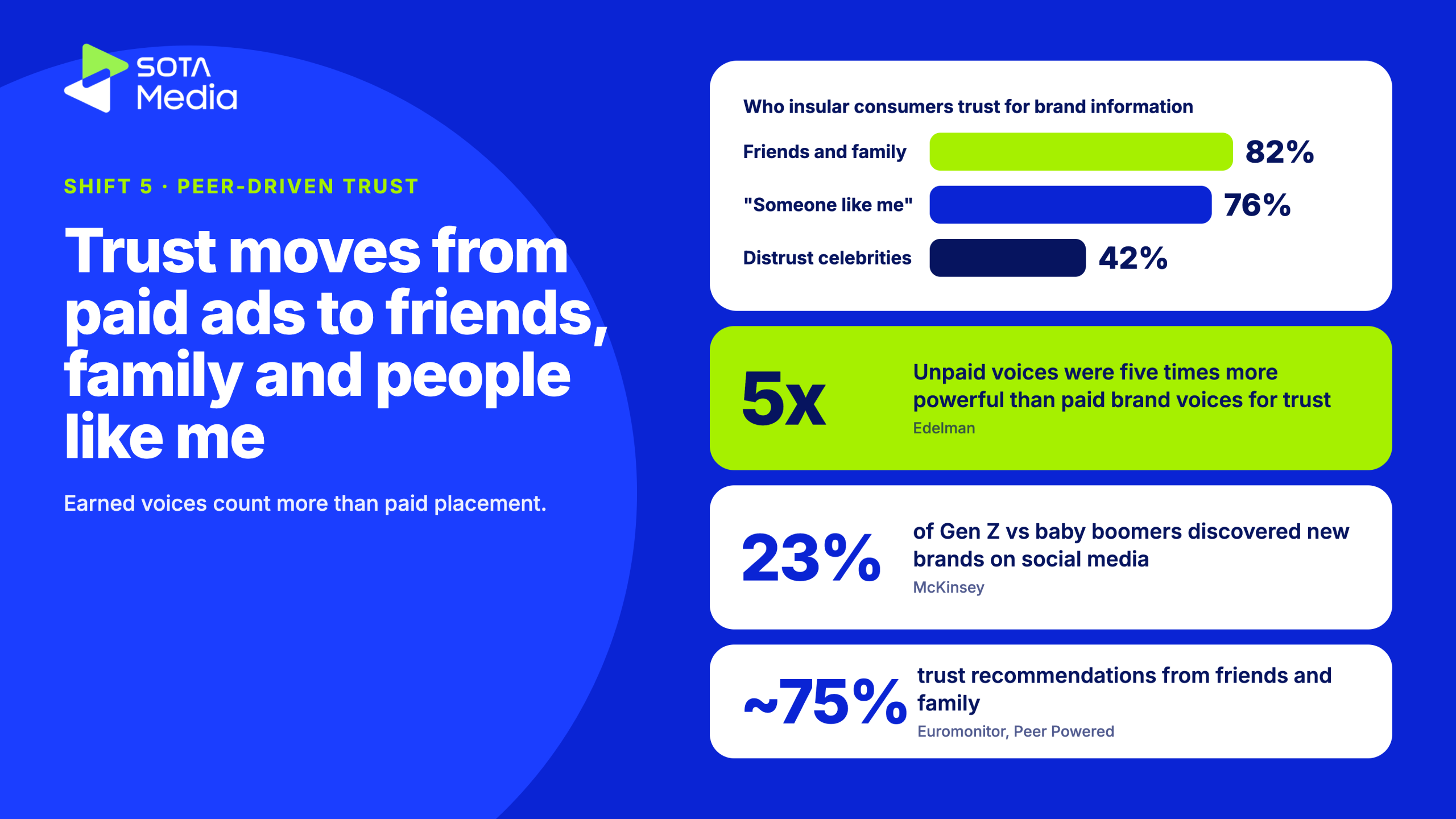
Euromonitor reports that nearly three-quarters of consumers trust recommendations from friends and family when buying, a trend it calls Peer Powered. Edelman found that among insular consumers, 82% trust friends and family and 76% trust “someone like me” for brand information, while 42% distrust celebrities. Unpaid voices were five times more powerful than paid brand voices for these consumers’ trust.
Younger buyers show the same pattern. In McKinsey’s survey, 23% of Gen Z discovered new brands on social media, compared with 7% of baby boomers. That favors micro-influencers and customers who talk about a product without a script, and it raises the value of earned media over paid placement.
A budget built around paid reach alone will miss the voices that consumer trends 2027 show buyers weighing most.
Shift 6: Brands have to prove their authority with evidence buyers can verify, and trust plus relevance together keep customers
Edelman’s data shows that trust alone does not keep a customer.
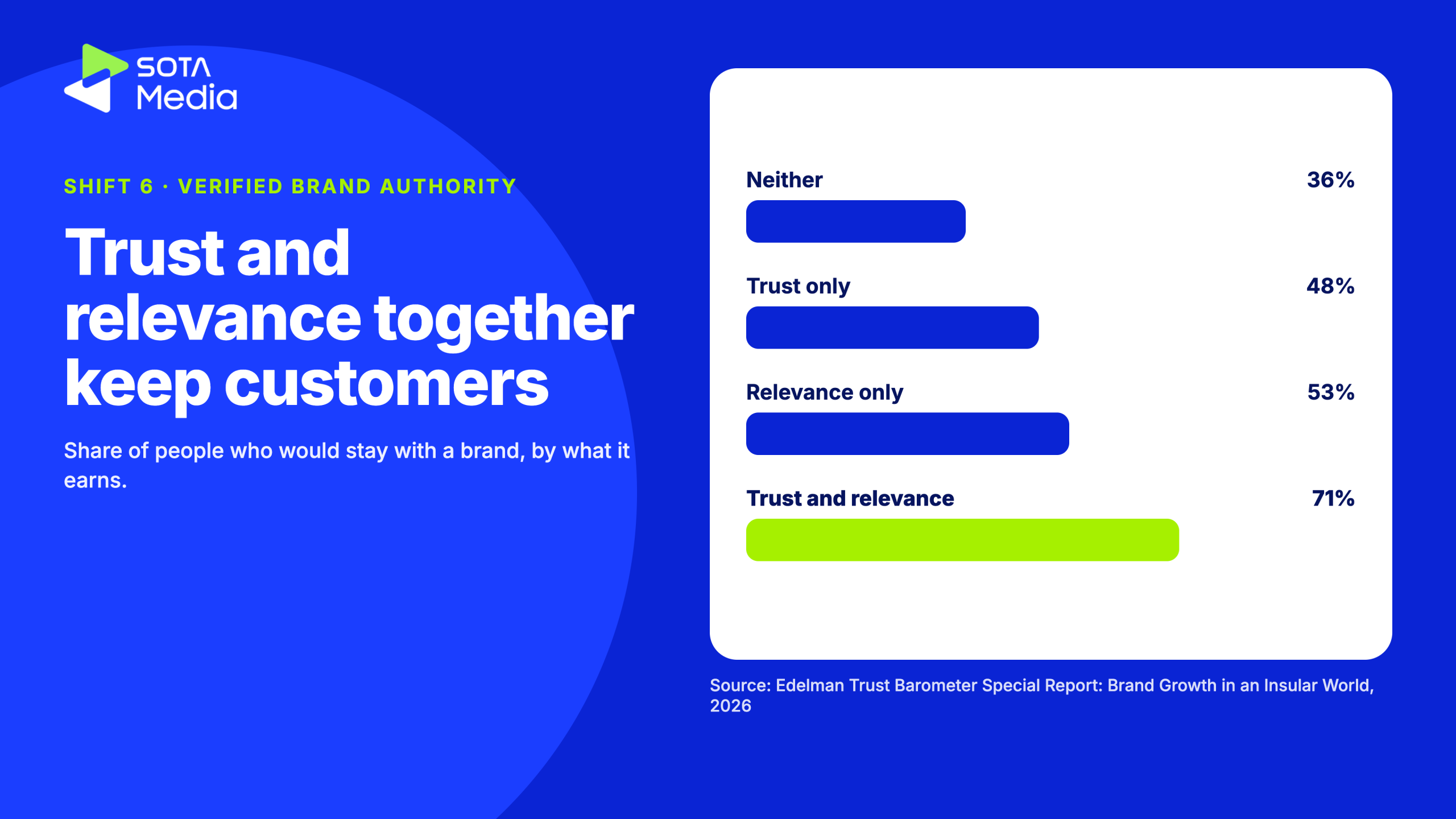
Among consumers who would keep using a brand that starts selling to people unlike them, acceptance was 36% with neither trust nor relevance, 48% with trust alone, 53% with relevance alone, and 71% with both. Mintel’s 2027 Global Consumer Predictions point the same direction.
Its Authority Shifts trend says traditional sources of authority are being disrupted, so trust is harder to earn and brands that can verify their authority gain the most. Its Relevance Reset trend says relevant brands rebuild connections around human agency instead of performing for algorithms.
In practice, verification means showing proof: named experts, data you publish, certifications, and customer results a reader can check. A consistent brand voice helps because shoppers who meet you across search, social, AI answers, and email need to recognize the same company each time.
Shift 7: Health and well-being now shape buying decisions well beyond traditional health categories
Among consumer trends 2027, health now influences decisions in categories far from the pharmacy aisle.
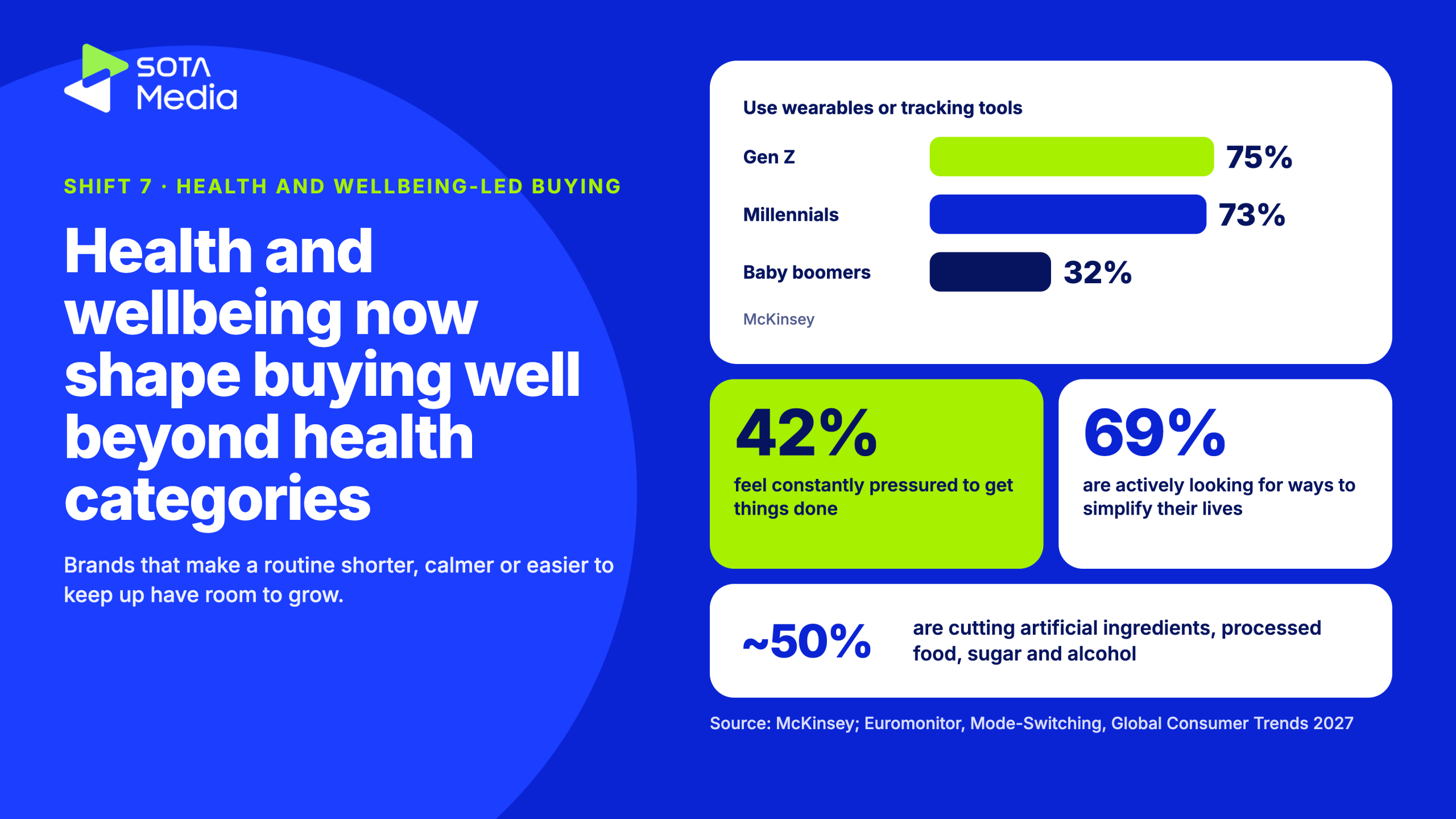
NIQ lists wellness, including GLP-1 medications and self-directed health management, as a driver of how consumers judge value. McKinsey found that 75% of Gen Z and 73% of millennials use wearables or tracking tools, against 32% of baby boomers, and that roughly half of consumers are reducing artificial ingredients, highly processed foods, sugar, and alcohol. Fewer than half feel they are meeting their wellness goals, which leaves room for brands that help.
Euromonitor’s Mode-Switching trend adds the emotional side: 42% of consumers feel constantly pressured to get things done, and 69% are actively looking for ways to simplify their lives. Brands that make a routine shorter, calmer, or easier to keep up match what these consumers say they want.
Shift 8: Consumers favor experiences, repair, and secondhand over buying new, and want tangible value now
Consumer trends 2027 also show people putting money into experiences and making existing things last.
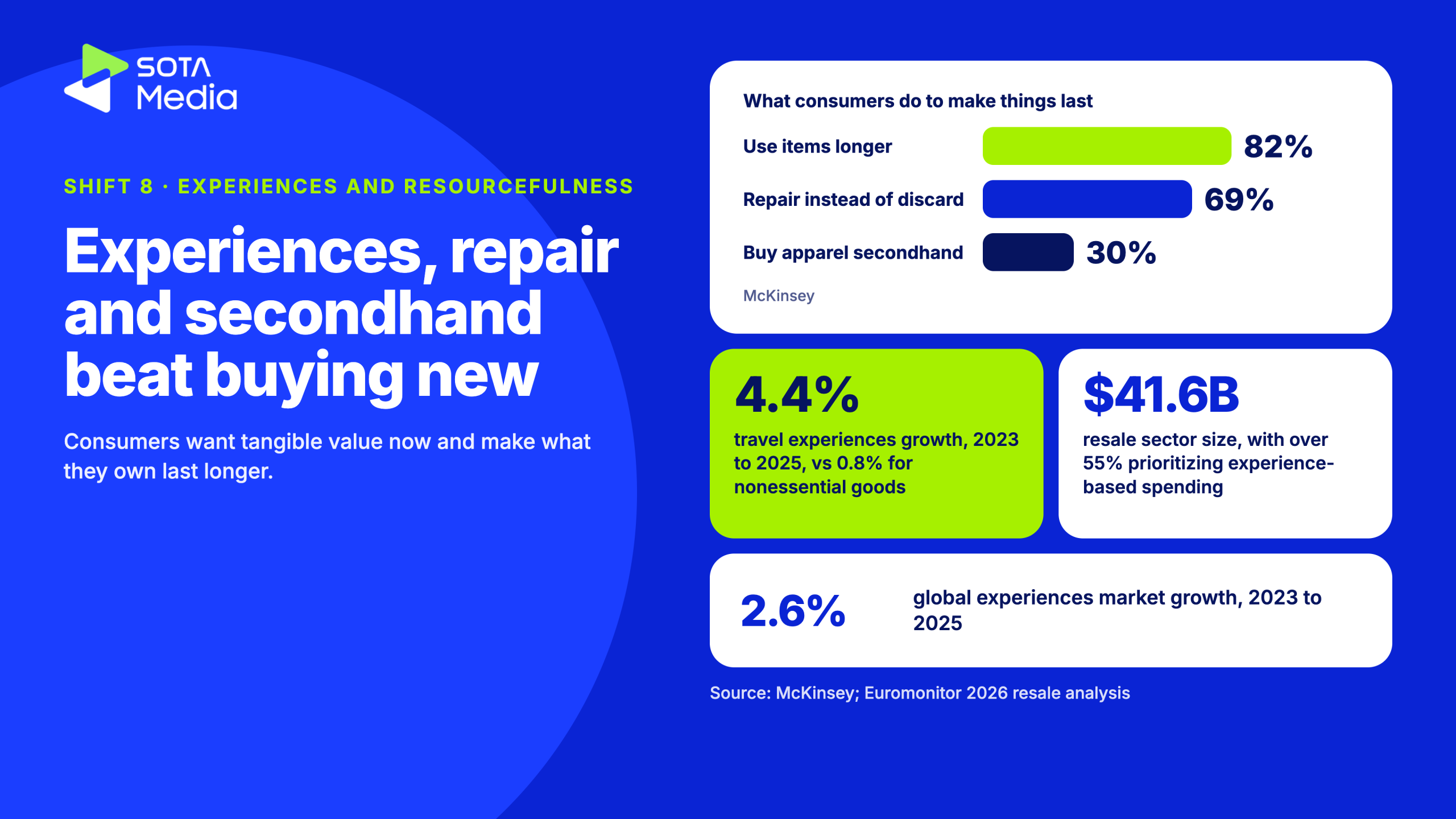
McKinsey found that the global experiences market grew 2.6% from 2023 to 2025 while nonessential goods grew 0.8%, and travel experiences grew 4.4%. At the same time, 82% of consumers are using items longer before replacing them, 69% are repairing instead of discarding, and 30% buy apparel secondhand. Euromonitor’s 2026 analysis puts the resale sector at USD 41.6 billion and says over 55% of consumers prioritize experience-based spending.
Euromonitor’s Future Tense trend explains the short horizon: consumers are skeptical about the future and favor immediate, tangible value over long-term promises. Mintel describes the brand response as a move from products to systems, where products, expertise, technology, and services combine into one experience built around an outcome. Repair guides, trade-in programs, and onboarding that gets a customer to a result quickly all fit this pattern.
5 ways to turn consumer trends 2027 into a plan that wins
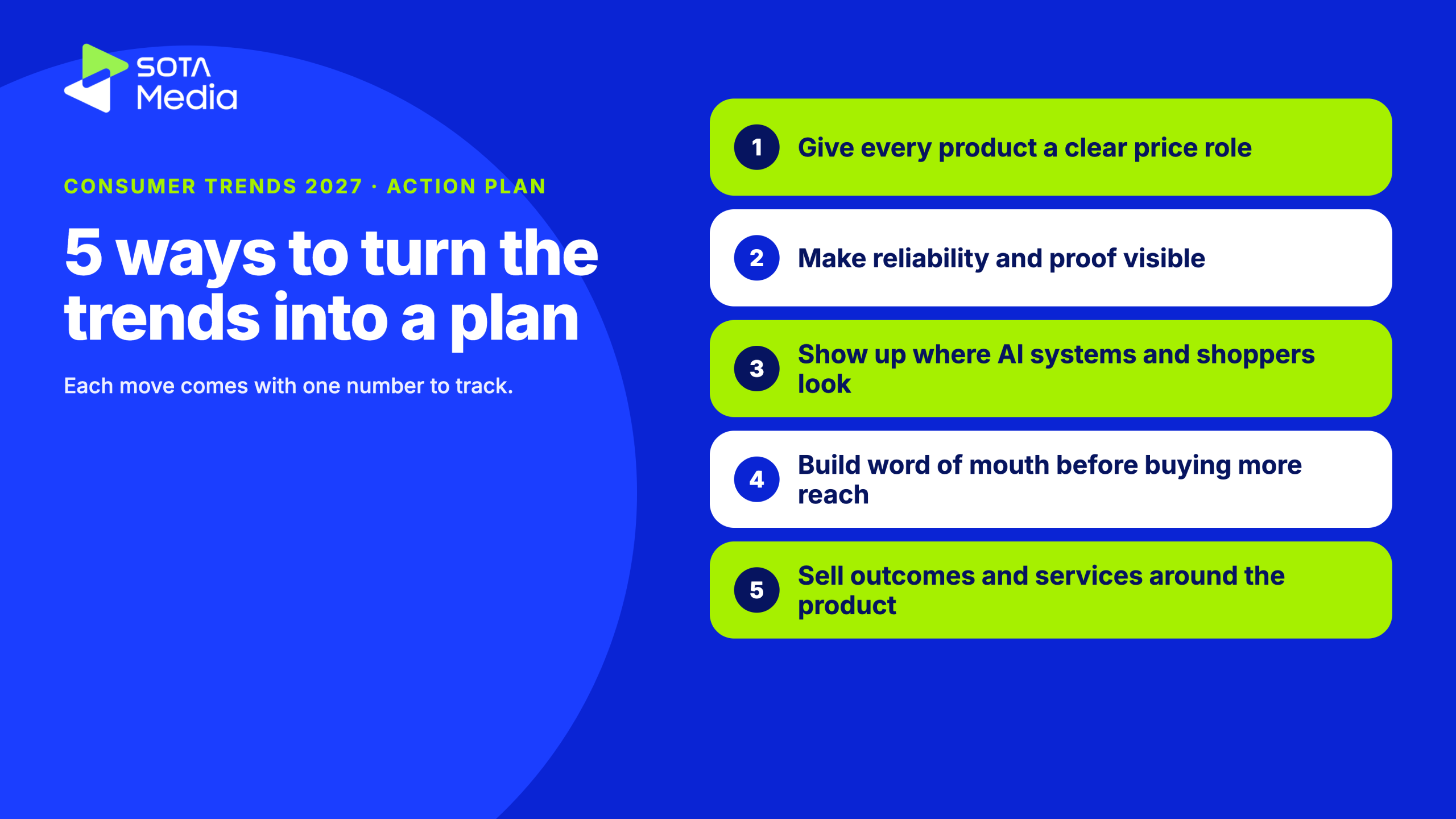
These five moves cover all eight shifts, and each one comes with a number to track.
Way 1: Give every product a clear price role
Sort the range into a value tier, a core tier, and a premium tier. Price the value tier to compete with discount options, and give the premium tier a specific reason to cost more, such as a better ingredient, a longer warranty, or an added service. Cut or reposition products in the middle that have no reason to exist. Track the share of sales from each price tier.
Way 2: Make reliability and proof visible
Put evidence where buyers decide: review scores and counts on product pages, clear return and guarantee terms, named experts, published test results, and the same specifications in every channel. Make sure claims and prices match what an accurate AI answer would say, so shoppers who check elsewhere find the same facts. Track average rating, review volume, and return rate.
Way 3: Show up where AI systems and shoppers look
Ask AI assistants and AI search the questions your buyers ask, and note which sources they cite. Build presence on those sources with third-party reviews, publication coverage, and answers in community forums, and keep the product data on your own site complete and structured. Track how often the brand appears and is cited across a fixed set of buyer questions each month.
Way 4: Build word of mouth before buying more reach
Move part of the paid budget into referral offers, customer communities, partnerships with small and mid-size creators, and customer stories told in the customer’s own words. Brief creators on the product and let them speak in their own voice. Track the referral share of new customers and the volume of unpaid mentions.
Way 5: Sell outcomes and services around the product
Add setup help, repair guides, spare parts, trade-in or resale programs, and simple routines that work with the wearables and apps customers already use. Frame each offer around the result the customer gets now, and avoid health claims you cannot support.
Track time to first result, repeat orders, and participation in repair and trade-in programs. These measures show whether your response to consumer trends 2027 is working. Start with the two ways that address your weakest numbers, give each an owner, and review the tracked figures every quarter, because NIQ expects volatility to stay.
Conclusion
The Consumer Trends 2027 research agrees on the main points. Shoppers are careful with money, rely on AI while doubting it, trust people like themselves, and judge brands on proof. Spending is splitting between saving and trading up, so the middle is the hardest place to stand.
A consumer trends 2027 plan built on clear price tiers, verifiable claims, and a presence in the places AI systems and peers draw from is easier to defend than one that assumes conditions will return to normal.
If you are turning consumer trends 2027 into a marketing plan, SotaMedia can help you build the content, AI visibility, and earned media to match.
Frequently asked questions
Euromonitor, NIQ, McKinsey, Deloitte, Mintel, and Edelman point to the same eight shifts: split spending, quality-led value, AI-led product discovery, doubt about AI, peer trust, verified authority, health-driven buying, and a preference for experiences and repair over new purchases.
The figure depends on the survey and how it defines AI use. McKinsey found that 68% of US respondents had used at least one AI tool in the past three months as of March 2026. NIQ found that 27% of consumers use AI shopping assistants or other AI tools to help decide what to buy. Euromonitor found that 81% use generative AI for daily activities.
Deloitte reports that 40% of consumers show deal-driven or cost-conscious habits, and nearly 70% of retail leaders see this as structural. Deloitte also reports that 40% of value perception comes from factors beyond price. Brands need a clear answer to why a product is worth what it costs, which can be quality, service, or reliability as well as a lower price.
McKinsey found that 23% of Gen Z discovered new brands on social media, compared with 7% of baby boomers, and that 34% of Gen Z say social media plays an important role at the purchase decision stage, compared with 16% of boomers. Peer voices and creators matter more than paid reach for this group.