



Omnichannel Digital Marketing
Ask what the marketing trends 2026 actually are, and the honest answer is not one trend. AI is changing how every channel operates, from the page that shows up in a search result to the email that lands in a prospect’s inbox before a rep ever calls.
AI is no longer sitting outside the marketing workflow as a tool for generating copy or images. It now influences how platforms rank information, buy media, recommend content, identify prospects, and distribute messages. When the underlying mechanism of a channel changes, the marketing strategy built around it has to change too.
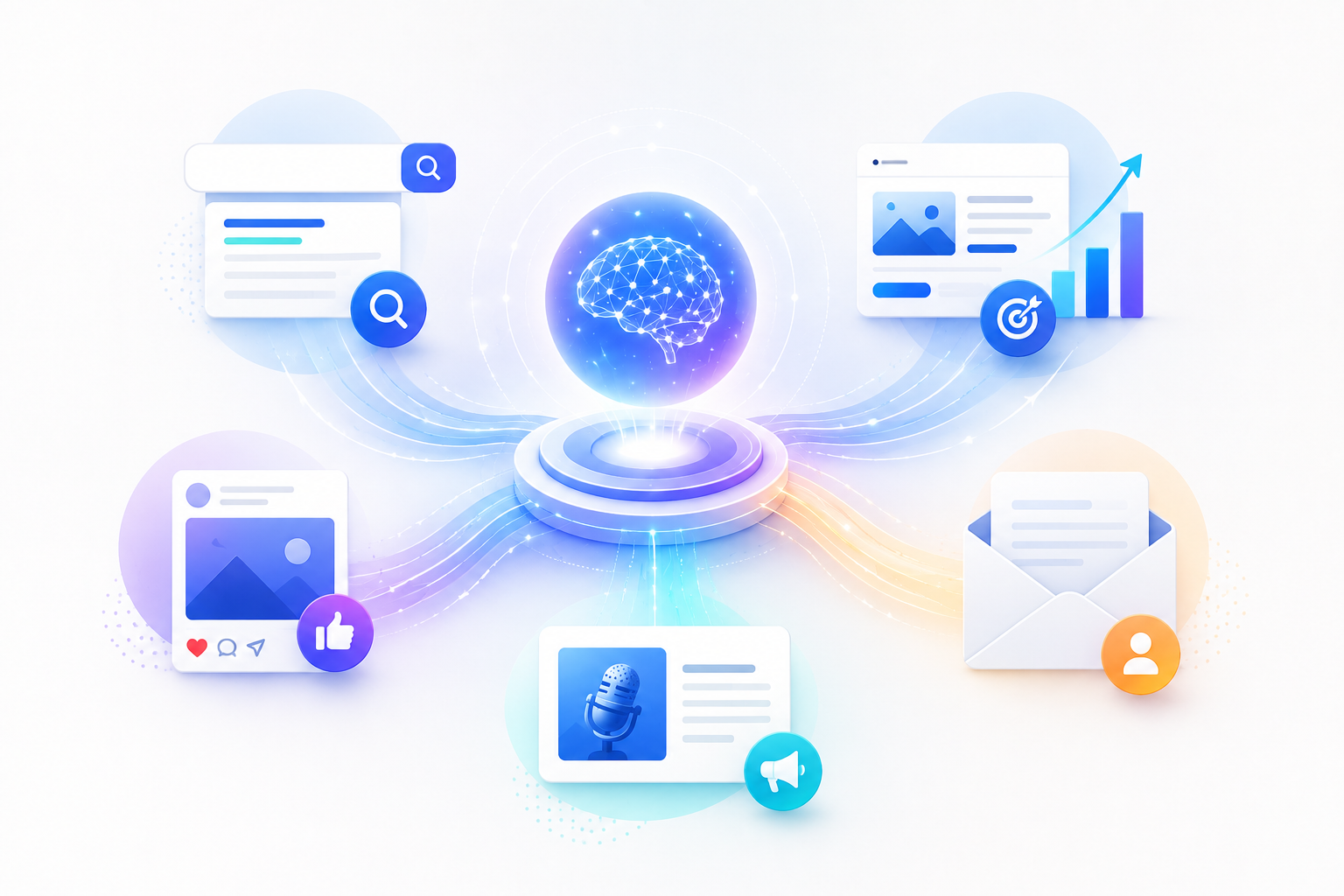
This article will guide you through five channels in the marketing trends 2026: search and GEO, paid media, social and content, email and lead generation, and PR, and name the specific mechanism AI is changing in each one.
Key takeaways
- Search is shifting from ranking to AI citation in the marketing trends 2026. GEO is becoming a visibility layer alongside SEO.
- Paid media bidding and targeting increasingly run on real-time automated systems instead of manually built audience segments.
- Social and content need specific, proof-based claims. Generic, adjective-heavy posts are losing their edge.
- Lead generation is moving toward AI-assisted prospecting, with buyers researching a company before a seller ever reaches out.
- The advantage is shifting from who has AI tools to who has built AI-powered marketing systems around them.
Search and GEO: from ranking to being cited in the marketing trends 2026
How AI Overview and answer engines changed what “ranking” means
Gartner predicts traditional search engine volume will drop 25% by 2026 as generative AI tools replace queries that used to run through a search box. Alan Antin, VP Analyst at Gartner, said generative AI solutions are becoming substitute answer engines, replacing queries that once ran through traditional search.
The mechanism: Structured, extractable content over keyword density
GEO, generative engine optimization, works by making content easy for an AI system to lift and cite directly: a direct answer near the top, a definition block that stands on its own, comparison data in a table, and sources named next to the claim they support. Keyword density does none of that work. Structure does.
What this means for a tech company’s content team
92% of marketers now use, or plan to use, SEO built for both traditional and AI-powered search. For a content team, that means auditing existing pages for extractability before writing anything new: does the page answer the core question in the first 150 words, does every stat carry a source link, and can a paragraph be lifted on its own and still make sense?
Paid media: AI-driven bidding and targeting
How real-time bidding models replaced manual audience segments

Google’s Performance Max lets advertisers set a conversion goal and hand targeting, creative combination, and bid decisions to a model that reads real-time signals across a campaign. Meta runs a comparable system for its own inventory. The manual work of building audience segments by hand is being replaced by systems that adjust per auction, not per campaign brief.
Adoption backs this up. 75% of PPC professionals now use generative AI at least sometimes to write ads, and the average click-through rate for Google search ads sits at 3.17% across industries, the benchmark every automated bidding system is now optimizing against in real time.
Where AI still needs human judgment
A bidding model can shift budget between channels in minutes. It cannot decide what a brand should say or which positioning earns trust with a technical buyer. Creative direction, offer structure, and audience definition still start with a person who understands the product.
How the system runs end-to-end
The workflow follows the same pattern across paid channels in the marketing trends 2026. The team starts with a business goal, such as generating pipeline, sign-ups, or demo requests. AI then handles repetitive execution, including bidding and asset testing, across a volume that would be difficult to manage manually. Humans stay responsible for creative direction and quality control. Finally, the team measures performance against the original goal and uses those findings to shape the next round of testing.
Social and content: From single assets to content systems
The shift from single-asset production to multi-cut content systems
Teams increasingly build one system that turns a single shoot, interview, or dataset into many assets: a long-form article, a LinkedIn post, a short video cut, and an email. The marketing trends 2026 show that 80% of marketers now use AI for content creation and 75% for media production.
Discovery has moved with production. 60% of consumers say social content, recommendations, or communities now shape how they discover new brands, with search increasingly used to validate a choice they have already started forming. The goal is no longer to produce one asset per project but to build a pipeline that extends the value of each source across channels.
Why specificity matters more as AI content volume grow in the marketing trends 2026
94% of marketers plan to use AI in content creation in the marketing trends 2026. That raises the baseline volume of AI-assisted content everywhere, which makes generic, adjective-heavy posts easier to spot and easier to scroll past. A post built around a named number, a named client, or a specific mechanism still stands out, because most AI-assisted content skips that step.
Email and lead generation: From manual outbound to AI prospecting
How 24/7 AI prospecting systems work
AI prospecting systems run discovery, qualification, and first-touch outreach continuously instead of during business hours. They score leads against defined criteria, draft a first message, and hand a rep the leads that clear a threshold. The mechanism replaces manual list-building and cold-email drafting. It does not replace the sales conversation itself.
61% of B2B purchase influencers say their organization already uses, or will use, a private generative AI engine to support purchasing decisions, per Forrester’s 2026 predictions. Buyers are running their own AI-assisted research before a seller ever gets a reply, which is part of why nearly 70% of marketers report leads now arrive later in the buying process.
What still requires a human in the marketing trends 2026
Forrester also found that 19% of B2B buyers using AI tools in their purchase process feel less confident in their decision because of inaccurate or unreliable information. That gap is where a human still earns trust: validating a claim, reading tone, and knowing when a lead is ready for a call instead of another automated touch.
PR and thought leadership in an AI-search world
Why named, dated proof matters more when AI summarizes your content

Marketing trends 2026 shows that named proof matters more because trust in AI-assisted marketing is thin. According to Deloitte’s CMO Survey, hyper-personalized content consistently outperforms generic content, with site conversion at 2.9% versus 0.5% and email click-through rate at 3.4% versus 1.8%, yet only 42% of consumers trust businesses to use AI ethically. Performance and trust are moving in opposite directions, which is exactly why a named source and a real number carry more weight than a well-written adjective.
When an AI system summarizes a page instead of sending a reader to it, the parts that survive summarization are the specific ones: a named source, a date, and a number. Gartner’s own guidance points the same way: content needs to demonstrate expertise, experience, authoritativeness, and trust, the same signals search quality raters have used for years.
Structuring thought leadership for both readers and AI citation
A thought leadership piece built for both audiences leads with the point, names the source behind every claim, and states a specific finding instead of a general trend. Vague sourcing like “experts say” or “studies show” gives an AI system nothing concrete to cite and gives a human reader no reason to trust it either.
What tech companies should do differently in the marketing trends 2026
Audit content for extractability, not just keyword coverage
Pull the pages that drive the most traffic and check each one against three questions: does it answer the core question in the first 150 words, does every stat carry a source link, and would a paragraph still make sense if an AI system lifted it on its own? Know how to audit in the marketing trend 2026 is important for B2B tech companies.
Build systems, not one-off campaigns
Deloitte’s CMO Survey found organizations that invest more in marketing technology than in working media, events, digital ads, sponsorships, see an 18% greater sales lift and 7% greater revenue growth overall than organizations that lean the other way.
A campaign has a defined end point, while a system keeps running and improving as it collects more data. An AI-assisted content pipeline, real-time bidding setup, or 24/7 prospecting workflow can be built once and reused across future launches.
The companies moving fastest in the marketing trends 2026 are investing less in isolated campaigns and more in systems that compound over time instead of starting from scratch with every new channel.
Work with a partner who understands the product, not just the funnel
Marketing a technical product requires more than optimizing acquisition and conversion. A team that understands the product itself, including its architecture, technical differentiators, and proof points, can turn that knowledge into content and campaigns that remain credible under the scrutiny of technical buyers.
Conclusion
From the marketing trends 2026, every channel in this piece runs on the same shift. AI has moved from a tool marketers reach for occasionally to the infrastructure each channel depends on, whether that’s the source an answer engine surfaces, the bid that clears an auction, or the lead that reaches a rep’s queue.
The shift in the marketing trends 2026 is not about adding more AI tools. It is about redesigning the marketing systems that connect those channels.
If you need a partner to assess and build those systems, SotaMedia is one option to consider, with experience helping tech companies connect AI-driven marketing strategy with the execution behind it.
Frequently asked questions
AI is changing how every channel operates, from search (GEO and AI Overview) to paid bidding, content production, and lead prospecting. The core shift is systems replacing manual, one-off execution.
GEO, generative engine optimization, means structuring content so AI answer engines can extract and cite it directly, not just rank it in a list of links.
AI models now handle bidding and audience targeting in real time, reducing the need for manual segment building. Human judgment stays essential for creative and positioning decisions.
Traditional SEO optimizes for ranking in a list of links. GEO optimizes for being the source an AI system cites or summarizes directly in its answer.
AI can automate parts of research, drafting, repurposing, and editing. Human judgment remains necessary for product accuracy, positioning, original insight, evidence, and final editorial decisions.
Start with repetitive workflows that have clear inputs and outputs: content repurposing, reporting, prospect research, and lead qualification, provided the underlying data and process are reliable.
Start with a workflow audit rather than a tool audit. Identify manual bottlenecks, assess data quality, choose one workflow to automate, and establish measurement before expanding to other channels.
AI systems need identifiable information and evidence to generate answers. Thought leadership backed by named sources, dates, original data, and clear expertise gives both readers and AI systems more to work with.