



Branding and Strategy
Any go-to-market strategy for Southeast Asia has to start from one fact: on a slide, the region looks like one opportunity. The ASEAN Secretariat’s Key Figures 2025 counts 684.1 million people across eleven member states and a combined GDP of US$3.9 trillion in 2024. In practice, a tech company sells into separate markets with their own payment rails, languages and buying habits.
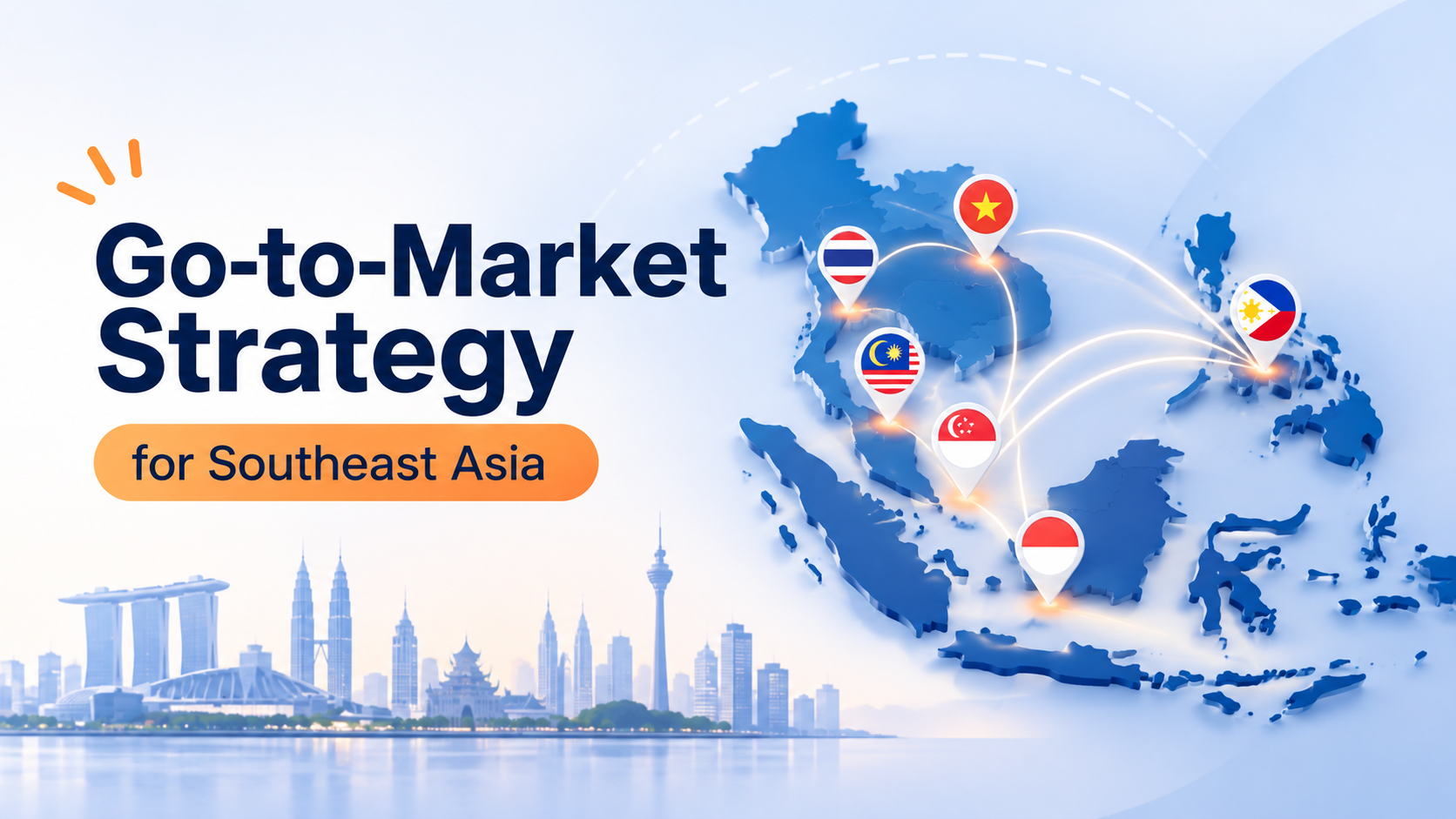
This guide shows how to build a go-to-market strategy for Southeast Asia. It covers how to pick a first market, how to enter Singapore, Indonesia, Vietnam, Thailand, Malaysia and the Philippines, and the five parts of a plan your team can run.
Why Southeast Asia is not one market
The economies differ in size
Indonesia produced US $1,357.3 billion of GDP in 2024, roughly a third of the bloc’s total, according to the same ASEAN figures. Singapore comes second at US$547.5 billion, just ahead of Thailand. Vietnam, the Philippines and Malaysia sit in a tighter band below that.
| Country | GDP 2024 (US$ billion) | GDP 2023 (US$ billion) |
|---|---|---|
| Indonesia | 1,357.3 | 1,371.1 |
| Singapore | 547.5 | 501.3 |
| Thailand | 526.5 | 514.9 |
| Vietnam | 476.3 | 429.5 |
| Philippines | 461.6 | 437.2 |
| Malaysia | 420.1 | 396.3 |
Source: ASEAN Key Figures 2025, current prices.
Digital growth is real, with one caveat
The e-Conomy SEA 2025 report from Google, Temasek and Bain & Company projects the region’s digital economy to pass US$300 billion in gross merchandise value in 2025, growing about 15% a year.
E-commerce alone is projected at US$185 billion, and video commerce accounts for roughly a quarter of total GMV. The report also says consumer interest in AI topics is about three times the global average.
One caveat matters if you build a business case on that headline. The report widened its coverage from six markets to ten, so the 2025 total is not directly comparable with earlier years.
Growth is slowing in 2026
The World Bank’s April 2026 update expects East Asia and Pacific growth to slow to 4.2% in 2026 from 5.0% in 2025. For the region outside China it projects 4.1% in 2026 and a rebound to 5.0% in 2027 if geopolitical tension eases.
It also names AI-related exports as a bright spot, especially in Malaysia, Thailand and Vietnam. Plan for buyers who scrutinize budgets this year and a stronger market next year.
Go-to-market strategy for Southeast Asia: how to choose your first market
Score each market on four things
Rate every candidate on buyer reach, payment and billing fit, data rules and partner access.
- Buyer reach asks whether you can find and talk to your target accounts through channels you can actually run.
- Payment and billing fit asks whether customers can pay you in a way they already use.
- Data rules cover what you must do before you store a customer record.
- Partner access covers resellers, integrators and agencies who already hold the relationships you need.
A market that scores well on size and poorly on all four is a worse first bet than a smaller one that scores well on most.
Pick one beachhead and one follow-on
Choose a second market that shares infrastructure with the first. Payments are a good example. Bank Indonesia lists cross-border QR cooperation with Thailand, Malaysia, Singapore and Japan, and e-Conomy SEA 2025 reports that eight countries have enabled cross-border QR interoperability. Markets linked this way are easier to run with one billing setup.
A market-by-market playbook
Each market below starts with the entry motion that fits your go-to-market strategy for Southeast Asia. Data rules sit together in part four of the plan, further down.
Singapore: the regional proof point
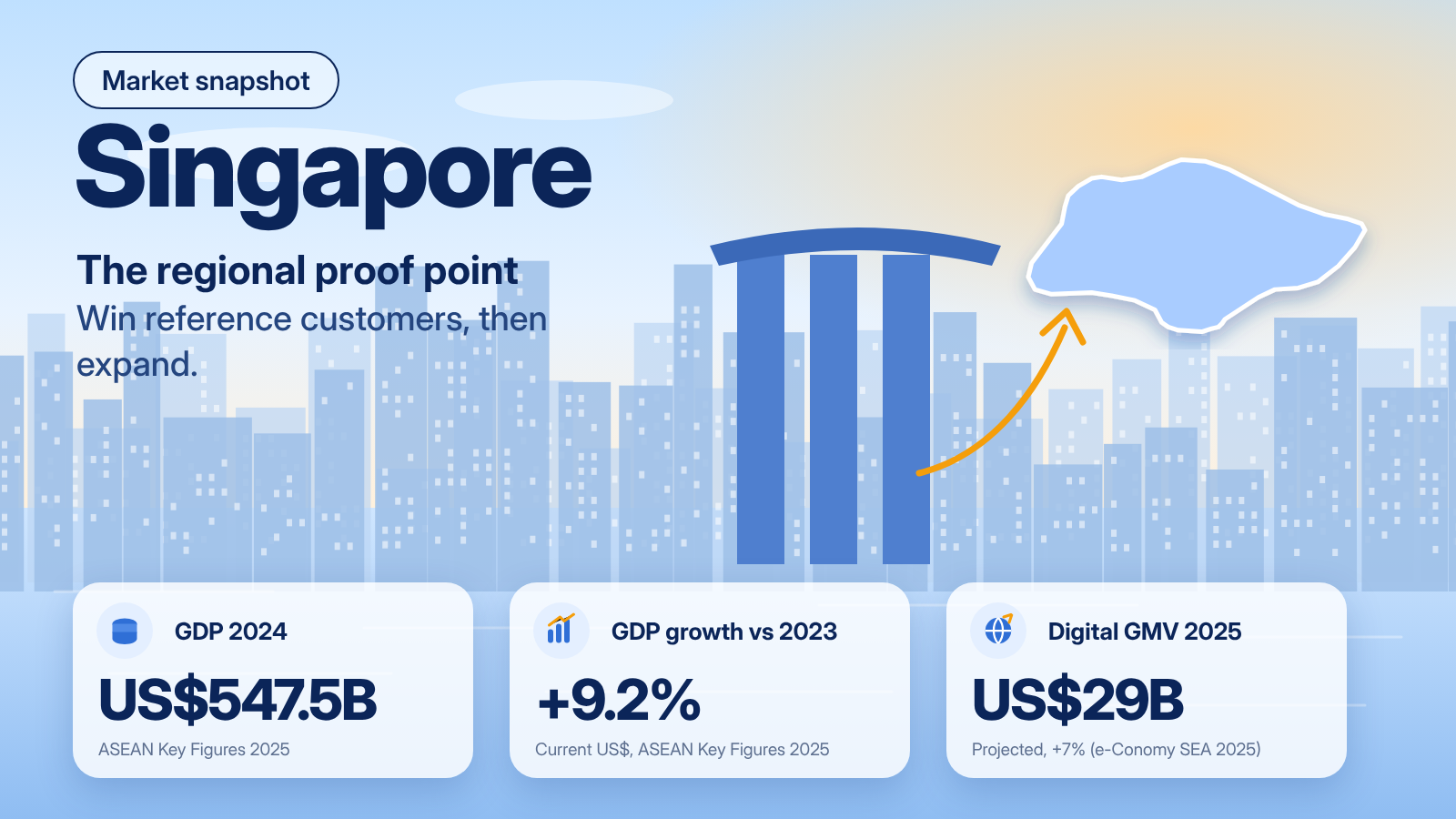
Singapore’s GMV is projected at US $29 billion in 2025, up 7% from 2024, which is slower growth than the region. That makes it a place to win reference customers rather than volume.
Lead with a direct enterprise motion, publish two or three named case studies, and use them as proof when you approach buyers in the neighbouring markets. It also works well as the home for your regional entity and first regional hires, since every other market in this guide can be managed from there.
Indonesia: the volume market
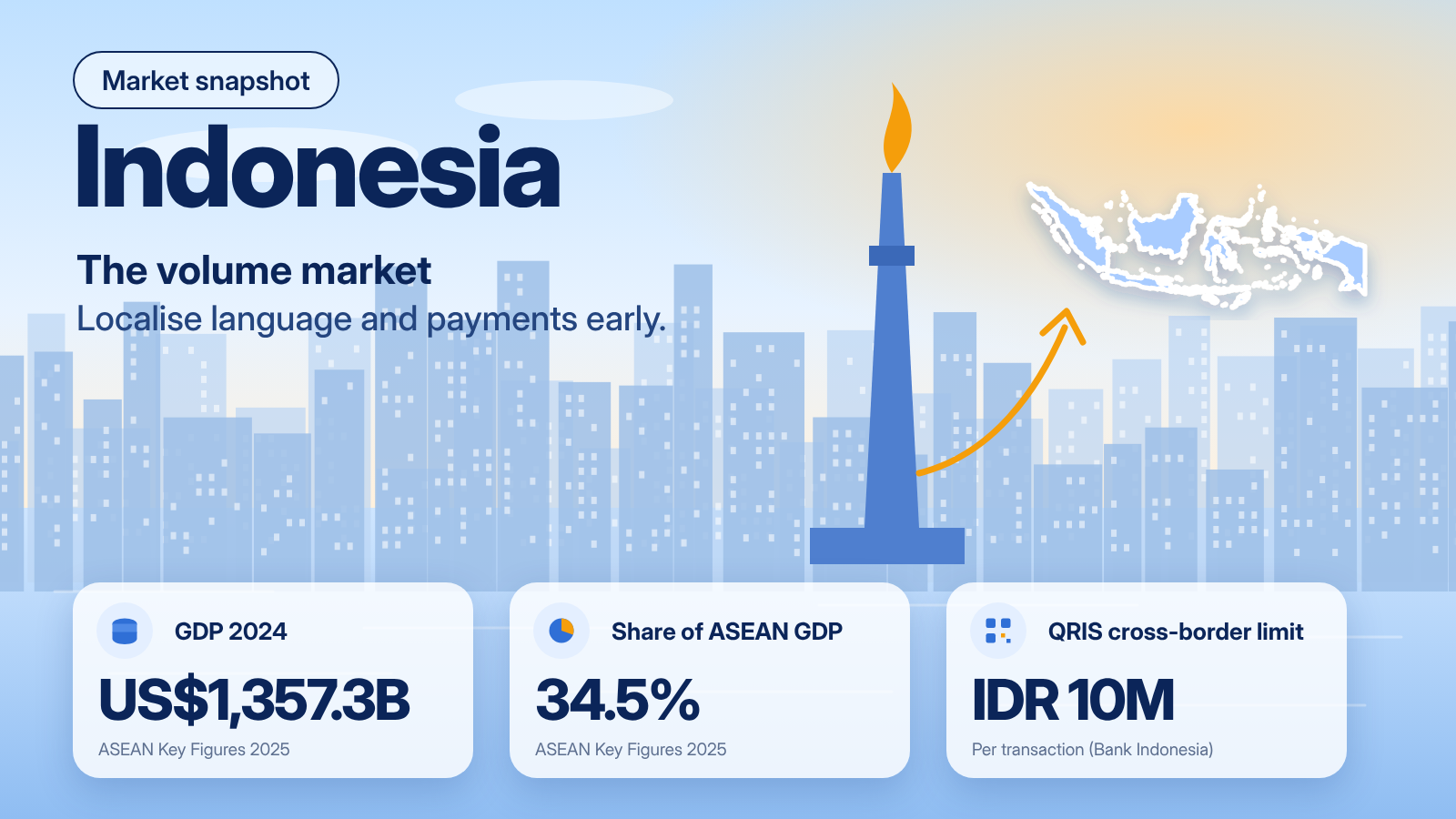
Indonesia has the largest economy in the bloc, so the prize is big and the entry cost is higher. Localise language and checkout from the start, and accept the national QR standard, QRIS, so customers can pay the way they already do.
Bank Indonesia states a QRIS cross-border limit of IDR 10,000,000 per transaction, the same as the domestic limit, which matters if your self-serve plans sit near that ceiling.
Indonesia’s GDP in current dollars dipped slightly between 2023 and 2024, from US$1,371.1 billion to US$1,357.3 billion. Price in rupiah and review your margins against exchange-rate moves.
Vietnam: fast growth and a local content gap
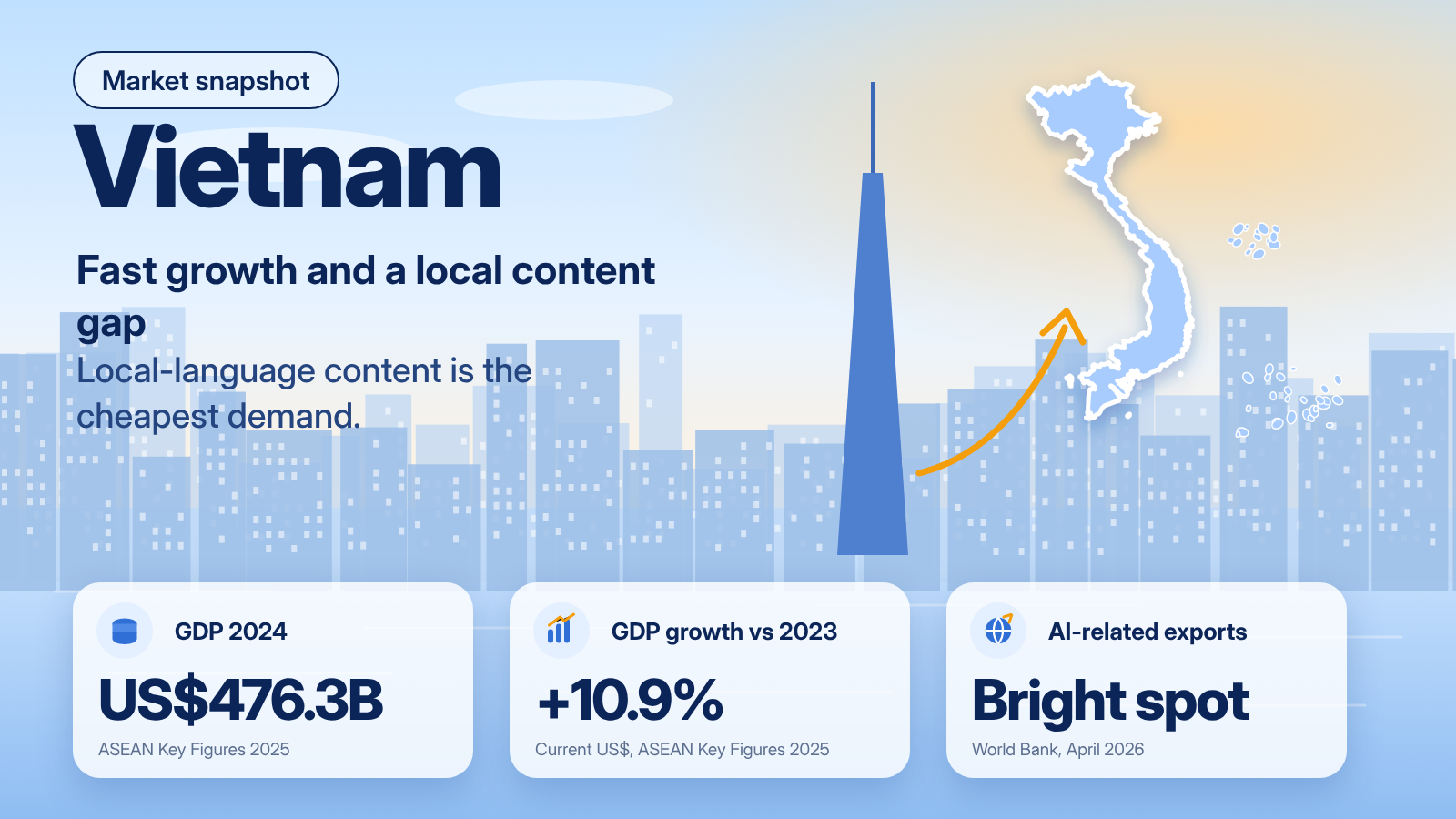
Vietnam’s GDP grew from US$429.5 billion to US$476.3 billion between 2023 and 2024, about 11% in current dollars, and the World Bank lists it among the countries benefiting from AI-related exports.
Buyers search and read in Vietnamese, so local-language content and search visibility are the cheapest way to build early demand. Any plan for Vietnam market entry should start there.
Thailand: a strong base for B2B tech
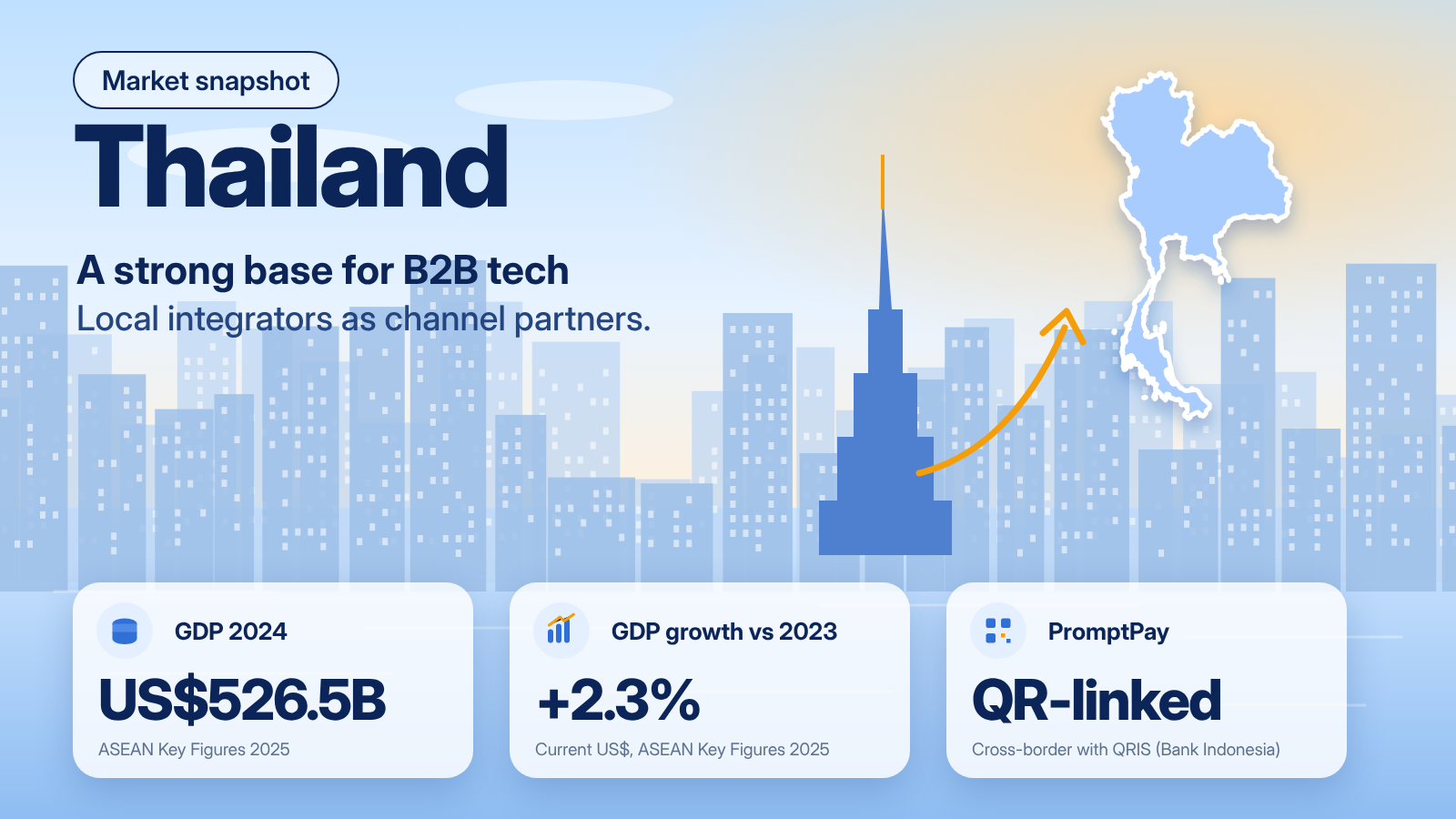
Thailand’s GDP was US$526.5 billion in 2024, and the World Bank names it with Malaysia and Vietnam as a beneficiary of AI-related exports. Thailand’s PromptPay is one of the QR partners in Bank Indonesia’s cross-border scheme, so a team that bills in Indonesia can extend payment acceptance to Thai customers without building a new rail.
In a go-to-market strategy for Southeast Asia, look for local integrators and consultancies as channel partners, since an enterprise sale usually needs someone on the ground to run implementation.
Malaysia: a connected market for a second launch
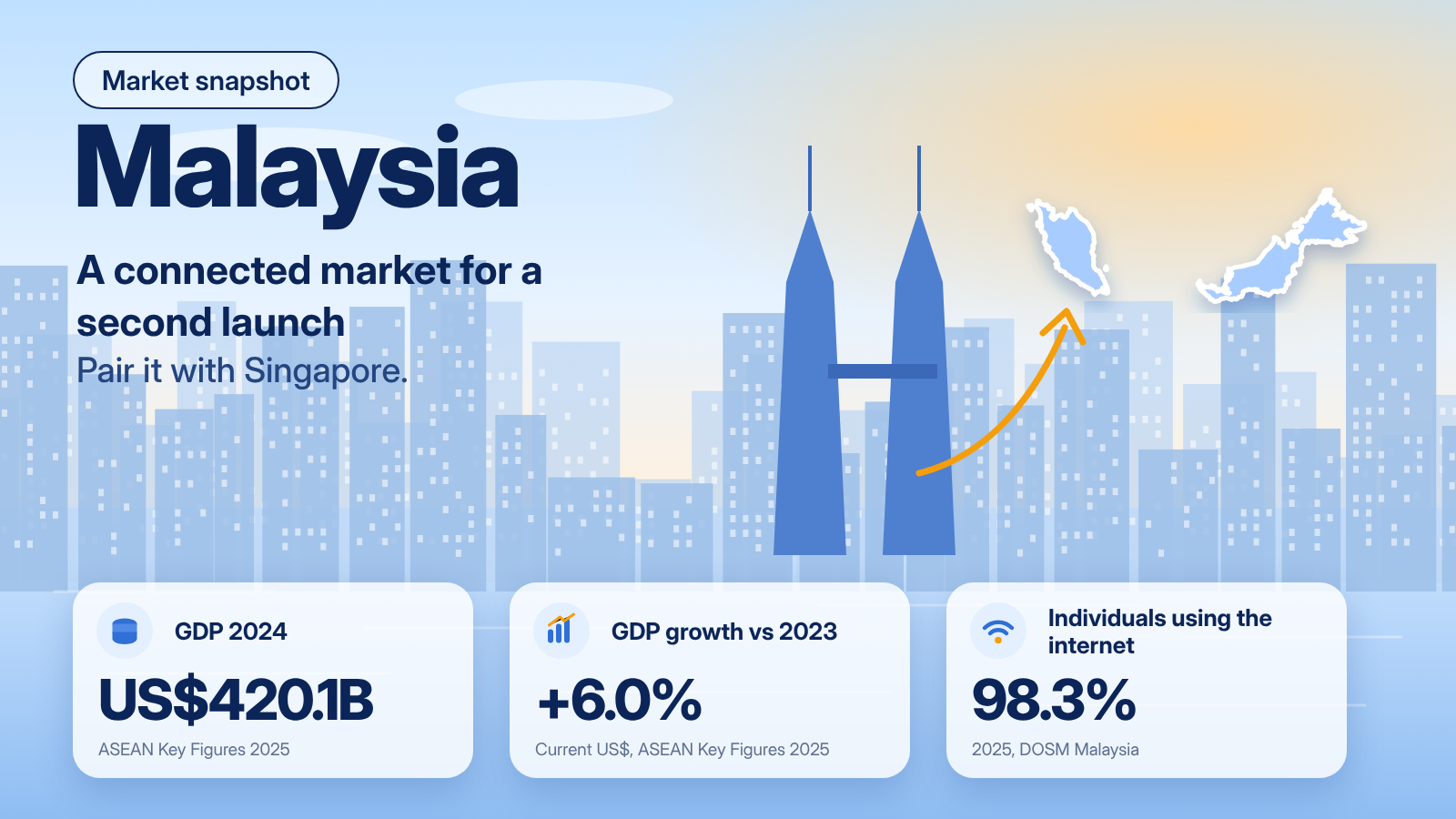
Malaysia’s GDP rose from US$396.3 billion to US$420.1 billion, about 6%. The Department of Statistics reports that 98.3% of individuals used the internet in 2025, and 99.6% used a mobile phone. Digital channels reach nearly everyone, so paid search, content and mobile-first onboarding all work as acquisition routes.
Within a go-to-market strategy for Southeast Asia, Malaysia and Singapore are a natural pair for a first two-market launch because their payment systems are linked through DuitNow QR and NETS QR.
Philippines: start with English-language content
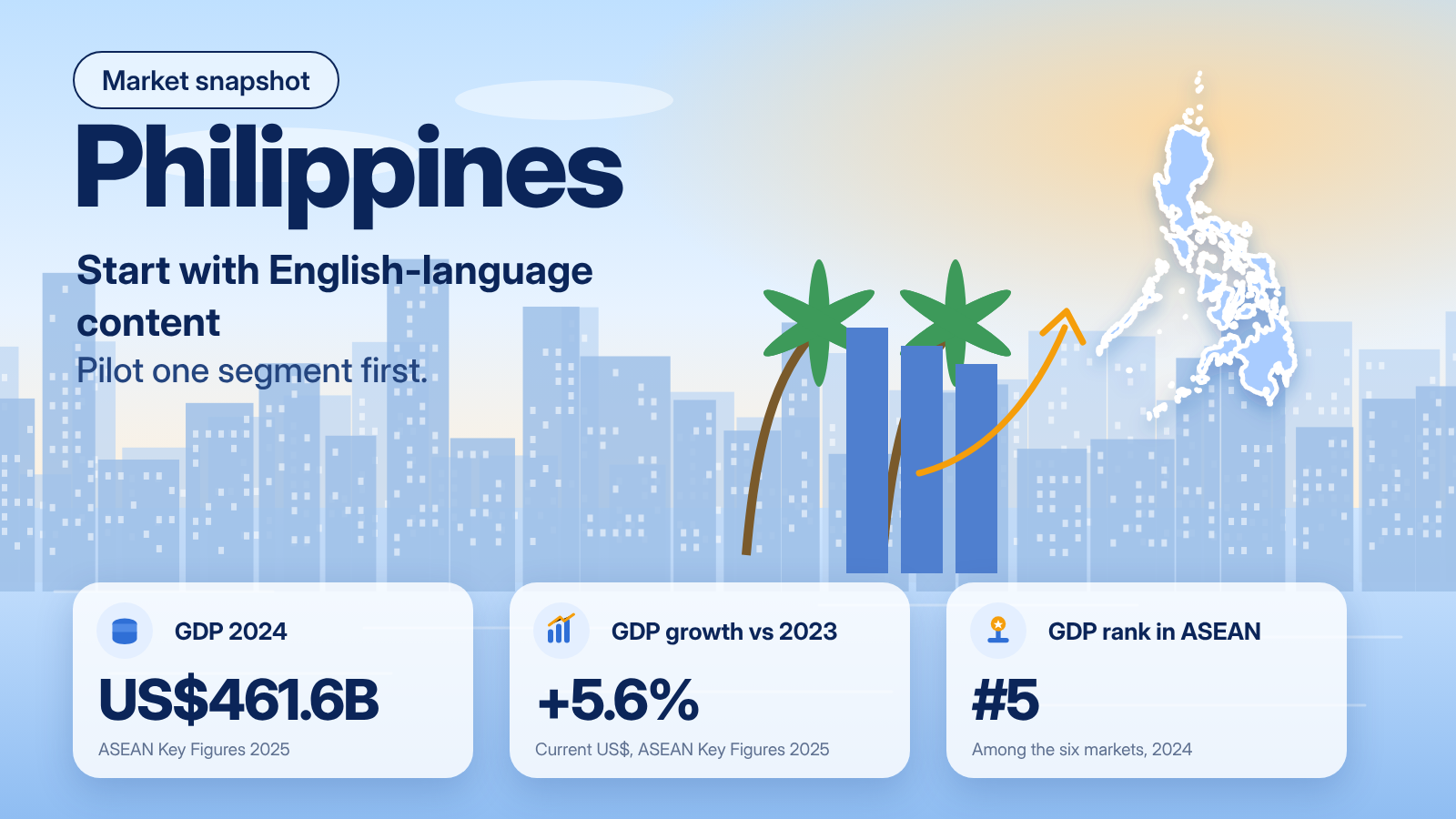
The Philippines grew from US$437.2 billion to US$461.6 billion, about 6%. English is widely used in business there, so you can test demand with the content you already have before you invest in local-language versions.
For a go-to-market strategy for Southeast Asia that starts here, run a small pilot with one segment, measure qualified leads and sales-cycle length, and add a local partner only once the numbers justify it.
The five parts of a go-to-market strategy for Southeast Asia
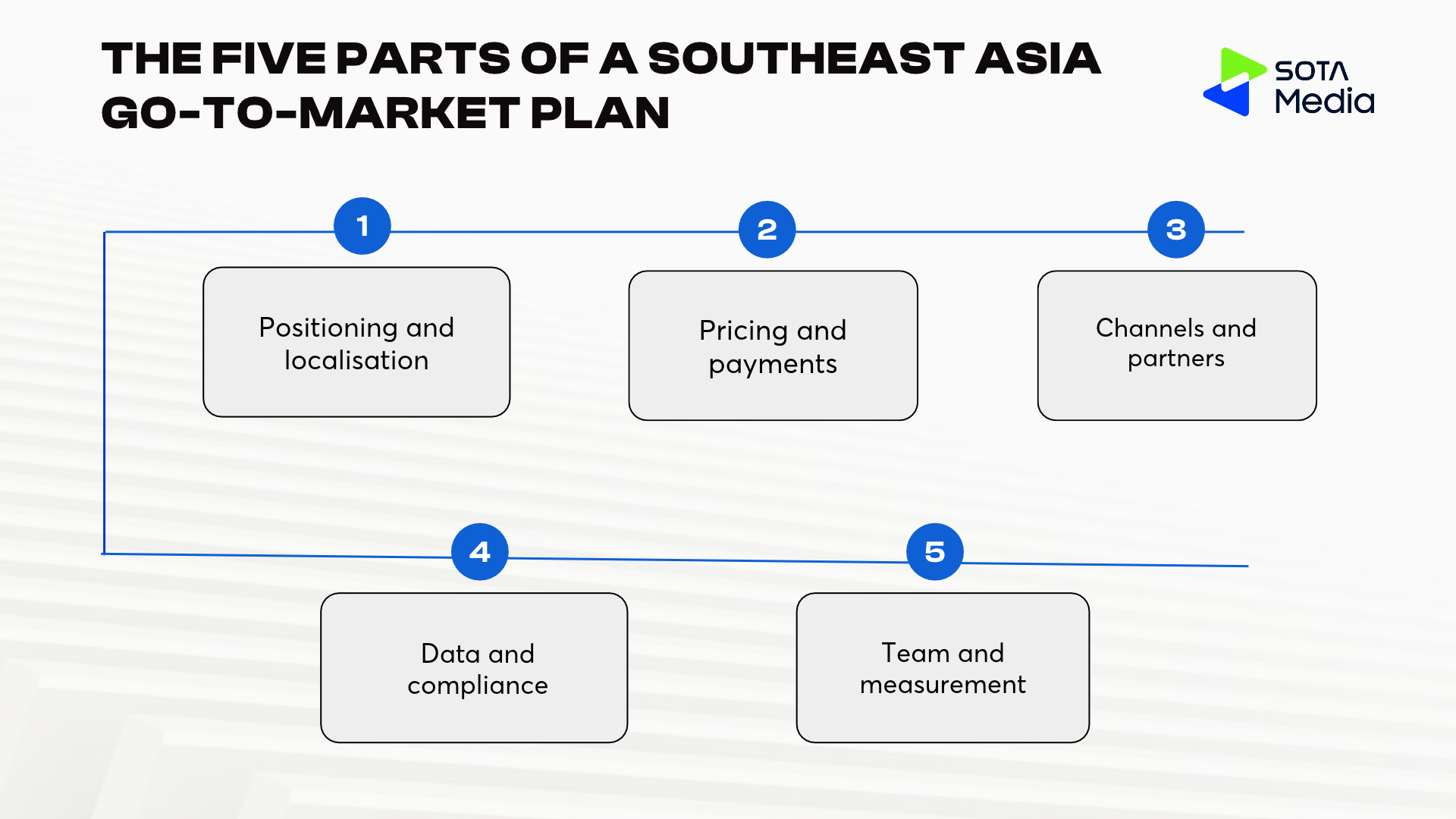
1. Positioning and localisation
Write a positioning statement per market, then check whether each claim holds up locally. A message that wins on speed in one country may need to win on cost or support in another. Keep one core story and change the proof points, as a good tech brand strategy does.
2. Pricing and payments
Set prices in local currency where buyers expect it, and offer the local payment method before you offer a card form. Test one market’s pricing before copying it to the next, because willingness to pay differs by market and segment.
3. Channels and partners
Pick two channels per market and run them well. For most B2B tech teams that means search and content on one side and a partner or reseller on the other. On the content side, B2B content marketing builds the library and B2B SEO strategy makes it easy to find.
Buyers also ask AI assistants, so generative engine optimization belongs in the plan. Executives who publish under their own name help in every market, and thought leadership is the cheapest way to get that started.
4. Data and compliance
Map where lead and customer data is stored, who can access it, and which country’s rules apply. Four of the six markets publish guidance you can read before you launch: the Singapore PDPC, Malaysia’s Personal Data Protection Commissioner, Thailand’s PDPC on transfers abroad, and the Philippines’ National Privacy Commission.
Have your counsel confirm the Indonesian and Vietnamese requirements for your use case. AI lead generation tools built on messy data produce messy pipelines.
5. Team and measurement
Start with a small regional team and add country leads once a market shows repeatable demand. Track a short list of numbers per market: qualified leads, pipeline, win rate and payback.
If you want outside help while you hire, a B2B tech agency or a growth marketing agency can cover the gap.
Common mistakes in a go-to-market strategy for Southeast Asia
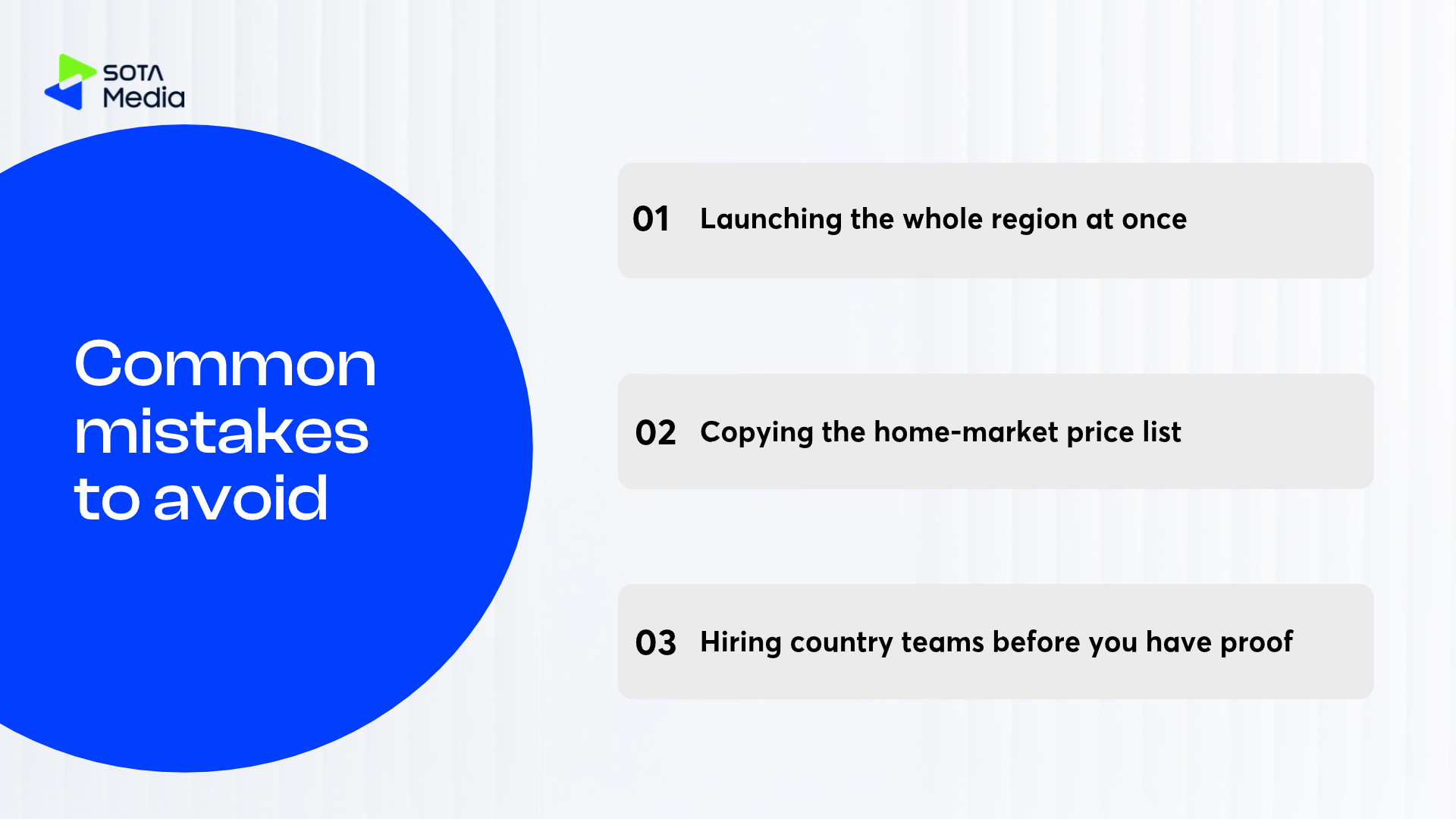
Launching the whole region at once
Six launches split your team six ways and produce six weak results. Sequence them.
Copying the home-market price list
A price that works in Singapore can be out of reach in other markets, and the reverse is also true. Test before you scale.
Hiring country teams before you have proof
A local team in every country is expensive. Prove demand with content, partners and a small sales pod first.
Where to start your go-to-market strategy for Southeast Asia this quarter
Score your top three markets on the four criteria above, pick a beachhead and a follow-on, and write one page per market covering positioning, price, payment method and data handling. Then choose two channels per market and set one measurable target for the first 90 days. That plan fits on a handful of slides and is enough to start selling.
Conclusion
A go-to-market strategy for Southeast Asia rewards a plan that treats each market on its own terms: score markets honestly, start with a beachhead, adapt payments and channels locally, and expand along shared infrastructure. The five parts of the plan above give your team a place to start.
SotaMedia has experience helping B2B tech companies build and execute go-to-market strategies across Southeast Asia. If you plan to expand into new markets or strengthen your regional presence, SotaMedia can help you develop a localized marketing strategy, reach the right audiences, and turn market opportunities into sustainable growth.
Frequently asked questions
Singapore and Malaysia are a natural pair for a first two-market launch because their payment systems are linked through DuitNow QR and NETS QR. Singapore works well as the home for your regional entity and as a source of reference customers. Malaysia adds a connected market where 98.3% of individuals used the internet in 2025.
Singapore's GMV is projected at US$29 billion in 2025, up 7% from 2024, which is slower than the region. That makes it a place to win named case studies rather than volume. You can then use them as proof when you approach buyers in neighbouring markets.
Indonesia has the largest economy in the bloc, with a GDP of US$1,357.3 billion in 2024. The entry cost is higher, so localise language and checkout from the start and accept the national QR standard, QRIS.
In Vietnam, buyers search and read in Vietnamese, so local-language content and search visibility are the cheapest way to build early demand. In the Philippines, English is widely used in business, so you can test demand with your existing content before you invest in local versions.
Look for local integrators and consultancies as channel partners, since an enterprise sale usually needs someone on the ground to run implementation. Thailand's PromptPay is also one of the QR partners in Bank Indonesia's cross-border scheme, so a team that bills in Indonesia can extend payment acceptance to Thai customers without building a new rail.