




Branding and Strategy
A fractional CMO is a senior marketing leader who works for your company part-time, on a monthly retainer, and owns marketing strategy and results the way a full-time chief marketing officer would. You get executive-level judgment for a share of the hours and cost of a full-time hire.
For a B2B tech company, the question is rarely whether senior marketing leadership matters. It is whether you need 40 hours a week of it yet. This guide covers what a fractional CMO does, what one costs in 2026, how the role compares with a full-time CMO and an agency, and the signals that tell you it is time to hire one.
Key takeaways
• A fractional CMO owns marketing strategy, budget and team direction part-time, usually 20 to 40 hours a month.
• Vendor-published 2026 data puts most fractional CMO retainers between $5,000 and $22,000 a month, with typical engagements around $8,000 to $15,000.
• The role fits companies with product-market fit, a revenue target and no one senior enough to own the marketing plan.
• Hire a fractional CMO to build the strategy and the team; hire a full-time CMO once marketing needs daily executive attention.
What is a fractional CMO?
A fractional CMO is an experienced marketing executive who leads your marketing function on a part-time, ongoing basis. Unlike a consultant who delivers a report and leaves, a fractional CMO sits in leadership meetings, sets priorities, manages the budget and answers for the numbers.
“Fractional” refers to time, not seniority. The person has usually run marketing at the CMO or VP level before and splits their week across 2 to 4 companies.
Fractional CMO vs interim CMO vs marketing consultant
The 3 titles get mixed up, but each one solves a different problem.
| Role | Time commitment | Typical length | Use it for |
|---|---|---|---|
| Fractional CMO | Part-time, ongoing | 6 to 18 months or longer | Building strategy, team and process when you cannot justify a full-time CMO |
| Interim CMO | Full-time, temporary | Until a permanent hire starts | Covering a gap after a CMO leaves |
| Marketing consultant | Project-based | Weeks to a few months | A defined deliverable, such as a positioning study or channel audit |
What does a fractional CMO do?
A fractional CMO does the same job as a full-time CMO, compressed into fewer hours. That means less time in execution and more time on decisions that shape everything else.
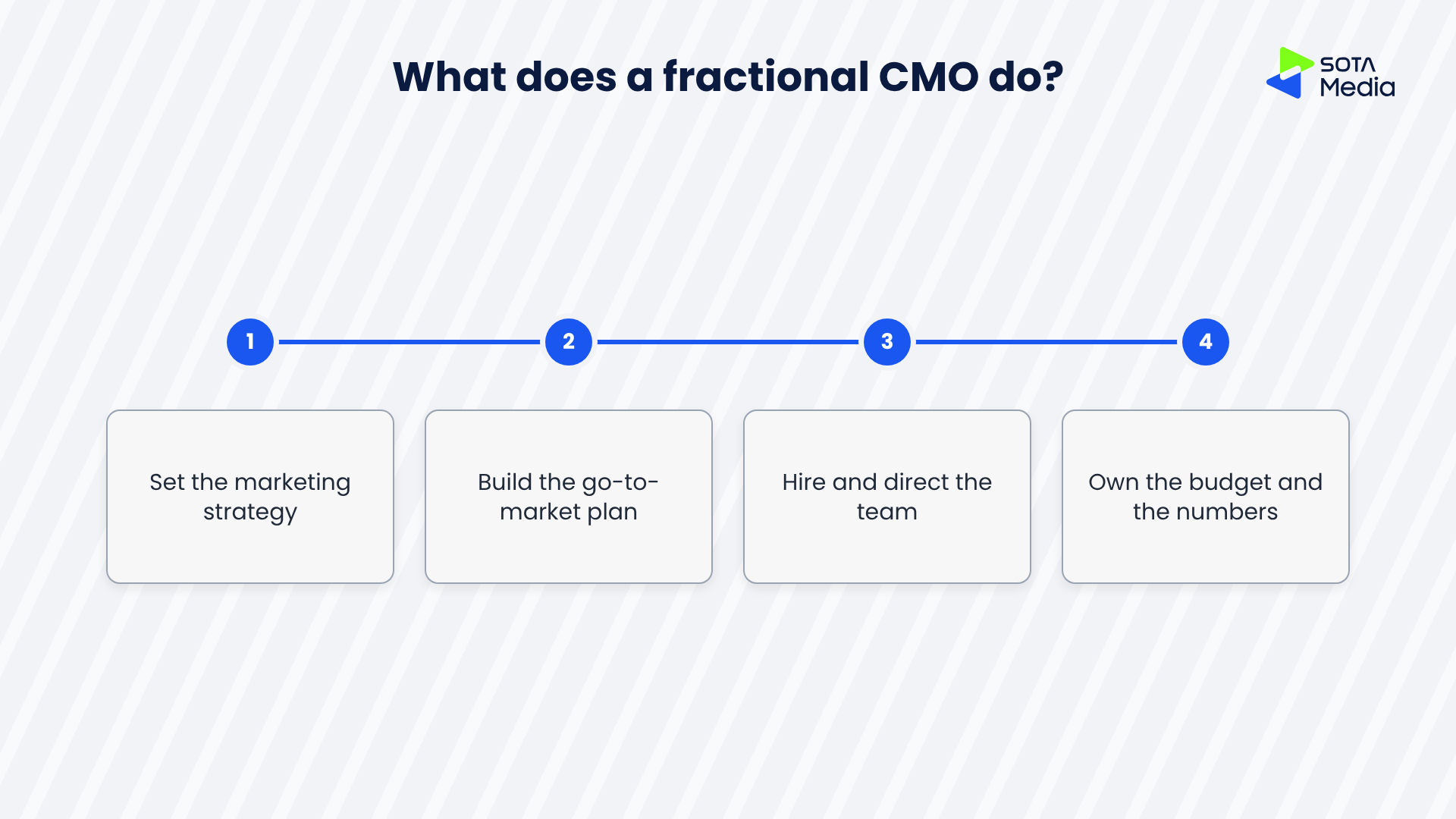
Set the marketing strategy
The fractional CMO decides who you sell to, what you say and which channels carry the message. In B2B tech, that usually starts with positioning: naming the problem your product solves better than the alternatives, in words your buyers already use.
Build the go-to-market plan
Strategy turns into a plan with targets, channels, budget and owners. A good plan ties marketing goals to pipeline and revenue, not to impressions or follower counts.
Hire and direct the team
Most fractional CMOs manage a small in-house team plus agencies or freelancers. They write job descriptions, interview candidates, brief agencies and set the weekly rhythm so work continues between their working days.
Own the budget and the numbers
The fractional CMO decides where the money goes and reports results to the CEO and board. Expect a dashboard that connects spend to qualified pipeline, plus a monthly review of what to cut and what to scale.
What the first 90 days usually look like
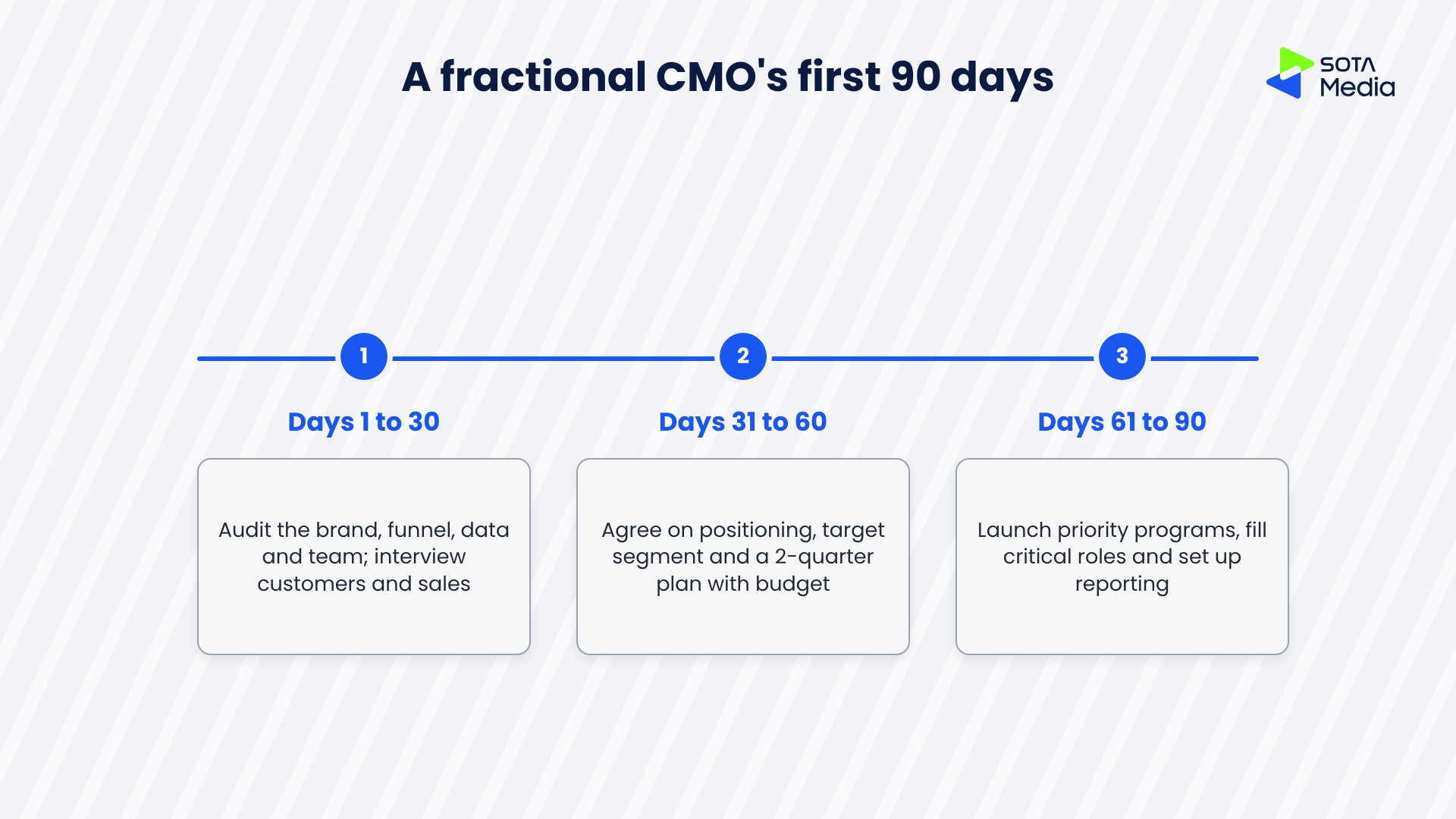
- Days 1 to 30: audit the current brand, funnel, data and team; interview customers and sales.
- Days 31 to 60: agree on positioning, the target segment and a 2-quarter plan with budget.
- Days 61 to 90: launch the first priority programs, fill critical roles and set up reporting.
How much does a fractional CMO cost in 2026?
Most fractional CMOs charge a monthly retainer. MarkCMO’s 2026 rate report, which compiles 11 fractional-market sources for US B2B growth-stage companies, puts retainers at $5,000 to $22,000 a month and typical engagements at $8,000 to $15,000 for 20 to 40 hours a month (MarkCMO, August 2026).
Both sources below are published by companies that sell fractional CMO services or track the market for it, so treat the ranges as directional, not as audited market data.
| Pricing model | Reported range |
|---|---|
| Monthly retainer | $5,000 to $22,000 a month |
| Hourly advisory | $200 to $500 an hour |
| Project or sprint (GTM plan, rebrand, launch) | $15,000 to $50,000 |
| Hybrid (cash plus equity) | $3,000 to $10,000 a month plus 0.1% to 0.5% equity |
How that compares with a full-time hire
The US Bureau of Labor Statistics reports a median annual wage of $166,790 for marketing managers in May 2025. That figure covers marketing managers in general, not CMOs, and excludes bonus, equity, benefits and recruiting costs, so a full-time CMO usually costs more.
A $10,000 monthly retainer adds up to $120,000 a year. The point is not that fractional is always cheaper. It is that you pay for the hours of senior leadership you need now, without a long search or a long commitment.
What drives the price
- Hours per month: 15 to 20 hours of advisory work costs less than 40 hours of hands-on leadership.
- Company stage: Fractional Pulse’s listing-based estimates rise from $3,000 to $6,000 a month at pre-seed to $15,000 to $25,000 at growth stage.
- Specialization: the same source puts B2B SaaS demand-generation specialists at $15,000 to $25,000 a month, against $7,000 to $12,000 for generalists.
- Hiring channel: marketplaces can add 25% to 40% on top of the direct rate, per Fractional Pulse.
Fractional CMO vs full-time CMO vs marketing agency
A fractional CMO is not a cheaper agency, and an agency is not a part-time CMO. The table is our editorial comparison of what each option gives you.
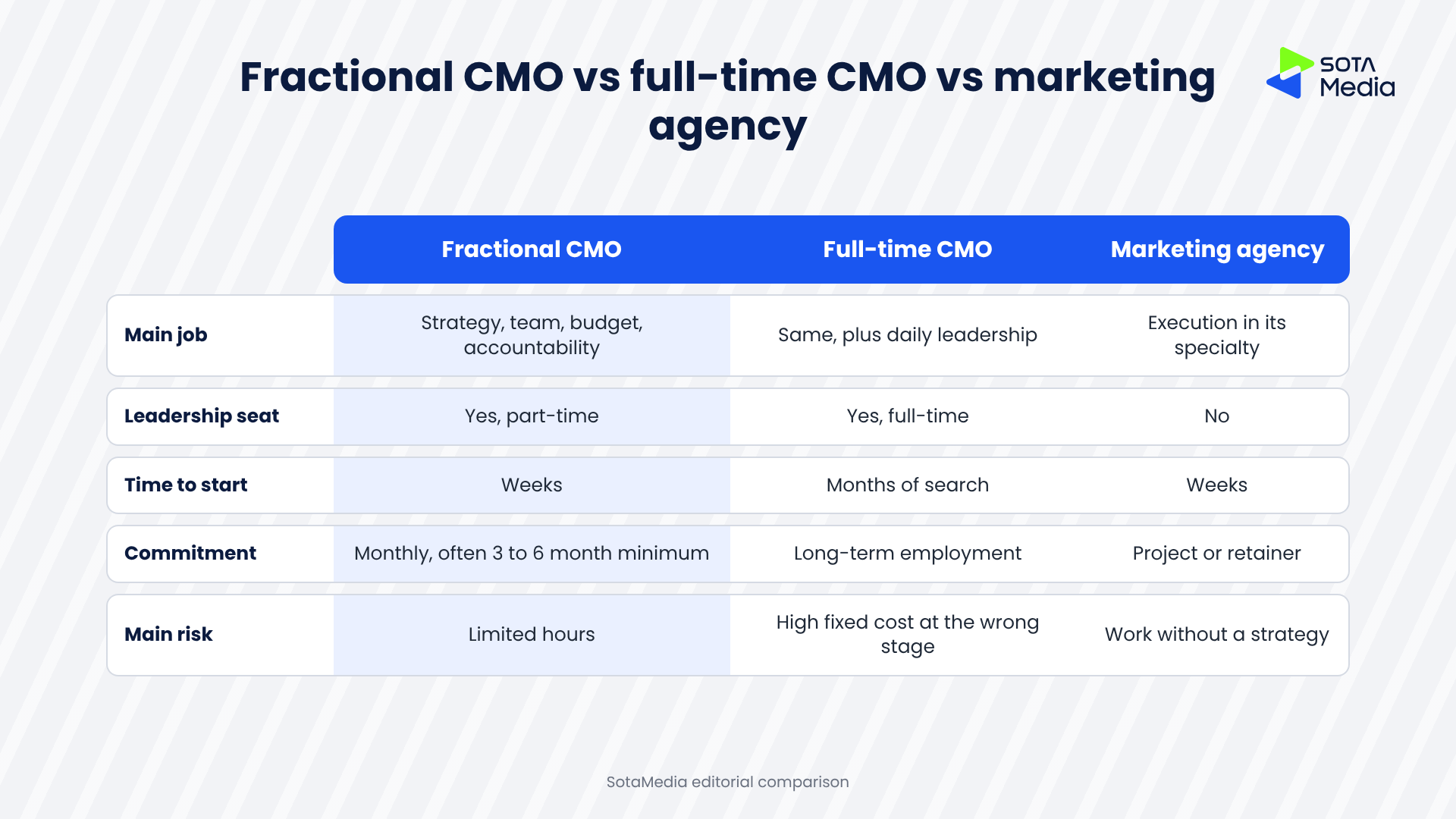
Many B2B tech companies combine the two outside options: a fractional CMO sets the strategy and briefs, and one or more agencies execute it.
When does a B2B tech company need a fractional CMO?
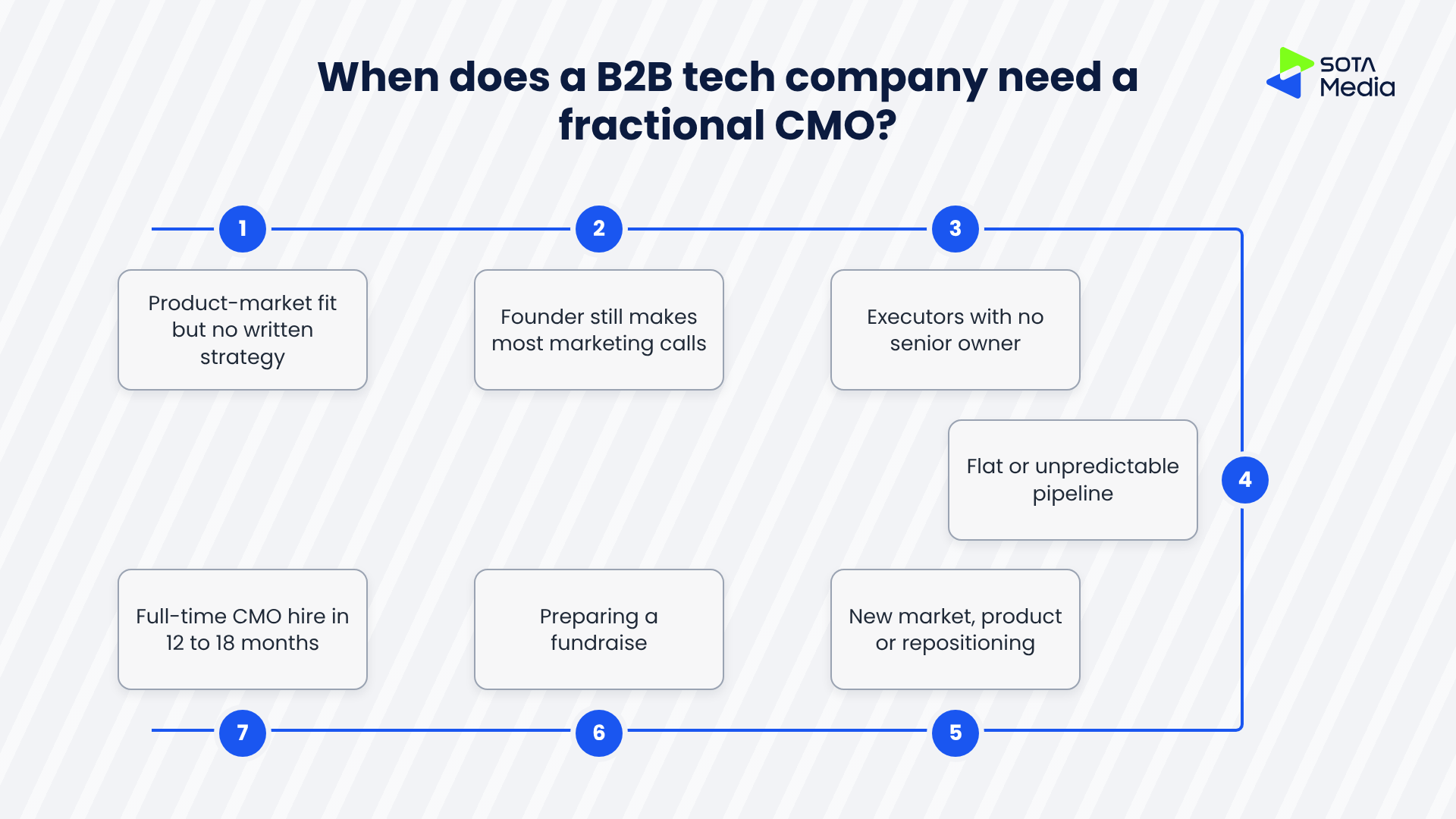
A fractional CMO makes sense when marketing decisions are holding back growth but the work does not yet fill a full-time executive role. Look for these signals:
- You have product-market fit and a revenue target, but no written marketing strategy.
- The founder or CEO still makes most marketing decisions and is running out of time.
- You have marketers or agencies executing, but nobody senior sets their priorities.
- Pipeline from marketing is flat or unpredictable, and nobody can explain why.
- You are entering a new market, launching a new product or repositioning after a pivot.
- You are preparing a fundraise and need a credible go-to-market plan for investors.
- You plan to hire a full-time CMO in 12 to 18 months and want the foundations in place first.
When a fractional CMO is the wrong choice
- No product-market fit yet: customer discovery belongs to the founders, not to a marketing executive.
- No budget or team to execute: a strategy nobody can carry out is an expensive document.
- Marketing already needs daily executive attention: large teams, multiple product lines or heavy board demands usually call for a full-time CMO.
Fractional CMO for startups: what changes by stage
For startups, the fractional CMO’s job shifts as the company grows. The ranges below are Fractional Pulse’s monthly estimates by stage.
| Stage | Typical focus | Reported monthly retainer |
|---|---|---|
| Pre-seed and seed | Positioning, messaging, first channel tests, founder-led content | $3,000 to $10,000 |
| Series A | Repeatable demand generation, first marketing hires, reporting | $8,000 to $15,000 |
| Series B and growth | Scaling channels, team structure, brand, hiring the full-time CMO | $12,000 to $25,000 |
How to hire a fractional CMO
- Write down the problem. Name the 1 or 2 outcomes you need in the next 6 months, such as a new positioning or a predictable pipeline source.
- Set hours and budget. Decide how many hours a month the role needs and which retainer range fits.
- Look for matching experience. Prioritize people who have marketed a similar product to a similar buyer, for example B2B SaaS sold to IT leaders.
- Ask for a 90-day plan. A strong candidate explains how they would audit, decide and launch in the first quarter.
- Agree on metrics and reporting. Tie success to pipeline, revenue or another business metric, and set a monthly review.
- Plan the handover. Decide early whether the role will end with a full-time hire, and make documentation part of the scope.
Questions to ask in the interview
- Which companies like ours have you led marketing for, and what changed in their pipeline?
- How many clients do you work with at the same time?
- Who executes the plan: our team, your network or an agency?
- What would you need from our CEO and sales team each week?
Conclusion
A fractional CMO gives a B2B tech company senior marketing leadership before a full-time CMO makes sense. The fit is strongest when you have a product that sells, a growth target and nobody senior enough to own the marketing plan.
At SotaMedia, our Branding and Strategy team works on positioning, messaging and go-to-market plans for tech companies. If you want a second view before you hire, ask us for a free brand and go-to-market audit, which includes a 90-day go-to-market outline.
Frequently asked questions
Most engagements run 20 to 40 hours a month, according to MarkCMO's 2026 rate report. Advisory-only arrangements can be fewer hours, billed at $200 to $500 an hour.
Many fractional CMOs ask for a 3 to 6 month minimum, per the same MarkCMO report. We suggest planning for at least 6 months, because the first quarter usually goes to audit, positioning and setup.
Yes. A common setup is a fractional CMO who sets strategy, budget and priorities, and an agency that executes specific channels. Agree up front who briefs the agency and who signs off on its work.
Sometimes. Some fractional CMOs move into a full-time role, while others prefer to help you hire one. Ask about this in the first interview so the scope includes a handover plan either way.