



Branding and Strategy
Vietnam, with strong economic growth, deeper trade integration, a large domestic market, is a potential destination for international companies. But entering Vietnam is not simply a matter of setting up a company and launching a product.
In this post, SotaMedia will explain the key factors businesses should evaluate for Vietnam market entry in 2026, from the country’s strategic advantages and market entry models to legal requirements, localization, budgeting, and ongoing compliance.
Keytakeaways
- Vietnam offers strong market potential, supported by 8.02% GDP growth in 2025, a population of 102.3 million, and growing foreign investment.
- Choose the right market entry model based on your ownership needs, investment scale, business model, and level of operational control.
- Location matters: Hanoi and Ho Chi Minh City offer established business ecosystems, while areas with difficult or exceptionally difficult socio-economic conditions may provide investment incentives for qualifying projects.
- Prepare the right legal documents: Foreign investors may need corporate documents, financial capacity evidence, investment approvals, company registration documents, and legalized Vietnamese translations.
Why Vietnam – Vietnam’s strategic value proposition for international investors
Economic growth & investment momentum
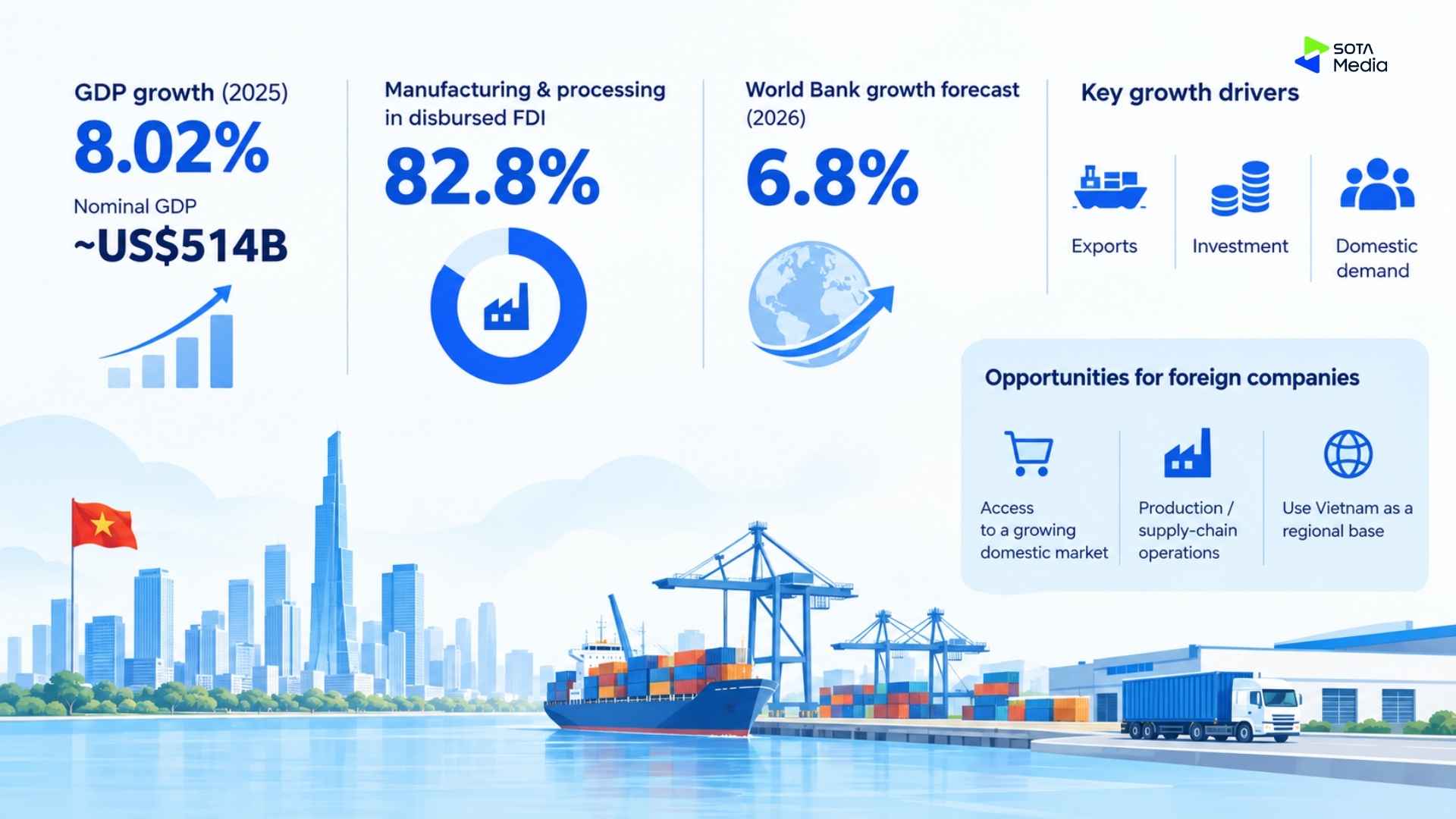
The economic growth of Vietnam market
Vietnam’s GDP grew 8.02% in 2025, while nominal GDP reached approximately US$514 billion.
Manufacturing and processing accounted for 82.8% of disbursed FDI, reinforcing Vietnam’s role in regional production and supply chains.
The World Bank projects Vietnam’s growth at 6.8% in 2026, while identifying exports, investment, and domestic demand as key growth drivers.
For foreign companies, this growth creates opportunities to access an expanding domestic market, establish production or supply-chain operations, and use Vietnam as a base for regional exports. The strong concentration of FDI in manufacturing also indicates an established ecosystem of suppliers and production activities that new investors can potentially connect with.
Strategic location & global trade integration
Vietnam is at the center of Southeast Asia, creating favourable conditions for transportation
Vietnam currently has 17 FTAs covering 65 partners, with the agreements collectively covering more than 80% of global GDP.
Key agreements include CPTPP, EVFTA, RCEP and UKVFTA, which help reduce tariff costs, improve export competitiveness, and support regional supply chain strategies.
Political stability & strategic partnerships
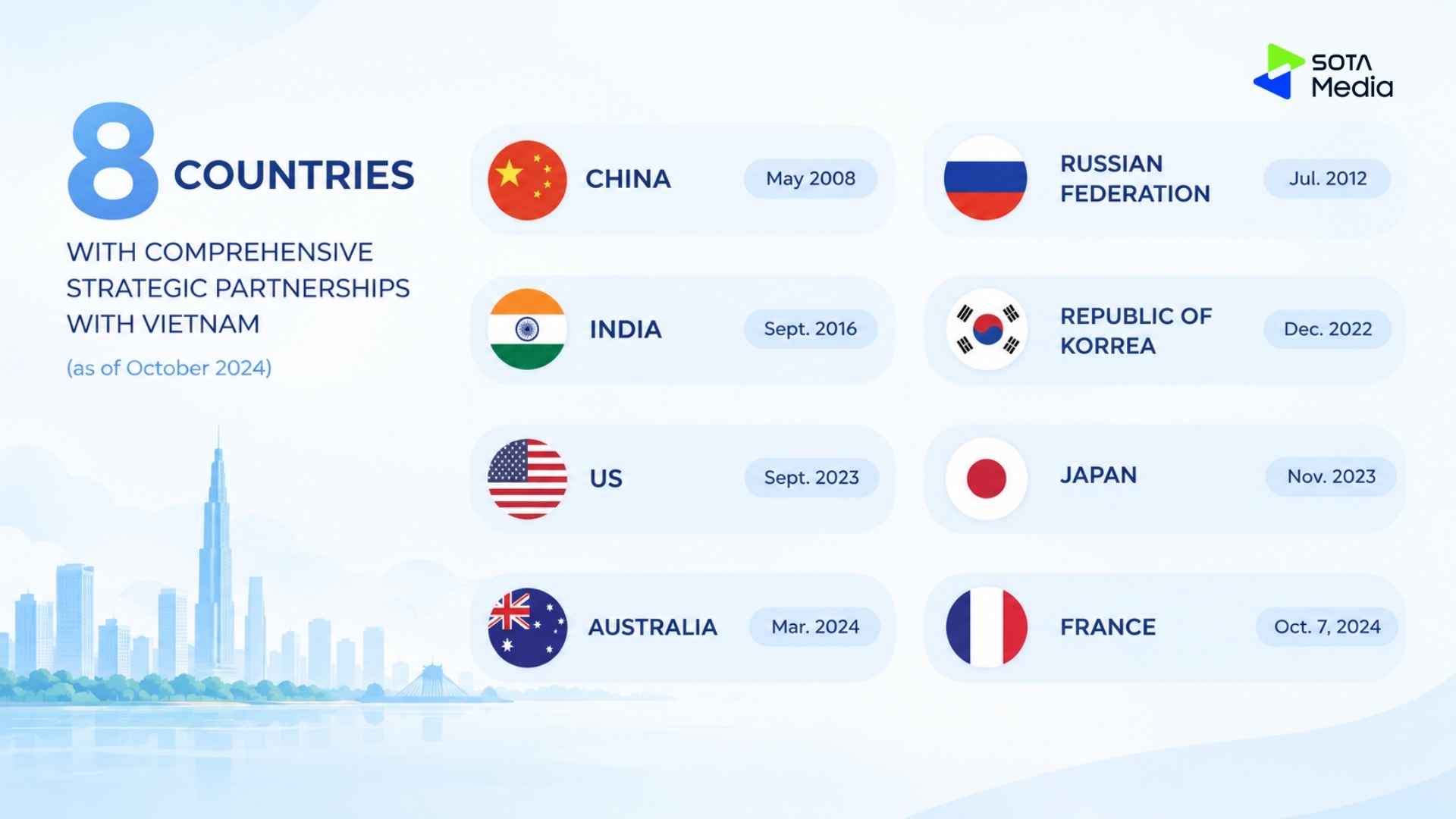
Vietnam maintains a consistent long-term development direction under its 2021-2030 Socio-Economic Development Strategy, with a vision toward 2045.
Vietnam has established Comprehensive Strategic Partnerships with eight countries: China, Russia, Japan, India, South Korea, the United States, Australia, and France.
These relationships create channels for cooperation in trade, technology, infrastructure, energy, and investment.
Large domestic market & workforce
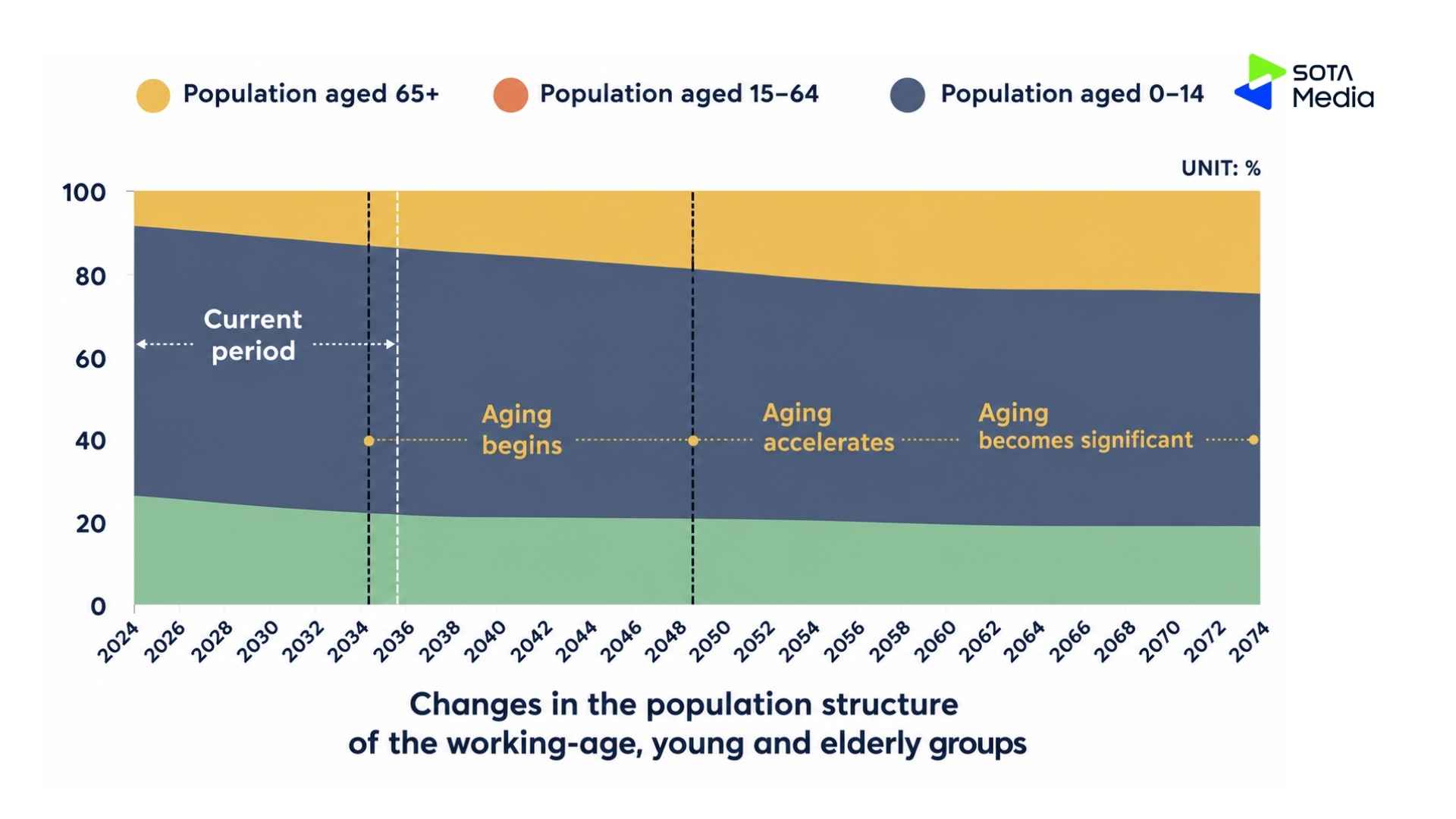
Changes in the population structure of VietNam
Vietnam’s population reached approximately 102.3 million in 2025, providing a sizeable domestic consumer and labor market.
From 2024-2034, Vietnam’s population is predicted to enter the golden-age population period, with 53.8 million people in the labour force in Q4 2025.
A large domestic market, growing incomes and an established manufacturing workforce support both market-entry and regional operations.
Technology & semiconductor ambition
Vietnam has identified semiconductors as a strategic technology industry under its national semiconductor strategy. By 2030, Vietnam aims to train at least 50,000 university-level semiconductor personnel.
The national semiconductor strategy targets the development of capabilities across IC design, manufacturing, packaging, and testing, creating opportunities for companies across the semiconductor value chain.
Green transition & energy investment
Vietnam has committed to net-zero emissions by 2050, with the Power Development Plan VIII supporting expansion of renewable energy and modernization of the power system.
Under the Just Energy Transition Partnership (JETP), international partners committed to mobilize an initial US$15.5 billion over 3-5 years to support Vietnam’s energy transition.
This creates investment opportunities across renewable energy, energy infrastructure, grid modernization and low-carbon manufacturing.
Evolving investment & regulatory environment
Vietnam has continued to reform its investment and business environment alongside broader institutional reforms.
The 15% Global Minimum Tax applies to qualifying multinational groups with consolidated revenue of at least €750 million, bringing Vietnam’s tax framework into alignment with the OECD Pillar Two framework.
Besides the new tax, the Vietnam government also implements the Investment Support Fund. Under Decree 182/2024/ND-CP, qualifying high-tech projects may receive direct support for workforce training (up to 50% of eligible costs), R&D activities (up to 30%), fixed-asset investments (up to 10%), and employee social infrastructure projects (up to 25%). Additional incentives are available for semiconductor and AI R&D centers.
Therefore, companies entering Vietnam should assess tax, licensing, and sector-specific requirements early, while new investment mechanisms can create opportunities for qualifying projects.
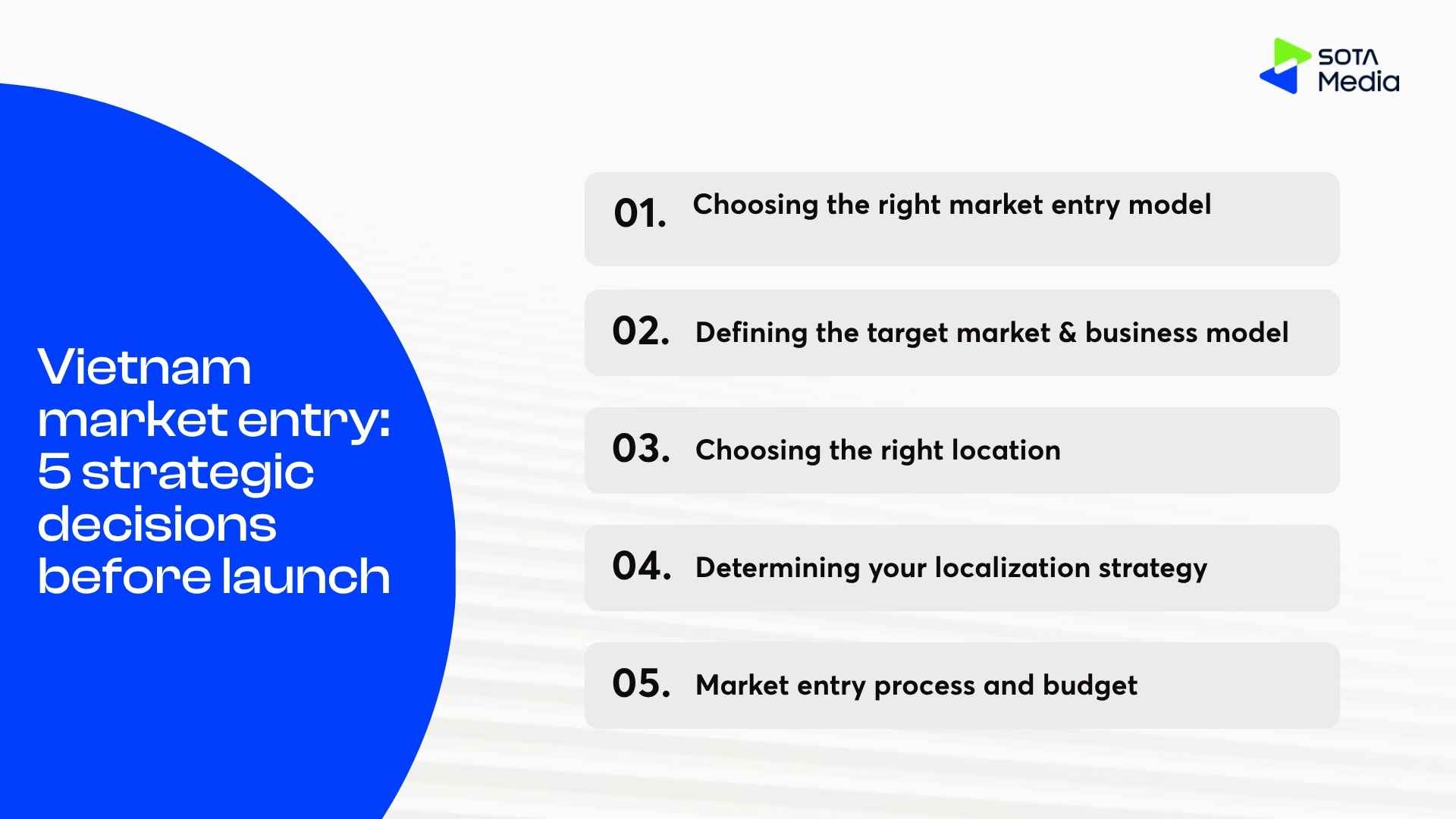
Vietnam market entry: 5 strategic decisions before launch
5 strategic decisions before launch
Choosing the right market entry model
Businesses can enter Vietnam through a foreign-invested entity, joint venture, acquisition, representative office, or local partnership, depending on ownership restrictions, investment scale, control requirements, and commercial objectives.
A direct entity provides greater operational control, while partnerships or JVs can offer faster access to local networks, customers, and expertise.
Defining the target market & business model
Identify the customer segments, revenue model, sales channels, and role of Vietnam in the wider business strategy.
Vietnam may serve as a consumer market, production base, sourcing hub, or regional operating center, and each model requires different investment and operating priorities.
Choosing the right location
Major economic centers: Hanoi and Ho Chi Minh City, Da nang can suit businesses that need access to customers, corporate partners, professional services, talent, and established commercial networks.
Difficult or exceptionally difficult socio-economic conditions area (such as Gia Lai, Lam Dong, etc): Business can get an incentive from Vietnam’s government (..) if investing in these areas for these field: industrial parks, industrial clusters, export-processing zones, high-tech parks, high-tech agricultural zones, concentrated digital technology zones, free trade zones, international financial centers, and economic zones. (Article 15 of Vietnam’s Law on Investment No. 143/2025/QH15)
Determining your localization strategy
Localization in Vietnam is more than translating. Businesses need to adapt their products or services, pricing, customer experience, distribution channels, communication, and after-sales support to local market conditions.
Customer preferences and purchasing behavior can vary by industry. B2C brands may need to adapt their messaging, retail channels, and customer service, while B2B businesses may place greater emphasis on local partnerships, sales processes, and relationship building. Manufacturers and service businesses may also need to localize suppliers, workforce models, logistics, and operating processes.
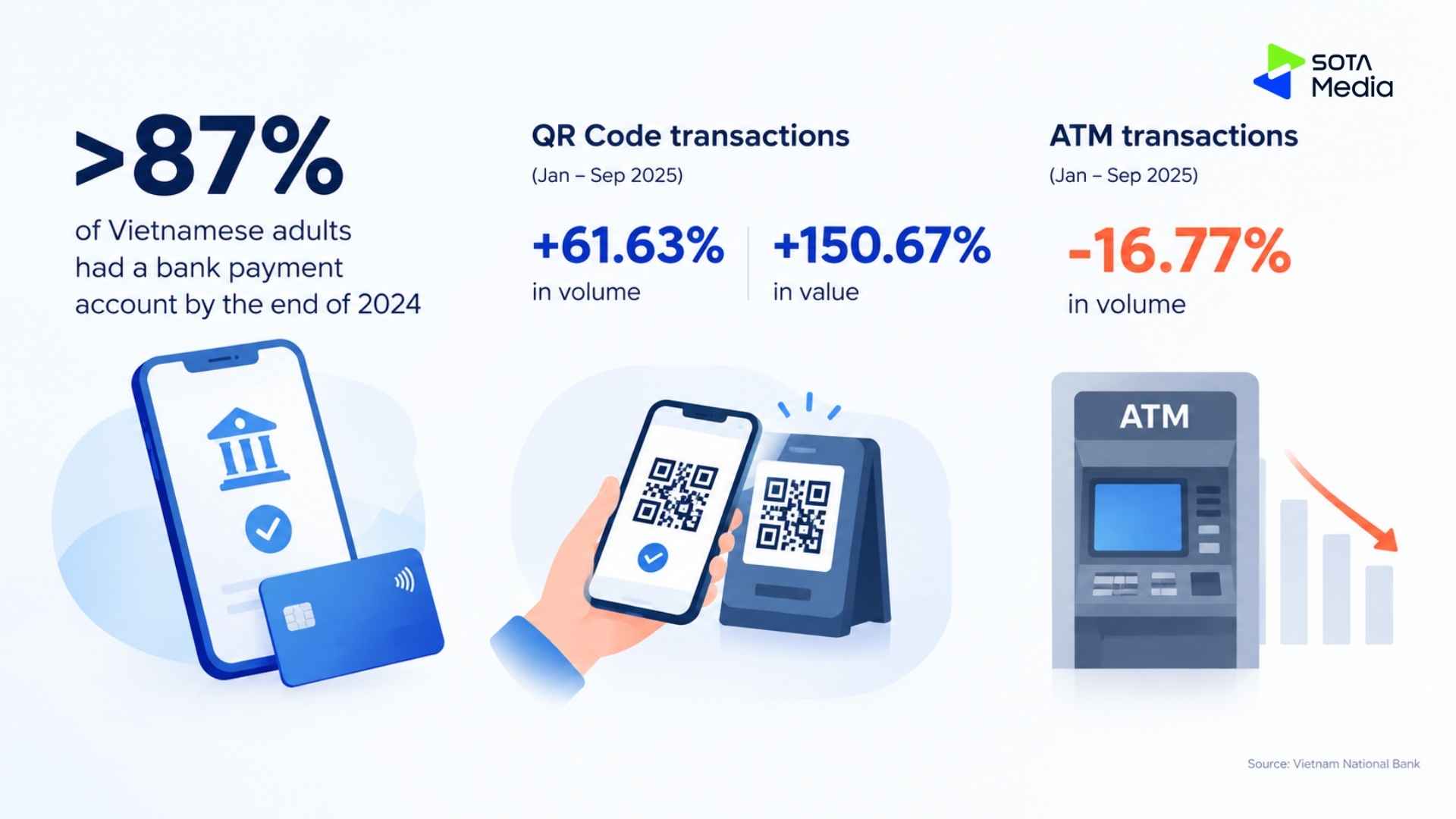
Payment and distribution should also reflect local market practices. In detail, more than 87% of Vietnamese adults had a bank payment account by the end of 2024, while non-cash payment transactions continued to grow strongly in 2025. In the first nine months of 2025, QR Code transactions increased 61.63% in volume and 150.67% in value year on year, while ATM transactions declined 16.77% in volume. (Vietnam National Bank)
Change in the payment method of Vietnamese customers
Market entry process and budget
Step 1: Planning
Assess the market-entry strategy, tax and corporate structure, investment restrictions, and sector-specific requirements before entering Vietnam.
Step 2: Structuring
Determine the appropriate corporate structure, including whether an offshore holding structure and/or a local Vietnamese entity is suitable.
Step 3: Establishment or Acquisition
Choose between establishing a new Vietnamese entity through incorporation and licensing, or entering Vietnam by investing in/acquiring an existing company.
Step 4: Post-Licensing & Transaction Support
Complete post-licensing registrations and operational setup, or, in an acquisition, support post-closing integration, SPA review, and compliance matters.
Step 5: Ongoing Compliance
Provide ongoing support for accounting, tax, payroll, reporting, and other statutory compliance obligations after the company begins operations.
The budget should cover more than initial setup. Businesses should account for licensing and legal costs, facilities, hiring, localization, taxes, compliance, distribution, marketing, and ongoing operations when planning their investment.
Fundamental requirements for establishment in Vietnam
Investors generally need to:
- Have a compliant legal representative structure, with at least one legal representative residing in Vietnam.
- Register office address in Vietnam
- Prove financial capacity to fund the investment and registered capital.
- A capital contribution plan, with charter capital contributed within the applicable statutory or registered timeframe under the ERC and, where applicable, IRC.
Checklist of required documents when entering Vietnam’s market
Under Decree No. 168/2025/ND-CP, the common documents required for a standard application for the establishment of a foreign-owned enterprise (FOE) are listed below:
|
No. |
Required Documents |
Corporate Investor |
Individual Investor |
|
DOCUMENTS FROM THE INVESTOR’S HOME COUNTRY |
|||
|
1 |
☐ Certificate of Incorporation or equivalent corporate registration document, duly legalised where required |
✓ |
|
|
2 |
☐ Corporate registration / business profile or equivalent document |
✓ |
|
|
3 |
☐ Document identifying the company’s current directors or authorised representatives, where applicable |
✓ |
|
|
4 |
☐ Resolution or decision approving the investment in Vietnam |
✓ |
|
|
5 |
☐ Passport or other valid identification document of the investor’s legal/authorised representative |
✓ |
|
|
6 |
☐ Passport or other valid identification document of the foreign individual investor |
✓ |
|
|
7 |
☐ Evidence of financial capacity, such as bank confirmation or other supporting financial documents |
✓ |
✓ |
|
8 |
☐ Power of Attorney / authorisation document, where the investor appoints another person to carry out the application |
✓ |
✓ |
|
DOCUMENTS FOR COMPANY REGISTRATION IN VIETNAM |
|||
|
9 |
☐ Application for Business Registration |
✓ |
✓ |
|
10 |
☐ Company Charter |
✓ |
✓ |
|
11 |
☐ List of members / shareholders, where applicable |
✓ |
✓ |
|
12 |
☐ Legal identification documents of the proposed Legal Representative(s) |
✓ |
✓ |
|
13 |
☐ Documents appointing or authorising the Legal Representative(s), where applicable |
✓ |
✓ |
|
14 |
☐ Beneficial Ownership Information, where required |
✓ |
✓ |
|
INVESTMENT-RELATED DOCUMENTS |
|||
|
15 |
☐ Investment Registration Certificate (IRC), where required |
✓ |
✓ |
|
16 |
☐ Approval for foreign capital contribution / share purchase / acquisition, where required |
✓ |
✓ |
|
17 |
☐ Sector-specific approval or licence, where required |
✓ |
✓ |
|
REGISTERED OFFICE / PREMISES DOCUMENTS |
|||
|
18 |
☐ Lease Agreement or Memorandum of Understanding for the registered office |
✓ |
✓ |
|
19 |
☐ Documents evidencing the landlord’s lawful right to lease the premises, where required |
✓ |
✓ |
|
DOCUMENT FORMALITIES |
|||
|
20 |
☐ Consular Legalisation of foreign-issued documents, where required |
✓ |
✓ |
|
21 |
☐ Vietnamese translation and certification of foreign-language documents |
✓ |
✓ |
|
22 |
☐ Notarised / certified copies, where required |
✓ |
✓ |
|
23 |
☐ Electronic identification / digital signature or authentication documents for online filing, where applicable |
✓ |
✓ |
Common Mistakes About Vietnam Market Entry
Over-relying on Digital-Only GTM Strategies: Foreign businesses may assume that digital advertising alone is enough to build market presence. Depending on the industry, local partnerships, offline networking, distribution relationships, events, and direct customer engagement can also play an important role in building trust and generating business.
Neglecting Cultural Nuances in Communication: Each country has different cultures and customs. If your business doesn’t research native culture, your campaign can disconnect from local people or even offend their culture. Businesses should adapt their messaging, customer experience, pricing communication, and channels to Vietnam’s cultural and consumption context.
Underestimating Local Competition: Foreign entrants compete with established local businesses that understand Vietnam’s customers, distribution networks, pricing, and regulatory environment. A clear value proposition, appropriate localization, and a realistic competitive strategy are essential for market entry.
How SotaMedia supports Vietnam market entry
At SotaMedia, we specialize in bridging the gap between global technology ambitions and local market adoption in Vietnam. As a core part of the SotaTek ecosystem, which operates across more than 25 countries, we combine world-class execution standards with deep, on-the-ground Vietnamese market expertise.
We provide end-to-end, localized go-to-market execution tailored specifically for SaaS, AI, Web3, and fintech brands by aligning global product value propositions with local market realities and regulatory landscapes. Partner with SotaMedia to transform your Vietnam market entry strategy into a seamless, high-growth reality.
Conclusion
Vietnam is a potential market for international companies. To take advantage of Vietnam’s potential, businesses need to choose the right entry structure, understand legal requirements, localize their offering, and plan for the costs and operational requirements that follow establishment.
If you are planning for Vietnam market entry, SotaMedia can help localize your go-to-market strategy, help you with legal documents, and connect your global positioning with local customer needs.
Frequently asked questions
Yes. Foreign investors can establish a wholly foreign-owned enterprise (FOE) in many sectors. However, some industries have foreign ownership restrictions or require additional approvals.
The timeline depends on the business sector, investment structure, and licensing requirements. For standard projects, incorporation and licensing can take several weeks, while regulated industries may require additional approvals.
Businesses should budget for company registration, legal and compliance services, office setup, hiring, taxes, localization, marketing, and ongoing operational expenses. The total cost varies significantly by industry and entry model.