
Branding and Strategy
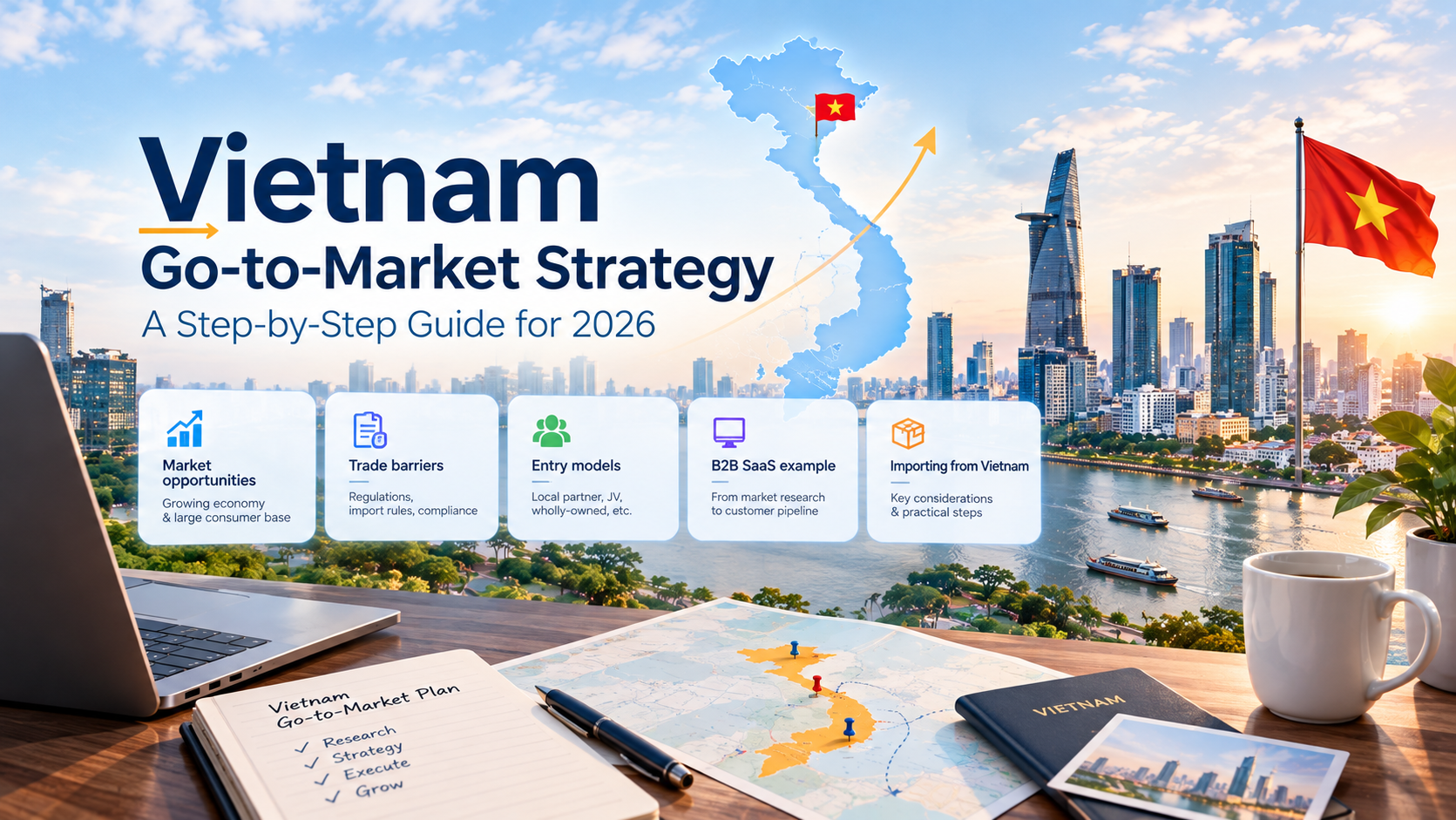
To build a Vietnam go-to-market strategy, you validate demand with local data and buyer interviews, choose an entry model, localise your offer, map the buying committee, pick Vietnam-specific channels, set up sales and compliance operations, and review results every 90 days. This guide walks through each step, then shows how Starbucks entered Vietnam.
The timing matters. Vietnam’s GDP grew 9.01% in the first 9 months of 2026, and total registered foreign investment rose 76.4% over the same period (Government News, 4 October 2026), according to the National Statistics Office. Without a localised plan, even well-funded marketing and sales efforts struggle to generate a qualified pipeline.
Key takeaways
- Vietnam’s GDP grew 9.01% in the first 9 months of 2026, and total registered foreign investment rose 76.4%, per the National Statistics Office.
- The World Bank reclassified Vietnam as an upper-middle-income country in July 2026 and forecasts 7.4% growth for 2026.
- Your entry model sets your speed and control: a representative office can research and promote but cannot earn revenue.
- Vietnam’s Personal Data Protection Law took effect on 1 January 2026, so check lead forms and cross-border CRM transfers before launch.
- A Vietnam go-to-market strategy works when you validate demand with local buyers first and scale in 90-day cycles on pipeline evidence.
Vietnam Market Overview: Key Figures for 2026
Vietnam had a population of 102.3 million in 2025, according to the National Statistics Office. The figures below give your Vietnam go-to-market strategy a factual base.

Two points matter when you plan a Vietnam go-to-market strategy.
First, consumer demand is growing: retail sales rose 13.4% in the first 9 months of 2026, and e-commerce alone was forecast to pass US$25 billion in 2025 (VnEconomy).
Second, purchasing power is concentrated. The US International Trade Administration (ITA) reports disposable income in major urban areas at 4 to 5 times the national average. Pick your cities and segments before you pick channels.
Vietnam Business Opportunities: Where Demand Is Growing
The ITA lists telecommunications and IT, power generation, transport infrastructure, environmental technology, aviation, defense, and education (English training and edtech) as short-term prospects for US companies, and expects healthcare to keep growing. Use that list as a starting point for your Vietnam go-to-market strategy, then test where your product solves a local problem.
Technology, AI, and Digital Services
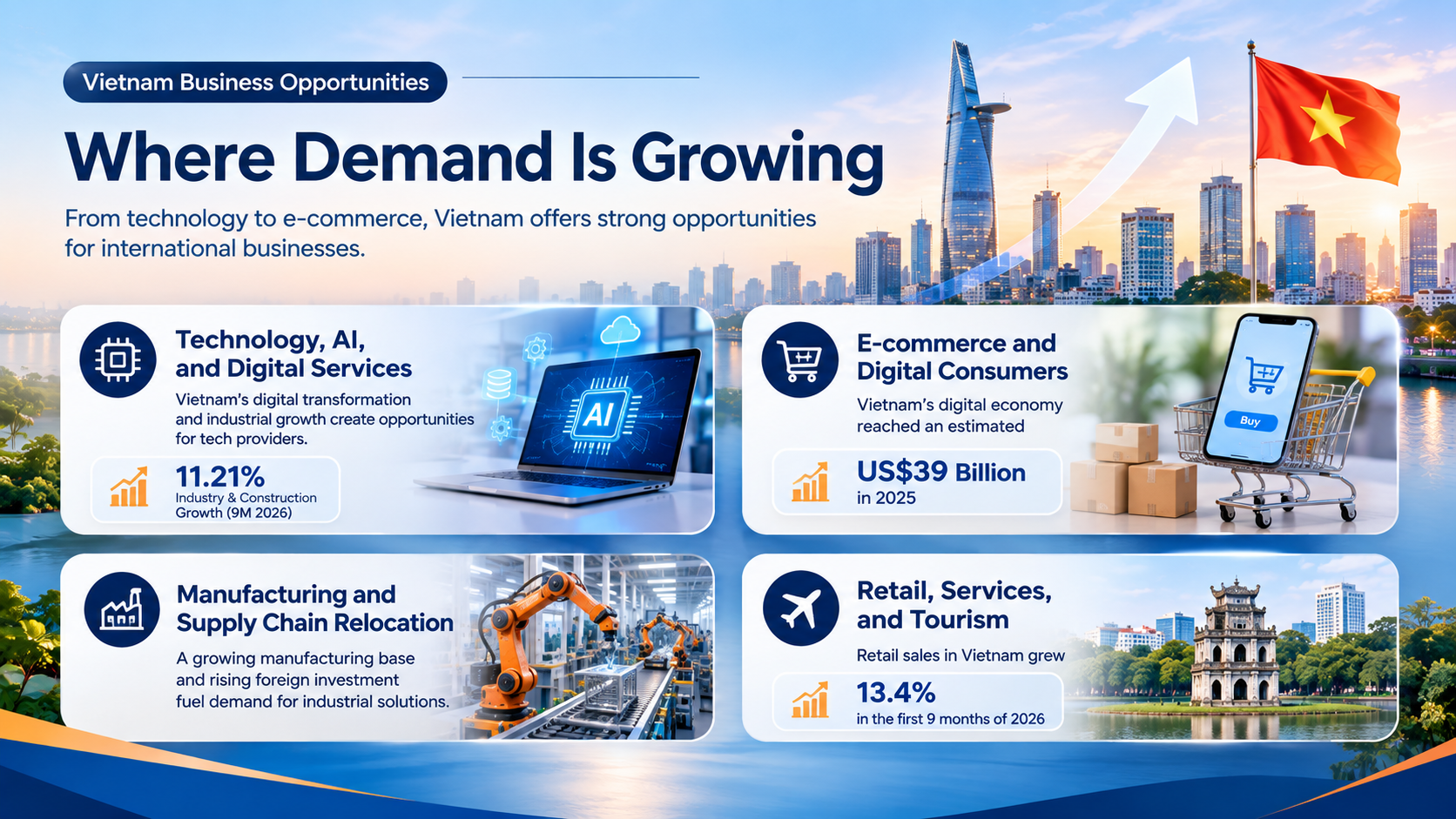
Vietnam’s digital transformation and industrial development create opportunities for technology providers. Industry and construction grew 11.21% in the first 9 months of 2026, so manufacturers and builders are adding capacity and need systems to run it.
Build your Vietnam go-to-market strategy around a specific operational problem: manual work, production efficiency or cybersecurity. Then show the business value in terms your buyer already tracks.
E-commerce and Digital Consumers
Vietnam’s digital economy reached an estimated US$39 billion in 2025, up 17%, according to e-Conomy SEA 2025 (VnEconomy). This creates opportunities for consumer brands, payment providers, logistics platforms, and e-commerce services. However, digital growth alone does not guarantee demand, so your Vietnam go-to-market strategy still needs product-level validation.
Research how local customers discover products, compare prices, pay and receive orders, then adapt your pricing, sales channels and delivery options to match.
Manufacturing and Supply Chain Relocation
Vietnam’s manufacturing base and foreign investment activity create demand for industrial equipment, enterprise software, B2B services, and skilled talent.
If you sell B2B, look at manufacturers that are expanding or that supply foreign-invested factories. Mapping supplier networks and procurement processes finds buyers faster than broad market targeting.
Retail, Services, and Tourism
Vietnam’s retail sales grew 13.4% in the first 9 months of 2026, supporting opportunities in lifestyle products, healthcare, education, hospitality, and consumer services. However, customer preferences and purchasing power vary by location and segment.
Start your Vietnam go-to-market strategy in Hanoi or Ho Chi Minh City with a clearly defined customer group. Validate demand, competition, and price sensitivity in the chosen segment before investing in nationwide distribution or marketing.
Vietnam Trade Barriers and Regulatory Risks to Consider
The ITA lists these challenges for US companies in Vietnam:
| Barrier | What it means for your entry plan |
|---|---|
| Policy inconsistency | Overlapping ministry jurisdictions can reduce transparency and consistency, which delays approvals. |
| Tax administration | ITA calls the application of tax laws one of the most challenging issues for US businesses; budget for compliance costs. |
| Intellectual property | Ineffective IP protection means infringement and counterfeiting risk; register IP before launch. |
| Selected high tariffs | Agricultural products, processed foods and nutritional supplements can face high duties. |
| Talent, start-up costs and infrastructure | Skilled-staff shortages, high start-up costs and infrastructure gaps affect operating plans. |
Regulatory requirements also shape your Vietnam go-to-market strategy, from company setup, e-commerce and hiring to personal data collection, CRM operations and cross-border data transfers. This guide is general information, not legal advice. Confirm the rules for your sector, ownership structure and business model with qualified local legal and tax advisers before launch.
Step-by-Step Vietnam Go-to-Market Strategy
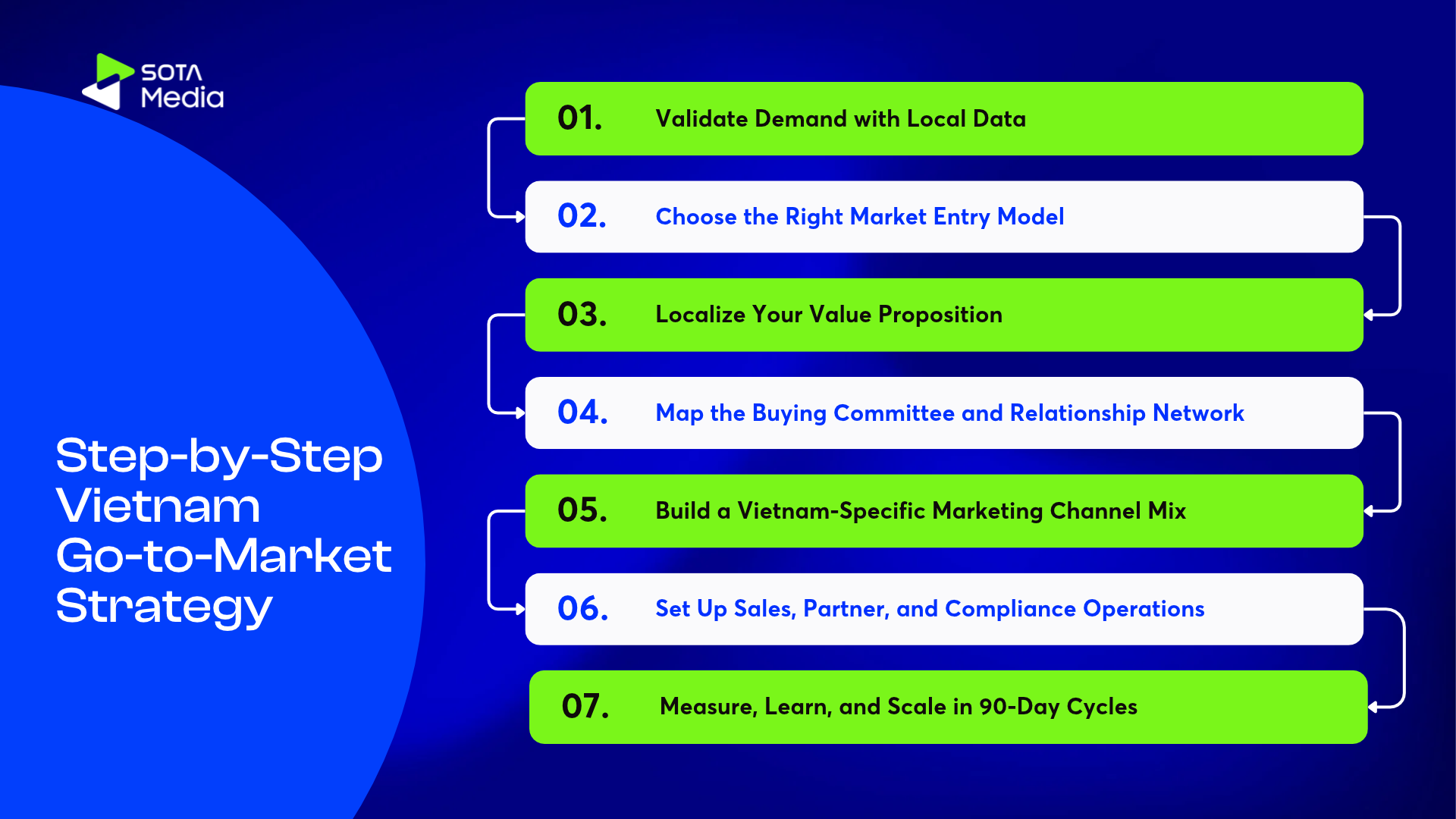
Use these 7 steps to structure your Vietnam go-to-market strategy. For company setup requirements and the decisions to make before launch, see our Vietnam market entry guide.
Step 1: Validate Demand with Local Data
Regional reports often blend countries with different buyer behaviour, purchasing power and rules. Size your opportunity with Vietnam-specific data from the National Statistics Office, sector ministries and the e-Conomy SEA report.
Then run 15 to 20 discovery interviews with local buyers before you commit a large budget. Ask 2 questions:
- Is the problem your product solves a real priority for Vietnamese customers?
- Who influences the decision, controls the budget, and approves the purchase?
Use these interviews to refine the segment, positioning, pricing and sales approach in your Vietnam go-to-market strategy.
Step 2: Choose the Entry Model for Your Vietnam Go-to-Market Strategy
Your entry model determines how quickly you can start operating, how much control you keep and what resources you need. The ITA describes 2 routes: indirect entry through an agent or distributor, and direct presence through a representative office, a branch or a foreign investment project under the Law on Investment 2020, as amended in 2025.
| Entry model | Main advantage | Key consideration |
|---|---|---|
| Distributor or reseller | Can provide local reach and market access with lower initial investment | You may have less control over margins, customer relationships, and customer data. |
| Strategic partner or joint venture | Provides access to local relationships and complementary capabilities | Requires clear agreements on ownership, responsibilities, and decision-making. |
| Representative office | Market research and business promotion; licence term of 5 years, renewable (Decree 07/2016/ND-CP, per ITA) | Cannot generate its own profit, sign contracts directly or issue invoices. |
| Branch | Direct presence for the parent company | Scope depends on the licence; confirm with counsel |
| Foreign-invested company (including wholly foreign-owned) | Most operational control | Higher setup, compliance and running costs. Some sectors cap foreign ownership |
For many B2B tech companies, a local partner is a sensible first step: you validate demand and win 3 to 5 reference customers before you incorporate. The right route for your Vietnam go-to-market strategy depends on sector licensing, customer requirements and your long-term plans.
Step 3: Localize Your Value Proposition
Translation alone rarely creates a compelling local offer. Vietnamese buyers may compare international products with local providers on price, after-sales support, implementation, and evidence that the solution works in their market.
Adapt the messaging in your Vietnam go-to-market strategy to local customer priorities. Where possible, use relevant case studies, clear pricing in VND, and examples that reflect Vietnamese business conditions.
For technology companies, explain how the product fits existing workflows and what support customers can expect after purchase. If your solution handles personal data or operates in a regulated sector, address relevant compliance requirements early in the sales process.
Step 4: Map the Buying Committee and Relationship Network
In B2B sales, the person who first evaluates a product may not be the person who approves the budget. Identify the key stakeholders involved in each purchase:
- Economic buyer: Approves the budget and evaluates business value.
- Technical evaluator: Assesses product capabilities, security, and integration.
- Relationship owner: Helps build trust and coordinate communication with the buying organization.
Local introductions, industry associations, chambers of commerce and professional events help you build relationships. Relationships open the door; your evidence of product fit closes the deal.
Step 5: Build a Vietnam-Specific Marketing Channel Mix
International marketing plans often overlook how Vietnamese customers discover brands and evaluate suppliers. Select channels based on your audience, purchase journey, and business objectives.
A B2B channel mix may include:
| Channel | Potential role |
|---|---|
| Facebook and Zalo | Community engagement, customer communication, and retargeting where appropriate |
| Reaching professional audiences, enterprise decision-makers, and multinational companies | |
| Local technology and business media | Building awareness and credibility among industry audiences |
| KOLs and industry experts | Sharing relevant expertise and introducing a brand to established communities |
| Industry events and roundtables | Meeting potential buyers and developing business relationships in Hanoi and Ho Chi Minh City |
| Google Search and SEO | Reaching users actively researching products, services, and solutions |
The channel mix in a Vietnam go-to-market strategy depends on the product and target segment. A consumer brand and an enterprise software provider should not automatically use the same channel plan.
Plan bilingual communication into your Vietnam go-to-market strategy where necessary. Vietnamese content can support local discovery and engagement, while English content may serve multinational buyers and regional headquarters.
Step 6: Set Up Sales, Partner, and Compliance Operations
Your Vietnam go-to-market strategy needs a clear path from initial interest to a qualified sales opportunity. Decide who will handle inbound leads, conduct discovery calls, manage local partners, and support customers after the sale.
Consider hiring or contracting a local commercial lead who understands the target sector and customer environment. Establish a process for lead qualification, follow-up, CRM management, and sales reporting.
Review hiring arrangements and employment rules with local counsel. Check data rules before you collect leads, launch forms or move customer data across borders: Vietnam’s Personal Data Protection Law (Law 91/2025/QH15) took effect on 1 January 2026, keeps a consent-centric approach, requires transfer impact assessments for cross-border transfers, and allows fines of up to 5% of prior-year revenue for cross-border transfer violations. Implementing decrees set the detailed dossier requirements, so confirm the current version with counsel.
Step 7: Measure, Learn, and Scale in 90-Day Cycles
A Vietnam go-to-market strategy needs a fixed review period to assess market response and decide where to invest next. Track performance at 3 levels:
- Market signals: Qualified conversations, buyer interviews, and partner meetings.
- Pipeline performance: Sales opportunities, conversion rates, and win rates.
- Revenue outcomes: Contract value, acquisition costs, and payback period.
Every 90 days, identify which segments, messages, partners and channels produced qualified opportunities, and move budget toward them. Scale on pipeline and revenue, since traffic and lead volume alone can hide poor fit.
Example: How Starbucks Entered Vietnam
Market Entry Background
Starbucks opened its first Vietnam store in Ho Chi Minh City in February 2013 (Viet Nam News, 17 September 2023). Its Vietnam go-to-market strategy had to work in a market with a long coffee culture and strong local chains.

The first Starbucks store in Vietnam, Ho Chi Minh City. Photo: Viet Nam News
Market Challenges and Risks
Vietnamese consumers traditionally drink black coffee and sweetened iced milk coffee, and neighbourhood cafés charge 20,000 to 25,000 VND a cup. A medium Starbucks Americano cost 55,000 VND, slightly above or level with Highlands Coffee and Trung Nguyen.
Go-to-Market Strategy
Starbucks positioned on the in-store experience and did not compete with street cafés on price. It kept its global identity while adding Vietnam-linked products such as Starbucks Reserve Vietnam Đà Lạt, introduced in 2015, 2017, 2018 and 2020, and a Central Highlands blend launched with its 100th store. It concentrated on major cities, with 50 of its 87 stores in Ho Chi Minh City by January 2023, and tested a smaller format of about 80 m² with a shorter menu.
Results and Lessons for Your Plan
The results are mixed. Starbucks reached its 100th store in Vietnam in September 2023, about 10 years after entry, yet held under 1% of the coffee market in early 2023, with Highlands Coffee and The Coffee House running far more locations.
For your Vietnam go-to-market strategy, that means:
- Test willingness to pay before you fix a price position.
- Give buyers a clear reason to choose you over a cheaper local option.
- Localise products where evidence supports it, and keep the brand consistent.
- Expect a premium position to win a niche, not mass share, unless your unit economics change.
What to Do in Your First 90 Days
Vietnam offers opportunities across technology, manufacturing, e-commerce, and consumer services, but success depends on understanding local demand, choosing the right entry model, and adapting to customer needs.
A practical Vietnam go-to-market strategy should connect market research with sales execution and measurable business outcomes. Start with a focused customer segment, test your assumptions with local buyers, and expand only when the evidence supports further investment.
At SotaMedia, we help international technology companies reach Vietnamese customers through localized marketing, bilingual content, SEO, paid advertising, Zalo, KOL partnerships, and technology PR. If you’re planning to enter Vietnam, contact us to discuss a marketing strategy that fits your business and target audience
Frequently asked questions
Common approaches include direct sales, partner-led distribution, inbound marketing, product-led growth, and account-based marketing. In Vietnam, B2B companies may combine local partnerships with account-based marketing to develop relationships with target accounts. The right approach depends on the product, customer segment, and sales model.
Those Cold War labels do not describe an economy. The World Bank reclassified Vietnam as an upper-middle-income country in July 2026, with GDP per capita of US$5,066 in 2025 (World Bank).
Whether US$1,000 is competitive depends on location, occupation, experience, and benefits. National GDP per capita is not the same as an individual's salary, so it should not be used alone to assess compensation. Benchmark pay against current data for the role and city you are hiring in.
It can be, if your product matches local demand and your operating model fits the rules. Use the growth and investment figures above as context, then assess sector fit, competition, compliance requirements and the cost of reaching customers before you enter.