




Branding and Strategy
A real estate marketing agency is a firm that generates and converts demand for property businesses. Its work can span brand positioning, digital advertising, content, SEO, social media, lead generation, and CRM depending on the business model and sales process.
This guide covers what these agencies do, how to test each criterion, which red flags predict a bad contract, and how the cost models compare. It is written for brokerage owners, developers, and proptech marketing leads about to sign a retainer.
Key takeaways
- A real estate marketing agency combines demand generation with the systems that move prospects toward a transaction.
- The 7 criteria that matter most are segment-specific case studies, lead-to-close data, compliance knowledge, full-funnel coverage, auditable reporting, automation, and transparent pricing.
- Questions to ask before signing: Named client results, the exact reporting workflow, and a written breakdown of fees and exclusions.
- Retainer, project, and performance models each carry different risks. Ad spend, software, and creative may bill outside the agency fee.
- Red flags: guaranteed leads or rankings, vanity metrics, lock-in terms, and no reference client you can call.
What is a real estate marketing agency?
A real estate marketing agency is a firm that generates and converts demand for property businesses, including agents, brokerages, developers, and proptech companies. It runs channels such as SEO, paid ads, listing syndication, and CRM nurture. It reports results against leads, appointments, and closed deals. The work covers the marketing side of a sale, from the first search to the handoff to a sales team.
What does a real estate marketing agency do?
Most agencies provide five key service areas that integrate with your sales process.
Core services
- SEO for listing pages: structured listing and neighborhood pages that rank for the searches your buyers run.
- Paid lead generation: Google, Meta, and portal ads. Housing ads carry targeting limits. In a 2022 settlement with the US Department of Justice, Meta stopped using its Special Ad Audience tool for housing ads and agreed not to offer targeting options that describe protected characteristics (US Department of Justice).
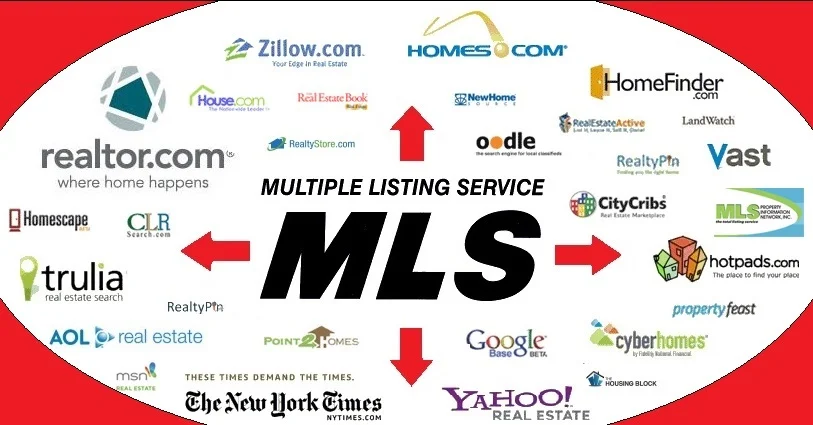
- MLS syndication: pushing listings to the MLS and downstream portals. Under the NAR model rules, a listing broker must submit a listing to the MLS within 1 business day of marketing it publicly, and public marketing includes brokerage website displays and email blasts (NAR). Local MLS deadlines vary, so confirm yours.
- CRM and lead nurture automation: routing, follow-up sequences, and lead scoring that keep a lead warm until an agent calls.
- Brand and content: listing copy, video, neighborhood guides, and launch material for developments.
Who needs one?
The criteria stay the same. The weight shifts by buyer type.
- Solo agents need lead flow and follow-up automation more than brand work. A full retainer may exceed what one agent’s volume supports, so a project or hybrid model can fit better.
- Brokerages need consistent lead routing across agents and reporting per agent or office. Lead-to-close data matters most.
- Developers need launch campaigns for a specific project. New-construction purchases rose to 16% of buyers in the 2025 NAR Profile, matching a level last seen in 2006 (NAR). New-development case studies and local zoning language matter more than resale results.
- Proptech companies sell software to property businesses, so the buyer is a B2B decision-maker, not a home buyer. They need a tech marketing agency that can explain the product to technical buyers, not a listing-focused shop.
How real estate marketing connects to the sales process
Marketing creates the lead, and sales closes it. The agency’s work ends at a qualified conversation, and the money is made or lost in the handoff.
A Harvard Business Review study of online sales leads found that most companies respond too slowly to online queries (HBR, 2011). The study spans many industries, not real estate alone. You can test the pattern in your own CRM: count the minutes from form fill to first call.
Agree on 3 things with any agency before launch: the definition of a qualified lead, who follows up and within what time, and how closed-deal outcomes flow back into reports and ad platforms. Without that loop, the agency optimizes for lead count, and you pay for volume that never closes.
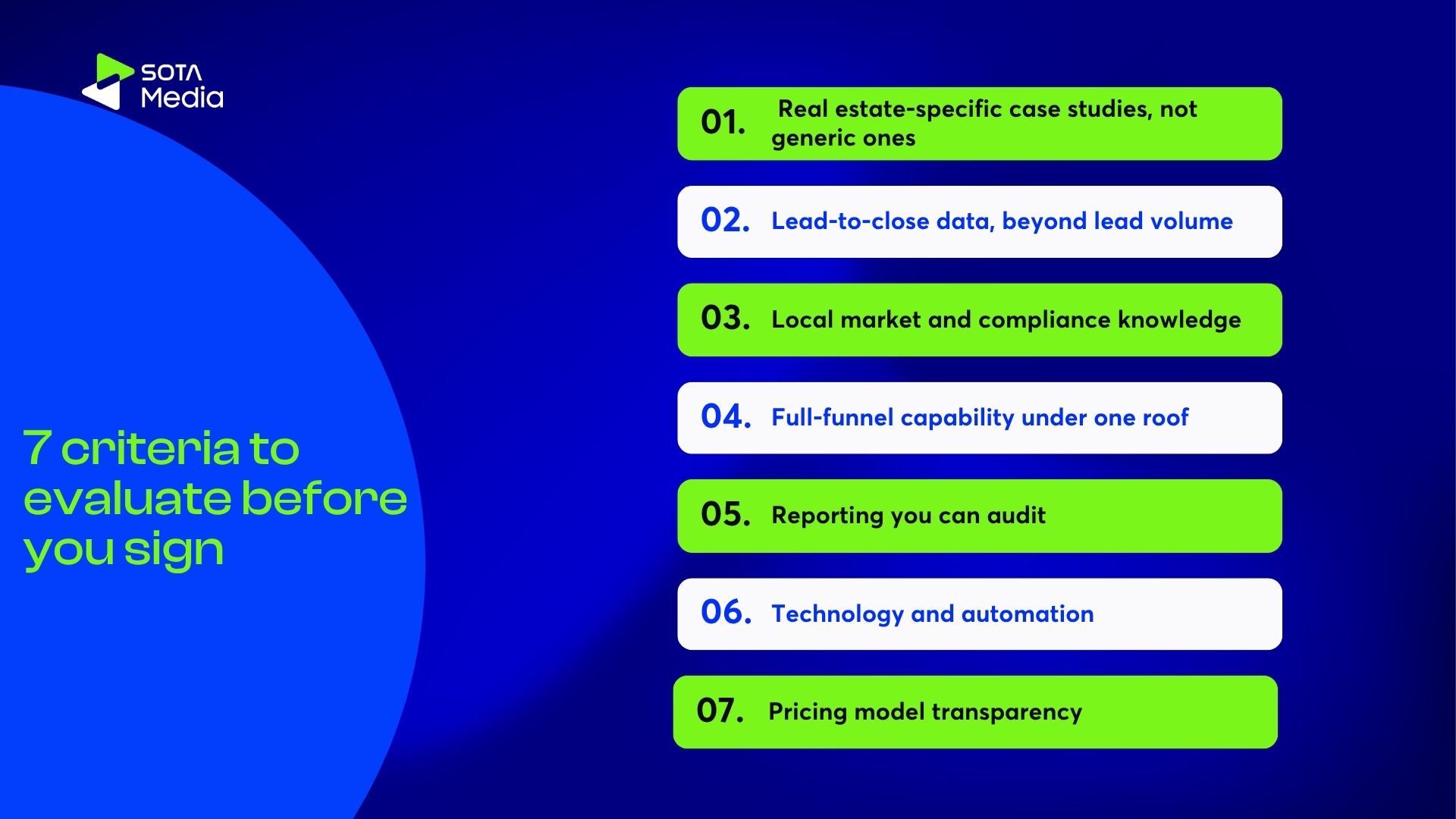
7 criteria to assess before signing with a real estate marketing agency
Each criterion has one check you can run in a single call.
1. Real estate-specific case studies, not generic ones
A case study from an ecommerce client tells you little about a condo launch. Residential resale, new development, and commercial each have their own buyers, sales cycles, and channels.
Check: ask for a client in your exact segment with a named result. A strong case study names the client, the period, the channel, and a number such as cost per lead or appointments booked. Then ask to speak with that client.
2. Lead-to-close data, beyond lead volume
An agency that reports only lead count hides conversion quality. Cheap leads that never answer a call still raise the count.
Check: ask for a sample report showing leads, appointments, offers, and closed deals by channel. Then ask how the agency gets closed-deal data, since that data usually sits in your CRM. An agency with no plan to connect to your CRM cannot report past the lead.
3. Local market and compliance knowledge
Housing advertising is regulated. In the US, HUD’s rule on discriminatory advertisements makes it unlawful to publish an advertisement that indicates a preference or limitation based on race, color, religion, sex, handicap, familial status, or national origin. It names words, photographs, and illustrations, and it covers selecting media or locations that deny parts of the market information about housing (24 CFR 100.75).
That reaches ad copy, imagery, and audience selection. MLS rules and local zoning language add more constraints.
Check: hand the agency one draft ad and one audience setup, and ask it to name every compliance risk before the call ends. An agency that answers “we follow the rules” without specifics has not done this before.
4. Full-funnel capability under one roof
Real estate demand moves through search, ads, listing syndication, and CRM follow-up. Leads leak in the gaps between them. One team can own all four, or the agency can disclose the partners it uses for the rest.
Check: ask for a one-page map showing who runs each stage, which stages a partner runs, and who owns the accounts. A hidden partner stack is a red flag.
5. Reports you can audit
A monthly PDF shows what the agency chose to show. A live dashboard shows what happened.
Check: ask for a live demo of a dashboard on a current client account. Confirm that your ad accounts, analytics, and CRM sit in your name with admin access for you. If you cannot pull a number yourself, you cannot audit it.
6. Technology and automation
Automation decides how fast a lead gets a response and how many leads a lean team can handle. Look for AI-driven lead scoring, 24/7 prospecting, and automated follow-up. Manual-only execution works at small volume and gets slower as volume grows.
Check: ask what is automated, what a human reviews, and what happens when a model scores a lead wrong. A concrete answer names the tool, the rule, and the review step.
7. Pricing model transparency
Any pricing model can hide costs in the exclusions.
Check: ask for an itemized quote and a written list of what it excludes, such as ad spend, software licenses, creative production, and portal fees. Compare 2 or 3 quotes line by line, not by total.
Red flags when signing with a real estate marketing agency
Guaranteed lead volume or ranking
Google’s documentation says no one can guarantee first place in search results and warns against SEOs that claim they can (Google Search Central). Lead volume works the same way. Search algorithms, ad auctions, and market conditions sit outside the agency’s control. Ask for forecasts with stated assumptions.

Vanity metrics only
Impressions, followers, and clicks do not pay a commission. If reports never tie activity to appointments or closed deals, the agency is measuring its own output, not your result. Ask which metric connects to revenue and when it will first appear.
Lock-in contracts with no exit clause
Read for 4 terms: minimum term, notice period, auto-renewal, and what transfers to you on exit. Ad accounts, data, and creative should transfer to you. A contract that keeps them with the agency turns a cancellation into a rebuild.
No named real estate client; they will let you contact
If every case study is anonymous or aggregated across the client base, you cannot check any of them. Ask for one reference call.
Real Estate Marketing Agency vs. In-House
| Criteria | Real Estate Marketing Agency | In-house |
|---|---|---|
| Speed to launch | Faster when the agency already has channel specialists, processes, and production capacity. | Depends on hiring, onboarding, tools, and internal approvals. |
| Cost structure | Variable fee by retainer, project, or performance model, plus media and third-party costs where applicable. | Salary, benefits, software, management, recruitment, and specialist coverage. |
| Real estate-specific expertise | Can be bought immediately if the agency has relevant cases and market knowledge. | Builds over time and depends on the experience of the people hired. |
| Scalability | Adds specialist capacity without hiring each role internally. | Strong when volume is steady enough to keep the team utilized year-round. |
The decision should follow workload and operating model, not a generic rule. A brokerage with steady acquisition volume and enough work to keep multiple specialists busy may justify an internal team. A smaller team or a time-bound development launch may need external capacity without carrying those roles all year.
Questions to ask before you sign for real estate marketing
If you only ask 3, ask questions 1, 2, and 6. Each question below has one line on what a strong answer sounds like.
- Can you name a real estate client in my segment and their result? Strong answer: names the client, gives a number such as cost per lead or close rate, and offers a reference call. Weak answer: “several happy clients.”
- What do you report between lead and close? Strong answer: lead-to-appointment and lead-to-close rates by channel, pulled from your CRM.
- What are your reporting cadence and dashboard access? Strong answer: live dashboard access, plus admin access to every account in your name.
- How do you handle Fair Housing and MLS rules in ad copy and targeting? Strong answer: describes a review step, names who owns it, and explains how housing-ad restrictions on each platform change the setup.
- What does the quote exclude? Strong answer: an itemized list covering ad spend, software, creative, and portal fees.
- What happens if we stop? Strong answer: a stated notice period, no surprise auto-renewal, and a clear handover of accounts, data, and creative.
What is the cost of hiring a real estate marketing agency?
We found no primary-source benchmark for real estate agency fees, so we do not quote a range. For scale, NAR’s 2026 Member Profile puts median total business expenses for a REALTOR® at $9,530 per year, against a median gross income of $59,200 (NAR, June 2026). A solo agent’s retainer has to fit inside that budget, so a project or hybrid model may suit small teams better. This section explains how each model works and where it carries risk.
Monthly retainer
A fixed monthly fee for a defined scope. It suits ongoing work such as SEO, content, and paid media management. The risk is paying for activity that produces no results, so put deliverables, hours, and reporting into the contract.
Project-based engagement
A fixed fee for a fixed deliverable, such as a launch campaign for a development, a listing site, or a brand refresh. The risk is scope creep, so agree how changes are priced before work starts.
Performance-based pricing
Fees tie to outcomes such as qualified leads, booked appointments, or closed transactions. This moves risk to the agency, and you should expect the rate to reflect it. Define what counts as a lead, who verifies it, and the period it is counted over. A hybrid model combines a lower retainer with a performance component.
For fees tied to closed transactions, have a real estate attorney review the agreement, since local rules on referral and commission payments differ.
Costs that may sit outside the agency fee
Ask for this list in writing:
- Ad spend paid to platforms
- Software such as CRM, dashboards, and call tracking
- Portal and listing fees
- Photography, video, and 3D tours
- MLS or IDX fees
- Compliance or legal review
A quote that lists none of these is incomplete, not cheaper.
Top 5 real estate marketing agencies (2026)
Disclosure: SotaMedia publishes this list and is included in it. The agencies are presented in alphabetical order, not ranked. The comparison uses the same five criteria: scope of link building services, named client work with published results, reporting transparency, market focus, and pricing model disclosure. Agency-reported results are presented as self-reported evidence, not independent market validation.
1. SotaMedia

Website: sota.media
A tech marketing agency in Vietnam and the marketing arm of SotaTek. The team works across SEO, GEO, PR, branding and AI marketing automation. For real estate businesses, this model is relevant when marketing needs to connect brand communication with digital acquisition, technology, and more complex customer journeys. SotaMedia’s public real estate work includes Vinhomes, while its broader positioning also makes it relevant to developers and proptech companies that need marketing support beyond listing promotion.
Best for: Real estate brands that need broader digital marketing, content, PR, and technical marketing support.
2. Asterisk Marketing

Website: asteriskmarketing.co
Asterisk Marketing focuses on digital marketing for the real estate industry and works with agents and teams across performance-focused channels. Its service mix includes PPC, SEO, retargeting, and Local Services Ads, giving real estate businesses options for combining paid acquisition with organic and local search visibility. The agency is a relevant option when the primary need is generating and converting buyer or seller enquiries rather than building a broader corporate marketing function.
Best for: Real estate agents and teams that need paid acquisition, SEO, retargeting, and local lead generation.
3. Augurian

Website: augurian.com
Augurian is a Minneapolis-St. Paul agency that serves clients across the US and has a dedicated real estate offering. Its real estate work covers brokerages, agents, and multifamily marketers, with services spanning paid media, SEO, and marketing analytics. The agency describes campaigns around conversion events such as tour requests and qualified leads rather than relying only on click volume. This makes its approach relevant to businesses that want channel performance connected to measurable actions further down the funnel.
Best for: Real estate companies that want paid media, SEO, and analytics tied to conversion events.
4. Dippidi

Website: dippidi.com
Dippidi provides a done-for-you marketing model for real estate professionals, combining Google Ads, Facebook and Instagram advertising, SEO, landing pages, CRM automation, and AI-assisted sales follow-up. The service mix is built around the full path from lead generation to follow-up, rather than treating advertising as a standalone activity. It can suit agents, teams, and brokerages that want an external partner to manage several acquisition and nurture functions without building each capability internally.
Best for: Real estate agents, teams, and brokerages looking for done-for-you advertising, SEO, and automated follow-up.
5. Real Estate Webmasters

Website: realestatewebmasters.com
Real Estate Webmasters focuses specifically on the real estate sector and combines website development with lead generation and marketing technology. Its offering includes an AI-powered CRM, SEO, AEO, PPC, and custom AI builds for real estate teams, alongside its website platform. This makes the agency relevant when a brokerage or team wants its website, lead capture, search visibility, advertising, and follow-up technology to work as connected parts of the same marketing system.
Best for: Real estate agents, teams, and brokerages that need websites, lead generation, CRM, SEO, and PPC in one system.
Conclusion
Choosing a real estate marketing agency starts with the sales outcome you need, then works backward to the channels, lead handoff, reporting, and specialist skills required to get there.
Before signing, ask for relevant case studies with named results, a clear lead handoff process, and a breakdown of every fee. If the agency cannot show how its work connects marketing activity to qualified leads and closed deals, the proposal is difficult to assess.
Use those checks to compare agencies against what your real estate business actually needs. If you need a partner that combines performance marketing, communications, and transparent reporting, SotaMedia is one option to consider.
Frequently asked questions
It handles lead generation, listing promotion, brand positioning, and often CRM and lead nurture for brokerages, agents, developers, and real estate tech companies. The work usually spans SEO, paid ads, and listing syndication.
No primary-source benchmark exists for agency fees, so ranges vary by quote. Pricing follows 3 models: retainer, project, and performance, and ad spend and software may bill separately. For scale, NAR’s 2026 Member Profile puts the median REALTOR®’s total annual business expenses at $9,530 (NAR, June 2026).
A real estate marketing agency understands MLS syndication, Fair Housing compliance, and local market dynamics. A generalist agency applies the same playbook regardless of vertical.
Ask for a named client in your exact segment and a specific number such as leads, close rate, or cost per lead. Then call the client. Aggregate claims across a whole client base cannot be checked.
It depends on volume and budget. In-house suits high-volume brokerages with steady ad spend. An agency suits agents, small teams, and developers who need full-funnel execution without hiring a team.
Guaranteed lead volume, vanity-metric-only reporting, no real estate client you can contact, and lock-in contracts with no exit clause.
No. No legitimate agency can guarantee lead volume or ranking, because search algorithms, ad auction dynamics, and market conditions sit outside its control. Google’s documentation makes the same point about rankings (Google Search Central).
Ask for a named client result in your segment, the reporting cadence and dashboard access, the pricing model and what it excludes, and the agency’s compliance knowledge for your market.