



Branding and Strategy
AI lead generation tools are software platforms that use machine learning, large language models (LLMs), and AI agents to find, qualify, enrich, and engage potential buyers automatically. Instead of relying on static contact lists and manual prospecting, B2B companies can use real-time data and buying signals to identify high-intent leads and reach them faster.
This guide covers how AI lead generation works, the top tools in 2026, and how to choose the right platform for your sales pipeline.
Key takeaways
• AI lead generation tools automate lead finding, qualification, enrichment, and outreach using machine learning and AI agents.
• 4 Core Capabilities: Find prospects, detect buying intent, enrich data, and automate outreach.
• Why B2B Companies Need Them: Save prospecting time, spot buying signals early, personalize outreach, and reduce CAC.
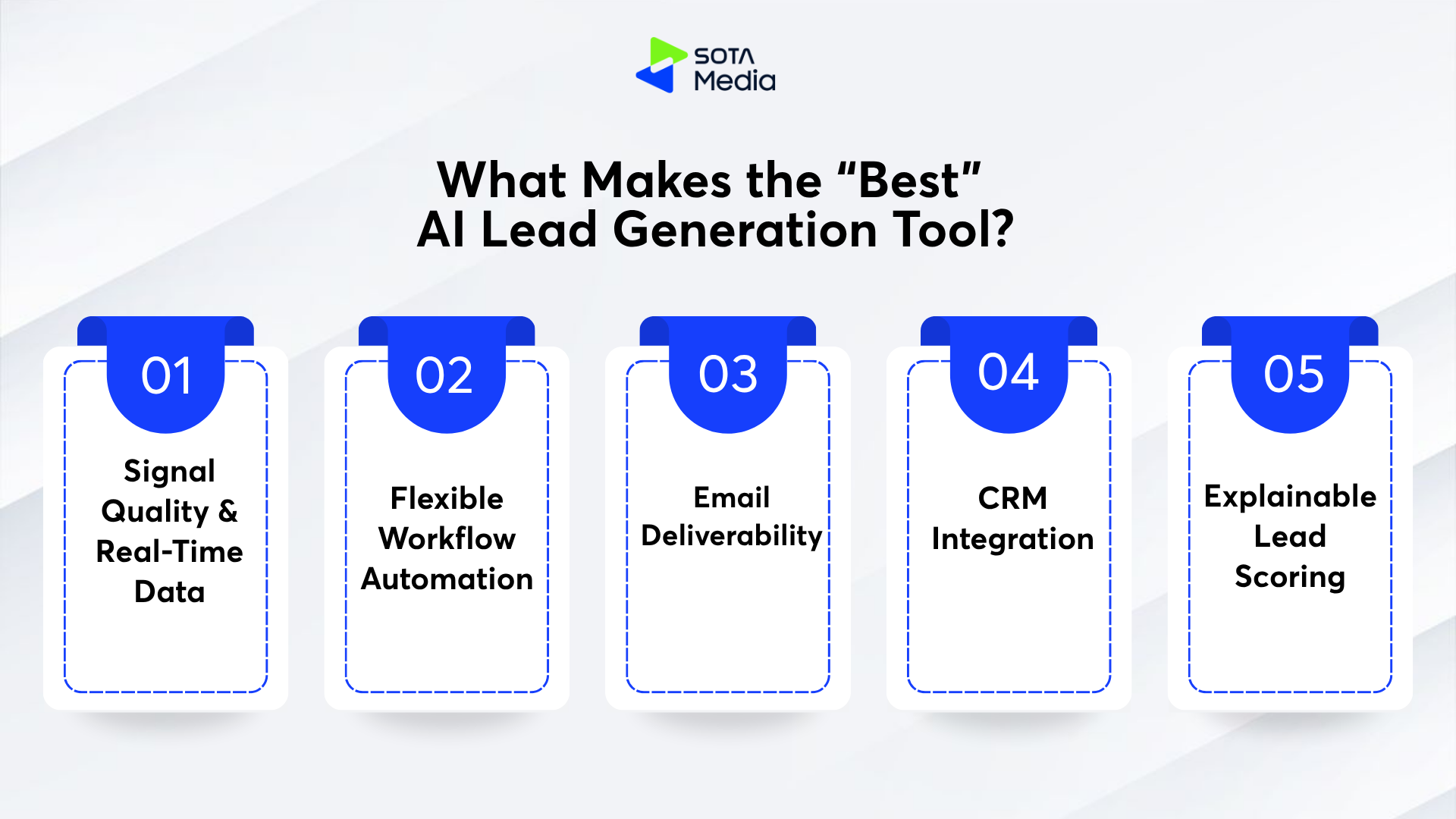
• Key Evaluation Factors: Real-time data, flexible workflows, strong deliverability, CRM integrations, and clear lead scoring.
• Common Mistakes to Avoid: Avoid spam, verify data, review AI research, and nurture inbound leads.
What are AI lead generation tools?
AI lead generation tools are software platforms powered by machine learning (ML), large language models (LLMs), natural language processing (NLP), and autonomous agents designed to discover, qualify, enrich, and engage prospective buyers automatically.
Unlike static databases, AI tools continuously interpret unstructured data, track real-time behavioral signals, predict conversion probability, and trigger personalized outreach without requiring manual input at every step.
In 2026, AI lead generation has evolved into intelligent systems capable of conducting deep web research, enriching prospect data, managing multi-channel outreach across email, LinkedIn, and phone, and continuously improving through pipeline feedback loops.
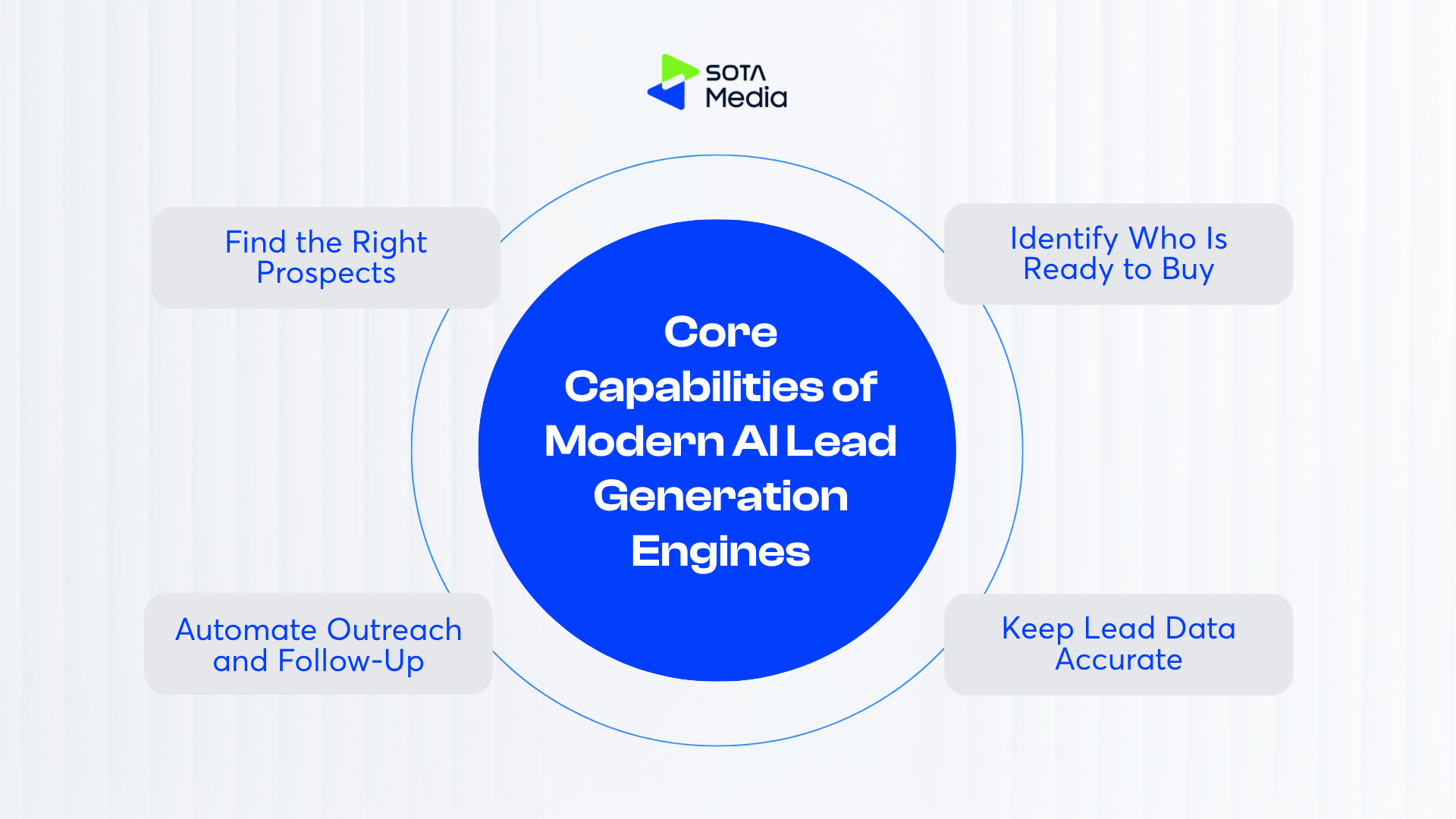
Core Capabilities of Modern AI Lead Generation Engines
AI lead generation moves sales from mass outreach to smarter targeting, helping teams prioritize who to contact, when to reach out, and what to say based on real-time signals.
Find the Right Prospects
AI continuously scans company websites, job boards, news, funding announcements, and technology data to identify accounts showing signs of potential demand. It combines signals such as funding, expansion, hiring, technology changes, and new product launches to build a more complete profile of target accounts.
Identify Who Is Ready to Buy
AI analyzes actions such as website visits, content engagement, and product research to detect buying intent. It then prioritizes prospects based on who is most likely to buy and why now is a good time to contact them.
Keep Lead Data Accurate
AI combines information from multiple sources to fill missing details and verify emails, phone numbers, job titles, and professional profiles. This reduces manual research and helps sales teams avoid wasting time on inaccurate leads.
Automate Outreach and Follow-Up
AI can create personalized messages, coordinate outreach across email and LinkedIn, manage routine replies, and schedule follow-ups. As sales results come in, the system learns which prospects, messages, and signals are most likely to generate results.
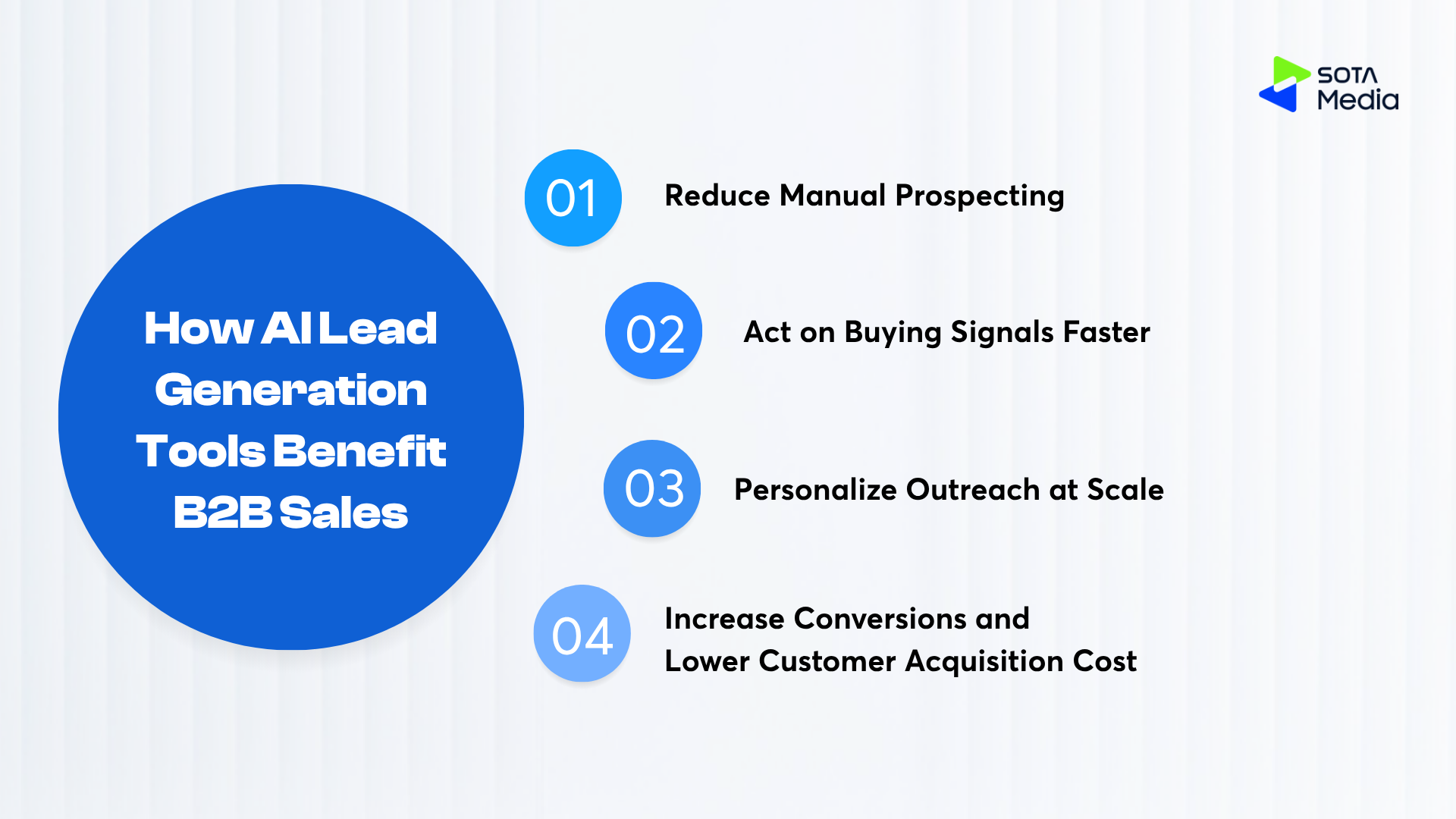
How AI Lead Generation Tools Benefit B2B Sales
Reduce Manual Prospecting
Sales reps spend over 60% of their day researching prospects and updating CRM data. By automating these time-consuming tasks, AI reduces manual prospecting work and gives reps more time to focus on qualified prospects, meaningful sales conversations, and closing deals.
Act on Buying Signals Faster
B2B buyers often start researching solutions before they contact a sales team. AI monitors trigger events such as new funding, hiring, budget changes, and technology shifts in near real time, helping sales teams identify emerging needs and reach out before competitors do.
Personalize Outreach at Scale
Generic outreach often gets ignored because it does not address a prospect’s specific needs. AI analyzes each prospect’s company, role, behavior, and buying signals to create more relevant messages at scale, helping sales teams increase engagement and response rates.
Increase Conversions and Lower Customer Acquisition Cost
AI helps sales teams prioritize high-intent prospects instead of spending time on unqualified leads. By focusing sales effort on accounts with stronger buying signals, teams can improve pipeline efficiency, increase reply-to-meeting conversion rates, and reduce Customer Acquisition Cost (CAC).
What Makes the “Best” AI Lead Generation Tool?
The best AI lead generation tool is not simply the one with the most AI features. When comparing platforms, focus on data quality, automation, integration, and the ability to explain why a lead is worth pursuing.
Signal Quality & Real-Time Data
Look for tools that use fresh, verified data rather than relying only on static lead databases. Real-time signals such as funding, hiring, technology changes, and website activity help sales teams identify prospects when their needs are most relevant.
Flexible Workflow Automation
A good platform should let teams create workflows based on different prospect signals and conditions. For example, if a decision-maker recently changed jobs, the tool can trigger a different outreach sequence from one used for an established contact.
Email Deliverability
Even the best AI-generated message is useless if it never reaches the inbox. Check whether the platform supports key deliverability features such as SPF, DKIM, DMARC, email verification, and inbox management.
CRM Integration
The tool should connect smoothly with systems such as Salesforce or HubSpot and keep lead, contact, and activity data synchronized. This prevents data from becoming fragmented across sales and marketing systems.
Explainable Lead Scoring
AI should show why a prospect receives a high score, rather than simply assigning a number. Clear reasons, such as recent funding, new hiring, or increased product interest, help sales teams understand which leads to prioritize and why.
6 Best AI Lead Generation Tools for B2B Sales in 2026
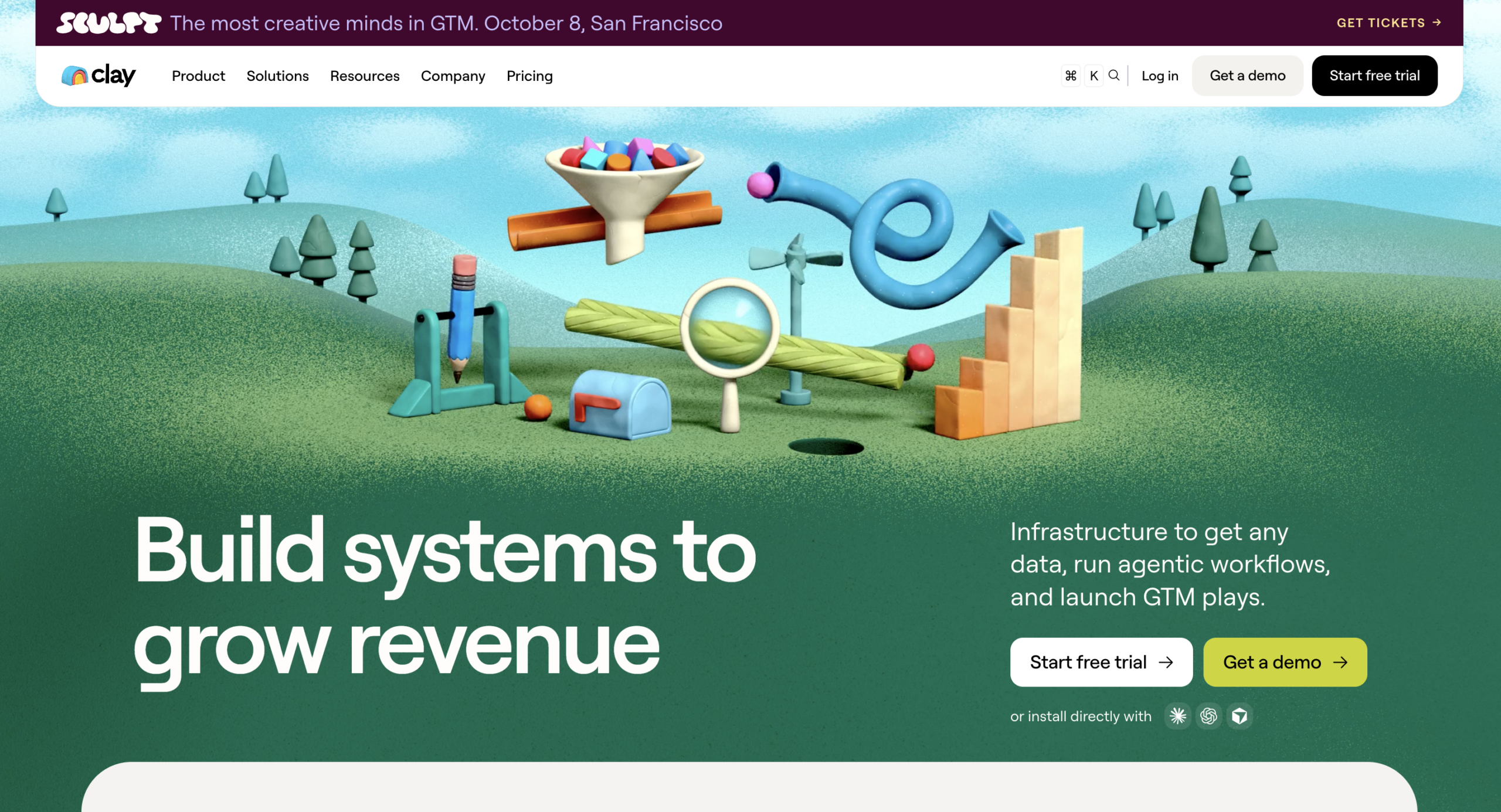
Clay: GTM workflow and data orchestration layer tool
Website: https://www.clay.com/
Best For: RevOps teams, Growth Marketers, and B2B Power Users who need deep programmatic waterfall enrichment and custom AI web research.
Overview: Clay is not a static database; it is a spreadsheet-style GTM workflow engine that aggregates over 200 data providers directly into a unified interface. Its waterfall enrichment process checks multiple sources to find missing contact and company data, boosting overall coverage from ~40% to over 80%.
Key Features:
- 200+ Data Providers: Checks multiple data sources to find missing emails, phone numbers, and company information. This helps improve lead data quality and coverage.
- Claygent: An AI research agent that reviews websites, LinkedIn, job posts, and news to collect useful company insights that may not be available in standard databases.
- Buying Signals: Tracks important updates such as job changes, new hires, funding news, promotions, and social activity to identify potential sales opportunities.
- Unlimited Seats: Allows teams to add unlimited members without extra seat-based fees. Costs mainly depend on data and action credits.
- Integrations & MCP: Connects with tools such as HubSpot, Salesforce, Instantly, and Smartlead. Its MCP server also supports AI tools like Claude.
Pros:
- Checks multiple data sources to find more complete lead information.
- Claygent finds useful company insights from websites, LinkedIn, job posts, and news.
- Add more team members without extra seat fees.
Cons:
- Complex workflows may take 2-3 weeks to learn.
- Data and action credits make monthly costs difficult to estimate.
- Requires another tool, such as Instantly or Smartlead, to send emails.
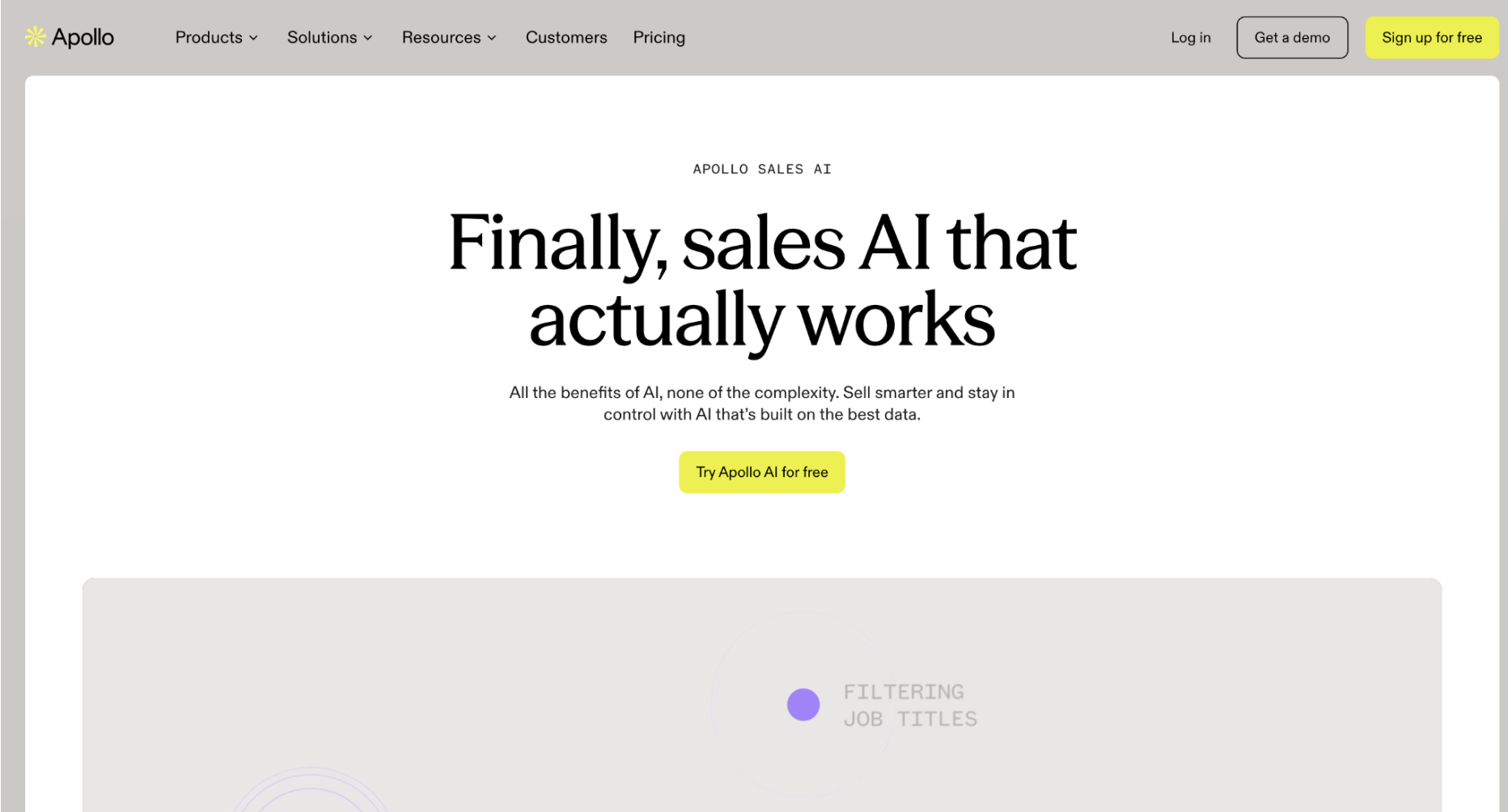
Apollo.ai: All-in-One B2B Prospecting & Database Tool
Website: https://www.apollo.io/fr
Best for: Startups and small B2B sales teams that need a large contact database and built-in outreach tools.
Overview: Apollo.io combines B2B contact data, company research, email sequences, calling, and CRM enrichment in one platform. It helps teams find prospects and start outreach without exporting data to another tool.
Key Features:
- Large B2B Database: Find contacts and companies using filters such as job title, industry, company size, and location.
- Email Sequences & Dialer: Create outreach campaigns and make calls in the same platform.
- AI Assistant & Copywriting: Generate email messages and outreach ideas for different buyer personas.
- AI Lead Scoring: Score and prioritize leads based on their potential value.
- Intent Signals: Track selected topics and activities that may show buying interest.
- Website Visitor Identification: Identify companies visiting your website.
- Integrations & MCP: Connect with CRM tools and AI platforms such as Claude.
Pros:
- Combines data, prospecting, email sequences, calling, and CRM enrichment.
- Teams can search for prospects and start campaigns without exporting data.
- Provides broad contact and company coverage.
- Allows users to test the platform before paying.
Cons:
- Some contact information may be outdated or incorrect, especially outside North America and at smaller companies.
- Its sequencer may not support the same volume as dedicated email-sending tools.
- Heavy data usage may require additional credits.
- Costs increase as more team members are added and the free version has fewer filters and sequence limits.
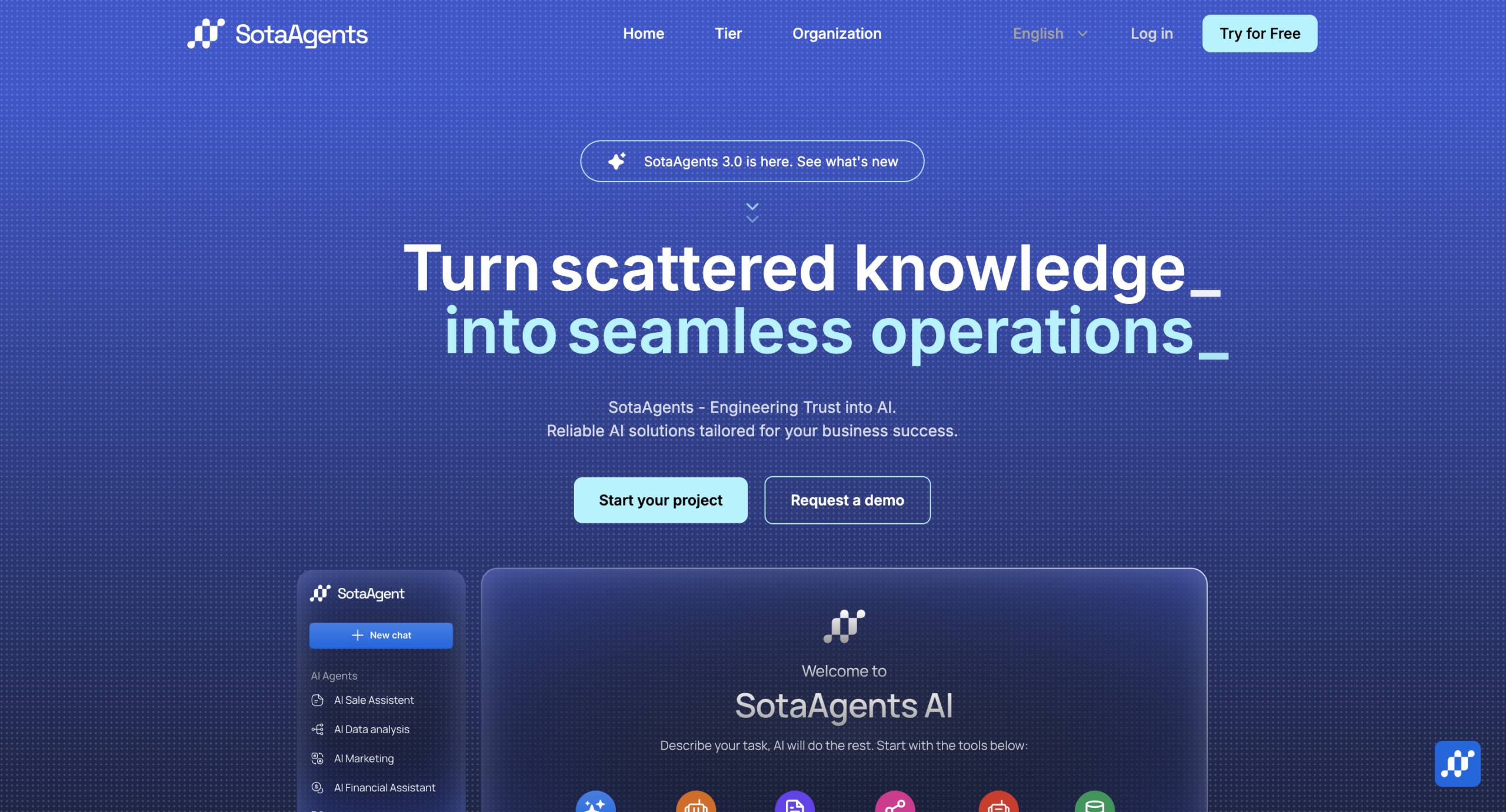
SotaAgents: Inbound Lead Qualification & Enterprise AI Workspace
Website: https://sotaagents.ai/
Best For: B2B Enterprises looking to automate 24/7 inbound lead qualification, multi-channel customer engagement, and internal sales knowledge retrieval.
Overview: While outbound tools focus on cold prospect lists, SotaAgents addresses the inbound side of B2B lead generation. It is an enterprise AI agent platform that converts raw corporate data (CRMs, ERPs, PDFs) into autonomous agents capable of qualifying inbound visitors, handling multi-channel sales inquiries, and syncing high-intent leads directly into sales workflows with zero delay.
Key Features:
- Omnichannel Lead Capture: Deploys conversational AI agents across Web, Zalo OA, Email, and WhatsApp to engage, qualify, and capture inbound B2B prospects 24/7.
- Graph RAG Sales Assistant: Connects directly to internal product docs and CRM data to answer complex technical inquiries from prospective buyers without hallucinating.
- Automated Document & Form Extraction: Extracts structured B2B lead data from uploaded invoices, RFQs, and forms, instantly routing qualified deals to reps.
- Enterprise Security & On-Premise Deployment: Offers full self-hosting and local data privacy options, making it safe for handling sensitive buyer interactions.
Pros:
- Excellent support for Vietnamese B2B channels like Zalo OA alongside global channels (WhatsApp, Email).
- Eliminates lead response delay by capturing and scoring prospects the moment they reach out.
- On-premise deployment ensures complete control over proprietary customer and product data.
Cons:
- Not built for cold outreach or outbound list building; relies on existing traffic and leads.
- Requires data flows, a knowledge base, and system integrations, making setup slower than plug-and-play tools.
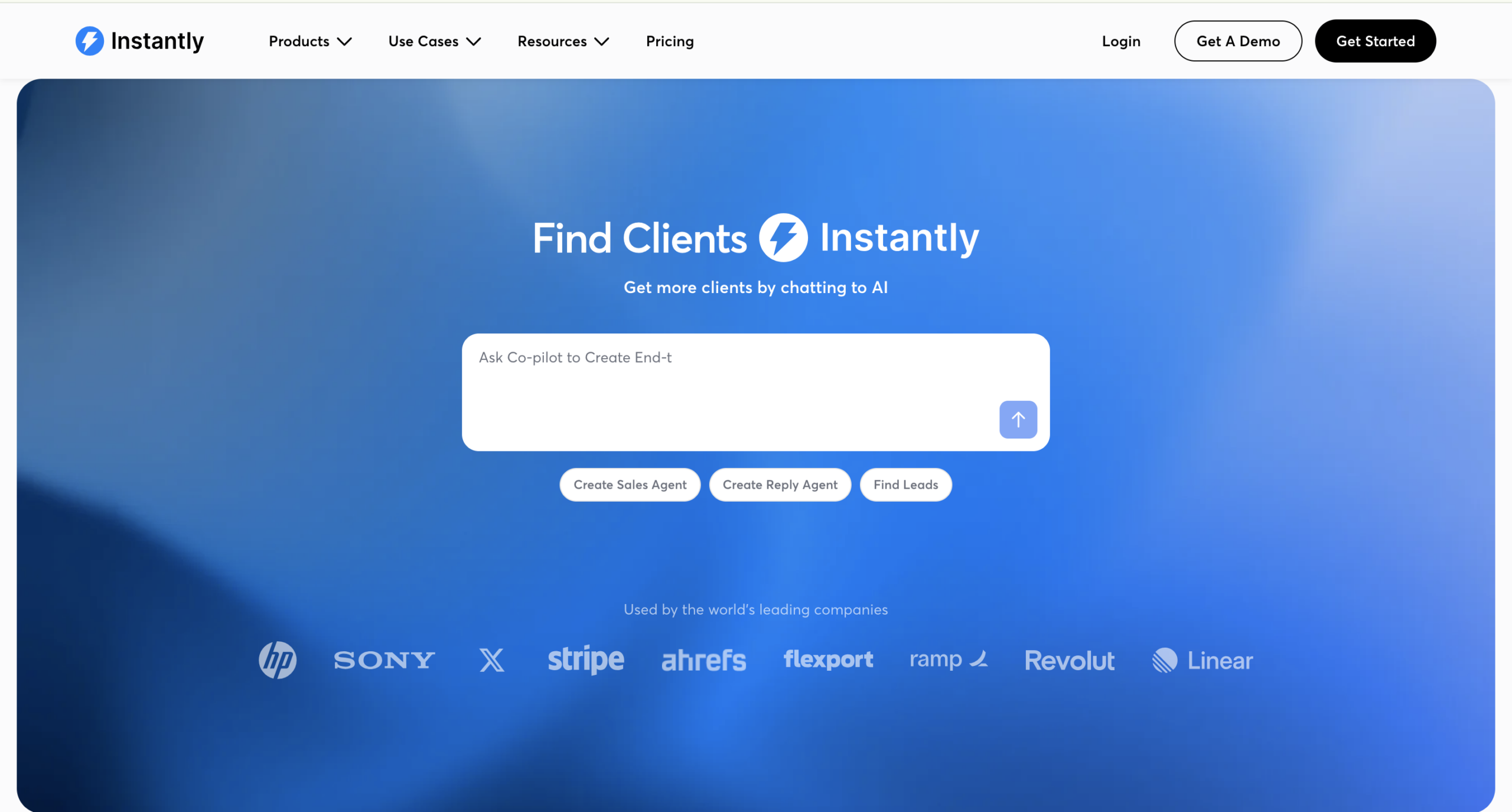
Instantly: Cold email infrastructure and deliverability tool
Website: https://instantly.ai/
Best For: B2B teams and agencies that need high-volume email sending, unlimited mailboxes, and built-in email warm-up.
Overview: Instantly is mainly an email-sending engine rather than a lead generation platform. It connects unlimited mailboxes, warms them automatically, and helps teams manage email campaigns from one place. Its contact database and CRM are available as separate subscriptions.
Key Features:
Unlimited Mailboxes: Connect as many mailboxes as needed without paying per mailbox.
- Free Unlimited Warm-Up: Automatically warm up connected mailboxes at no extra cost.
- Sender Rotation: Distribute daily sending volume across multiple accounts.
- Unibox: Manage replies from all connected mailboxes in one inbox.
- MCP Server & CLI: Use the V2 API with AI tools such as Claude or Cursor to manage campaigns.
Pros:
- Connect multiple mailboxes in bulk without additional DNS work.
- Instantly has the highest G2 rating among the tools compared in this article, based on more than 4,000 reviews.
- Useful for teams running multiple email campaigns across different sending accounts.
Cons:
- Email sending, contact data, and CRM are billed separately, increasing the total cost of a complete setup.
- Sequences do not include LinkedIn steps or LinkedIn replies in the Unibox.
- Instantly’s contact database is a separate product, so the platform is primarily focused on sending and managing outreach.
6sense: Predictive Intent & Account-Based Marketing Tool
Webiste: https://6sense.com/
Best for: Enterprise B2B companies with long sales cycles, defined target accounts, and an existing Account-Based Marketing (ABM) strategy.
Overview: 6sense is a predictive intent platform that helps businesses identify which accounts are already researching their products or services. Instead of simply finding more contacts, it predicts which accounts are in-market and where they are in the buying journey. This allows sales and marketing teams to prioritize outreach and advertising based on account intent.
Key Features:
Predictive Account Scoring: Identify accounts that are likely to be in-market, not just accounts that have already shown interest.
- Buying-Stage Visibility: Understand where each account is in its buying journey.
- Sales & Marketing Orchestration: Align advertising spend and sales outreach around the same high-intent accounts.
- Salesforce Integration: View account insights directly inside Salesforce without switching between platforms.
- AI Email Agents: Trigger automated outreach based on account behavior.
Pros:
- Helps teams identify potential buyers before they directly engage with the brand.
- Supports account prioritization when deals take several months to close.
- Connects advertising, account research, and outreach around shared target accounts.
- Allows sales representatives to access account insights within their existing CRM.
Cons:
- It is not always clear why an account received a particular intent score.
- The platform is mainly designed for companies that already have a structured account-based marketing program.
- It may provide limited value for founders or teams that only need a basic contact list and outbound workflow.
How to Choose the Right AI Lead Generation Tool to Fuel Your Sales Pipeline
Choosing the right AI lead generation tool starts with understanding your sales process, data quality, and automation needs. A clear evaluation helps you choose the right platform and build a stronger sales pipeline.
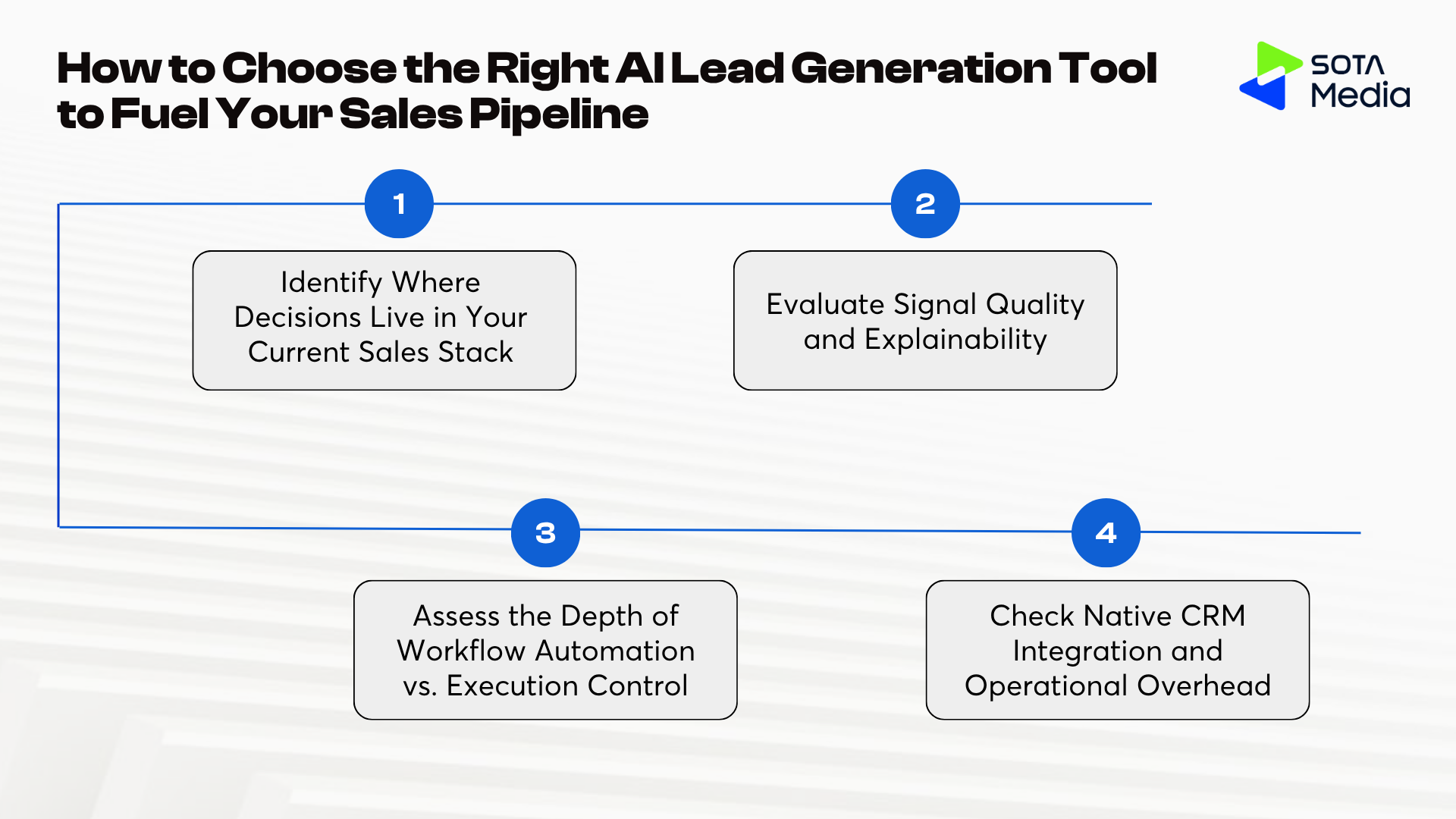
Identify Where Decisions Live in Your Current Sales Stack
Before adding a new platform, identify the biggest problem in your sales process. If your team struggles to find accurate contact information, choose a data enrichment tool. If reps spend too much time answering emails and booking demos, consider an AI SDR. If emails bounce or go to spam, focus on email deliverability.
Evaluate Signal Quality and Explainability
Choose platforms that show clear evidence behind each lead or account signal. Ask vendors to explain why a prospect was flagged, and avoid black-box scores without context. Transparent signals help reps personalize outreach and focus on relevant prospects.
Assess the Depth of Workflow Automation vs. Execution Control
Consider how much of the sales process you want AI to manage. Some platforms support a Human-in-the-Loop workflow, where AI provides recommendations and sales representatives review messages before taking action. Others offer Fully Autonomous Execution, handling outreach, basic objections, and meeting scheduling with limited human involvement. Choose the level of automation that matches your team’s processes, data quality, and need for control.
Check Native CRM Integration and Operational Overhead
A sales platform should work smoothly with your existing CRM instead of creating another data silo. Check whether it supports two-way synchronization, duplicate management, lead-to-account mapping, and do-not-contact (DNC) lists. Strong integration helps keep customer data consistent and prevents operational conflicts across sales and marketing teams.
Common Mistakes to Avoid in AI Lead Generation
Sending Too Many Generic Emails
AI makes it easy to send thousands of emails, but mass outreach can damage your domain reputation, trigger spam filters, and frustrate potential customers. Focus on relevant prospects and personalized messages instead.
Skipping Data Verification
Relying on one data provider can lead to inaccurate emails and phone numbers. Use multiple data sources to verify contact information before launching a campaign.
Trusting Unchecked AI Research
AI-generated prospect research may contain outdated or incorrect information. Always use verifiable data and check important details before mentioning a prospect’s role, company, or activity.
Ignoring Inbound Leads
Do not focus only on outbound prospecting while website leads remain unattended. Use AI lead agents to qualify, score, and schedule meetings with inbound leads quickly.
Conclusion
AI lead generation tools now go beyond automated emails, combining intent data, verified contact information, and autonomous SDR workflows. The key is to use AI for relevant, well-timed conversations, not mass spam, and choose the solution that addresses your team’s main bottleneck.
In this guide, we’ve covered how AI lead generation works, what to look for in an AI tool, and the common mistakes to avoid. If you’re looking to apply these strategies with less manual work, Sota Media can help. Contact Sota Media to explore AI automation solutions that streamline lead generation, nurture prospects, personalize customer journeys, and help turn qualified leads into meaningful business opportunities.
Frequently asked questions
No. They eliminate routine administrative tasks such as scraping directories, cross-referencing contact info, and initial scheduling. Human reps remain indispensable for navigating complex enterprise politics, building genuine rapport, tailoring custom solutions, and closing contracts.
Top-tier outbound setups decouple sending domains from your primary workspace, deploy multiple secondary inboxes, rotate sender addresses, automate warmups, and apply strict email hygiene (SPF, DKIM, DMARC) alongside human-like sending throttles.
Turnkey tools like Apollo or Instantly can be set up in a few hours. Tailored enterprise agent solutions like SotaAgents require 2 to 4 weeks to customize workflows, ingest product knowledge bases, and configure deep CRM mappings.