


Omnichannel Digital Marketing
Many B2B companies publish content regularly but still struggle to generate qualified leads. The issue is often not content volume, but the lack of a clear B2B content strategy that connects content to buyer needs and business goals.
In this post, SotaMedia will explain why many B2B content strategies fail to drive results, which content formats are performing best in 2026, and how to build a B2B content strategy that supports pipeline growth and revenue.
What is B2B content marketing?
B2B content marketing is creating content for business buyers, including CEOs, procurement teams, and other stakeholders involved in purchasing decisions. Instead of pushing products or services, B2B content helps potential customers understand problems, evaluate solutions, and make informed decisions. Some of B2B content for
Companies use formats such as blog posts, case studies, white papers, webinars, and industry reports to educate buyers and build trust throughout the buying process.
Why Does B2B Content Require a Different Strategy?
Most marketers are familiar with B2C content. However, business buyers evaluate products differently from individual consumers. They involve multiple stakeholders, longer evaluation periods, and higher financial risk.
As a result, strategies that work in B2C marketing do not always work in B2B. The differences below explain why B2B companies need a dedicated content strategy.
|
Criteria |
B2B Content Marketing |
B2C Content Marketing |
|
Target Audience |
Business decision-makers |
Individual consumers |
|
Sales Cycle |
Longer sales cycles |
Shorter buying cycles |
|
Buying Process |
Multiple stakeholders involved |
Usually one buyer |
|
Content Depth |
Longer-form content with industry expertise, data, research, and detailed analysis |
Shorter, easier-to-consume content focused on engagement and quick decision-making |
|
Content Formats |
Case studies, white papers, webinars, industry reports, buying guides |
Short-form videos, influencer content, product reviews, UGC, lifestyle content |
Why can’t your B2B content strategy generate leads?
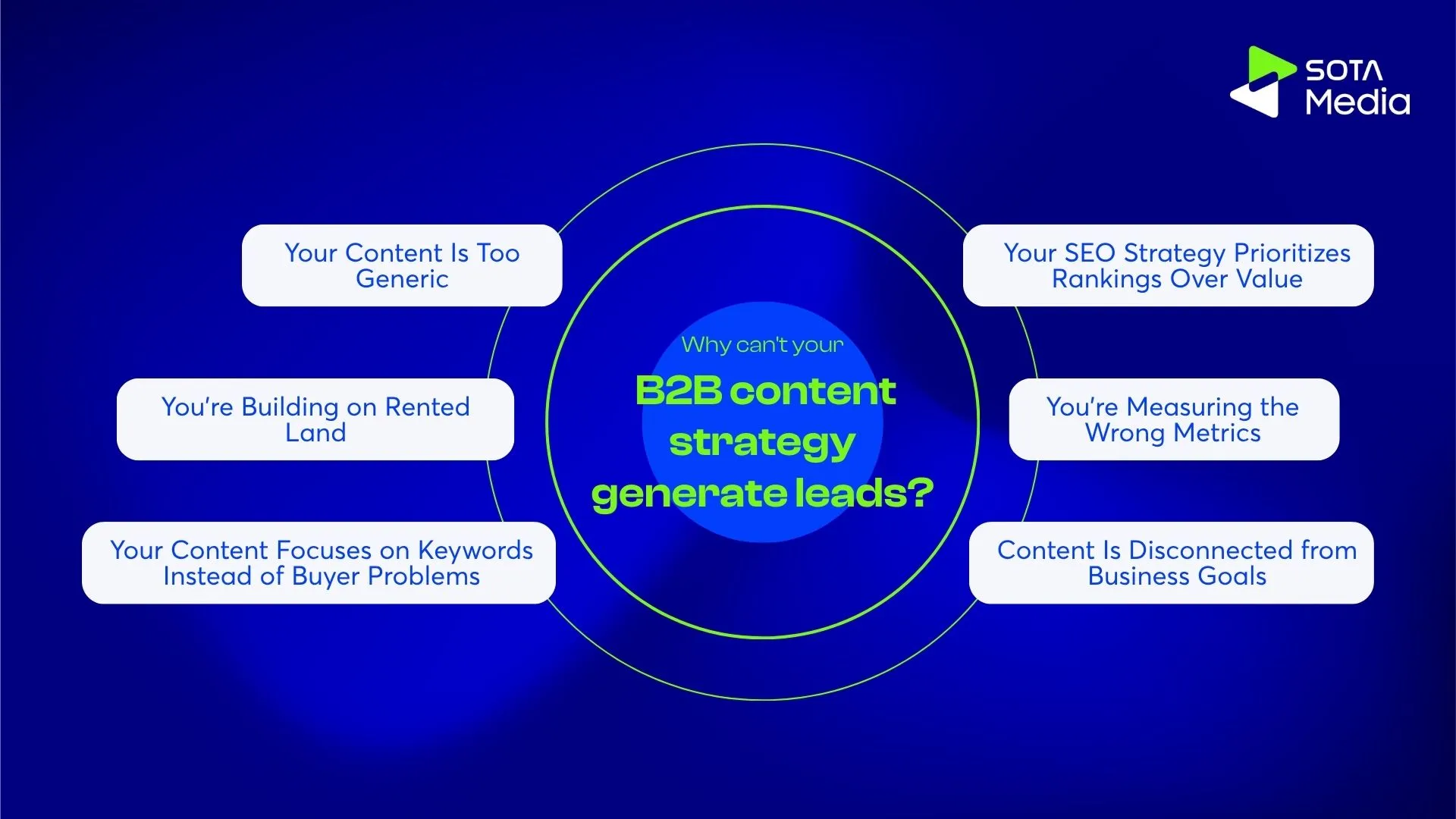
Reasons why your content can not generate leads
Your Content Is Too Generic
Many companies create content for a broad audience to attract more traffic. However, this makes your content look similar to other content. As a result, buyers have little reason to remember your brand or return to your website. Effective B2B content focuses on a specific audience, industry challenge, or use case and is supported by real experience, customer insights, or expertise that cannot be easily copied.
Your Content Focuses on Keywords Instead of Buyer Problems
Ranking for keywords does not automatically generate leads. Buyers are looking for solutions to real business problems, not just information. Instead of starting with “What keyword should we rank for?” start with “What problem is our buyer trying to solve?” The second approach can drive both engagement and conversions.
Your SEO Strategy Prioritizes Rankings Over Value
Traditional SEO focuses heavily on search volume and rankings. However, modern buyers increasingly use AI-powered search tools and expect comprehensive, trustworthy answers. The goal should not be to publish more content but to become the most helpful source on a topic.
You’re building on rented land.
Instead of relying heavily on social platforms like LinkedIn, Facebook, etc. to distribute content. While these channels are valuable, the audience ultimately belongs to the platform. A sustainable content strategy also invests in owned channels such as your website, blog, email newsletter, and resource center.
You’re Measuring the Wrong Metrics
Traffic, impressions, and social engagement can indicate visibility, but they do not necessarily reflect business impact. The most successful B2B companies evaluate content based on qualified leads, pipeline contribution, revenue influence, and ROI rather than vanity metrics alone.
Content Is Disconnected from Business Goals
The biggest reason B2B content fails to generate leads is that it operates separately from sales and revenue objectives. Content should support demand generation, pipeline growth, and customer acquisition. When content is aligned with business outcomes, it becomes a growth engine rather than just a publishing activity.
How to Create B2B Content That Drives Business Growth
Creating more content doesn’t necessarily generate more leads. The most effective B2B content strategies focus on helping buyers make decisions, building trust, and creating differentiation in the market. Here are 5 principles that can drive better business results.
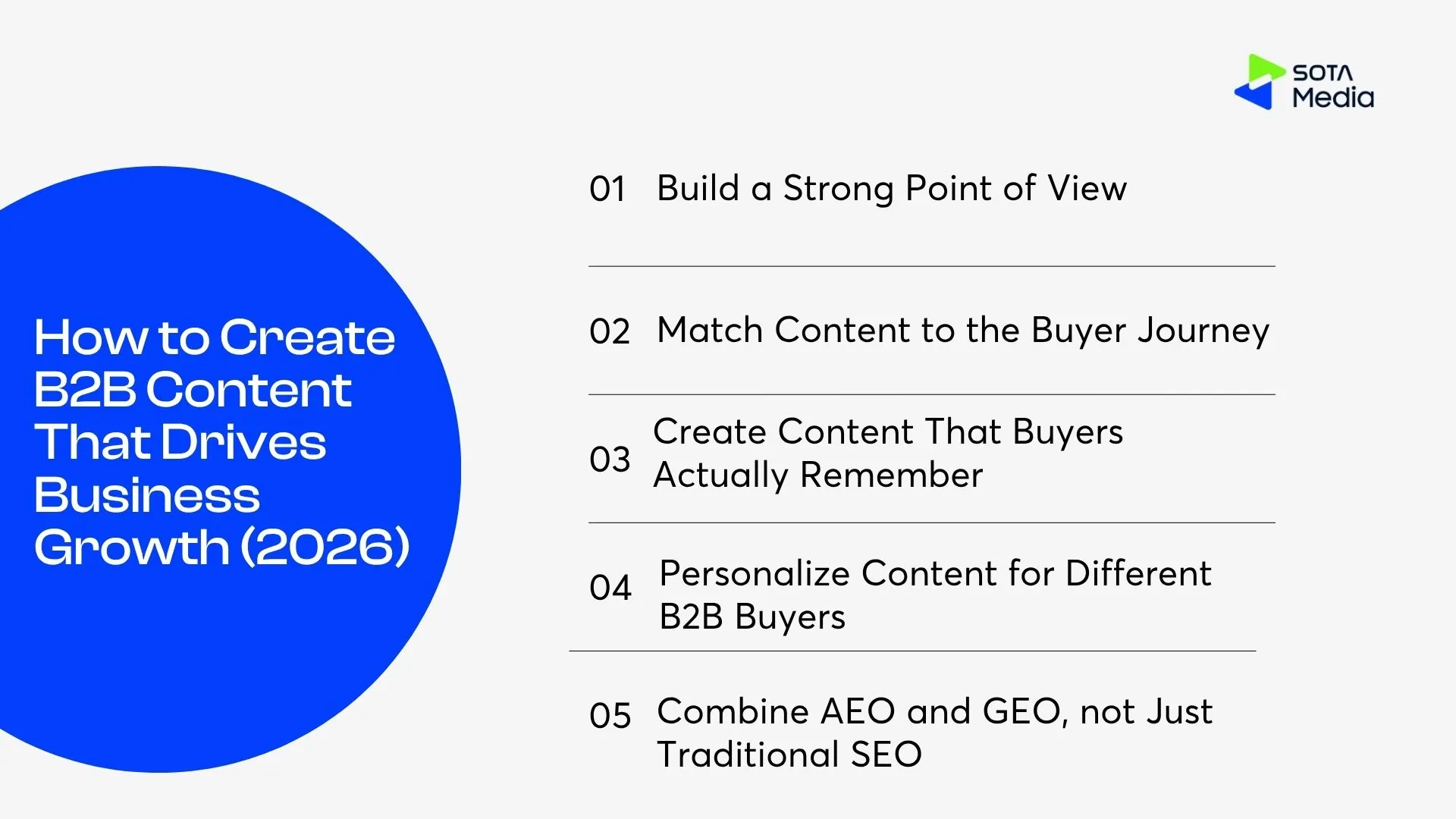
Tips to create effective B2B content in 2026
Build a Strong Point of View
A strong point of view gives your company a unique perspective on industry challenges and opportunities. Unlike messaging, which explains what your company does, a Point of View explains what your company believes. It helps differentiate your brand, build authority, and create more memorable content.
A simple framework is to answer three questions:
- What assumption do we challenge?
- What do we believe?
- Why does it matter now?
The strongest B2B brands are often known for their ideas, not just their products.
Match Content to the Buyer Journey
Different buyers need different information depending on where they are in the buying process. Publishing the wrong content at the wrong stage often results in low engagement and poor conversion rates.
|
Buyer Stage |
Recommended Content |
|
Awareness |
Educational blogs, thought leadership, industry trends |
|
Consideration |
Comparisons, frameworks, buying guides |
|
Decision |
Case studies, ROI calculators, implementation guides, FAQs |
|
Customer |
Onboarding, knowledge base, webinars, retention content |
For example, a buyer in the awareness stage is looking to understand a problem, while a buyer in the decision stage wants proof that your solution works. Aligning content with the buyer journey ensures prospects receive the right information at the right time.
Create Content That Buyers Actually Remember
Most B2B content is educational, but education alone is rarely enough. Buyers are exposed to hundreds of articles, reports, and LinkedIn posts every week. To stand out, your content needs to be memorable.
Focus on stories, ideas, and insights rather than simply sharing information. Address real customer problems instead of promoting products, and support your recommendations with data, research, and case studies rather than opinions.
Most importantly, every piece of content should reinforce your point of view. When buyers repeatedly encounter the same ideas and perspectives across your content, they begin to associate those beliefs with your brand. Over time, this builds trust, authority, and preference long before a sales conversation begins.
Personalize Content for Different B2B Buyers
Different stakeholders care about different information. A CEO may focus on revenue growth and business impact, while an IT leader is more concerned with security, integration, and implementation.
Therefore, you should create specific content for different decision-makers. You can adapt your messaging, examples, and value propositions based on the priorities of each role. For example, executives may respond better to ROI-focused content, while operational teams may need practical implementation guidance.
Besides, you can create personalized landing pages, industry-specific case studies, and ABM or ABX campaigns. This can help marketing and sales engage the right people with the right message at the right stage of the buying journey.
Combine AEO and GEO, not Just Traditional SEO
More B2B buyers now use ChatGPT, Google AI Overviews, etc. to research solutions before visiting a website. 71% of B2B software buyers now use AI chatbots during the research process, and 51% start their research with an AI chatbot more often than Google (G2’s 2026 AI Search Insight Report)
Therefore, B2B marketers should combine GEO and AEO to increase the chances of their content being cited and recommended in AI-generated answers.
To increase the likelihood of being cited in AI-generated answers, content should demonstrate strong E-E-A-T by combining real-world experience, industry expertise, credible sources, and trustworthy information. AI systems are more likely to reference content that provides clear answers and original insights rather than generic advice.
However, B2B marketers still need to focus on SEO to ensure your company’s credibility. Because B2B buying decisions often involve multiple stakeholders and longer evaluation cycles. Buyers may discover your company through AI search, but they still visit your website to evaluate expertise, review case studies, and compare solutions before making a decision.
In general, GEO/AEO helps increase your brand appearance and rank, while SEO helps buyers validate your expertise and decide whether your company is the right fit for their needs.
The Most Effective B2B Content Formats in 2026
NetLine’s latest B2B Content Consumption & Demand Report shows 5 effective B2B content formats in 2026.
|
Content Format |
Why It Matters |
Best Use Case |
|
eBooks |
Account for 53% of total content demand, making them the most consumed B2B content format. Ideal for attracting top-of-funnel audiences and generating leads. |
Awareness & Lead Generation |
|
White Papers |
Associated with significantly higher purchase intent and are commonly consumed by buyers actively evaluating solutions. |
Consideration & Vendor Evaluation |
|
Playbooks |
Generate the highest purchase intent, with registrations 115% more likely to be associated with a buying decision within 12 months. |
Demand Generation & Pipeline Creation |
|
Webinars |
Continue to be one of the strongest engagement formats, helping brands educate prospects and capture buying signals throughout the buyer journey. Webinar registrations have shown strong intent signals in NetLine research. |
Lead Nurturing & Product Education |
How Can I Create a Successful B2B Content Strategy?
A successful B2B content strategy starts with business objectives, not content ideas. Before creating content, you need to understand what outcomes you want to achieve, who you’re targeting, and which formats best support your buyers throughout their journey.
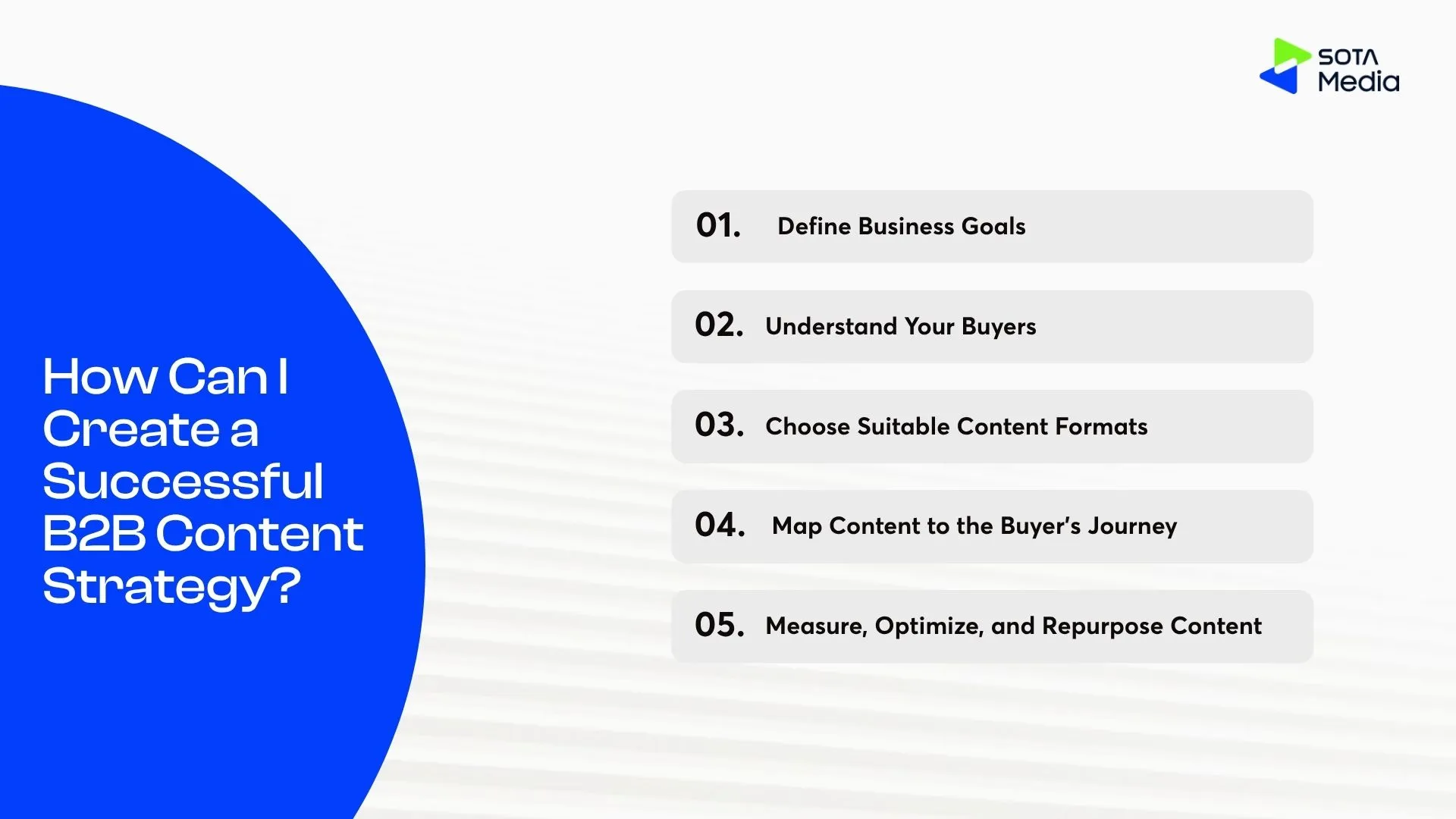
Five steps to create a successful B2B content strategy in 2026
Step 1: Define Business Goals
Your content strategy should be aligned with business objectives. Different goals require different content, messaging, and measurement frameworks.
Common B2B content marketing goals include:
- Brand awareness: Increase visibility and reach among target audiences.
- Pipeline generation: Attract and nurture qualified prospects.
- Revenue growth: Support sales conversations and improve conversion rates.
- Customer retention: Educate existing customers and strengthen long-term relationships.
Clear goals help determine what content to create and how success should be measured.
Step 2: Understand Your Buyers
Many companies only look at demographics, but effective B2B content requires a much deeper understanding of buyers and their decision-making process.
Your research should include:
- Ideal Customer Profile (ICP): The type of company most likely to benefit from your solution.
- Buyer Persona: The individuals involved in the purchasing decision.
- Jobs To Be Done (JTBD): The outcomes buyers are trying to achieve.
- Buying Triggers: Events or challenges that create demand for a solution.
- Objections: Common concerns that delay or prevent purchases.
- Preferred Channels: Where buyers consume information and engage with content.
The better you understand your audience, the easier it becomes to create content that drives engagement and conversions.
Step 3: Choose Suitable Content Formats
Each content format helps buyers solve a different problem. Instead of publishing every format available, focus on the formats that support your business goals and fit how your audience researches solutions.
|
Content Format |
Best Used For |
When to Use |
|
Blog Posts |
Buyer education, SEO, organic acquisition |
When answering customer questions or targeting specific search intent |
|
Case Studies |
Trust building and proof |
When buyers need evidence before evaluating vendors |
|
White Papers |
Research and industry analysis |
When discussing complex topics or collecting high-intent leads |
|
Videos |
Product education and demonstrations |
When showing workflows, tutorials, or customer use cases |
|
Podcasts |
Audience development and industry conversations |
When targeting professionals who prefer audio content |
|
Webinars |
Buyer education and lead generation |
When explaining a product, framework, or industry topic in depth |
|
Email Newsletters |
Lead nurturing and customer communication |
When maintaining regular contact with prospects and customers |
|
LinkedIn Content |
Professional visibility and audience engagement |
When sharing insights, company research, or industry observations |
|
Infographics |
Data visualization and process explanation |
When presenting research findings, frameworks, or workflows |
Instead of choosing formats based on trends, select the channels and content types that align with how your buyers prefer to consume information and make purchasing decisions. A smaller number of well-executed formats often outperforms trying to be everywhere at once.
Step 4: Map Content to the Buyer’s Journey
Creating content without considering the buyer’s journey often leads to low engagement and poor conversion rates. Each stage requires different information, so your content should help buyers move naturally from awareness to purchase and beyond.
|
Buyer Journey Stage |
Content Types |
Primary Goal |
|
Awareness |
Educational articles, industry reports, thought leadership, infographics |
Help buyers understand a problem |
|
Consideration |
Comparison content, buying guides, webinars, white papers |
Help buyers evaluate available options |
|
Decision |
Case studies, product demos, ROI calculators, FAQs |
Reduce risk and support vendor selection |
|
Customer |
Onboarding resources, knowledge base content, newsletters, customer webinars |
Increase retention and product adoption |
Step 5: Measure, Optimize, and Repurpose Content
Publishing content is only the first step. To maximize ROI, regularly measure performance, improve high-performing assets, and repurpose successful content into multiple formats such as videos, social posts, webinars, newsletters, or infographics.
Track the Right KPIs
Different goals require different metrics. Focus on KPIs that align with business outcomes rather than relying solely on vanity metrics.
|
Goal |
Metrics |
|
Awareness |
Organic traffic, impressions, search visibility, branded search volume |
|
Engagement |
Time on page, scroll depth, newsletter engagement, social interactions |
|
Lead Generation |
MQLs, SQLs, demo requests, content downloads |
|
Revenue |
Pipeline-influenced, revenue-influenced, CAC, ROI |
|
Retention |
Product adoption, customer engagement, renewal rate, expansion revenue |
Don’t just create new content continuously. You should review existing assets, identify what’s performing well, update outdated information, and repurpose proven content across multiple channels. Sometimes, optimizing existing content can deliver a higher return than creating something new from scratch.
Conclusion
A successful B2B content strategy helps buyers make decisions, supports sales conversations, and connects content performance to business outcomes. Companies that understand their buyers, create content for each stage of the journey, and measure success beyond traffic are more likely to generate a qualified pipeline from content.
We hope this post gives you a practical framework for building a B2B content strategy that drives measurable growth. If you want to accelerate the process, contact SotaMedia to turn content into a predictable source of leads and pipeline.
Frequently asked questions
Better qualification. More content often creates more leads, but not necessarily more opportunities. Teams usually see a bigger pipeline impact when they improve segmentation, qualify buyers before sales calls, and attract the right prospects instead of a larger audience.
A strong B2B content strategy starts with clear business goals, a deep understanding of buyers, and a clear point of view. It should align content with the buyer journey, focus on real customer problems, and measure success through pipeline and revenue, not just traffic.
The strongest results are coming from highly targeted account-based marketing (ABM), not mass outreach. Teams are spending more time understanding a specific account before making contact, then using that insight to create content and conversations that feel relevant to the buyer's situation.
B2B purchases involve larger budgets, longer evaluation cycles, and multiple stakeholders. Content often needs several touchpoints before a buyer is ready to engage. Results compound over time as content builds authority, trust, and visibility across a topic.
In many cases, yes. Publishing more content can feel productive, but volume alone rarely drives pipeline. Assets tied to buyer intent, such as comparison pages, calculators, assessments, and data-backed case studies, often generate more qualified opportunities than dozens of generic articles.
Measure content against business outcomes, not vanity metrics. Key indicators include qualified leads, pipeline influenced, revenue influenced, customer acquisition cost (CAC), and return on investment (ROI). Traffic matters only if it contributes to these outcomes.
No. GEO is more influential in industries with short buying cycles, where buyers need quick answers. In B2B, although GEO can help brands appear during the research stage, SEO makes your company more credible. Because B2B buyers still need to visit your website to evaluate expertise, review case studies, and verify whether your company is the right fit for their needs.