




Branding and Strategy
The rise of AI-powered vibe coding has made it faster than ever to build and launch new software products. As competition grows, many technology companies work with B2B tech agencies to support product positioning, demand generation, and technical marketing.
This guide explains what a B2B tech agency does, the trends shaping the industry in 2026, the services worth investing in, and the key criteria and red flags to consider when choosing the right partner.
Key takeaways
- Specialization wins. The B2B tech agency market in 2026 rewards specialization. Agencies fluent in AI-assisted content and account-based marketing (ABM) consistently outperform generalist shops.
- Committees, not individuals. On average, 13 internal stakeholders and nine external participants influence a B2B purchase decision, so a B2B tech agency needs a plan for reaching a whole committee, not just top-of-funnel traffic.
- Proof beats logos. A short list of case studies with attributable numbers tells you more than a long client logo wall.
- GEO is table stakes. GEO is now a base service, not an add-on, since a growing share of B2B research happens inside AI chat tools before a buyer visits your site.
- Guarantees are a warning sign. A guaranteed result with no measurement plan behind it is the clearest sign to walk away.
- The engagement model is a fit question. Retainer vs. project-based is a fit question, not a right-or-wrong one, tied to how continuous your content and demand needs are.
What Is a B2B Tech Agency?
Definition of a B2B Tech Agency
A B2B tech agency is a marketing or growth partner that works specifically with technology and software companies selling to other businesses, rather than to individual consumers.
Unlike a generalist marketing agency, it builds its process around the mechanics of B2B sales: long cycles, multiple decision-makers, technical buyers, and a need to prove ROI in board-level terms. Its core output covers content, demand generation, and increasingly, visibility inside AI search and answer engines.
The Agency’s Role in a Tech Company’s Growth Journey
The role shifts as a company grows. Early on, the priority is positioning and enough content to rank and get cited. Once growth kicks in, the focus moves to demand generation and ABM aimed at named accounts. At scale, the work adds brand, analyst relations, and category-defining thought leadership. A B2B tech agency worth keeping around adjusts its scope as the company moves through these stages, instead of running the same playbook regardless of where the client stands.
Top Trends Shaping B2B Tech Agencies in 2026
AI in B2B Content Marketing
Generative AI has moved from experiment to default workflow. Of nearly 4,500 marketers, 75% say they have adopted AI, and 85% say AI is already reshaping their SEO strategy.
For a B2B tech agency, this changes the job description. Drafting is largely automated. The value has shifted to strategy, technical accuracy, and the editorial judgment that keeps content from reading like every other AI-generated post in the same category.
The Rise of GEO in Enterprise Marketing
Enterprise buyers now complete most of their research before they ever raise a hand. Between 70% and 80% of the B2B buyer journey happens before a prospect contacts sales.
A growing share of that research now happens inside ChatGPT, Gemini, and Perplexity instead of a traditional search bar. GEO, structuring content so it gets cited by these tools, has moved from a niche tactic to a required line item in any B2B content marketing plan.
Personalization by Account (ABM 2.0)
Account-based marketing has always been about relevance over reach. What changed are the ability to personalize at scale and the payoff for engaging a full buying committee instead of a single champion. Deals with three or more actively engaged stakeholders close 2.4 times faster than single-threaded deals.
Agencies that build ABM 2.0 correctly combine intent data, account-level content, and multithreaded outreach across the committee rather than betting the deal on one contact.
Why Do B2B Tech Companies Need a B2B Tech Agency?
Specialized Marketing Becomes More Valuable
When software products can be built and launched in days instead of months, more competitors enter the market in less time. This makes product features become easier to replicate; companies increasingly compete on how well they communicate value to technical buyers. This is where B2B tech agencies can add value through positioning, technical content, and demand generation.
Long Sales Cycles and Multiple Decision-Makers
According to Gartner, B2B buying committees now average 6 to 10 stakeholders, up from 4 to 6 in 2017, and 77% of buyers describe their most recent purchase as very complex or difficult.
Reaching and aligning that many people requires a coordinated content and demand plan across roles, something a generalist agency built for single-decision-maker B2C purchases is rarely set up to do.
Deep Technical and Industry Expertise Required
B2B tech buyers, especially technical ones, can tell within a paragraph whether a writer understands the product category. A B2B tech agency that has to be taught the basics of your industry on every call slows the work down and produces content that reads generic.
Which Services to Look for in a B2B Tech Agency?
B2B Content Marketing
This is the foundation: content that establishes expertise and gives the buying committee something to circulate internally. Whitepapers and case studies and thought leadership content carry much of the mid-funnel, where a technical buyer is building the internal case for a purchase.
Demand Generation and Account-Based Marketing (ABM)
Demand generation fills the pipeline; ABM concentrates that effort on a defined list of high-value accounts. A B2B tech agency should be able to run both and know when to shift budget between them based on account size and sales cycle stage.
SEO/GEO for the Technology Sector
Technical SEO and GEO for a SaaS company differ from a typical e-commerce or local business setup. Product pages, documentation, comparison content, and integration pages all need their own approach and increasingly need to be structured for citation by AI answer engines, not just ranked in a search results page.
Paid Media and Performance Marketing for SaaS
Paid channels compress timelines, particularly for supporting a launch or filling a pipeline gap ahead of a funding milestone. The B2B tech agency should understand SaaS-specific metrics like CAC payback and pipeline-influenced revenue, not just cost per click.
Sales and Marketing Alignment (RevOps Support)
Marketing that never talks to sales tends to optimize for the wrong signals. Agencies that support RevOps, shared definitions of a qualified lead, consistent CRM data, and joint reporting keep both teams pointed at the same pipeline number.
Criteria for Choosing the Right B2B Tech Agency
Hands-On Experience in SaaS or Tech
Ask for the specific accounts they have run in your category, not just the industries listed on their homepage. A B2B tech agency that has shipped campaigns for a similar product understands your buyer’s objections without needing them explained.
Portfolio and Case Studies Backed by Real Results
A strong portfolio names the metric that moved, the timeframe, and the starting point. Vague language like “significant growth” without a number attached is a sign the result was not worth quantifying.
Understanding of Enterprise Marketing and the B2B Buying Process
The B2B tech agency should be able to describe, unprompted, how they would map and reach a buying committee for your specific deal size. If the answer stays at the level of “we create great content,” the understanding of the buying process is shallow.
A Team That Covers Content, Tech, Data, and Design
B2B tech marketing spans writing, technical SEO, analytics, and visual design. A B2B tech agency missing one of these functions usually outsources it inconsistently, which shows up in slower delivery and disconnected reporting.
The Technology and Tools the Agency Actually Uses
Ask which AI tools, analytics platforms, and CRM integrations they run day to day. A specific, current answer is a better signal than a slide listing every tool on the market.
Clear pricing and honest ROI conversations
You need to know what you are spending, why it is structured that way, and what outcomes and returns are realistic given the investment level and timeline. Agencies that avoid this conversation are either poorly organized or setting the wrong expectations.
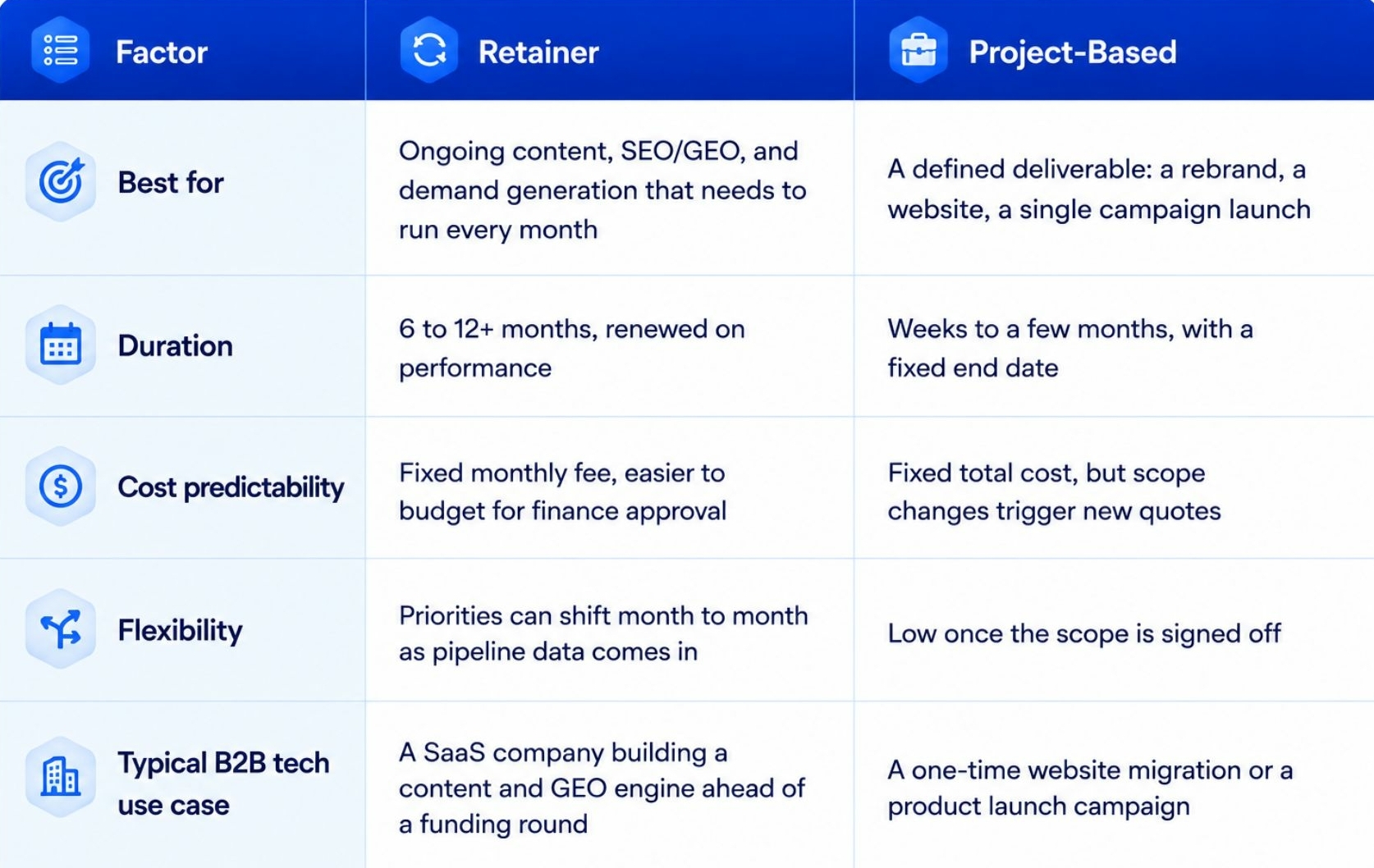
Engagement Model and Flexibility (Retainer vs. Project-Based)
The right model depends on how continuous your marketing needs are. The table below compares the two for a B2B tech company.
How Do You Choose the Right B2B Tech Agency?
Do They Have Proven Experience in Your Industry?
Request two or three client names in your exact category and ask what specifically they were hired to fix.
What Technology and AI Tools Do They Actually Use?
A B2B tech agency that can explain its AI stack, and where a human still reviews the output, is further along than one that avoids the question.
Can They Show Measurable Case Studies?
Look for a number, a timeframe, and a method for how that number was measured, not just a screenshot of a dashboard.
How Transparent Is Their Reporting Process?
Ask to see a sample report before signing. If it only shows vanity metrics like impressions, expect the same after the contract starts.
Do They Offer Scalable, Flexible Engagement Models?
The right B2B tech agency depends on your business goals, growth stage, and marketing priorities. Use the criteria in this guide to compare agencies based on their industry experience, technical expertise, and approach to measuring results.
SotaMedia is one B2B tech agency to consider. We focus on technical marketing, SEO/GEO, demand generation, and AI-supported execution, with reporting tied to business metrics rather than marketing outputs.
Red Flags to Avoid When Choosing a B2B Tech Agency
No Case Studies or Real Numbers
A B2B tech agency that cannot point to a specific, measured result is asking you to be its first proof point.
Limited Understanding of Your Product or Technology
If the team cannot explain your product back to you in their own words after a discovery call, the content they produce will read the same way.
Unrealistic Result Guarantees
No B2B tech agency controls the algorithm behind organic search, AI citations, or a buyer’s internal approval process. A guaranteed ranking, guaranteed lead count, or guaranteed citation rate is a sales tactic, not a forecast.
No Clear Measurement Strategy
If the proposal does not name which metrics it will track and how often, you will not know whether the engagement is working until the contract is nearly up for renewal.
Conclusion
The right B2B tech agency depends on your business model, growth stage, and marketing priorities. By understanding the services, trends, and evaluation criteria covered in this guide, you can make a more informed decision.
If your company needs a partner with experience in SaaS and B2B technology marketing, SotaMedia is the one worth evaluating alongside the other options available. Talk to SotaMedia about what you are trying to grow, and we will give you a straight answer on whether we are the right fit.
Frequently asked questions
A B2B tech agency specializes in technical products, longer sales cycles, and multiple decision-makers. A generalist agency usually optimizes for B2C patterns like single-decision purchases and shorter cycles.
Retainers for a specialized B2B tech agency typically start in the low thousands per month and scale with scope. Project-based work is priced per deliverable and depends on complexity and timeline.
Yes, if the product is technical and the buying process involves more than one decision-maker. Early-stage companies often start with a narrower scope, such as content and SEO/GEO, before adding demand generation.
Most B2B tech companies see early traffic and citation gains within the first quarter, with pipeline impact following as content matures and ranks or gets cited more consistently.
Many do, though the scope shifts toward account-based marketing, longer content cycles, and closer alignment with sales given the larger buying committees at enterprise accounts.
Track pipeline-influenced revenue, qualified leads, and citation or ranking visibility, not just traffic or impressions. Ask the agency to report on these from month one.
Yes. Technical buyers can tell quickly when content is written without real product understanding, and shallow content rarely earns trust from a technical audience.
Choose a retainer for ongoing content, SEO, and GEO needs. Choose project-based for a defined deliverable like a website rebuild or a single campaign launch.