


Omnichannel Digital Marketing
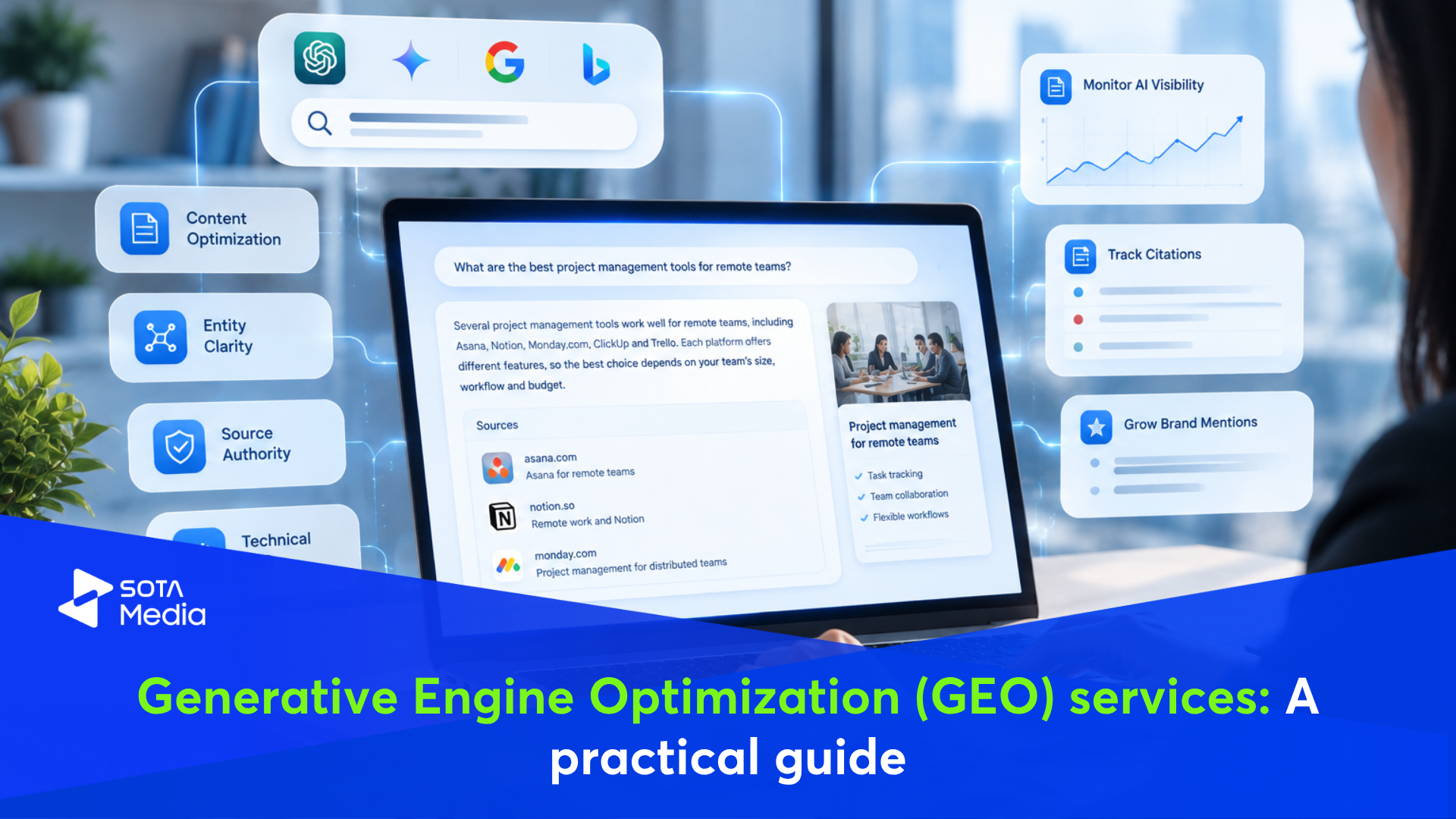
Generative engine optimization (GEO) services help businesses improve how their brand, products, services, and expertise are understood, selected, summarized, and cited in AI-generated search answers. The problem is not simply ranking for another keyword. A company can perform well in traditional search and still be missing from AI answers, cited less often than competitors, or described inaccurately. GEO addresses that gap through content, entity clarity, reliable evidence, technical accessibility, and repeatable visibility measurement.
Key takeaways
- GEO improves how a brand is understood and represented in AI-generated search answers.
- A useful GEO program combines content optimization, entity clarity, evidence, technical accessibility, and visibility tracking.
- SEO, AEO, and GEO overlap, but they focus on different search outcomes and should work together.
- Strong GEO content answers customer questions directly and supports important claims with verifiable information.
- No provider can guarantee that an AI system will mention or cite a brand for every query.
- Performance should be measured through mentions, citations, cited pages, accuracy, topic coverage, and business outcomes.
What are generative engine optimization services?
Generative engine optimization services are professional services that improve how a brand’s information is understood, selected, summarized, and cited by generative search systems. The work focuses on the content, sources, technical setup, and brand signals that help an AI system identify useful and reliable information.
The challenge differs from traditional keyword ranking because generative systems can synthesize information from several sources. The GEO research published through Princeton University describes generative engines as systems that gather and synthesize information from multiple sources.
A GEO project therefore checks whether the business is clearly associated with its services, products, experts, audience, and expertise across the wider information environment. If the same service is described differently across the website, business profiles, and external publications, GEO can identify those inconsistencies and improve the connection between the brand and the topics it wants to be known for.
The goal is not to control an AI answer. A business cannot force a model to mention or cite it. The practical goal is to make important information clear, useful, consistent, accessible, and supported by evidence.
For a market-level view, SotaMedia’s guide to GEO agencies in Vietnam provides additional context on the service category.
How are GEO services different from SEO and AEO services?
| Service | Main objective | Typical work | Common performance signals |
|---|---|---|---|
| SEO services | Improve organic discoverability and website traffic. | Technical SEO, keyword research, page optimization, internal linking, and authority development. | Indexing, rankings, impressions, clicks, organic sessions, and conversions |
| AEO services | Help content answer specific questions clearly. | Direct definitions, question-led sections, concise summaries, structured information, and useful FAQs. | Answer coverage, featured results, engagement, and task completion |
| GEO services | Improve visibility and accuracy inside generative answers. | Prompt research, entity review, source strengthening, citation-ready content, technical checks, and AI visibility tracking. | Brand mentions, citations, cited URLs, description accuracy, topic coverage, and AI referrals. |
These strategies are connected rather than interchangeable. Google’s guidance on AI features and your website states that existing SEO fundamentals remain relevant for AI Overviews and AI Mode, including crawlability, internal links, textual content, and structured data that matches visible content.
GEO is therefore better treated as part of a broader search strategy rather than a replacement for SEO. See also SotaMedia’s SEO vs GEO comparison for a practical look at the difference in outcomes.
How do generative engine optimization services work?
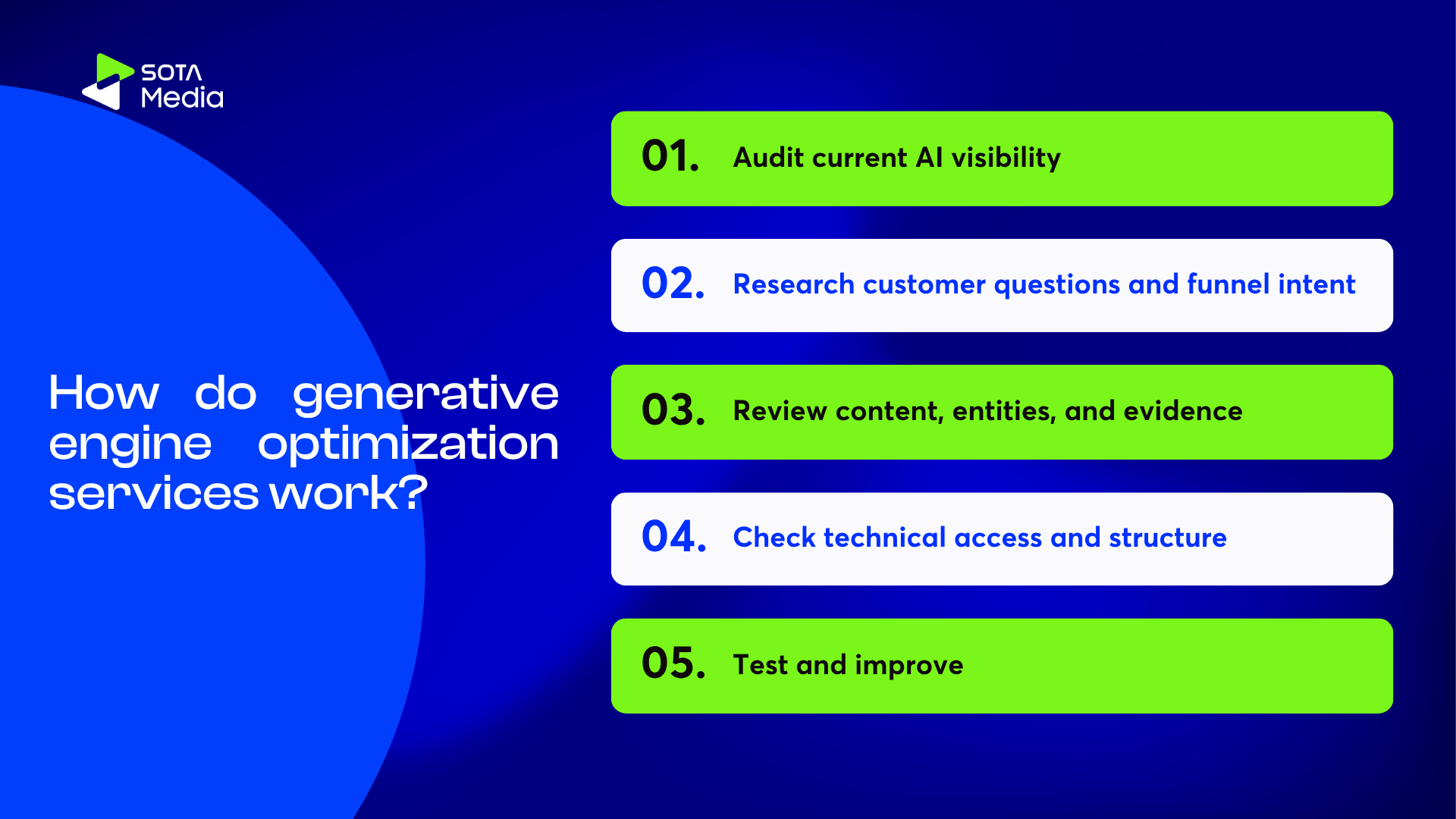
A GEO project starts by identifying how the brand currently appears in AI-generated answers. The team then studies the questions people ask, reviews the available content, and improves the signals that help generative systems understand and verify the business.
How do generative engine optimization services work?
Audit current AI visibility
Test a defined set of questions across the AI search systems relevant to the business. Record which brands appear, which websites are cited, which pages support the answer, and how the business is described. Mentions and direct citations should be recorded separately, with the platform, prompt, date, and relevant conditions documented for later comparison.
Research customer questions and funnel intent
Prompt research should reflect real customer needs: definitions, problems, use cases, costs, risks, comparisons, and provider selection. These questions should also be mapped to the funnel. A person asking what GEO is needs a different page from someone comparing GEO providers.
That distinction matters because content should solve the user’s next problem. If the searcher is already evaluating vendors, another generic explainer is unlikely to help. The content should move toward capabilities, evidence, comparison criteria, risks, and the decision itself.
Review content, entities, and evidence
Check whether the brand, services, products, experts, audience, and expertise are described consistently. Important claims should have evidence behind them, such as original research, company data, case results, expert commentary, industry reports, or reliable external sources.
The objective is not to copy sites already appearing in AI answers. It is to understand what information makes those sources useful and create something clearer, more specific, or better supported. For teams scaling content operations, SotaMedia’s content automation guide provides related workflow context.
Check technical access and structure
Technical GEO work can include crawl permissions, indexing, rendering, internal links, metadata, canonical tags, structured data, author information, and page organization. Google’s link guidance explains why crawlable links and descriptive anchor text help both users and search systems understand site structure.
Technical changes should have a clear purpose. Google’s structured data guidelines emphasize that markup should represent visible content and does not guarantee a search appearance.
Test and improve
After changes are published, test the original prompt set again under comparable conditions. Compare mentions, citations, cited pages, competitor presence, and brand accuracy against the baseline. Because generated answers change over time, GEO is an ongoing process rather than a one-time optimization.
What deliverables should you expect from GEO services?
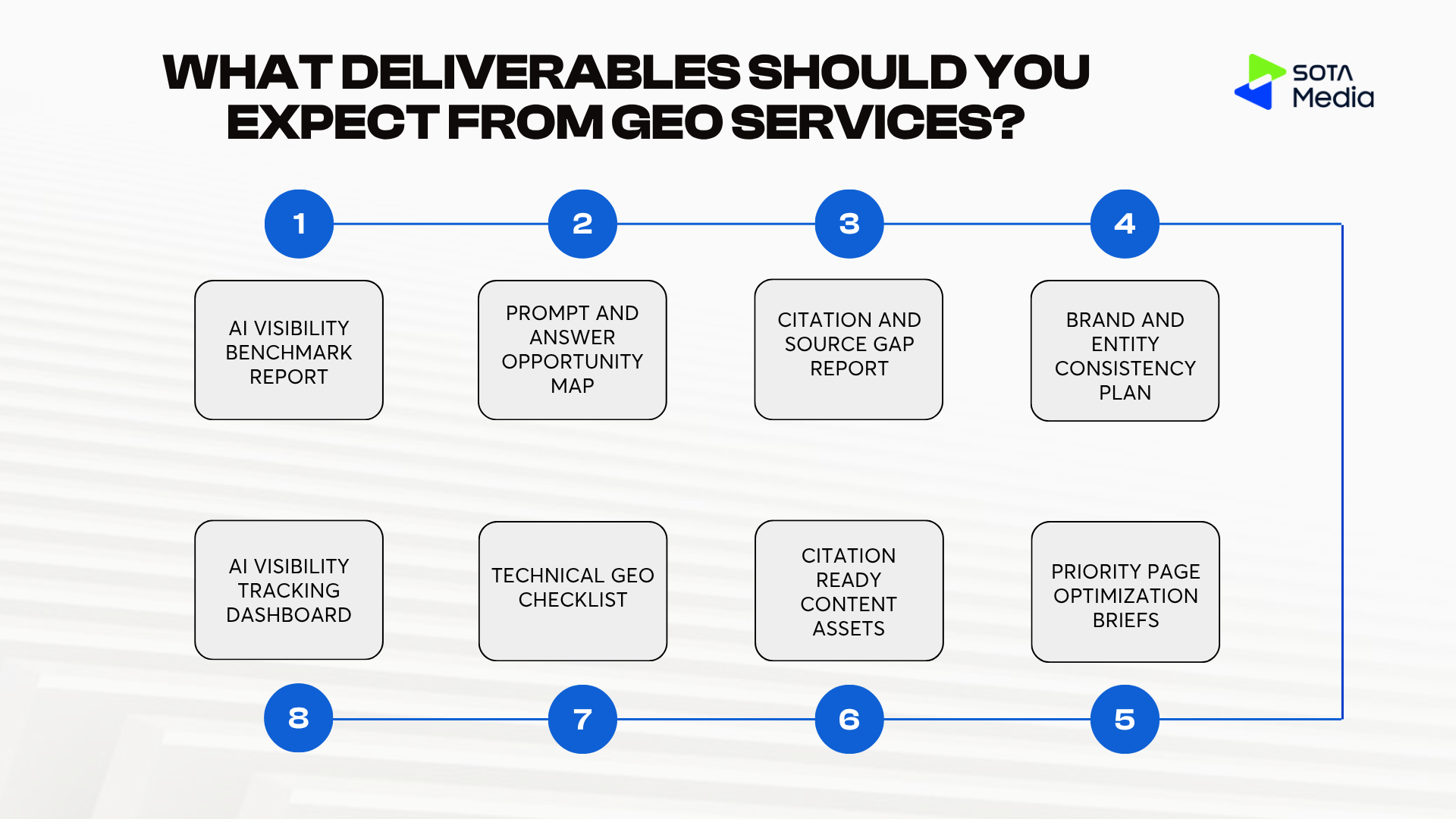
A generative engine optimization proposal should describe what the client will receive, not only list broad activities such as research, optimization, and reporting. Complete generative engine optimization services should give the client a clear view of current visibility, priority opportunities, required content changes, and the method used to track progress.
What deliverables should you expect from GEO services?
- AI visibility benchmark: the platforms, prompts, brands, sources, cited URLs, and current brand accuracy.
- Prompt and opportunity map: customer questions grouped by topic, funnel stage, existing support, and content gaps.
- Source gap analysis: the sources appearing in relevant answers and the evidence or information needed to compete.
- Page-level recommendations: specific changes to priority pages rather than a generic instruction to optimize for GEO.
- Technical checklist: issues affecting crawling, indexing, internal discovery, structure, or understanding.
- Visibility tracking: recurring measurement of mentions, citations, cited pages, competitors, and brand accuracy.
For businesses comparing GEO with wider technical marketing capabilities, SotaMedia’s overview of tech marketing agencies in Vietnam offers related context.
What makes content useful for generative search systems?
Content used in generative engine optimization services needs to be clear enough to answer a question and detailed enough to support verification. Page quality comes from the relationship between the answer, evidence, authorship, structure, and wider brand information.
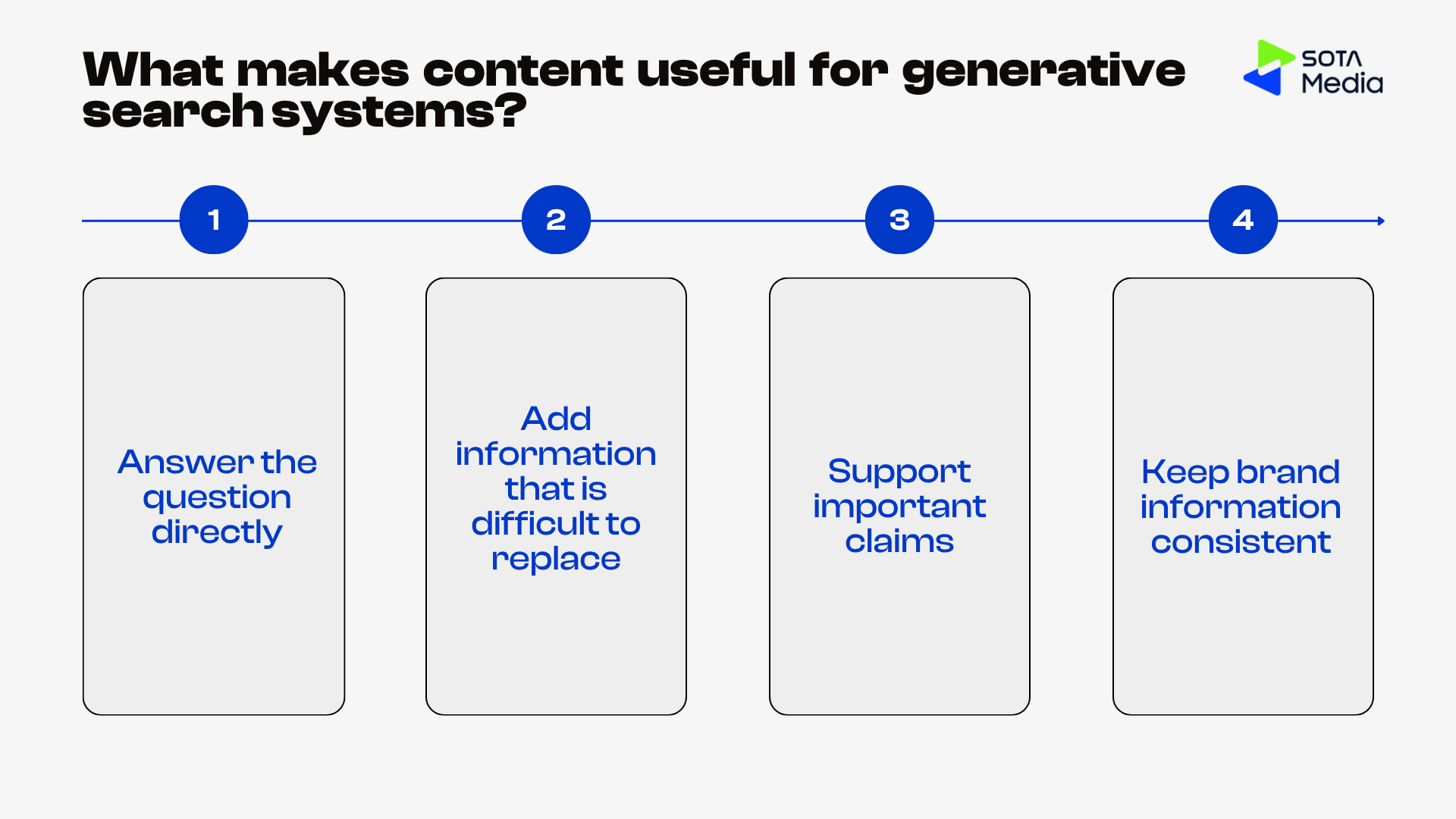
What makes content useful for generative search systems?
Answer the question directly
A page should give its main answer early. If the reader wants to know what a service is, how it works, or how two options compare, address that question before adding background information.
Add information that is difficult to replace
Generic definitions are easy to reproduce. Original research, first-party data, expert explanations, case studies, practical frameworks, and detailed comparisons provide stronger informational value. Google’s guidance on generative AI features similarly emphasizes useful, reliable, people-first content instead of pages created mainly to manipulate AI responses.
Support important claims
Important statements should connect to evidence readers can inspect. Adding unrelated external links does not strengthen a claim. The source should support the specific information being presented.
Keep brand information consistent
The company name, services, audience, location, products, and expert relationships should remain factually consistent across the website and relevant external profiles.
Businesses looking at the wider marketing mix can also explore SotaMedia’s digital marketing services, which combine content, SEO, GEO, performance, and AI marketing capabilities.
How should businesses measure GEO performance?
Generative engine optimization services should use a repeatable measurement method instead of relying on occasional screenshots. Because generated answers can vary, the business needs a stable prompt set, documented testing conditions, and separate metrics for mentions, citations, accuracy, and outcomes.
|
Metric |
What it shows |
|
Brand mentions |
How often the company appears in selected answers. |
|
Citations |
Whether the company’s pages are used as supporting sources. |
|
Brand accuracy |
Whether the generated answer correctly describes the company and its services. |
|
Topic coverage |
Where the brand appears compared with competitors across priority questions. |
|
Business outcomes |
Potential changes in AI referral traffic, branded demand, leads, assisted conversions, or lead quality. |
Mentions and citations should remain separate metrics. A brand can be mentioned without its website being cited. Business outcomes should also be reported separately because visibility does not automatically create a visit or conversion.
Google now provides dedicated Search Console reporting for generative AI performance, including impressions, pages, countries, devices, and dates for eligible generative AI features. These platform-level signals should complement, not replace, broader business measurement.
What should you check before choosing a GEO provider?
A generative engine optimization proposal should define what will be researched, changed, measured, and delivered. Broad promises about AI visibility are difficult to evaluate without a clear scope.
- Check the platforms and prompts: confirm which AI systems, business topics, and branded, non-branded, comparison, or recommendation prompts are included.
- Ask for a baseline: the provider should document current mentions, citations, cited pages, competitors, and brand accuracy before optimization.
- Clarify page-level deliverables: confirm which pages will be audited, optimized, rewritten, or created and who handles implementation.
- Ask how evidence will be developed: understand whether the work uses expert interviews, original research, case studies, company data, or external references.
- Define technical responsibility: make clear who identifies, implements, and verifies technical changes.
- Review reporting and limitations: ask how prompts are tested and how changes are recorded. Guaranteed citations, permanent inclusion, or fixed positions are not realistic promises.
- Confirm ownership: make sure the client retains access to prompts, benchmark data, reports, dashboards, and other project assets.
When comparing agencies, SotaMedia’s AI marketing agency comparison provides another reference point for assessing capabilities beyond a generic GEO label.
When do businesses need GEO services?
Generative engine optimization services are most useful when AI search visibility has become a real commercial problem. One strong signal is that customers are already asking AI systems for recommendations, comparisons, or provider shortlists, but the business rarely appears.
Another signal is inaccurate representation. If an AI system repeatedly describes the company with outdated services, the wrong audience, or incomplete capabilities, the problem is broader than a single ranking.
GEO can also help when an internal team creates good content but cannot determine why competitors are repeatedly cited. The issue may involve evidence, source quality, entity clarity, technical accessibility, or a mismatch between customer questions and existing pages.
Not every company needs a dedicated GEO program. If the website has serious technical SEO problems, thin content, weak product information, or unclear positioning, fixing those foundations may deliver more value first. For a wider comparison, see SotaMedia’s overview of marketing agencies in Vietnam.
Conclusion
Generative engine optimization helps businesses improve how their brand is understood, mentioned, and cited in AI-generated search answers. The strongest approach combines useful content, clear brand information, reliable evidence, and technical accessibility rather than focusing on AI visibility alone. For businesses considering GEO, the key is to identify where visibility is currently weak and which improvements can support real search and business goals.
Contact SotaMedia to assess your current AI search visibility and identify the next opportunities.
Frequently asked questions
Generative engine optimization services improve how a brand’s information is understood, verified and surfaced inside answers produced by AI search systems. The work can include content review, source development, technical checks, entity consistency and AI visibility tracking.
GEO services make important pages clearer, strengthen supporting evidence and correct inconsistent brand information across online sources. They also track whether the business appears for relevant prompts and which pages or sources support that visibility.
Traditional SEO focuses mainly on organic rankings, website traffic and search engine visibility. GEO focuses on how a brand is mentioned, described and cited inside generated answers. The two approaches work together because strong technical SEO and useful content still support AI search visibility.
A competitor can have clearer topic coverage, stronger supporting sources, more consistent brand information or content that answers the question more directly. A GEO visibility audit can identify which pages and external sources support the competitor’s presence and where the brand has information gaps.
Businesses should begin with pages connected to important customer questions, comparisons and purchase decisions. Priority should also go to pages that already receive organic visibility but contain unclear explanations, outdated information or unsupported claims.
The timeline depends on the number of platforms, prompts, pages and technical issues included in the project. Generative engine optimization services normally begin with an audit and priority plan before moving into content updates, source development and ongoing tracking.
The cost depends on the project scope, platform coverage, prompt volume, content production, research requirements and technical support. A clear proposal should separate audit work, implementation, reporting and ongoing support so the client understands each cost.
Businesses can track brand mentions, direct citations, cited pages, description accuracy, topic coverage and competitor presence. Referral traffic, branded search growth, assisted conversions and lead quality should be reviewed separately as business outcomes.
No. Generated answers can change across platforms, prompts, locations and testing periods. A GEO provider can improve the quality, accessibility and consistency of a brand’s information, but it cannot control the final answer produced by an AI system.
The business should prepare its priority topics, customer questions, important pages, preferred brand descriptions and available first party evidence. It should also identify internal experts, content approvers and technical team members who can support the project.