


Branding and Strategy
A Web3 marketing agency runs growth, community, and communication work for crypto, blockchain, and token-based products. The scope covers KOL and KOC partnerships, on-chain user acquisition, tokenomics messaging, community management on Discord and Telegram, and exchange listing support, on top of the content, SEO and PR work any tech company needs.
This guide covers what these agencies do day to day, the specific benefits of hiring one, how a Web3 marketing agency differs from a generalist digital shop, the criteria to check before you sign a retainer, and the red flags that show up when a pitch outruns the track record behind it.
Key takeaways
- A Web3 marketing agency handles growth, community, and communication for crypto and blockchain products, using tokenomics, on-chain data, and community-first tactics, which a generalist agency typically does not.
- The core difference from a generalist digital agency is technical fluency: reading a tokenomics model and on-chain metrics as a baseline skill, not a learning curve billed to your account.
- Choosing one comes down to 5 checks: named track record, real success metrics, tokenomics fluency, team structure, and pricing model. No ranking, no “best.”
- Building in-house makes more sense when you need long-term control and already have crypto-native marketing talent on staff.
- Watch for guaranteed listings, no named case studies, and community metrics reported with no product understanding behind them.
- 5 Web3 marketing agencies, reviewed in alphabetical order by their specialization, key features, and verified client work.
What is a Web3 marketing agency?
A Web3 marketing agency is a firm that runs growth and communication work for blockchain, crypto and token-based products, built around the mechanics that make this market different: tokenomics, on-chain data, and community ownership.
On-chain data shows exactly who is buying, holding, or dumping a token in real time, which changes what “engagement” means and how fast a campaign has to react. And distribution runs through Discord, Telegram, and X, not a newsletter list.
That is the mechanism-level difference. A team that has worked inside crypto reads a whitepaper and a token unlock schedule as a baseline skill. A team that has not treats them as a new client onboarding cost, one you end up paying for either way.
Web3 marketing agency vs. generalist agency
| Criteria | Web3 marketing agency | Generalist digital agency |
|---|---|---|
| Technical understanding | Reads tokenomics and on-chain data as a baseline skill | Learns Web3 concepts on your account, if at all |
| Network access | Existing KOL, exchange, and community relationships | Little to no Web3-specific network |
| Speed | Executes fast on a defined scope, slower on custom builds | Fast on generic marketing, slow to ramp on Web3-specific work |
| Control | Shared agency owns execution | Shared, but less Web3 judgment to lean on |
What does a Web3 marketing agency do?
Community management and KOL/KOC marketing
Discord and Telegram moderation, event planning, and day-to-day community engagement sit alongside KOL (key opinion leader) and KOC (key opinion consumer) campaigns: paying or gifting crypto-native creators to cover a project across X, YouTube, and Telegram. The work is judged on whether the community stays active after an incentive ends, not on follower counts during a campaign.
Content and GEO/SEO for Web3 audiences
Web3 content has to work for two search audiences: people using Google and AI answer engines. That means optimizing for both SEO and GEO. Content still needs the fundamentals of on-page SEO, direct answers, named sources, and extractable structure, alongside crypto-specific keyword research and terminology that a generalist SEO team usually has to learn from scratch.
On-chain growth and user acquisition
Wallet-level data lets an agency track adoption directly: new wallets interacting with a protocol, transaction volume, and retention by cohort. Growth campaigns are built around that data instead of last-click attribution, which does not translate well to a decentralized product.
Token launch and tokenomics communication
A token generation event needs its own communication plan: explaining vesting schedules, unlock timing, and utility to a community before launch, then managing the message once the token starts trading. Getting this messaging wrong is one of the most common reasons a launch loses community trust in its first week.
PR, media relations, and exchange listing support
Traditional PR (press releases, media relationships, contributed articles) still applies, but a Web3 marketing agency also has relationships with crypto-native outlets and can support the media strategy around an exchange listing, which follows its own timeline and disclosure norms.
Benefits of hiring a Web3 marketing agency
Faster time to market vs building in-house
A Web3 marketing agency arrives with a working KOL network, community playbooks, and launch templates already built. Standing up that same capability internally means hiring for roles the market has to compete for, and most early teams do not have 6 months to spend on it before a launch date.
Access to existing KOL and community networks
Agencies maintain ongoing relationships with vetted creators and community managers across multiple projects at once. A new in-house hire starts those relationships from zero, and crypto-native creators are more responsive to agencies they already work with regularly than to a first cold outreach from an unfamiliar brand.
Technical fluency across both crypto and traditional tech stacks
A Web3 marketing agency that has also worked in SaaS or enterprise IT brings a second advantage: it can translate a product’s actual architecture into content a technical buyer trusts, alongside the token. That matters for any project that sells to both crypto-native users and traditional B2B buyers at the same time.
How to choose the right Web3 marketing agency
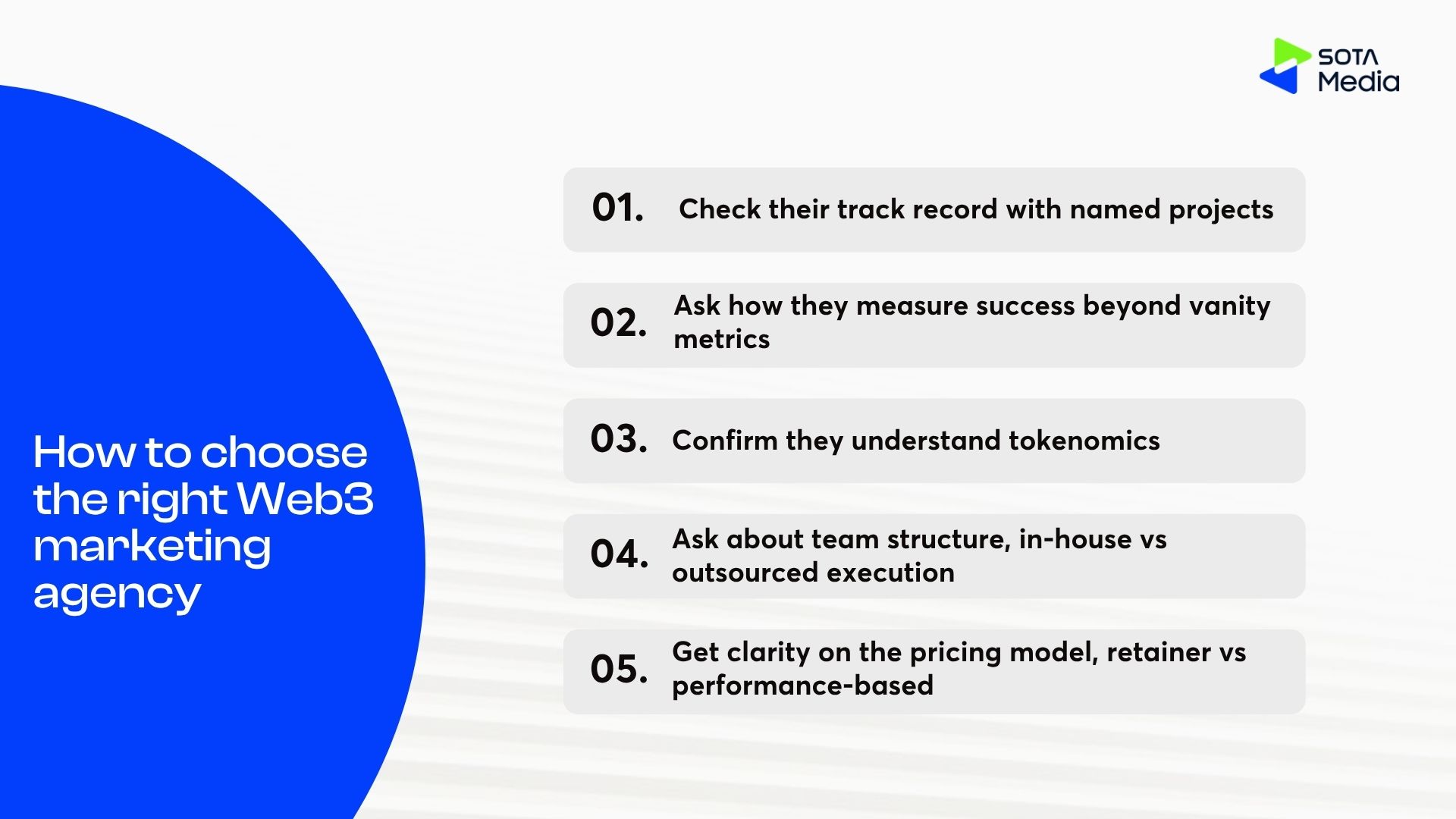
Check their track record with named projects
A logo wall proves nothing on its own. Ask for 2 or 3 named projects with the specific result: users acquired, funds raised, community size at a specific date, and a way to verify it independently.
Ask how they measure success beyond vanity metrics
Follower counts and impressions are easy to inflate. Ask what the agency reports on past a campaign’s first week: wallet retention, active community members 30 days out, or conversion from community member to product user.
Confirm they understand tokenomics
Ask the Web3 marketing agency to walk through your token model back to you in their own words before you sign anything. If the answer stays at the level of “we’ll post about it,” the gap will show up at launch.
Ask about team structure and in-house vs. outsourced execution
Some agencies run every function in-house while others assemble a team of freelancers per project. Neither is automatically wrong, but you should know which one you are hiring, since it affects consistency and who is accountable when something breaks.
Get clarity on the pricing model, retainer vs. performance-based
Retainers buy ongoing capacity. Performance-based deals tie payment to specific deliverables like media placements or listings. Ask what happens to the scope if results come in under target before the contract, not after.
Red flags to watch for
These are the specific signals a Web3 agency is not what its pitch claims. Two or more of these signals in the same pitch is worth a direct question before you sign.
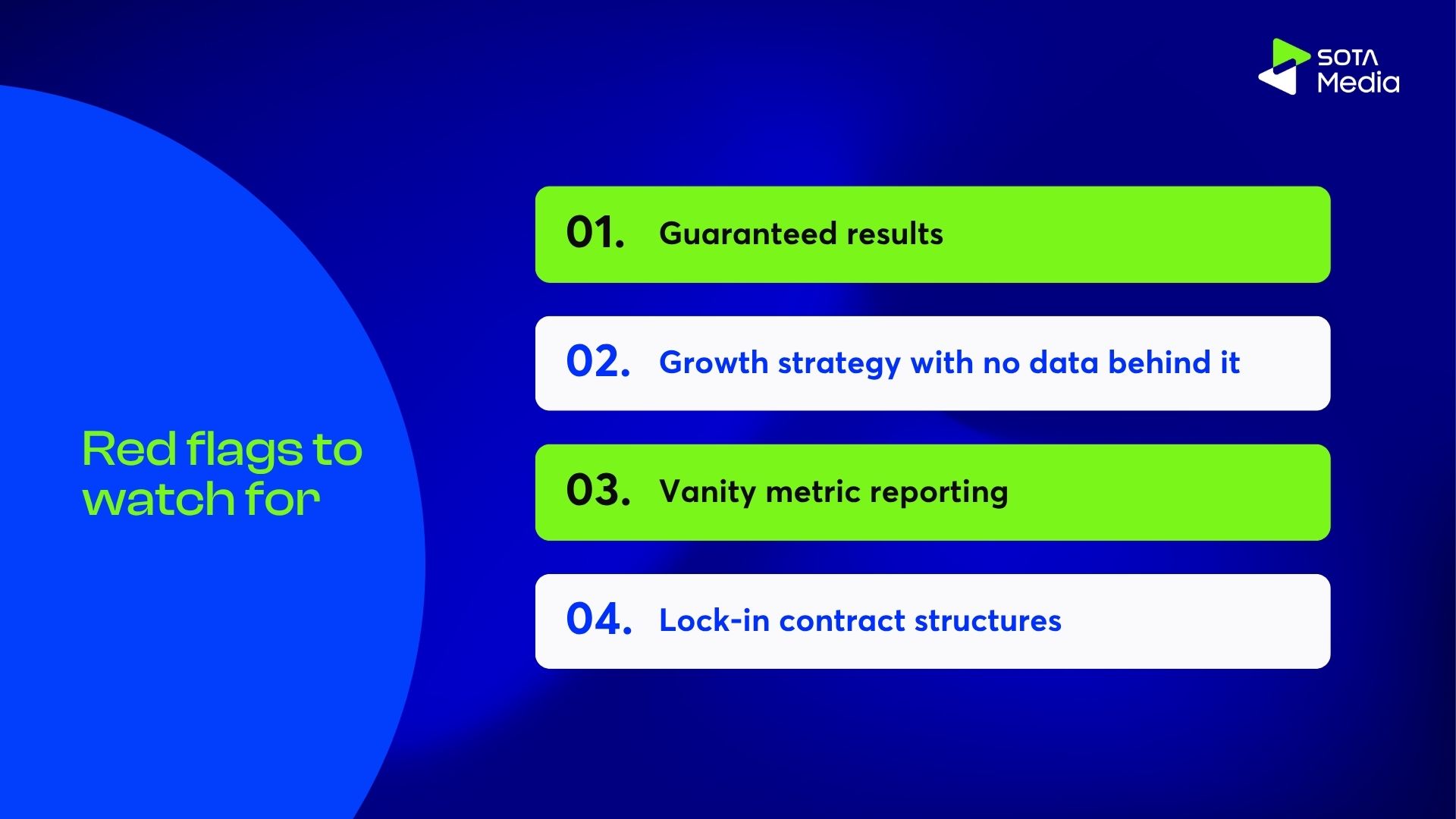
Guaranteed results
No agency controls token price, market conditions, community receptivity or platform changes, so none can guarantee a price outcome or a fixed ROI in a market this volatile. A guarantee usually means the agency is overstating its track record, or targeting a metric that costs nothing to manufacture. Ask for the assumptions behind any number in a pitch, not just the number itself.
Growth strategy with no data behind it
A growth plan with no track record behind it is an assumption dressed up as a strategy. Ask for the past campaigns that back the approach, the metrics they produced, and how closely those projects match yours. A plan that cannot be traced to a result is guesswork with good slides.
Vanity metric reporting
Impressions, follower counts, and Discord member totals measure attention, not outcome. An agency that reports these numbers without connecting them to retention, conversion, or on-chain activity is not showing you whether the work moved anything. Ask what happened after the first metric: did the community stay active, or did wallets convert.
Lock-in contract structures
A 6- to 12-month contract without performance checkpoints or an exit clause leaves you with limited flexibility. Before signing, agree on clear deliverables, review milestones, and a reasonable termination option if the partnership falls short. Commit to longer engagements once the agency has earned your trust.
Top 5 Web3 marketing agencies (2026)
The 5 agencies below are listed alphabetically, not ranked. Selection criteria: each operates as a dedicated Web3 or crypto marketing firm, publishes named client work on its own site, and has been active in the space for at least 2 years as of this article’s data collection date, September 2026.
Figures below are each agency’s own published claims as of that date, not independently audited, and should be verified directly with the Web3 marketing agency before you rely on them.
SotaMedia
Website: https://sota.media/
SotaMedia, the tech marketing agency under SotaTek Group – an IT group with over 10 years of experience and a presence in 25 countries. SotaMedia supports businesses across industries, including technology, finance and pairs growth systems with technical fluency across SaaS, IT outsourcing and Web3.
Best for: tech and Web3-adjacent companies that want an agency with deep product understanding, not just campaign execution.
AP Collective
Website: https://www.apcollective.io/
A full-stack crypto marketing firm operating since 2023, working across token launch marketing, KOL campaigns, PR and community growth. Its published client work includes the Pudgy Penguins $PENGU token launch and Raydium’s brand repositioning campaign, both reported on the agency’s own site.
Best for: token generation events (TGE) and full-stack campaigns that need creator and KOL coordination at scale.
Coinbound
Website: https://coinbound.io/
Operating in crypto and Web3 marketing since 2018, offering KOL marketing, PR, community management, SEO and paid media. The agency publishes a client list that includes MetaMask, Cosmos, Nexo and OKX, and reports having run more than 1,400 campaigns to date, per its own site.
Best for: PR and influencer-led visibility for exchanges, wallets and established crypto brands.
Lunar Strategy

Website: https://www.lunarstrategy.com/
Founded in 2019, focused on consulting, social media marketing, community management, influencer strategy and PR for crypto and blockchain projects, with accelerator programs for token generation events. The agency’s published client list includes Polkadot, Internet Computer and OKX.
Best for: go-to-market consulting paired with execution for early-stage token launches.
MarketAcross

Website: https://marketacross.com/
A blockchain PR and marketing firm operating since 2012, focused on media outreach, thought leadership and SEO for crypto and Web3 companies. Its published client list includes Binance, Polygon and Polkadot, with a results-based retainer model rather than a fixed monthly fee.
Best for: earned media and crypto-native PR on a results-based retainer.
When to build in-house instead of hiring out
Hiring out makes sense pre-launch or during a token generation event, when speed and existing KOL access matter more than long-term control.
Building in-house makes more sense once a project has stable revenue, a defined community strategy, and can compete for crypto-native marketing talent directly, since that talent then compounds inside the company instead of across an agency’s client roster.
Conclusion
A Web3 marketing agency earns its retainer by understanding the product behind the token, not by publishing faster.
Before signing, ask for 2 named case studies with real metrics, then check who will work on the account and how pricing is structured. If you sell to both crypto-native users and traditional B2B buyers, test whether the agency can speak to both audiences without losing the product context.
Use those checks to compare agencies against what your project actually requires. If you need that mix of technical and Web3 fluency, SotaMedia is one option to consider.
Frequently asked questions
A Web3 marketing agency runs growth, community and communication work for crypto and blockchain products, covering KOL partnerships, on-chain user acquisition, tokenomics messaging, and exchange or listing support alongside standard content and PR.
The core difference is technical fluency. A Web3 agency reads tokenomics, on-chain metrics and community-first growth mechanics as a baseline skill, which a generalist digital agency typically does not work with.
Pricing varies by scope and engagement model, retainer vs performance-based, so we will not state a number here.
Hiring out makes sense when speed to market and existing KOL or community access matter more than long-term control, typically pre-launch or during a token launch window.
Ask for named case studies with actual metrics, confirm the team understands your tokenomics model, and check how execution is structured: in-house team or outsourced freelancers.
Some can. Agencies with a broader tech marketing background, beyond crypto-native shops alone, tend to serve both well, because they understand the product layer and the community layer.
A guaranteed listing or guaranteed result, no named case studies, and a focus on community metrics with no clear understanding of the actual product are the main ones to watch for.
Yes, community management is usually a core service, but it should sit alongside product understanding and growth strategy, not stand in as the entire offering.