




Omnichannel Digital Marketing
Threads marketing is the use of Meta’s Threads app to build awareness and start demand through public posts, replies, communities, and direct messages. Meta launched Threads on July 5, 2023 and reported 500 million monthly active users on June 16, 2026.
For tech companies, Threads marketing changes the math on organic reach. You can get in front of developers, operators, and buyers in public conversation without paying for every impression. The catch is that Threads punishes the broadcast habits most brands carried over from X and LinkedIn.
This Threads marketing guide covers how Threads distributes posts, how it compares with X, LinkedIn, and Instagram, and a 6-step plan to launch your brand on Threads.
Key takeaways
- Meta reported 500 million monthly active Threads users on June 16, 2026, under 3 years after launch.
- In Meta’s 2024 analysis of global creators, replies drew almost half of views, so reply time belongs in your Threads marketing plan.
- Topic tags, communities, and the Your Algo setting decide much of who sees a post.
- The Threads API allows 250 published posts and 1,000 replies per profile in any 24 hours, enough to run Threads from your content calendar.
- Treat Threads marketing as a conversation channel next to LinkedIn and X, and add paid placements only after organic posts prove the message.
What makes Threads marketing different
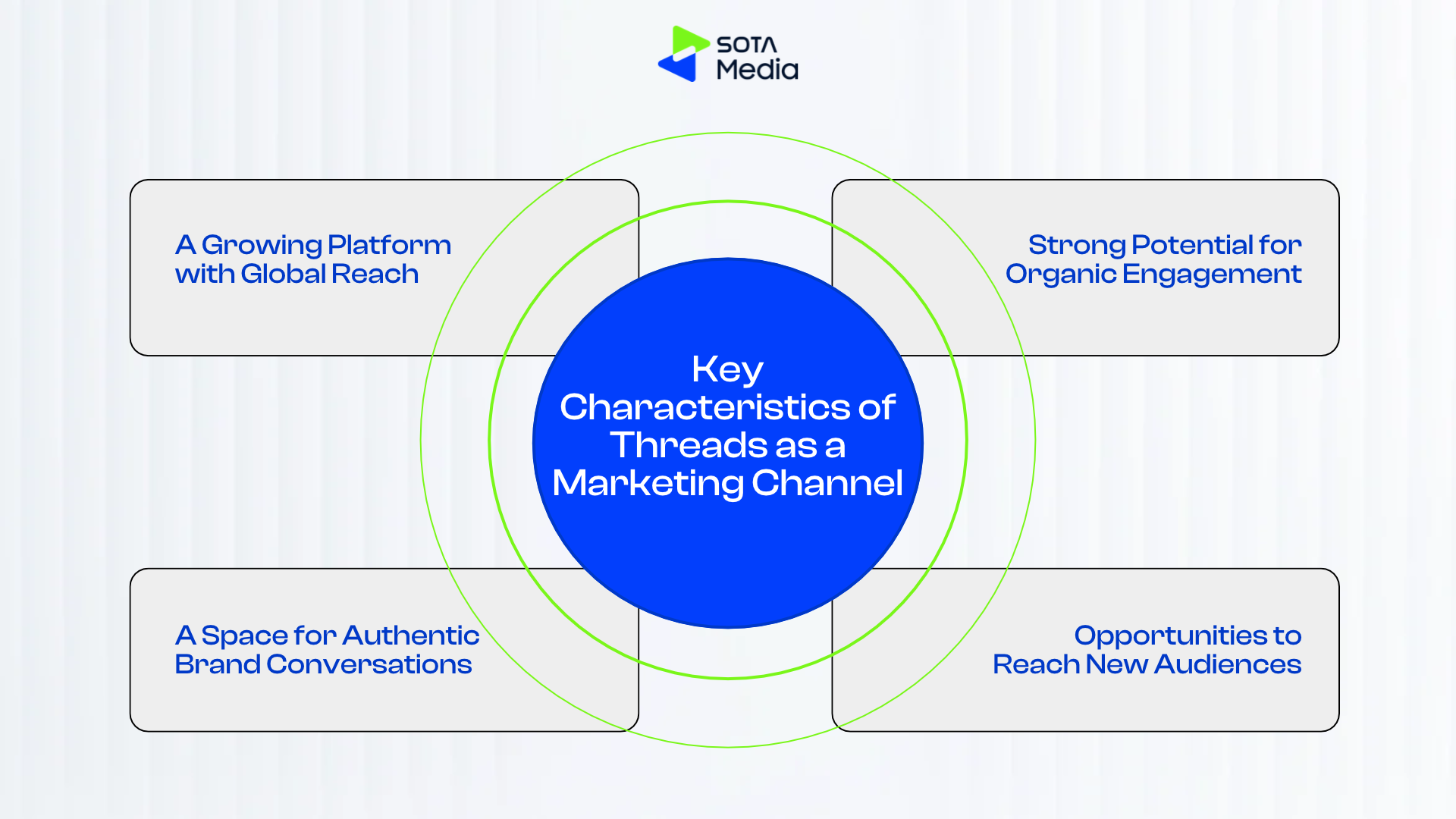
Scale reached in under 3 years
Threads went from launch in July 2023 to 500 million monthly active users in June 2026. That is a large audience, yet most B2B teams still treat Threads marketing as an afterthought.
Replies carry a large share of views
In Meta’s analysis of global Threads creators over 30 days in the first half of 2024, replies accounted for almost half of views.
An audience that only partly overlaps with Instagram
It shares Meta’s account system with Instagram, but its feed and audience behave differently. Meta reported in July 2025 that more than a third of daily Threads users with connections follow mostly different accounts on Threads than on Instagram. Your Instagram following gives you a start; most of the audience you want on Threads you will build there.
Text-first conversation
A Threads post is text-first, up to 500 characters, and the conversation around it happens in replies, quotes and direct messages. In Threads marketing, a brand that answers questions and takes part in industry discussions there builds a recognizable voice in public.
Read more: Earned Media: Definition, Examples and Practical Strategies
How Threads works for brands
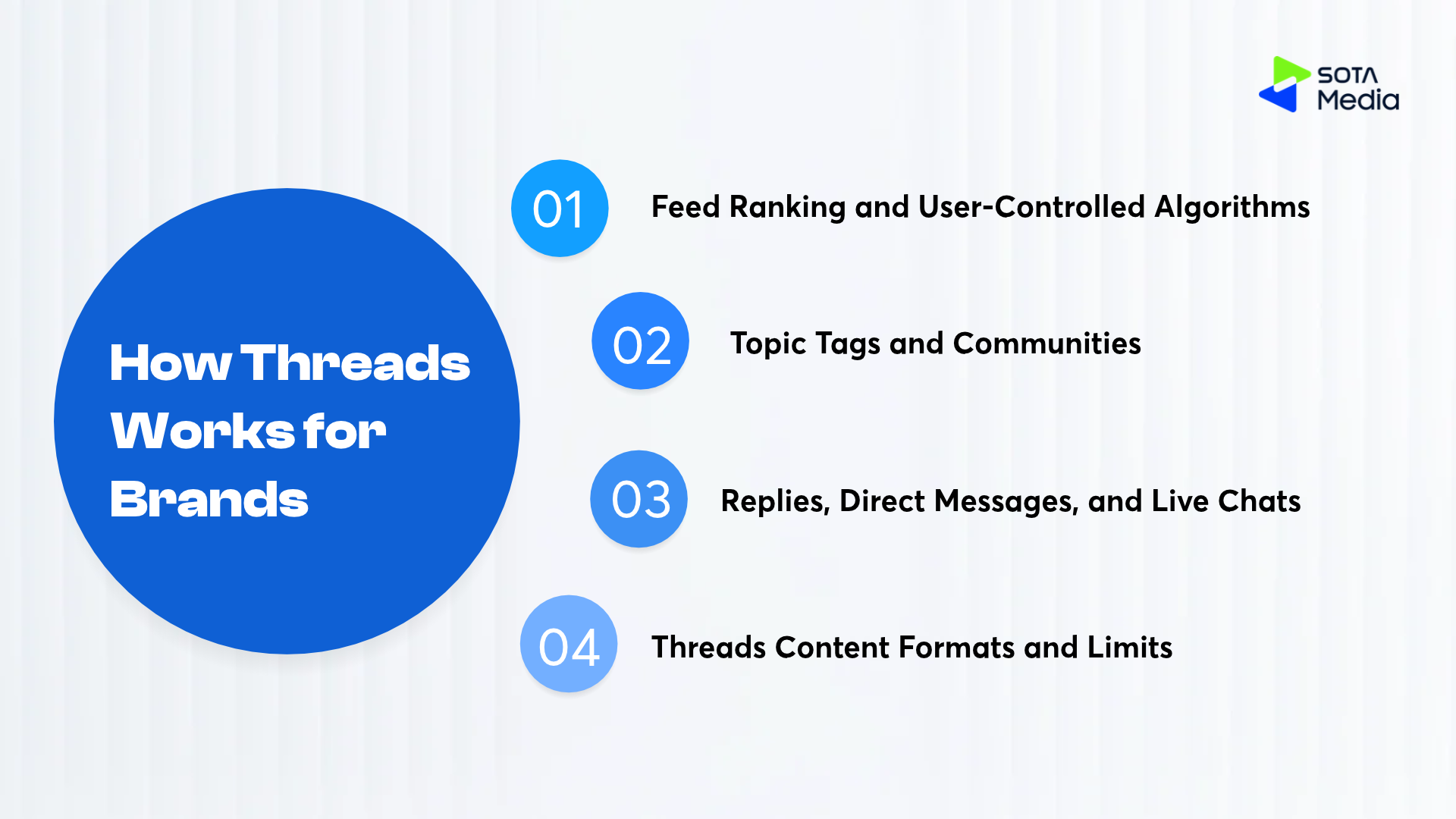
For Threads marketing, 3 features decide much of who sees a post: the For You feed with its Your Algo setting, topic tags and communities, and replies.
Feed ranking and user-controlled algorithms
The For You feed recommends posts from accounts a user may not follow [CẦN NGUỒN: Meta page on For You feed ranking signals]. Since June 2026, people in the US, Canada, the UK, Australia, and New Zealand can use Your Algo to tell the feed which topics to show for 1, 3, or 7 days.
Topic tags and communities
Topic tags group posts by subject. Communities are public spaces built on popular tags: Meta launched them in October 2025 across more than 100 topics, passed 200 topics by a December 2025 update, and took them out of beta in June 2026. For technology brands doing Threads marketing, discussions about AI, software development and startups are where relevant audiences gather.
Replies, direct messages and Live Chats
By answering questions and adding useful points to existing discussions, brands reach people beyond their own followers. Threads added direct messages in July 2025, message requests from non-followers in September 2025, and group chats of up to 50 people who follow you in October 2025.
Live Chats arrived in April 2026 for a small group of creators, starting in the NBA community. Up to 150 people can send messages while others watch, and chats stay publicly discoverable after they end. In June 2026 Meta expanded Live Chats to more communities.
Content formats and limits
| Format | Limit |
|---|---|
| Text post | 500 characters |
| Text attachment | Up to 10,000 characters |
| Carousel | 2 to 20 images or videos |
| Video | Up to 5 minutes |
| Links | 5 or fewer per post for API-published posts |
Meta’s creator guidance says video, photo, and carousel posts that include text have performed better than media posts without text. In Threads marketing, the caption deserves as much attention as the creative asset. A useful explanation, a clear point of view, or a question can give people a reason to engage with the post.
Threads vs. X, LinkedIn and Instagram: what are the differences?
Each platform rewards a different behaviour. The right mix depends on where your buyers talk, what they trust and what you want them to do next. The table is our editorial summary of how teams use each platform, not platform-reported data.
How Threads compares with other social platforms
| Criteria | Threads | X | ||
|---|---|---|---|---|
| Core format | Short text posts and replies | Real-time updates and trending topics | Posts, articles and documents on professional topics | Reels, Stories and visual posts |
| How people find content | Replies, topic tags and communities | Timely topics and trending discussions | Professional relevance and network engagement | Video views, saves and shares |
| User mindset | Casual conversation and opinions | News and live reaction | Career, industry knowledge, networking | Visual discovery, shopping, entertainment |
| B2B role | Awareness, founder content, community, launches | Tech news, developer communities | Lead generation, recruiting, enterprise relationships | Brand awareness, employer branding, product demos |
Reach differs too. In Pew Research Center’s 2025 survey of US adults, 21% said they used X and 8% used Threads. Pew’s 2026 update puts X at 18% and does not report a 2026 Threads figure.
Which platform fits which goal
- Enterprise lead generation: we recommend LinkedIn as your primary channel for business decision-makers, with Threads building familiarity through informal discussion.
- Developer and practitioner engagement: combine Threads with X to take part in industry conversations. Threads supports topic-based discovery, while X helps brands engage with real-time news and trends.
- Founder and executive visibility: use Threads to share personal insights and engage directly with industry communities, even if your account has a small following.
- Consumer-facing technology: pair Threads with Instagram to connect conversational content with visual storytelling and product discovery.
For most tech brands, Threads marketing works as a complementary channel alongside LinkedIn and X.
Why Threads marketing matters for tech companies
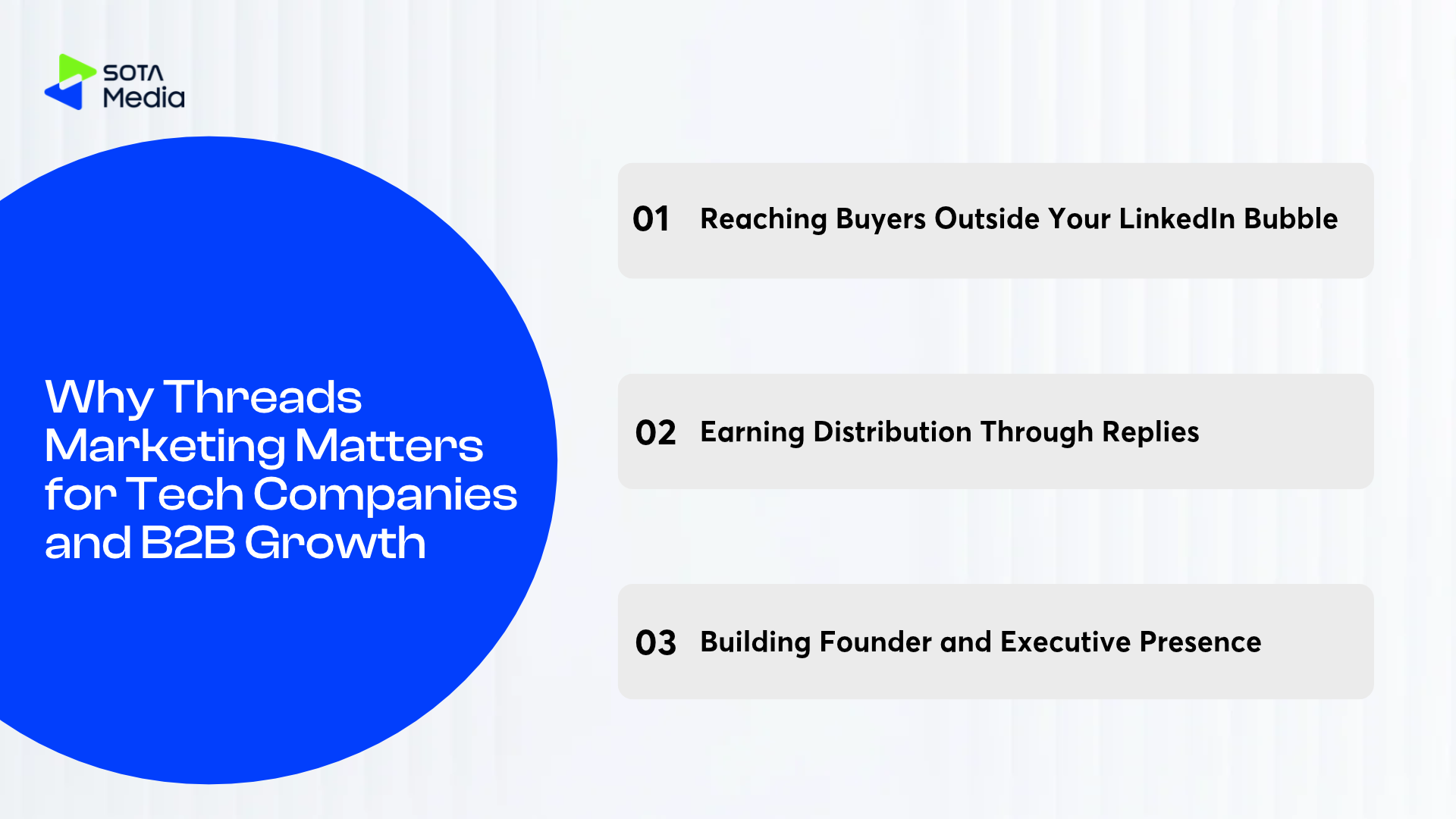
Reaching buyers outside your LinkedIn network
LinkedIn connects you with professional audiences inside your network. On Threads, engineers and product leaders can find your posts through topic tags, communities and replies, even if they have never heard of your brand.
Earning distribution through replies
Because replies drew almost half of creator views in Meta’s 2024 analysis, a useful reply under a popular post in your category puts your account in front of people who do not follow you yet. In a small brand’s Threads marketing plan, budget reply time each week the same way you budget post time.
Building founder and executive presence
A CTO or CEO account can share opinions on the category, react to industry news and answer questions in public at no media cost. That presence can support sales conversations, hiring and PR.
Read more: B2B SEO Strategy for Pipeline Growth: A Complete Guide (2026)
Step-by-step guide to launching Threads marketing for your brand
Step 1: Set up brand and executive profiles
Create the brand profile, then set up profiles for 1 or 2 executives who will post in their own voice. Write bios that name the topic you own, not just the company tagline, and pin a post that explains what followers will get.
Step 2: Choose 2 to 3 topic lanes and their communities
Pick Threads marketing topics where your product has an informed opinion: for example, AI infrastructure, developer productivity or fintech compliance. Join the matching communities and spend a week reading before posting. Note which accounts start conversations and which formats get replies.
Step 3: Build a reply-first posting rhythm
Meta’s creator guidance recommends posting at least 2 to 5 times per week. As a starting point, we suggest:
- 2 to 3 original posts a week per account, each tagged to one topic lane
- 15 to 20 thoughtful replies a week under posts from others in your category
- Text on every media post, since Meta reports that media posts with text have performed better
- An open question at the end of some posts to invite replies
Step 4: Scale with scheduling, drafts and the Threads API
Threads lets you save up to 100 drafts. Adam Mosseri announced in January 2025 that posts can be scheduled up to 75 days in advance.
For larger teams, the Threads API allows 250 API-published posts and 1,000 replies per profile in a rolling 24-hour window, and covers publishing, reply management, and insights. That is enough to connect Threads to your content calendar, social tools, or an AI-assisted reply workflow, with a human approving what goes out.
Step 5: Measure Threads marketing performance with Threads Insights
The Threads Insights APIg reports views, likes, replies, reposts, quotes, and shares per post (views and shares are marked “in development”). At the profile level, it adds link clicks, follower count and follower demographics; demographics need at least 100 followers.
Focus on 3 areas:
- Reach: track views and follower growth across your topic lanes.
- Engagement quality: monitor replies and quotes to see which posts start real discussion.
- Business impact: use UTM parameters to track link clicks in your analytics platform and CRM.
Review your Threads marketing performance monthly to see which topics attract relevant audiences and drive website traffic, then adjust your topic lanes.
Step 6: Add paid distribution once organic proves the message
Meta began rolling out ads on Threads to all users worldwide in late January 2026. Advertisers add Threads placements to Advantage+ or manual campaigns in Ads Manager, with image, video and carousel formats.
Before adding paid promotion to your Threads marketing, identify organic posts that generate strong replies and relevant discussions. These posts show which messages resonate with your audience and give you a starting point for testing paid distribution.
Monitor performance after promotion to check whether the extra reach turns into engagement and website traffic.
Conclusion
Threads has 500 million monthly users, a feed that rewards topic focus and replies, and a US audience that brands have not yet crowded. For tech companies, the Threads marketing plan is clear: own 2 or 3 topics, put executives in front, reply more than you post, and measure clicks rather than views.
At SotaMedia, our Omnichannel Digital Marketing team plans and runs Threads programmes for tech companies, from topic planning and executive content to AI-assisted reply workflows with human review. If you are planning a Threads launch, ask us for a Threads channel audit of your topics, profiles and first 30 days of posts.
Frequently asked questions
Yes, as a conversation and awareness channel. Threads matches posts to topics and communities, so B2B brands can reach practitioners outside their existing network. LinkedIn usually remains the main channel for direct lead generation.
Meta recommends at least 2 to 5 posts per week. Because replies drive almost half of views, plan reply time as well as post volume.
Yes. Meta offers Threads as an ad placement in Meta Ads Manager. Check Meta Business Help for the formats and markets currently supported before planning spend.
Yes. The Threads API supports publishing, reply management and insights, with a limit of 250 API-published posts and 1,000 replies per profile every 24 hours.
Threads leans on topics, communities and replies for discovery, while X leans on recency and the follower graph. X still reaches more US adults: 21% versus 8% for Threads in Pew's 2025 data.
Track views and follower growth for reach, replies and quotes for engagement quality, and UTM-tagged link clicks for pipeline. Insights are available in the app, on the web and through the API.