


Omnichannel Digital Marketing
B2B marketing in Vietnam is the set of strategies and channels a company uses to win business buyers in the Vietnamese market. Three things decide what works: who sits on the buying committee, which local platforms those buyers use (Zalo, Facebook, LinkedIn), and whether the content is in Vietnamese or English.
This guide gives you a 5-step strategy, 6 channels matched to funnel stages, 7 CRM metrics and 2 named examples. Where a figure is global, we label it as global.
Key takeaways
- B2B marketing in Vietnam starts with a map of the buying committee, not a channel list.
- A 5-step strategy covers ICP, positioning, language, channel mix and pipeline measurement.
- Search and GEO capture demand, LinkedIn and Zalo build reach and follow-up, events build trust.
- Measure qualified meetings and pipeline value. Traffic alone does not show buying intent.
- Named examples from SotaTek and Sumitomo Heavy Industries show how product mechanism drives content.
What B2B marketing in Vietnam covers
Definition and scope
B2B marketing in Vietnam is how a company reaches and converts business buyers in the Vietnamese market. Buyers sit in sectors such as IT outsourcing, B2B SaaS, manufacturing and fintech. Unlike B2C marketing in Vietnam, the sale takes weeks or months, involves several people and has to survive technical scrutiny before it ends in a contract instead of a checkout.
How Vietnamese B2B buyers decide
Buyers decide in committees. Forrester’s 2026 State of Business Buying reports that a typical global purchase involves 13 internal stakeholders and 9 external influencers, and that procurement is a decision-maker in 53% of buying cycles. This is global data, not a Vietnam figure.
Gartner’s buying research adds that validation and consensus creation run through the whole purchase, so suppliers win by giving every stakeholder consistent information. In our work with Vietnamese tech buyers, we see two local patterns the global data does not measure: referral trust, and evaluation in Vietnamese by the local decision-maker even when the vendor pitch is in English. These are our observations, not survey findings.
Market context
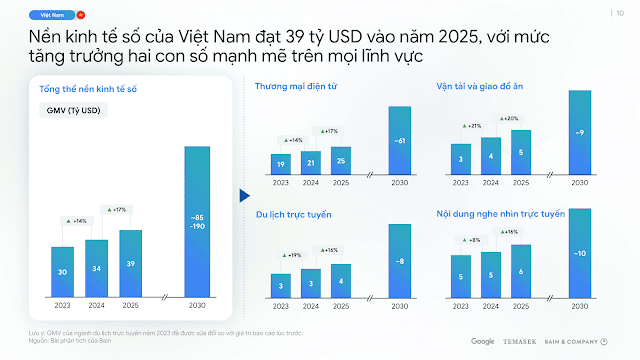
According to e-Conomy SEA 2025 by Google, Temasek and Bain & Company, Vietnam’s digital economy was projected to reach USD 39 billion in gross merchandise value (GMV) in 2025, up 17% year on year. E-commerce was projected to reach USD 25 billion, roughly two-thirds of the covered digital economy. These figures give digital-market context. They are not the size or growth rate of Vietnam’s B2B marketing market.
A 5-step B2B marketing strategy for Vietnam
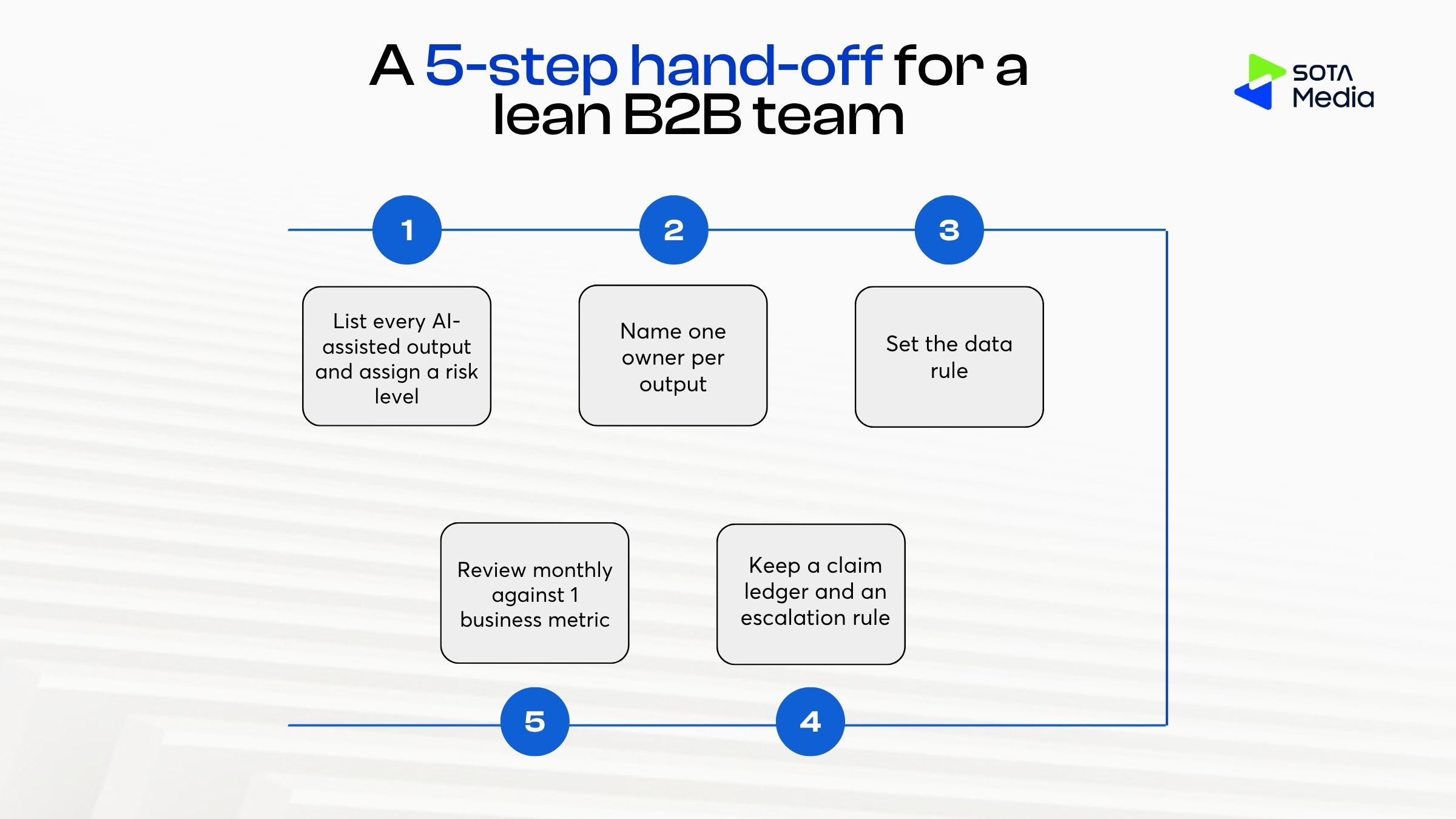
Step 1: Define the ICP and map the buying committee
Start with firmographics: sector, company size, tech stack. Then name the 3 roles that sign off: the technical lead, the budget owner and the end user. Add the trigger event that starts a search, such as a funding round, a compliance deadline or a failed vendor. Since Forrester finds procurement involved in 53% of global cycles, add procurement to the map for larger deals.
Step 2: Set positioning around the product mechanism
Explain how the product works before you state the outcome. Technical buyers trust a mechanism they can check.
Step 3: Choose the language per buyer
Use Vietnamese for domestic decision-makers and English for export buyers. Use both when a foreign HQ and a local team share the decision. Publish the technical page in the language of the person who will evaluate it.
Step 4: Match channels to funnel stage
Assign each channel one job: capture, reach, nurture or trust. Cap the first quarter at 2 channels, each with a named owner. Add a third only after the first two report qualified meetings.
Step 5: Measure pipeline, not traffic
Track qualified meetings, cost per qualified meeting, pipeline value and win rate by channel, all tied to a CRM. Marketing and sales agree on the definition of a qualified meeting before the first campaign starts. The table gives the 7 metrics we use. Pull their inputs from 7 CRM fields: meeting outcome, account fit, deal amount, stage, source, created date and close date.
| KPI | Formula | Cadence and caveat |
|---|---|---|
| Qualified meetings | Held meetings that meet the agreed ICP and qualification criteria. Exclude no-shows and duplicates. | Weekly. Sales and marketing agree the definition. |
| Cost per qualified meeting | Attributed campaign cost / qualified meetings held | Monthly. State media-only or fully loaded cost. |
| Meeting-to-opportunity rate | Meetings producing an accepted opportunity / qualified meetings held x 100% | Monthly. Allow for sales-cycle lag. |
| Marketing-sourced pipeline value | Sum of deal amounts for accepted opportunities sourced by marketing in the period | Monthly. Report currency and deduplicate deals. |
| Weighted open pipeline | Sum of open deal amount x probability of closing | Monthly. A forecast, not realized revenue. |
| Win rate by source channel | Closed-won / (closed-won + closed-lost) x 100% | Monthly or quarterly. Exclude open deals. |
| Average sales cycle | Sum of days from opportunity creation to closed-won / closed-won deals | Quarterly. Use the same start event across channels. |
B2B marketing channels in Vietnam
Six channel groups cover most B2B campaigns in Vietnam. Pick by funnel stage and buyer behavior, not by habit.
| Channel | Funnel stage | Fits when |
|---|---|---|
| Search and GEO content | Capture | Buyers research vendors before contact |
| Reach | You target roles at named accounts | |
| Zalo and Facebook | Reach, nurture | Buyers are domestic and follow-up is local |
| Email and outbound | Nurture | You have a short list of named accounts |
| Events and webinars | Trust | Deals are high-value with a long evaluation |
| Partnerships and KOL or KOC | Trust | You need technical credibility with a niche |
Search and GEO content
Buyers research vendors in Google and in AI answers before they contact anyone. A Princeton, Georgia Tech and Allen Institute for AI study found that GEO methods raised source visibility in generative engine responses by up to 40%, with citations, quotations and statistics among the strongest. The study used a benchmark of generative engines, not Vietnamese B2B queries, so treat 40% as a ceiling, not a forecast.
LinkedIn supports targeting by job title, skills, company and matched audiences, which fits role-based reach into named accounts. We add founder-led posts for technical credibility. That is our execution tactic, not a LinkedIn requirement.
Zalo and Facebook
Use Zalo Official Account for follow-up. Zalo describes the OA as a business’s official account and main customer-interaction channel, with messaging, broadcast, customer-care and mini-CRM features. Use Facebook for local reach: Meta Lead Ads with Instant Forms collect contact details and custom qualification questions without leaving Facebook or Instagram.
Email and outbound prospecting
Run named-account sequences against the ICP list from Step 1. We use AI lead prospecting as the automated execution layer, so a lean team covers more accounts without a bigger manual workload.
Events and webinars
Trade events, technical webinars and live demos suit deals with a long evaluation. Gartner finds validation and consensus creation run throughout a B2B purchase, so a demo works when it gives your technical contact something to show colleagues.
Partnerships and KOL or KOC for technical buyers
Industry associations, integration partners and technical creators carry credibility that your own site cannot. We cover the creator side in our guide to influencer marketing in Vietnam.
B2B marketing in Vietnam examples
Sumitomo Heavy Industries: localized Facebook marketing in Vietnam
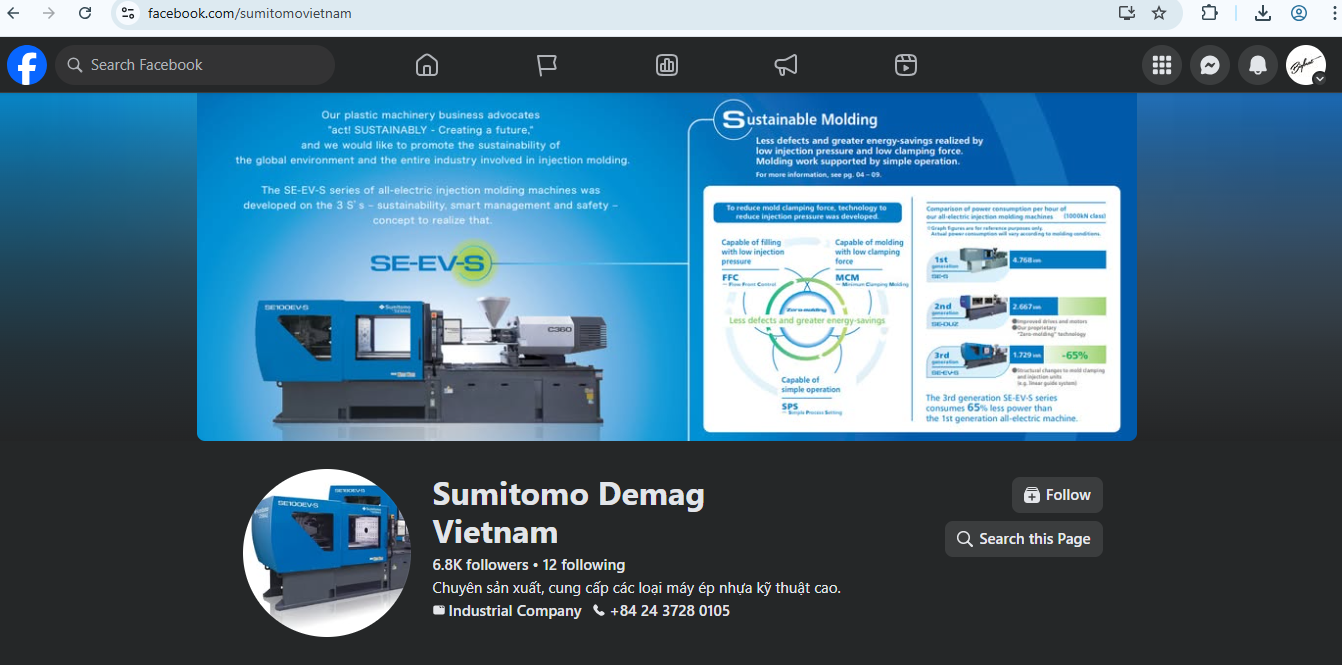
Sumitomo Heavy Industries is a Japan-based maker of industrial machinery. Its Vietnam subsidiary sells plastic injection molding machines to Japanese-affiliated and local Vietnamese companies. Bigbeat handled strategy and overall design. Feedforce Vietnam handled local advertising and Vietnamese-language content.
Targeting covered industries and industrial zones such as Binh Duong and Bac Ninh. Static banners, short product videos and Facebook instant forms drove discovery and inquiries. The Facebook page grew from about 200 to about 7,000 followers, and inquiries arrived consistently, including from contacts with no earlier touchpoint.
Source: https://asean.bigbeat.co.jp/project/shi/
4 mistakes that stall B2B campaigns in Vietnam
- Translating a global playbook word for word instead of localizing the offer and channels.
- Reporting traffic and followers instead of qualified meetings.
- Writing for one buyer when 3 roles sign off.
- Running 5 channels at once with no owner for any of them.
Conclusion
You now have a 5-step strategy, 6 channels matched to funnel stages and 7 metrics that tie marketing to pipeline.
This week, list the technical lead, budget owner and end user at your top 20 target accounts, pick 2 channels, and agree with sales what counts as a qualified meeting.
If you need help turning that strategy into execution, SotaMedia is one option to consider, with experience connecting technical product knowledge, AI-powered content workflows, and lead prospecting.
Frequently asked questions
B2B marketing in Vietnam is the process of reaching and converting business buyers in the Vietnamese market through search, LinkedIn, Zalo, email, events, partnerships and other demand-generation activities.
The strategy has to account for local buyer behavior, language preferences, business relationships and channel usage. The right mix depends on the industry, buyer roles and sales process, not on Vietnam alone.
Six practical groups: search and GEO content, LinkedIn, Zalo and Facebook, email and outbound, events and webinars, and partnerships or KOL and KOC activity.
It can be, when your target audience is active on the platform. LinkedIn is useful for reaching defined professional roles, publishing expert content and supporting account-based outreach. Judge it by qualified engagement and pipeline, not reach alone.
Define the ICP and buying committee, then choose channels based on how those buyers research and evaluate vendors. Search content, LinkedIn, outbound, events and partnerships each support a different stage.
No reliable single benchmark covers all B2B sectors. Cost depends on channel mix, internal resources, content needs, media spend, sales cycle and target account value. Any specific range needs a current source.
Map the Vietnamese ICP, buying roles and decision process. Localize the offer and content, choose channels that match buyer behavior, and decide between an in-house team and a local marketing partner.
Yes, when buyers research products, vendors or technical problems through search. For technical B2B companies, SEO also supports GEO by making product information easier for AI answer systems to retrieve and cite.