



AI Marketing
An AI marketing agency runs content, SEO, paid media, and reporting through AI-assisted workflows. Human strategists set direction and approve every output.
This guide defines the model, shows what the work looks like day to day, and sets out 6 criteria for vetting an agency. It then compares 10 agencies against those criteria.
Key takeaways
- An AI marketing agency automates production and analysis. Strategy, brand judgment, and approvals stay with people.
- The model changes workflow speed and reporting. It does not remove the need for a clear brief.
- Judge any agency on 6 criteria: product understanding, named results, workflow transparency, tool stack, reporting, and contract terms.
- A guaranteed ranking, traffic, or citation number is a red flag.
- The 10 agencies below use the same fields for each entry. Data was collected on 10 Nov 2026.
What an AI marketing agency is
An AI marketing agency plans and runs marketing programs using AI systems for production, analysis, and optimization. Human strategists set direction, review output, and own brand risk. Typical scope covers content, SEO and GEO, paid media, lead prospecting, and reporting.
The difference from a traditional agency is the workflow. Repeatable tasks run through automated pipelines, so the same team handles more volume.
Core services of an AI marketing agency
Content production
The workflow has 5 steps: brief, AI draft, human edit, fact-check, approval. Each step needs a named owner, and the editor and fact-checker should be people, not prompts.
Salesforce’s State of Marketing research found that 63% of marketers using AI use generative AI, and data leaks ranked as their top generative AI concern (Salesforce). That concern is why data handling is one of the vetting criteria below.
Google’s guidance says generative AI can help with research and structure, but producing many pages without adding value for users may violate its scaled content abuse policy (Google Search Central). The same page now tells publishers to fact-check AI output manually before publishing.
SEO and GEO
The workflow covers query research, entity clarity, answer-first page structure, and citation tracking in AI search. GEO has academic backing: a 2023 paper by researchers at Princeton University and IIT Delhi, among others, found that GEO methods can raise visibility in generative engine responses by up to 40%, with results varying by domain (Aggarwal et al., arXiv, 2023).
That figure comes from one benchmark. It is a research result, not a forecast for your site.
Paid media optimization
The workflow combines creative variants, budget pacing, and anomaly alerts. Ad platforms already automate part of it: Google describes Smart Bidding as automated bid strategies that use Google AI to optimize conversions or conversion value in ad auctions (Google Ads Help).
Humans set the targets and approve spend. The agency’s job is to feed the system clean conversion data and catch what it misreads.
Lead prospecting and reporting
This service runs 24/7 prospecting workflows and real-time dashboards. It is where automated execution shows most clearly.
One example from our own work: for an online education client, we built a desktop app that scans, scores, and shortlists KOC profiles, which cut discovery time from 2 to 3 days to a few hours. That is a case-specific result, not a market average.
AI marketing agency vs traditional agency
The table compares the 2 models on neutral criteria.
| Criteria | Traditional agency | AI marketing agency |
|---|---|---|
| Production workflow | Staffed task by task | Automated pipelines with human review |
| Reporting | Periodic decks | Dashboards, often real time |
| Where human time goes | Production and strategy | Strategy, review, and approval |
| Main risk | Capacity limits | Unreviewed output and generic content |
| What to verify | Team seniority | Which tasks are automated and who approves them |
How to evaluate an AI marketing agency
6 evaluation criteria
We use the same 6 criteria for every agency entry later in this guide.
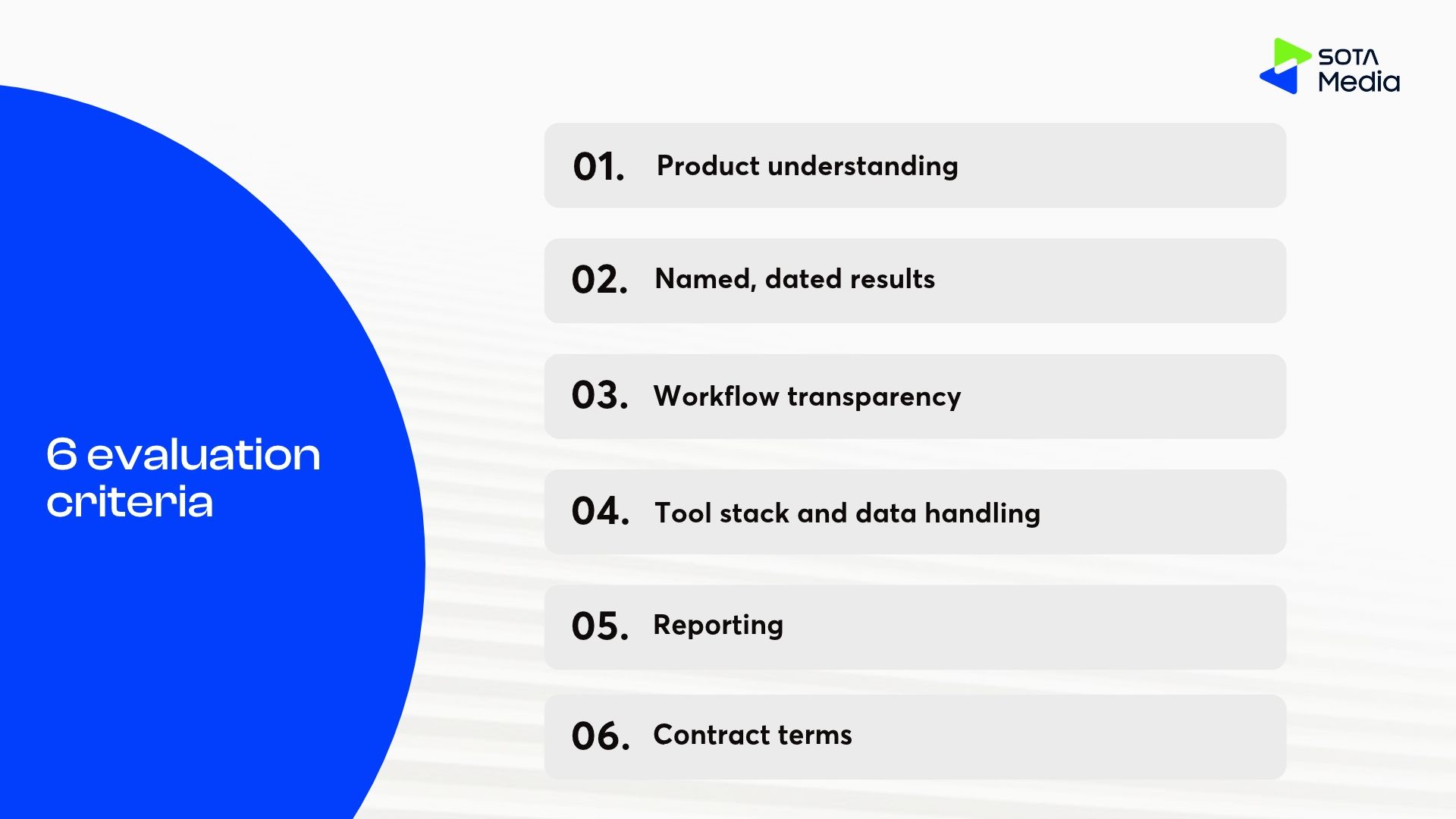
1. Product understanding
Ask the agency to explain your product back to you before it pitches. Technical products need technical writers.
2. Named, dated results
A case study needs a client name, a metric, and a date. Label single-client results as case-specific.
3. Workflow transparency
Request a walkthrough of 1 workflow from start to finish. Ask for a list of what is automated and what is manual.
4. Tool stack and data handling
Ask which models and tools touch client data and where that data is stored.
5. Reporting
Check metric definitions, refresh frequency, and how the baseline was set.
6. Contract terms
Check lock-in, ownership of assets and prompts, and exit terms.
4 red flags
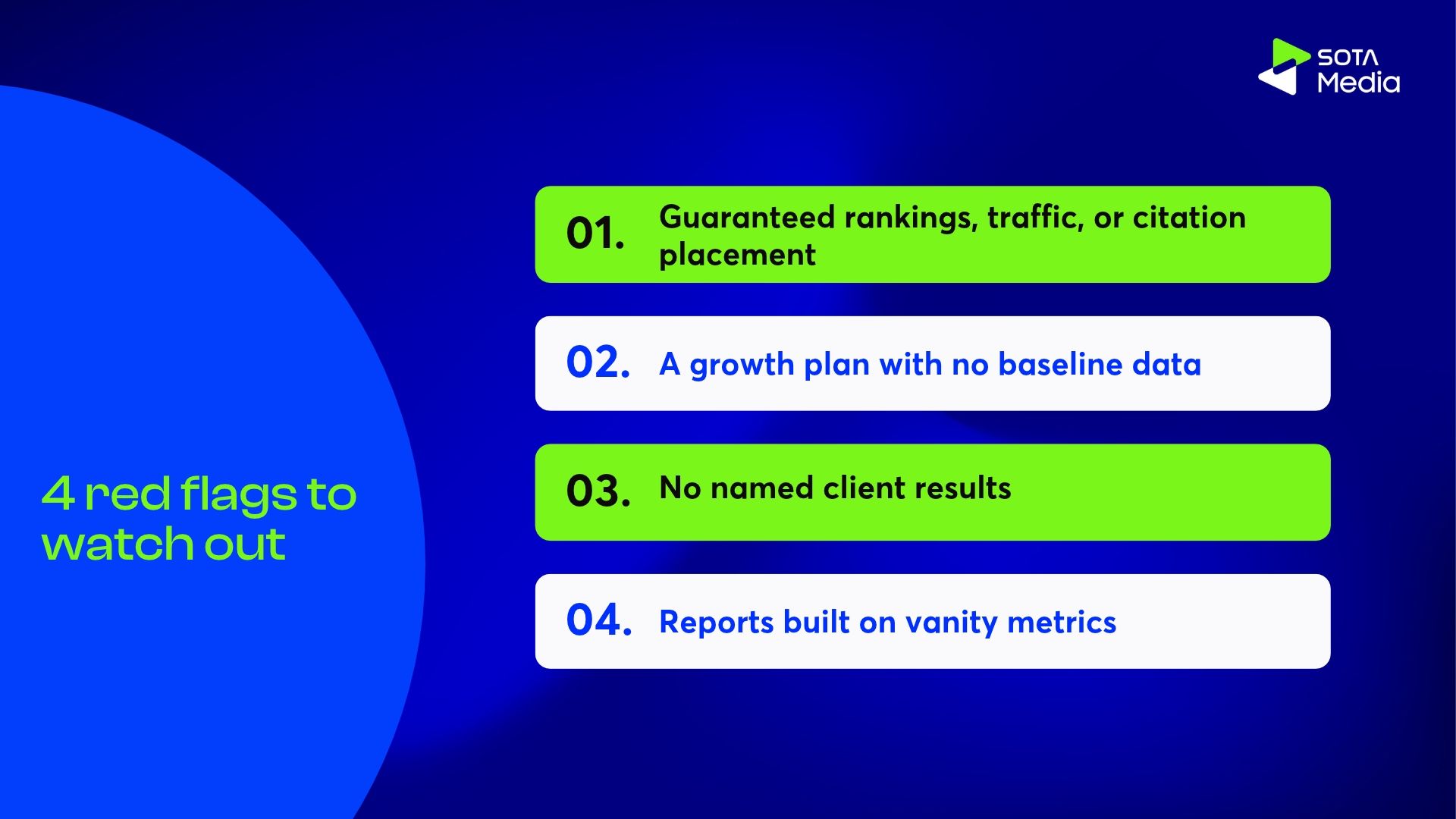
- Guaranteed outcomes. A promised ranking, traffic figure, or AI citation date, since no agency controls Google or an LLM’s output.
- No baseline. A growth plan that skips your current traffic, leads, and cost per lead has nothing to measure against.
- No named results. Case studies that say “a SaaS client” without a client name, metric, and date cannot be checked.
- Vanity metrics. Reports that lead with impressions or follower counts instead of leads, pipeline, or revenue.
10 AI marketing agencies to compare in 2026
Selection criteria and disclosure
We compared agencies on the 6 criteria above, using public information collected in 2026. Agencies are listed in alphabetical order, not by rank. Details may have changed since collection.
The 10 agencies
Each entry uses the same 5 fields. The agency name is the heading, and the website sits on its own line below.
GTM 80/20
Website: gtm8020.com
- Suited for: SaaS and AI companies that want an external demand team.
- Services: SEO, AEO and GEO, paid media.
- Named result: MintMCP, 6 months: from zero organic inbound to consistent enterprise inbound, with appearances in ChatGPT, Claude, Perplexity, and Notion AI answers. The page publishes no numeric metric and no date.
Ignite Visibility
Website: ignitevisibility.com
- Suited for: franchise and multi-location brands.
- Services: SEO, paid media, AI search optimization (GEO and AEO).
- Named result: home services franchise group with 5,500+ locations, 2026: 458% AI visibility growth across 5,000+ blog posts, 20% growth in web leads, 60% faster content deployment.
Jellyfish
Website: jellyfish.com
- Suited for: brands running Google Performance Max campaigns at scale.
- Services: paid media, analytics, AI-driven media optimization (Share of Model).
- Named result: Gentle Monster, pre-holiday period: +39% ROAS on US Performance Max campaigns.
NoGood
Website: nogood.io
- Suited for: SaaS, consumer, and AI brands that want AEO alongside growth marketing.
- Services: AEO and GEO, paid media, creative.
- Named result: SteelSeries, 2025 (narrative runs January to October): 23x year-over-year AI search traffic and 27x year-over-year conversions from AI platforms.
Omniscient Digital

Website: beomniscient.com
- Suited for: B2B SaaS companies investing in organic growth.
- Services: SEO, GEO, digital PR.
- Named result: Convert, 2025: LLM prompt visibility up 81% (31% to 55% of tracked prompts) and AI citation share up 140% (15% to 35%) in 60 days.
Previsible
Website: previsible.io
- Suited for: publishers and brands that need search and AI discovery visibility.
- Services: SEO, GEO.
- Named result: KQED, over 2 years: Google Discover 10x, organic search 2x, Google News 3x.
SEOProfy
Website: seoprofy.com
- Suited for: brands that want to add AI visibility to an SEO program.
- Services: SEO, AI visibility.
- Named result: ATAS (trading analytics software), 6 months: AI citations up 181%, a top 3 position among competitors by AI share of voice, and 4,490 registrations from AI referral traffic.
Website: singlegrain.com
- Suited for: teams that want SEO, GEO, and paid media in one agency.
- Services: SEO, GEO and AEO, paid media.
- Named result: LS Building Products, 6-month engagement: organic traffic up 67% and Google AI Overview mentions up 540%. The page shows no date.
SotaMedia
Website: sota.media
- Suited for: tech companies and founders who need marketing written by people who understand the product.
- Services: AI content pipelines, 24/7 lead prospecting, real-time dashboards.
- Named result: Saydi, 500K+ users and 11% free-to-paid against a 2 to 5% industry average.
WebFX

Website: webfx.com
- Suited for: teams that want SEO, GEO, and paid media backed by in-house platforms (OmniSEO, RevenueCloudFX).
- Services: SEO and GEO, paid media, analytics.
- Named result: Thompson Tractor: traffic from generative AI sources up 586% and leads from AI platforms up 500%.
How to run the selection
Selecting the right AI marketing agency requires more than comparing service packages or pricing. You need to understand how each agency approaches your business goals, applies AI to its workflows, and measures actual marketing performance.
Follow these five steps to make a more informed decision:
1. Write a one-page brief
Before contacting potential agencies, create a one-page brief outlining what your business needs. This helps agencies understand your expectations and provide more relevant proposals. Include three essential elements:
-
Business goal: Define what you want to achieve, such as generating more qualified leads, increasing organic traffic, improving conversion rates, or reducing customer acquisition costs.
-
Marketing channels: Identify the channels you want the agency to manage, such as SEO, paid advertising, content marketing, email marketing, or social media.
-
Baseline metrics: Share your current performance data, including monthly website traffic, conversion rates, cost per lead (CPL), customer acquisition cost (CAC), or marketing ROI.
A clear brief gives every AI marketing agency the same starting point, making their proposals easier to compare.
2. Shortlist three agencies using the six selection criteria
Avoid evaluating agencies based solely on their websites, brand reputation, or promises of AI-powered results.
Instead, shortlist three candidates and assess each against the six criteria discussed above:
-
Industry experience and understanding of your target market.
-
AI capabilities and technology stack.
-
Human expertise and strategic oversight.
-
Transparency in reporting and performance measurement.
-
Relevant case studies and proven results.
-
Pricing structure and scalability.
Create a simple comparison sheet and score each AI marketing agency against these criteria. This makes it easier to identify which agency offers the strongest combination of technical capabilities, strategic thinking, and business value.
3. Ask each AI marketing agency to map automated vs manual tasks
One of the most important questions to ask an AI marketing agency is: Which parts of your marketing process are actually powered by AI, and which still require human expertise?
Request a workflow breakdown for your specific brief.
For example:
| Marketing activity | AI-powered tasks | Human-led tasks |
|---|---|---|
| SEO | Keyword clustering, content gap analysis, reporting | Search strategy, editorial direction |
| Content marketing | Research assistance, content outlines, optimization | Fact-checking, brand voice, final editing |
| Paid advertising | Audience analysis, bid optimization, performance insights | Campaign strategy, budget allocation |
| Email marketing | Segmentation, personalization, automation | Messaging strategy, creative direction |
| Analytics | Data processing, anomaly detection, reporting | Interpretation and business decisions |
The goal is not to find an AI marketing agency that automates everything. It is to understand whether AI meaningfully improves efficiency, consistency, and campaign performance without sacrificing quality.
4. Request one named, dated case study per AI marketing agency
Ask each shortlisted AI marketing agency to provide at least one case study featuring a real client, a clear project timeline, and measurable outcomes.
A credible case study should include:
-
Client and industry: Who was the client, and what market did they operate in?
-
Business challenge: What marketing problem needed to be solved?
-
AI implementation: Which AI tools, workflows, or automation systems were used?
-
Project timeline: How long did the campaign or engagement run?
-
Measurable results: What changed in organic traffic, qualified leads, conversion rates, CAC, or marketing efficiency?
Pay particular attention to how the AI marketing agency connects its AI implementation to actual business outcomes. If possible, ask for a client reference or supporting performance data to validate the results.
5. Agree on a pilot with defined metrics before signing a long contract
Rather than committing to a six- or twelve-month engagement immediately, consider starting with a small pilot project.
A pilot allows your team to evaluate the agency’s communication, execution quality, AI workflows, and ability to deliver measurable results before making a larger investment.
Define the following before the pilot begins:
-
Scope: Specify the channels, campaigns, deliverables, and responsibilities included.
-
Duration: Set a realistic testing period, such as 30–90 days, depending on the marketing channel and expected time to results.
-
KPIs: Agree on measurable indicators such as qualified leads, conversion rates, CPL, content output, or campaign efficiency.
-
Reporting: Establish how frequently the agency will share performance updates and what data will be included.
-
Success criteria: Define what a successful pilot looks like and what would justify expanding the partnership.
Keep in mind that different marketing channels require different evaluation periods. Paid advertising may provide early performance signals, while SEO and organic content typically need more time to demonstrate meaningful growth.
Once the pilot is complete, evaluate the results against your original baseline and business objectives. If the AI marketing agency demonstrates strong execution, transparent reporting, and measurable progress, you can move forward with greater confidence.
Conclusion
An AI marketing agency automates production and analysis while people keep strategy and approvals. The 6 criteria and 4 red flags above separate a documented workflow from a pitch deck.
Your next action is a 1-page brief with a goal, a channel, and a baseline metric. Send it to every agency on your shortlist and ask each one to mark which tasks are automated and which stay manual.
If you need help turning that brief into a working process, SotaMedia is one option to consider, with experience applying AI and automation to marketing execution for tech products.
Frequently asked questions
An agency that runs content, SEO, paid media, and reporting through AI-assisted workflows. Human strategists set direction and approve output. The AI layer handles repeatable production and analysis.
Typical scope includes content production, SEO and GEO, paid media optimization, lead prospecting, and dashboards. Scope varies, so ask which tasks are automated and which stay manual.
The workflow differs. Traditional agencies staff each task with people, while AI agencies run repeatable tasks through automated pipelines and spend human time on strategy and review. Compare team seniority as well as tooling.
Pricing depends on scope, channel mix, and volume. Agencies use retainers, project fees, or performance-linked models.
No. AI handles drafting, analysis, and repetitive production. Strategy, positioning, and brand risk need a named human owner.
Use the 6 criteria: product understanding, named results, workflow transparency, tool stack, reporting, and contract terms. Ask for 1 workflow walkthrough and 1 dated case study.
No agency can guarantee rankings, traffic, or AI citations. Ask for a pilot with a baseline and defined metrics.
Google assesses content on helpfulness, and its spam policies target content made at scale without adding value for users (Google Search Central). Require human review and original detail in every piece.