




AI Marketing
Marketing agency cost depends on 3 variables: the pricing model, the scope of work, and the seniority of the people doing it. Tech companies usually pay through a monthly retainer, a fixed project fee, an hourly rate, or a fee tied to performance. Each model prices risk differently, so the cheapest quote is rarely the cheapest outcome.
This guide covers the 4 pricing models, fees by service, 5 cost drivers specific to tech products, a 5-step budgeting method, and the charges that rarely appear in the first quote.
Key takeaways
- Marketing agency cost is set by 3 things: pricing model, scope, and team seniority.
- 4 pricing models cover most contracts: retainer, project fee, hourly rate, and performance-linked fee.
- Gartner reports an average marketing budget of 7.8% of company revenue in 2026. Use it to sanity-check the agency line, not to set it (Gartner, May 2026).
- Ad spend, software licenses, and production often sit outside the agency fee. Ask for them in writing.
- Tech products take more specialist input to market well, which changes hours and scope. Compare deliverables, not only the monthly number.
Marketing agency cost by pricing model
The pricing model decides who carries the risk: the agency, the client, or both. The table below shows how the 4 common models split it.
| Model | How it is billed | Where the risk sits | Fits |
|---|---|---|---|
| Monthly retainer | Fixed fee per month for an agreed scope | Shared. The agency holds capacity, the client holds the outcome | Ongoing SEO, content, social, paid media |
| Project fee | Fixed fee per defined deliverable | Agency, if the scope is tight | Brand audit, website, launch campaign |
| Hourly rate | Rate x hours logged | Client | Consulting, short fixes, unclear scope |
| Performance-linked | Fee tied to a metric such as leads or revenue | Shifts to the agency, priced into the fee | Mature funnels with clean attribution |
Monthly retainer
A retainer covers a fixed monthly scope: channels, deliverables, and reporting cadence. It fits work where results compound over time, such as SEO and content, because the agency keeps a team available and publishes on a steady schedule.
The client carries the outcome risk, so the scope document matters more than the monthly number. Ask for the deliverable list, the reporting dates, and the notice period before you compare prices.
Project-based fee
A project fee covers a defined output with a start and end date. Ask what counts as a revision and how many rounds the price includes.
This model suits one-off work with a clear brief, such as a brand audit, a website, or a launch campaign. It fits poorly for channels that need months of iteration, because every change after the first version becomes a new quote.
Hourly rate
An hourly rate covers logged time only. Strategy, QA, and account management are often billed as separate lines.
The model works for audits and advisory sessions where the scope is unclear. Costs are hard to forecast, so set a monthly cap and request a time log with each invoice.
Performance-linked fee
A performance-linked fee combines a base fee with a variable part tied to an agreed metric, such as qualified leads or revenue. It needs clean attribution and a metric both sides define the same way.
No agency can guarantee a result, because ranking, conversion, and revenue also depend on the product and the market. Treat any guarantee in a quote as a red flag.
Marketing agency cost by service
Fees differ by service because each service has a different billing unit. The table lists the unit for each one and what the fee usually covers.
| Service | Billing unit | What the fee usually covers |
|---|---|---|
| SEO and GEO | Monthly retainer | Audit, keyword and entity mapping, monthly content, links, reporting |
| Content production | Per asset or monthly | Briefs, writing, technical review, editing, basic design |
| Paid media management | Flat fee or % of ad spend | Setup, campaign management, optimization, reporting. Ad spend is billed separately |
| KOL and influencer campaigns | Per campaign plus talent fees | Creator sourcing, briefing, contracting, reporting. Talent fees are billed separately |
| Full-service marketing | Monthly retainer | Strategy plus 2 or more channels, creative, reporting |
SEO and GEO work splits into 2 parts. The audit and setup phase is a one-time technical and content review, plus keyword and entity mapping.
Ongoing optimization is monthly content, link, and citation work for search results and AI answers. GEO reporting is still maturing, so a good agency reports what it can measure and does not promise AI citations.
Content production
Technical content costs more than general content because the writer has to read the product. A piece on LLM tooling, on-chain data, or SaaS architecture needs someone who understands the subject well enough to catch a wrong claim before it ships.
Ask how the marketing agency matches writers to your topic and who reviews the draft for accuracy.
Paid media management
The marketing agency cost and the media budget are 2 different charges. The cost pays for planning, setup, optimization, and reporting. The media budget goes to the platform, such as Meta, Google, or LinkedIn.
The 2 are billed differently, so a quote that shows only 1 number is incomplete. Ask whether the management fee is flat or a percentage of ad spend, and what happens to the fee when spend changes.
KOL and influencer campaigns
KOL campaigns have 2 cost layers: the agency’s campaign management fee and the talent fees paid to creators. Ask for both lines separately, since talent fees move with reach and format.
Full-service marketing
A bundle beats buying channels one by one when the channels share strategy, creative, and reporting. One team plans the funnel, and the client manages 1 contract instead of 4.
Bundles usually leave out ad spend, software licenses, and heavy production such as video. Read the exclusions line before you read the price.
What drives marketing agency cost for tech companies
Five factors move the quote more than the agency’s brand or location.
Product complexity
A fintech API or a semiconductor inspection tool takes more research hours than a consumer app. Cost rises with the time needed to understand the product, which is why agencies that start from the product brief price differently from agencies that start from a template.
Scope and number of channels
Each extra channel adds strategy, production, and reporting hours. A 1-channel scope, such as LinkedIn content only, needs 1 content calendar and 1 report. A 3-channel scope, such as LinkedIn, paid search, and email, needs 3 calendars, 3 sets of creative, and a combined report.
Team seniority and agency size
Senior strategists bill higher rates. The question to ask is whether that buys fewer revision rounds and faster decisions. Request the names and roles of the people who will do the work, and confirm who attends your weekly calls.
Location and market
Rates differ by market, and an hourly figure alone says little about the final marketing agency cost. Compare scope, output, and reporting across quotes instead.
Automation and tooling
AI content pipelines and live dashboards reduce manual hours, and that changes how an agency prices execution. The saving shows up in the number of hours per deliverable, so ask the agency to state it.
How to set a marketing agency budget
Start from a revenue benchmark
Gartner’s 2026 CMO Spend Survey puts the average marketing budget at 7.8% of company revenue, up from 7.7% in 2025 (Gartner press release, 11 May 2026). The same survey reports that CMOs put an average of 15.3% of marketing budgets into AI initiatives.
Read the figure as context. Gartner surveyed 401 marketing leaders in North America, the UK, and Europe, and most respondents work at large companies, so a seed-stage tech company should not copy the percentage (Gartner, 11 May 2026). Use it to check whether the agency line looks reasonable next to your total marketing budget.
Budget in 5 steps
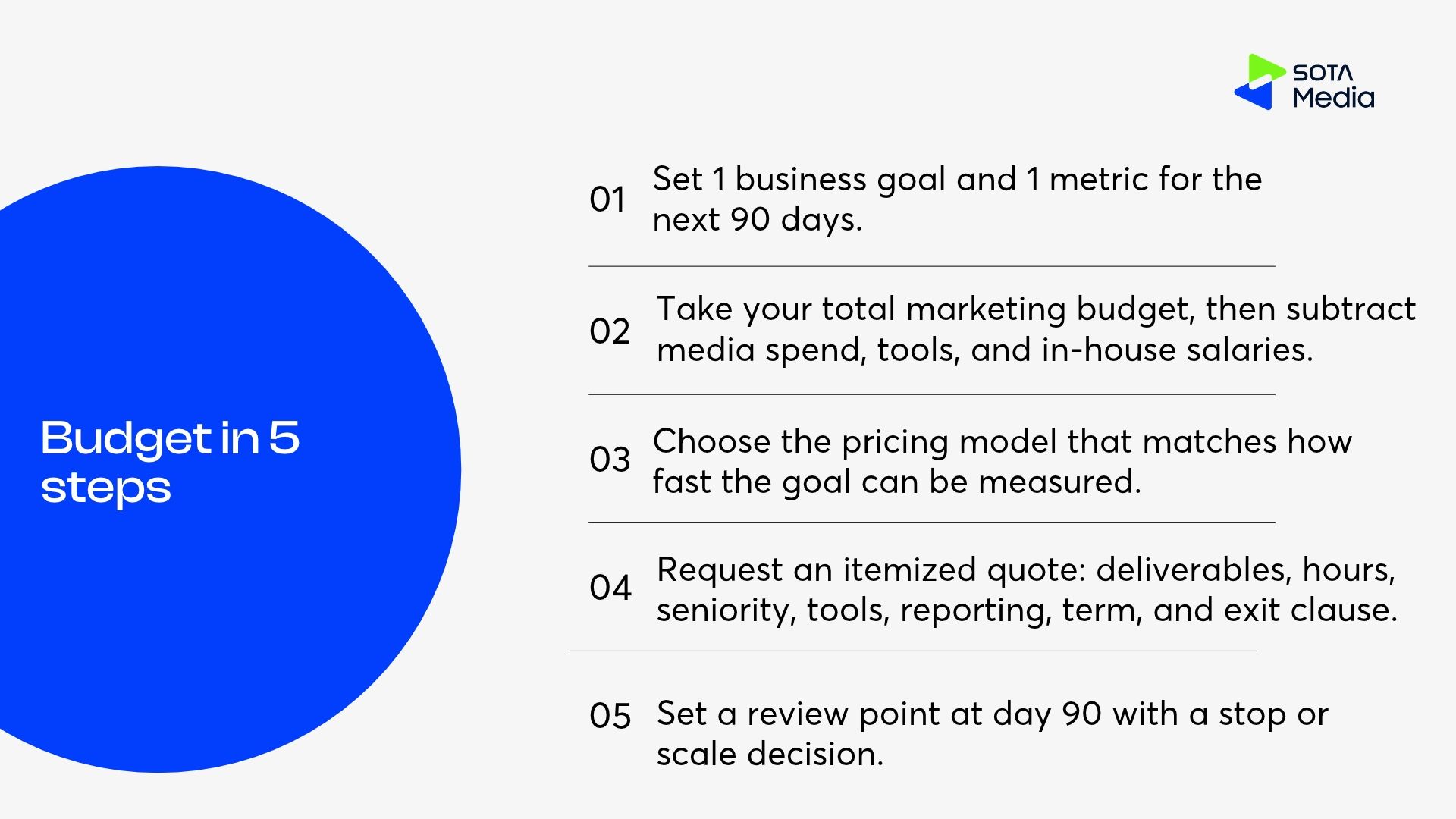
- Set 1 business goal and 1 metric for the next 90 days.
- Take your total marketing budget, then subtract media spend, tools, and in-house salaries. The remainder is the agency line.
- Choose the pricing model that matches how fast the goal can be measured.
- Request an itemized quote: deliverables, hours, seniority, tools, reporting, term, and exit clause.
- Set a review point at day 90 with a stop or scale decision.
Match the model to your stage
The pairings below are planning logic, not statistics. Adjust them to your own cash position and goal.
- Pre-seed and seed: project fees or a small retainer, with a short term.
- Series A and growth: a retainer with defined channels and a monthly reporting cadence.
- Established SME or enterprise: a multi-channel retainer plus project work for launches.
Hidden costs and red flags in agency quotes
Costs that sit outside the quote
Ask the marketing agency cost to confirm in writing whether each of these is included:
- Ad spend paid to platforms
- Software and tool licenses
- Stock, freelance, or video production
- Change orders for scope added mid-contract
- Setup or onboarding fees
Red flags before you sign
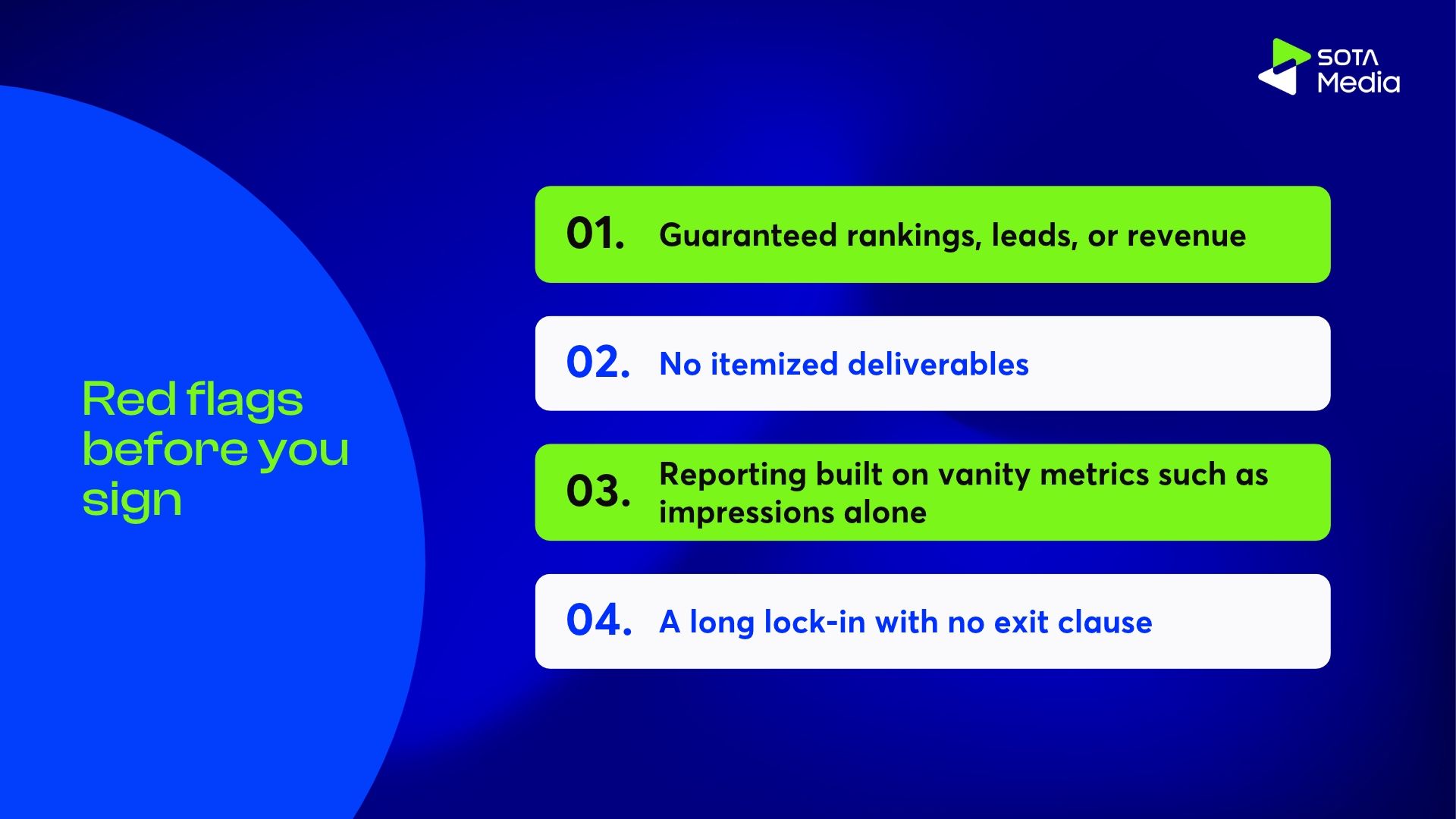
- Guaranteed rankings, leads, or revenue. Rankings and conversion depend on factors the marketing agency cost does not control. Ask for committed deliverables, publishing dates, and a reporting schedule instead.
- No itemized deliverables. “SEO and content, monthly fee” hides what you receive. Ask for the number of articles, audits, and reports per month, with hours and seniority for each.
- Reporting built on vanity metrics. Impressions alone cannot show progress toward your 90-day goal. Ask for qualified leads or cost per lead, with read access to the raw data.
- A long lock-in with no exit clause. A 12-month term with no break point keeps you paying for a plan that stopped working. Ask for a notice period and written confirmation that you own the ad accounts and content.
Conclusion
Marketing agency cost comes down to 3 variables: how you pay, what you get, and who does the work. The 4 pricing models split risk differently. Ad spend and licenses usually sit outside the fee, and tech products add research hours that a generic quote can miss.
Before you request quotes, write 1 goal and 1 metric for the next 90 days. Put every quote into the same itemized sheet, compare cost per deliverable, and set a day-90 review with a stop or scale decision.
If you need help turning that sheet into a scoped quote, SotaMedia is one option to consider, with experience planning strategy, content, and paid media for tech products.
Frequently asked questions
It depends on the pricing model, scope, and team seniority. A single-channel retainer costs less than a multi-channel one, and product complexity adds research hours.
A retainer is a fixed monthly fee for ongoing work. A project fee is a fixed price for a defined deliverable with an end date. Choose a retainer for channels that compound, such as SEO, and a project fee for one-off work.
Usually not. The agency fee covers planning, management, and reporting, while ad spend goes to the platform. Confirm this in the contract and ask how the management fee is calculated.
Gartner reports an average of 7.8% of company revenue in 2026 (Gartner, May 2026). Treat it as a reference point, since your stage, margins, and growth goal decide the real figure.
Not by default. The agency prices the risk it takes into the fee, and the metric needs clean attribution. No agency can guarantee a result, so read how the metric is defined and who owns the data.
It varies by channel. Paid media can show data within weeks, while SEO and content build over months. Ask for milestones by month instead of accepting a single end date.
Rates differ by market, but a lower rate does not mean a lower total cost. Compare deliverables, seniority, and reporting.
Put every quote into the same sheet: deliverables, hours, seniority, tools, reporting cadence, contract term, and exit clause. Then compare cost per deliverable, not the monthly total.