




Branding and Strategy
A go-to-market strategy (GTM) is the plan for getting a product in front of the right buyers and turning them into paying customers. Tech companies need one before launch, when entering a new segment, and when growth stalls.
The job is harder than it was a few years ago. Gartner surveyed 632 B2B buyers in August and September 2024 and found that buying groups now include 5 to 16 people from as many as four functions, and that 74% of those groups show unhealthy conflict while deciding. McKinsey’s 2024 B2B Pulse, which polled nearly 4,000 decision makers across 13 countries, puts the average buyer at ten interaction channels, up from five in 2016. A launch plan built around one channel and one persona misses most of that.
This guide walks through a six-part go-to-market strategy framework, the US-specific requirements that affect it, a 90-day plan, and the mistakes tech teams repeat. It is written for founders, heads of marketing, and product leaders planning their 2027 roadmap.
What a go-to-market strategy includes
A go-to-market strategy answers five questions. Who are you selling to? What problem do you solve for them? Why should they pick you over the alternatives? How will they pay? How will they find you and buy?
Those questions map to the parts of a go-to-market strategy covered below: target market and ideal customer profile (ICP), positioning, pricing, sales motion, and channels. Metrics tie the parts together so you can tell which one is failing.
A go-to-market strategy is also wider than a marketing plan. A marketing plan covers campaigns and content. A go-to-market strategy decides pricing, who sells, how onboarding works, and which customers you turn down. Marketing carries out one slice of it.
Why a go-to-market strategy is harder going into 2027
Three shifts change the work.
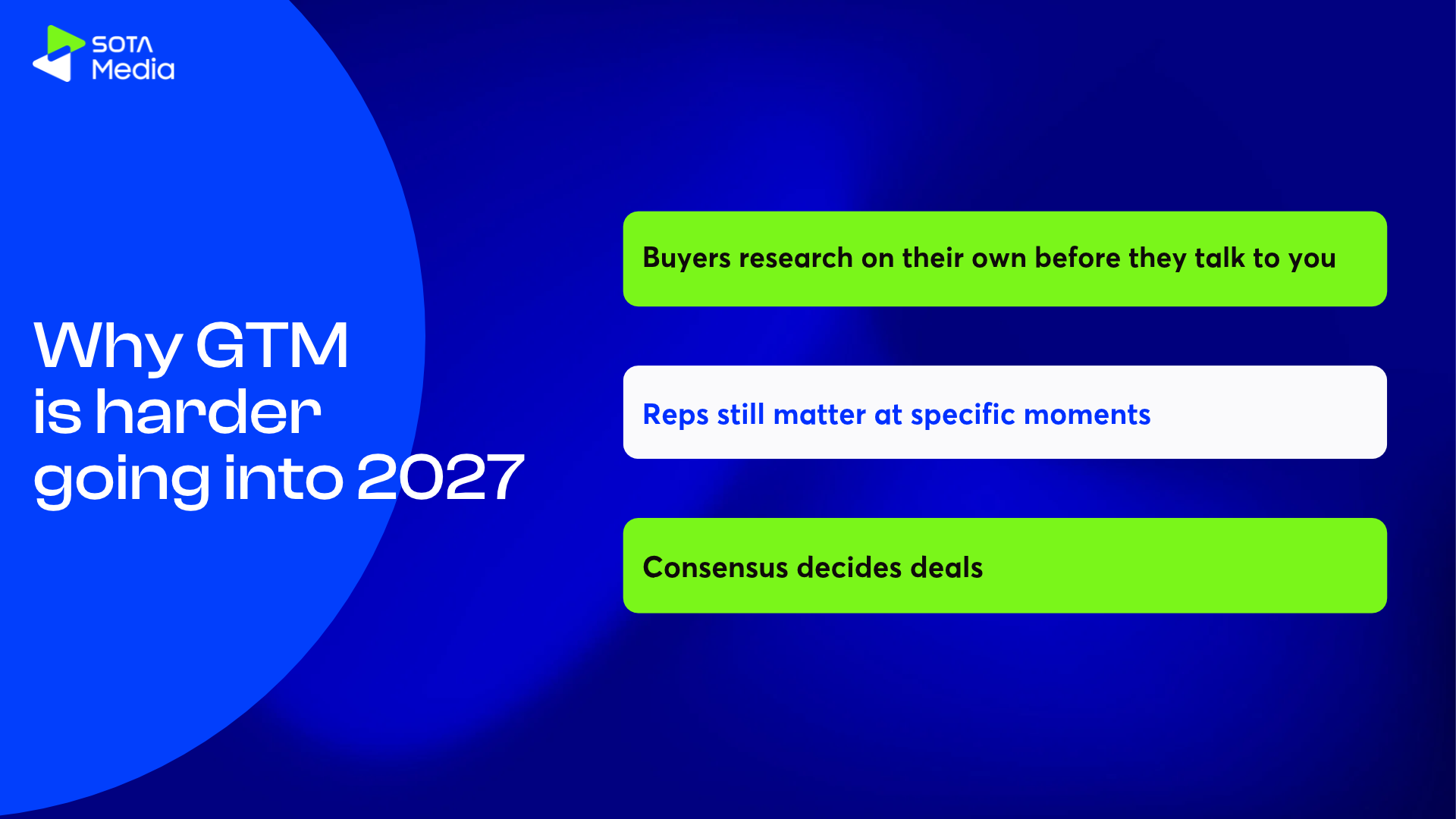
Buyers research on their own before they talk to you
Gartner’s May 2026 release, based on 645 B2B buyers surveyed in August and September 2025, found that buyers used an average of seven information sources in a recent purchase, 45% used generative AI (mostly to research vendors and products), and 70% preferred a fully digital, self-service buying experience. Your website, documentation, and third-party profiles now do part of the selling before a rep gets involved.
Reps still matter at specific moments
The same survey found that 69% of buyers prefer to check AI-generated findings with a sales rep. Reps remain the most important source when buyers define the business problem, choose a preferred supplier and build internal support, and finalize the purchase.
Consensus decides deals
In Gartner’s 2024 survey, buying groups that reached consensus were 2.5 times more likely to report a high-quality deal. Messaging tailored to the whole buying group improved consensus by 20%, while messaging aimed at individual relevance reduced it by 59%. Selling to a single champion is no longer enough.
The six-part GTM framework
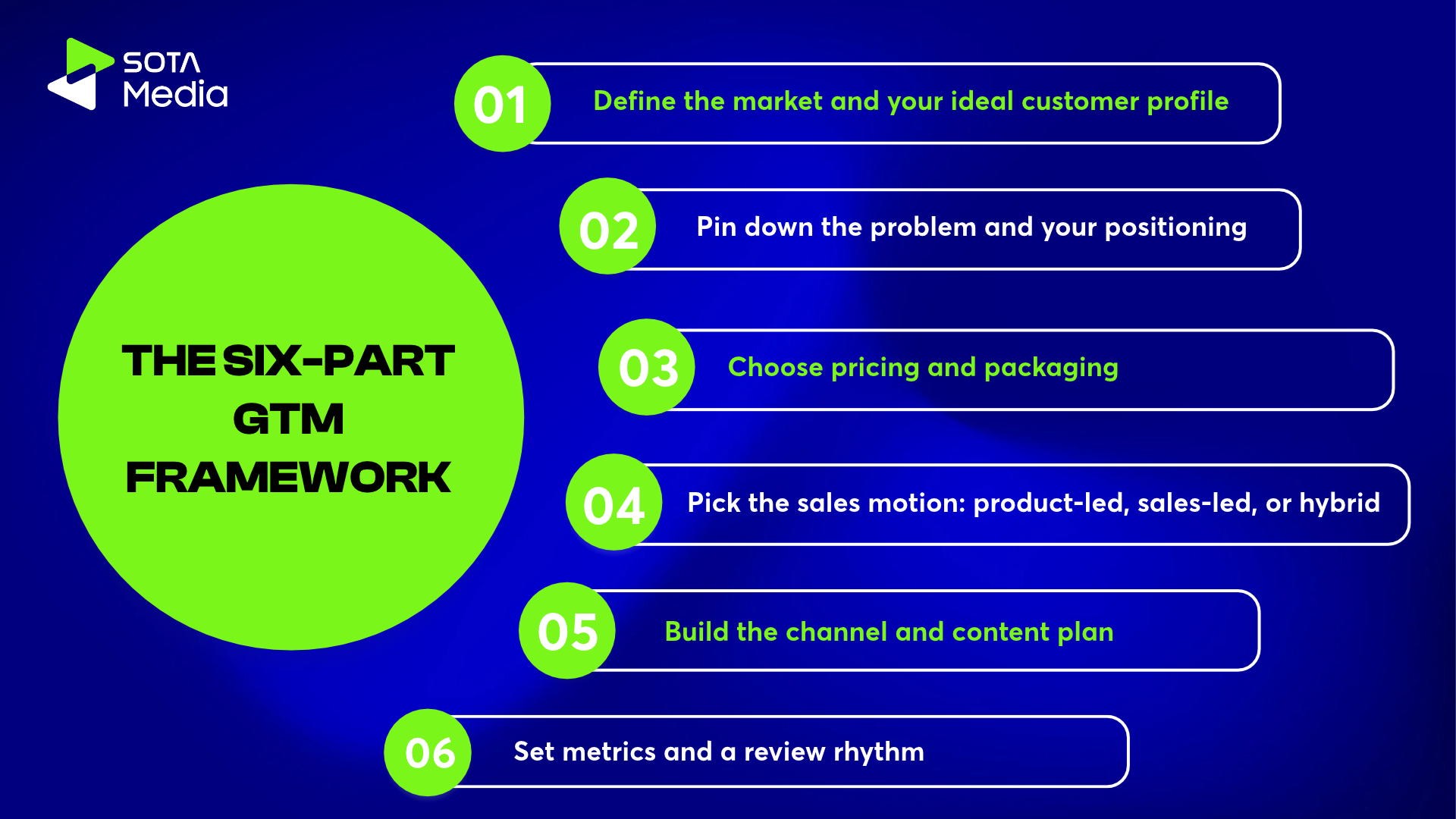
1. Define the market and your ideal customer profile
Count the US companies that could buy, have the problem you solve, and are reachable with your team and budget. That number is your starting market. Then write the ICP: industry, company size, state or region, and the triggers that make a company ready to buy, such as a funding round, a migration, or a new compliance rule.
Add a buying committee map of who uses the product, who pays, who approves security or legal, and who can block the deal. Gartner’s finding that group-level messaging raises consensus is the reason to do this before you write copy.
2. Pin down the problem and your positioning
Positioning states who the product is for, what category it competes in, and why it wins. Use the jobs-to-be-done lens from Clayton Christensen and his co-authors: describe the situation, the alternative customers use today, and the outcome you deliver. Our guide to tech brand strategy covers how to build that foundation.
3. Choose pricing and packaging
Decide what you charge for (seats, usage, outcomes, or a flat fee), how you package it, and how people start (free trial, freemium, demo, or pilot), and price in US dollars. Self-serve products suit a trial or freemium plan. Products that need integration or a security review suit a paid pilot and an annual contract.
Gartner found that 70% of buyers prefer a fully digital, self-service experience, which is a reason to publish at least your entry-tier price. Test the price with real buyers before launch.
4. Pick the sales motion: product-led, sales-led, or hybrid
A sales-led motion relies on reps, a product-led motion lets users start and expand on their own, and a hybrid motion combines both. The buyer data points toward hybrid: in McKinsey’s 2024 survey, online sales accounted for 34% of revenue for B2B respondents, and 69% of buyers in Gartner’s 2026 survey still prefer to check AI-generated findings with a sales rep.
Choose by contract value, time to value, and number of approvers. Then write down the handoff: which buying signals move an account to a rep, who owns it, and what response time you promise. For the tooling side, see our AI marketing automation guide.
5. Build the channel and content plan
McKinsey’s ten-channel average means no single channel carries a launch. Pick a small set your ICP already uses, such as search, LinkedIn, review sites, events, or cloud marketplaces like AWS Marketplace, and give each one a job. For current trends, see our overview of B2B content marketing in 2026.
6. Set metrics and a review rhythm
Track one leading and one lagging number per stage: qualified traffic for awareness, ICP-matched demo requests for demand, win rate and sales cycle length for sales, and net revenue retention for retention. Also watch customer acquisition cost (CAC), the months of gross margin needed to pay it back, and the ratio of customer lifetime value to CAC. Set thresholds from your own margins and runway, review activity weekly and pipeline monthly, and revisit positioning, pricing, and ICP quarterly.
Adapting your go-to-market strategy for the US market
Security reviews and SOC 2
Expect a security review. A SOC 2 report is an examination of a service organization’s controls against the AICPA’s Trust Services Criteria for security, availability, processing integrity, confidentiality, or privacy, and it gives a buyer’s security team a standard document to read. Start before you need one, since a buyer who asks for a report you do not have will pause the deal.
Federal sales and FedRAMP
If you plan to sell to federal agencies, learn FedRAMP early. FedRAMP covers cloud products and services that maintain federal information on behalf of a federal agency, and agencies must promote FedRAMP Certified services when a use falls within its scope. Each agency decides whether a given use case is in scope, so ask the agency before you plan the work.
State privacy rules
Privacy rules vary by state, so review each state where you have users. California’s thresholds, covered above, are a place to start.
Local proof and billing
Collect US references early. A case study from a US customer in your target segment answers the question buyers ask about whether you already work with companies like theirs. Set up US dollar billing and a support window that covers US business hours.
Start with one vertical or region
Pick one vertical or region first and expand after it works. The US is too large to market to as a single audience, and each segment has its own triggers, buyers, and channels.
A 90-day GTM plan
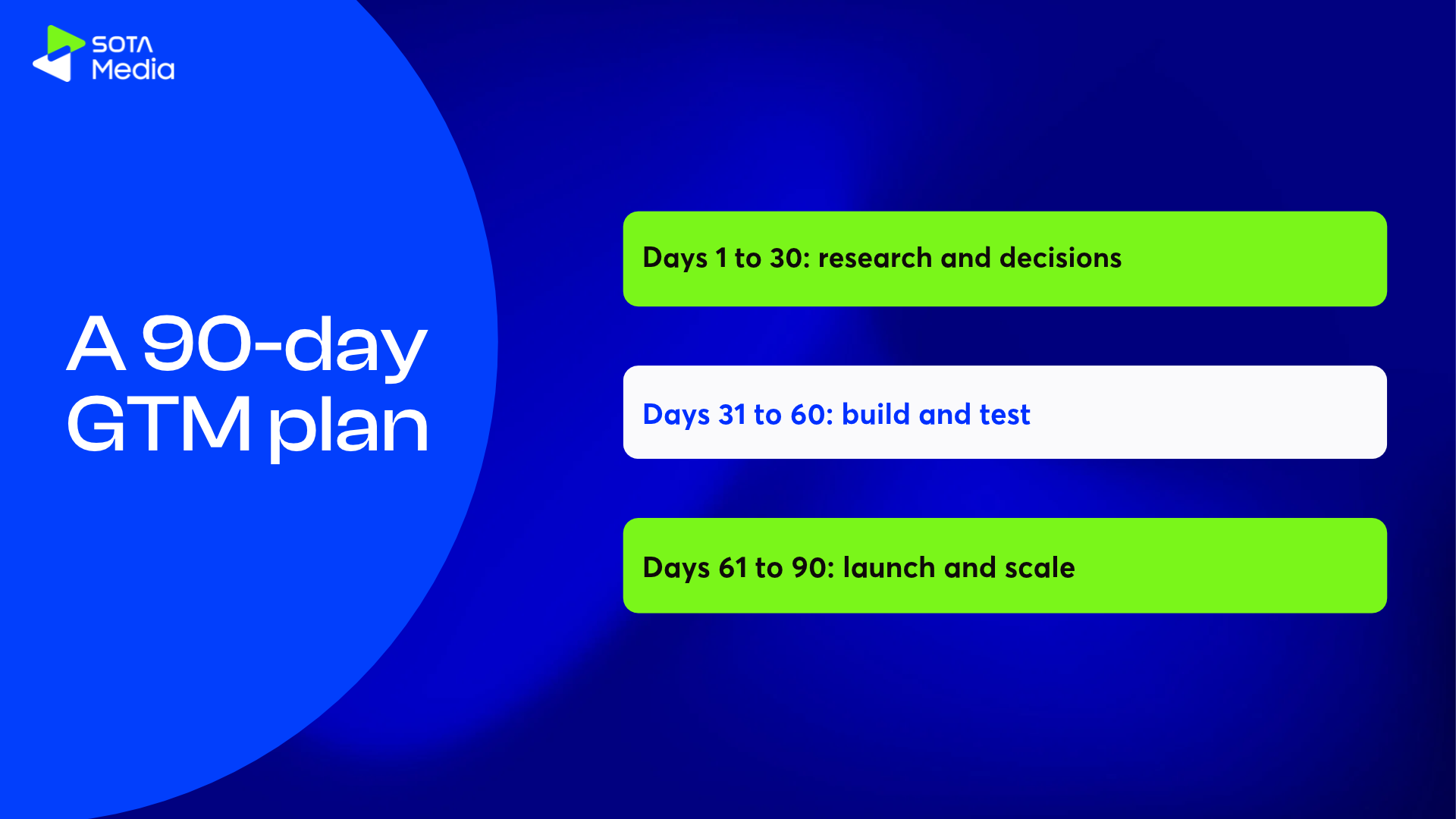
Days 1 to 30: research and decisions
Run customer interviews, draft the ICP and buying committee map, write the positioning, and choose the pricing model and sales motion. The output is a one-page go-to-market strategy brief that product, sales, and marketing all sign off on.
Days 31 to 60: build and test
Ship the website pages, sales assets, onboarding flow, and tracking, and start the security documentation your target buyers will ask for. Run a small pilot with 10 to 20 target accounts, measure conversion at each step, and fix the weakest step.
Days 61 to 90: launch and scale
Put budget behind the channels that produced qualified pipeline, cut the ones that did not, and hold the first quarterly review.
Common go-to-market strategy mistakes
Targeting everyone
A broad market feels safer, but it spreads budget across segments with different triggers and buying committees. Pick one segment, win it, and expand from there.
Treating launch as a date
A launch day creates a spike. Pipeline comes from the weeks of testing and fixing before and after it.
Selling to one person
If the champion cannot explain the value to finance, security, and the end users, the deal stalls. Gartner’s consensus data says the same thing from the buyer side.
Counting activity instead of pipeline
Impressions, posts, and email sends feel like progress. Agree on one definition of a qualified lead across marketing and sales, and report on how many become opportunities and customers.
How the framework changes by company stage
Before product-market fit
Work with one segment, sell founder-led, and spend your time on interviews. Skip scaling channels until the Ellis survey and retention data show that users want the product.
Early growth
Turn what worked into a repeatable motion. Document the ICP, hire the first marketing and sales roles, and standardize onboarding. If you want outside help with growth, see our growth marketing agency guide for what they do and what they cost.
Scale-up or a new market
Extend your go-to-market strategy to new segments or regions one at a time. Bring in partners and specialized roles, and keep a single GTM brief that each team updates. If you bring in outside help, our guide to choosing a B2B tech agency lists what to check.
Where to start this week
Pick the three customers who renewed or expanded fastest and interview them this week. Their answers give you a first draft of your ICP, your positioning, and the triggers to target. Then write the one-page GTM brief and share it with product, sales, and customer success.
Conclusion
A 2027 go-to-market strategy for the US starts with a clear ICP and buying committee, then positioning, pricing, a sales motion that fits your contract value, a small set of channels, and the compliance documents your buyers will ask for. Buyers research on their own, bring large groups into the decision, and still want a person at the moments that matter, so each part has to work across self-service and sales. Test the plan in 90 days and revisit it every quarter. Talk to SotaMedia if you want a B2B tech marketing team to build and run your US go-to-market plan with you.
Frequently asked questions
A go-to-market strategy is the plan for reaching the right buyers and turning them into paying customers. It covers the target market, positioning, pricing, sales motion, and channels, plus the metrics that show which part is failing.
The strategy sets the decisions: who you sell to, why they pick you, how you price, and who sells. A go-to-market plan turns those decisions into dated actions, owners, and budgets, such as the 90-day plan in this guide.
B2B deals involve buying groups that span several functions, including finance, security, and legal. A B2B go-to-market strategy needs a buying committee map and messaging for each member, not only for the champion who found you.
SaaS adds pricing and packaging, self-serve or sales-led onboarding, and renewal and expansion to the plan. A go-to-market strategy for SaaS should track retention and expansion next to new pipeline, because recurring revenue depends on customers staying.
Check the privacy rules in each state where you have users, set up US dollar billing, collect US customer references, and offer a support window that covers US business hours. Start with one vertical or region and expand after it works.
This guide uses a 90-day plan: days 1 to 30 for research and decisions, days 31 to 60 to build and test, and days 61 to 90 to launch and scale. Treat it as a starting point and adjust it to your team and market.