


Omnichannel Digital Marketing
ChatGPT Ads are opening a new way for businesses to reach customers while they research products, compare options, and make decisions.
Unlike traditional search and social advertising, ChatGPT Ads appear within a conversational AI experience, creating opportunities to connect with users based on what they are trying to accomplish.
This guide explains the platform, compares it with other advertising channels, and covers the steps to launch and optimize a ChatGPT Ads campaign in 2026.
What Are ChatGPT Ads?
ChatGPT Ads are paid advertisements displayed within the ChatGPT experience. They allow businesses to promote products and services to users whose conversations may be relevant to their offerings.
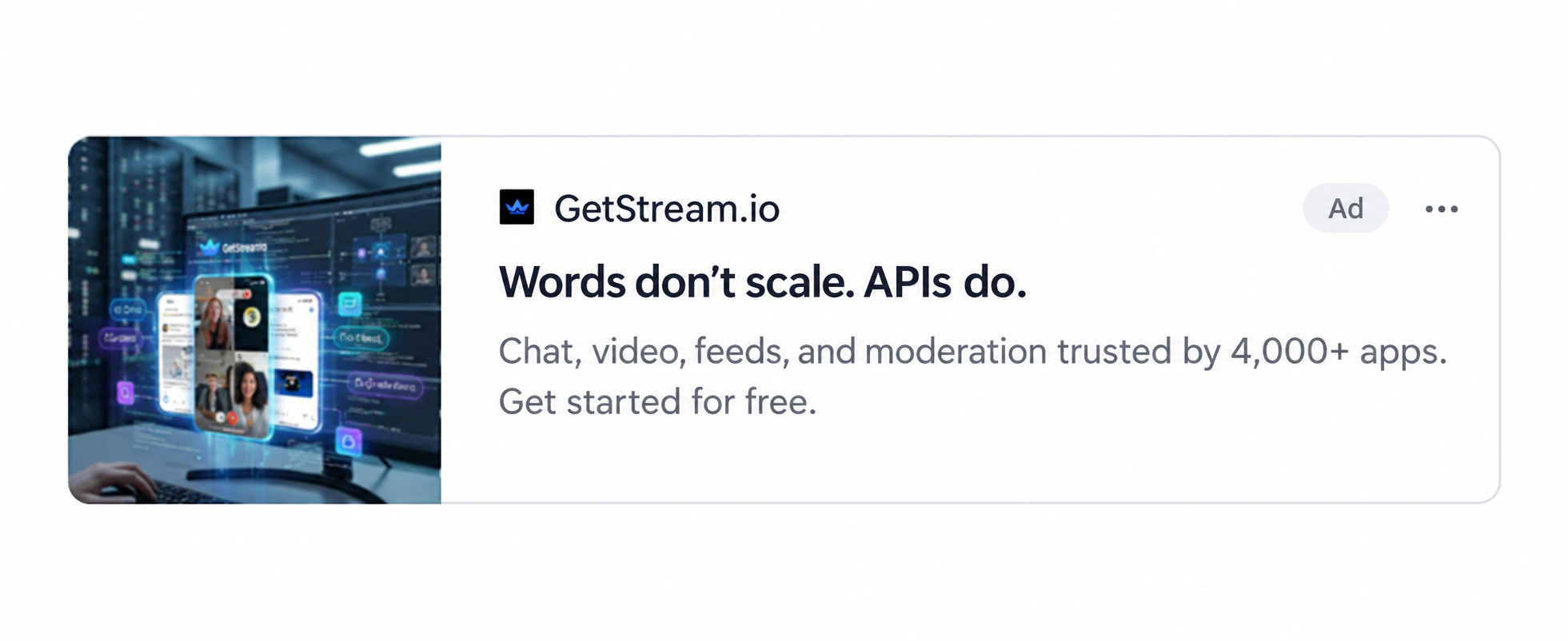
Ads appear below ChatGPT responses and are clearly separated from organic answers. An ad can include the advertiser’s name, logo, headline, description, image, and landing page.
For example, someone researching project management software may encounter a relevant advertisement while exploring tools for their team.
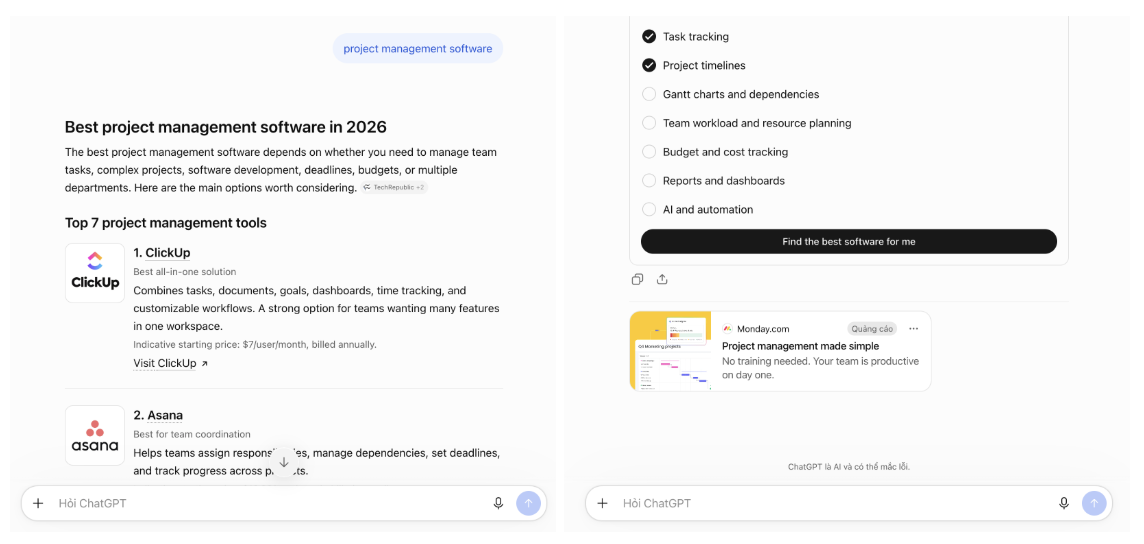
ChatGPT Ads are designed to support relevant discovery without allowing advertisers to influence ChatGPT’s answers. Advertisers also do not receive users’ private conversations or chat history.
How ChatGPT Ads Work
ChatGPT Ads use conversational context and advertising relevance to determine which ads may be appropriate for a user.
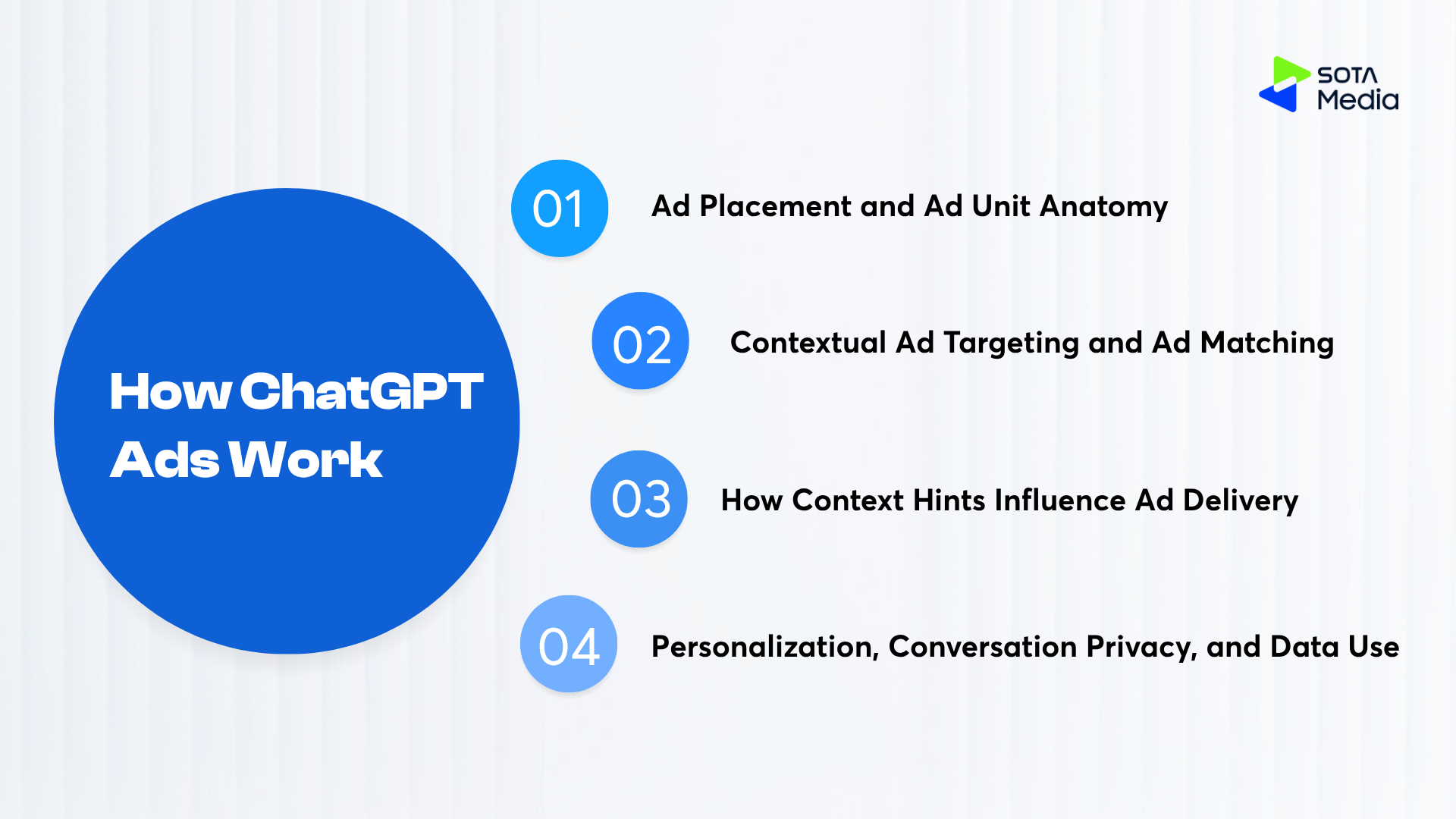
Ad Placement and Ad Unit Anatomy
Ads appear below ChatGPT responses when a relevant match is available. Each ad is clearly labeled and visually distinct from the assistant’s answer.
This placement gives businesses an opportunity to reach users while they are actively exploring a topic, evaluating a product, or considering a purchase.
Contextual Ad Targeting and Ad Matching
OpenAI considers several signals when matching ads, including the current conversation’s context and intent, the ad’s content, its landing page, advertiser-provided context hints, and selected personalization signals when enabled.
This differs from relying exclusively on a typed search query or predefined audience segment. However, relevance does not guarantee that a particular ad will appear in a specific conversation.
How Context Hints Influence Ad Delivery
Advertisers can add context hints at the ad-group level to explain what their products offer, who they help, and when they are useful. Hints should be specific, accurate, and relevant. They guide ad matching but are not exact-match keywords or delivery guarantees.
Personalization, Conversation Privacy, and Data Use
When ad personalization is enabled, selected signals from a user’s broader ChatGPT experience may help determine ad relevance. Advertisers do not receive the underlying conversations, memories, or personal details.
This separation is important for marketers because effective advertising must remain relevant without compromising user trust.
What Are the Differences Between ChatGPT Ads vs. Google Paid Search, Meta Ads, & TikTok Ads
Each platform serves different advertising needs. The right choice depends on where customers discover products, how they evaluate options, and what action the business wants them to take.
| Feature | ChatGPT Ads | Google Search Ads | Meta Ads | TikTok Ads |
|---|---|---|---|---|
| Targeting Approach | Conversation context, ad relevance, context hints, and supported audience settings | Search keywords, queries, and campaign targeting | Audience, demographic, interest, and behavioral signals | Demographics, interests, behaviors, and audience signals |
| Ad Placement | Sponsored ads below ChatGPT responses | Sponsored search results | Feeds, Stories, Reels, and other placements | In-feed video and other supported placements |
| User Context | Exploring options, comparing solutions, and researching needs | Actively searching for information or products | Browsing social content and discovering products | Discovering content, trends, and products |
| Ad-Free Access | Ads are not shown on eligible paid plans, including Plus, Pro, and Business/Enterprise | Search ads can appear regardless of the user’s Google subscription status | Depends on product, region, and available subscription options | Ads generally appear in the standard ad-supported experience |
How ChatGPT Ads Compare with Other Advertising Platforms
ChatGPT Ads differ because the surrounding conversation can provide context about a user’s needs. Google Search Ads primarily respond to search intent, while Meta and TikTok offer established advertising formats built around social content and audience engagement.
These channels can complement one another rather than compete directly.
Which Advertising Platform Best Fits Your Marketing Goals?
Choose Google Ads when capturing existing search demand is the priority. Consider Meta or TikTok when visual storytelling, audience reach, or social discovery plays a major role.
ChatGPT Ads may be worth testing when your product solves a specific problem that people commonly explore through AI-assisted research.
The best approach is to choose the platform that matches your audience’s intent and buying journey, then test performance against clear business goals. Compare qualified leads, conversion rates, and acquisition costs rather than relying on clicks or impressions alone.
Why ChatGPT Ads Matter for Marketers & B2B Growth
ChatGPT Ads create another potential touchpoint in the customer journey, particularly when people use AI to understand a problem or evaluate possible solutions.
Why ChatGPT Ads Matter for Marketers & B2B Growth
Capturing Buyers in the AI-Assisted Research Phase
Improving Traffic Relevance and Conversion Opportunities
Integrating Paid ChatGPT Ads with Organic AEO/GEO Strategies
Capturing Buyers in the AI-Assisted Research Phase
ChatGPT Ads gives brands an opportunity to reach potential buyers while they actively research problems, explore solutions, and compare options through AI conversations.
For B2B marketers, this creates another way to connect with audiences during the early stages of the buying journey, when they are still defining their needs and evaluating possible solutions.
Improving Traffic Relevance and Conversion Opportunities
Because ChatGPT Ads can use conversational context to match ads with relevant topics, they may help businesses reach users whose current interests align with their offerings.
This creates an opportunity to attract more relevant traffic and guide potential customers toward useful resources, product pages, or demos.
Integrating Paid ChatGPT Ads with Organic AEO/GEO Strategies
Paid ChatGPT Ads can complement organic Answer Engine Optimization (AEO) and Generative Engine Optimization (GEO).
While paid ads provide additional opportunities to reach relevant audiences, AEO/GEO helps brands increase their chances of appearing in AI-generated answers.
Together, these approaches allow businesses to build visibility through both paid placements and organic discovery.
ChatGPT Ads Examples: How Stream Turns Developer Questions into Qualified Sales Opportunities
Context
Stream provides real-time communication APIs and SDKs for chat, video, audio, activity feeds, and moderation. As developers increasingly use AI assistants to solve technical problems, Stream saw an opportunity to reach potential buyers while they were actively exploring solutions.
What Worked
Stream tested ChatGPT Ads with messaging tailored to specific developer needs, such as adding chat or video capabilities to an application. Rather than relying on broad audience targeting, the campaign focused on relevant technical questions and presented Stream as a natural next step for developers ready to build.
Results
During the test from June 5 to August 5, 2026, Stream reported:
- 2× ROAS from its developer-focused campaign.
- Over 70% of ad clicks resulted in website sessions, compared with less than 10% for the other channels tested.
- ChatGPT Ads generated sign-ups and sales opportunities, according to Stream’s internal campaign data.
Why It Worked
The campaign aligned ad messaging with the technical problems developers were actively trying to solve. This gave Stream an opportunity to reach potential buyers in a relevant context and guide them toward a practical solution.
The results suggest that, for specialized B2B products, matching ads to users’ needs can help turn engagement into measurable business outcomes.
Step-by-Step Guide to Launching a Campaign in ChatGPT Ads Manager
Launching a ChatGPT Ads campaign involves more than setting a budget and uploading creative assets. Advertisers need to align their campaign goals, measurement setup, context hints, and landing pages to reach relevant audiences and evaluate performance. The following steps explain what to configure and the decisions worth making before launch.
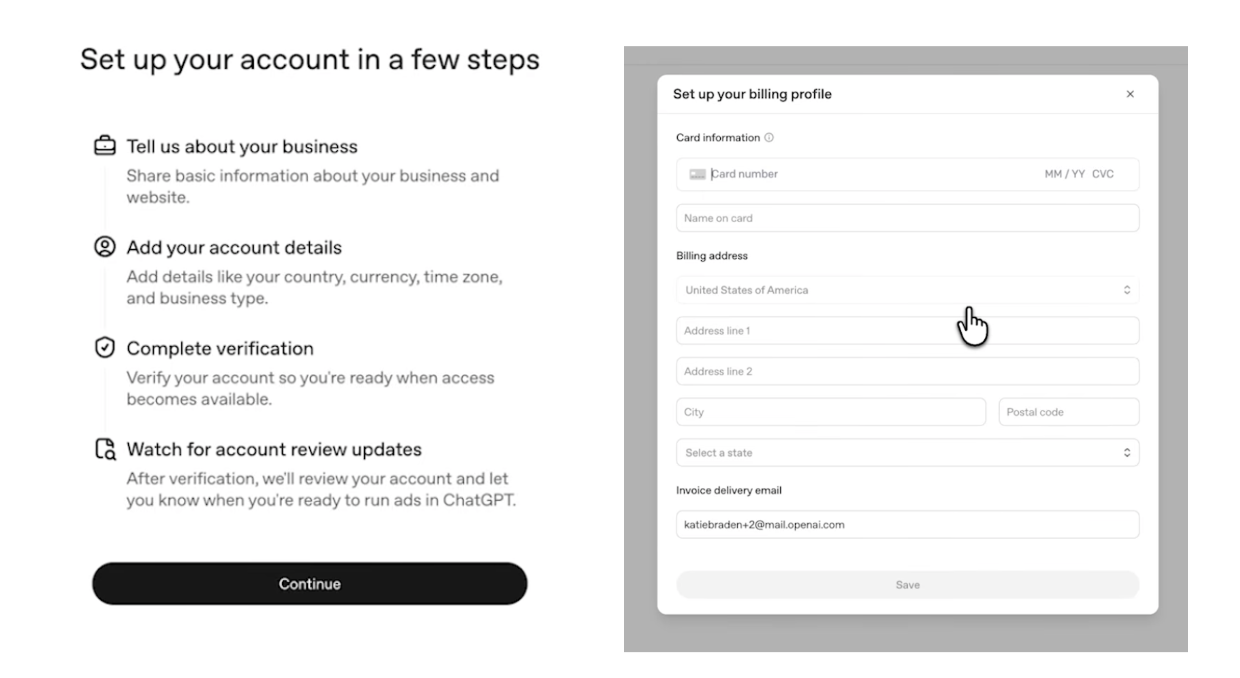
Step 1: Create Your Ads Manager Account and Complete Verification
Sign in to OpenAI Ads Manager, set up your business profile, configure billing, and complete the required verification. Keep your business information and brand assets consistent, and confirm account access before launch to avoid delays during campaign setup.
Step 2: Set Up Conversion Measurement Before Spending
Before launching, define your primary conversion goal, such as a lead submission, registration, or purchase. Set up the OpenAI Pixel or Conversions API (CAPI) and use UTM parameters to track campaign traffic in analytics tools. Test your tracking setup before spending to ensure you can measure actual conversions and evaluate campaign performance accurately.
Step 3: Choose a Campaign Objective That Matches Your Goal
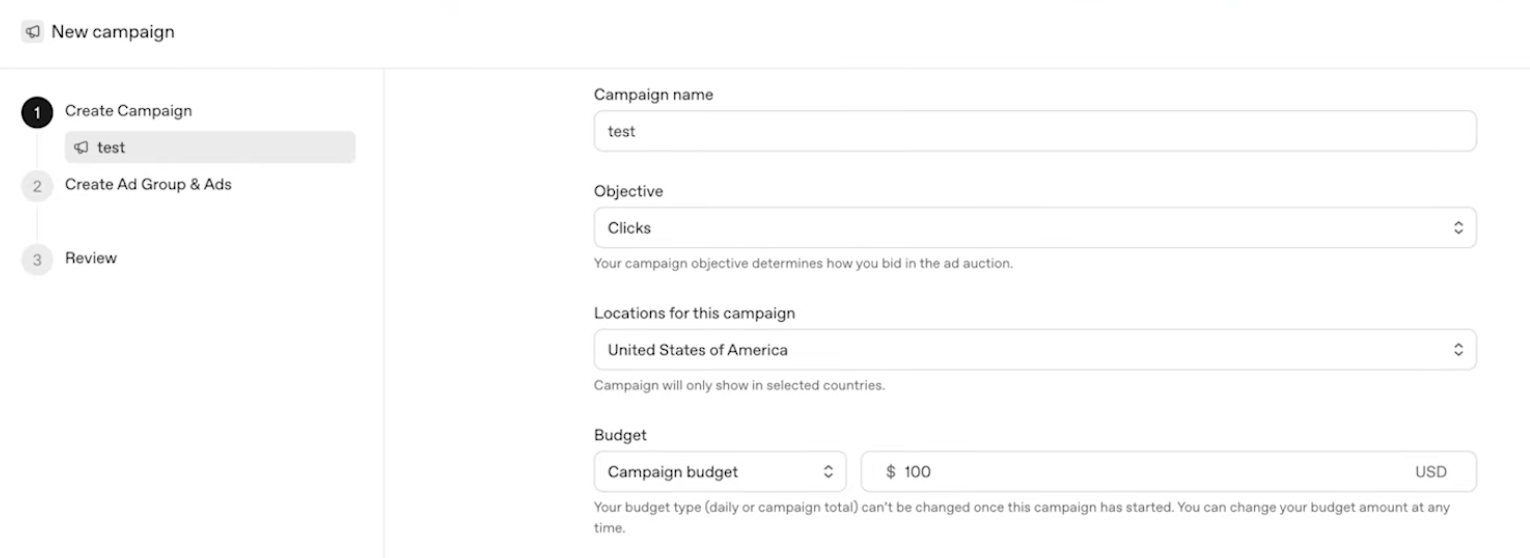
Choose your campaign objective based on your primary goal: Views (CPM) for brand awareness, Clicks (CPC) for website traffic, or Conversions to drive specific actions such as lead submissions or purchases.
Each objective uses different optimization and billing approaches, so track relevant metrics such as impressions, CTR, CPC, conversion rate, and cost per conversion to evaluate performance.
Check the available options in Ads Manager before creating your campaign, as objectives and billing models may vary, and changing your selection later may require a new campaign.
Step 4: Set Your Budget, Schedule, and Geographic Targeting
Set a budget that your team can afford to test, then choose the schedule and locations that match your intended audience.
Geographic options and minimum budget requirements can vary by market, so use the current options displayed in Ads Manager rather than relying on a fixed list of supported countries.
How to plan your budget:
- Start with a test budget: Allocate enough to gather useful delivery and performance signals without committing your full budget before you understand the results.
- Account for the buying cycle: B2B campaigns may need more time to observe qualified leads and downstream outcomes than campaigns promoting a simple purchase.
- Avoid changing too many variables at once: If you change the budget, targeting, context hints, and creative simultaneously, it becomes harder to identify what caused a performance change.
Step 5: Structure Ad Groups and Write Useful Context Hints
Ad groups organize campaigns around related topics or buyer needs, while context hints help match ads with relevant conversations.
Context hints describe the types of conversations, topics, or keywords in which an ad may be relevant. They guide ad matching, but they are not exact-match keywords and do not guarantee that an ad will appear in a particular conversation.
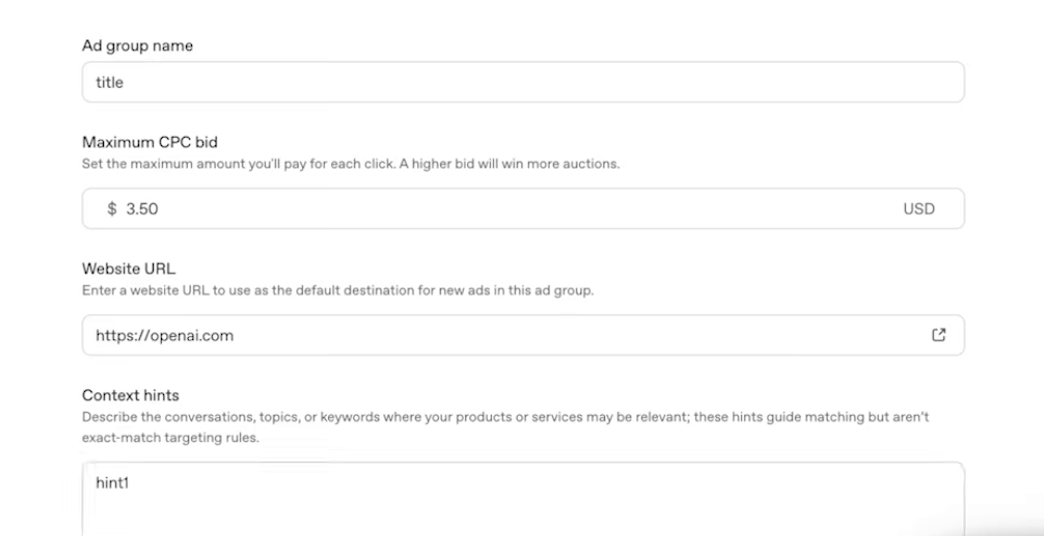
For B2B campaigns, use customer questions, sales-call insights, search queries, product use cases, and audience research to inform your hints.
Keep each ad group focused on a clear customer need, then monitor delivery and performance to refine your hints rather than adding more without a clear reason.
Step 6: Create Ad Creative and Match the Destination Page
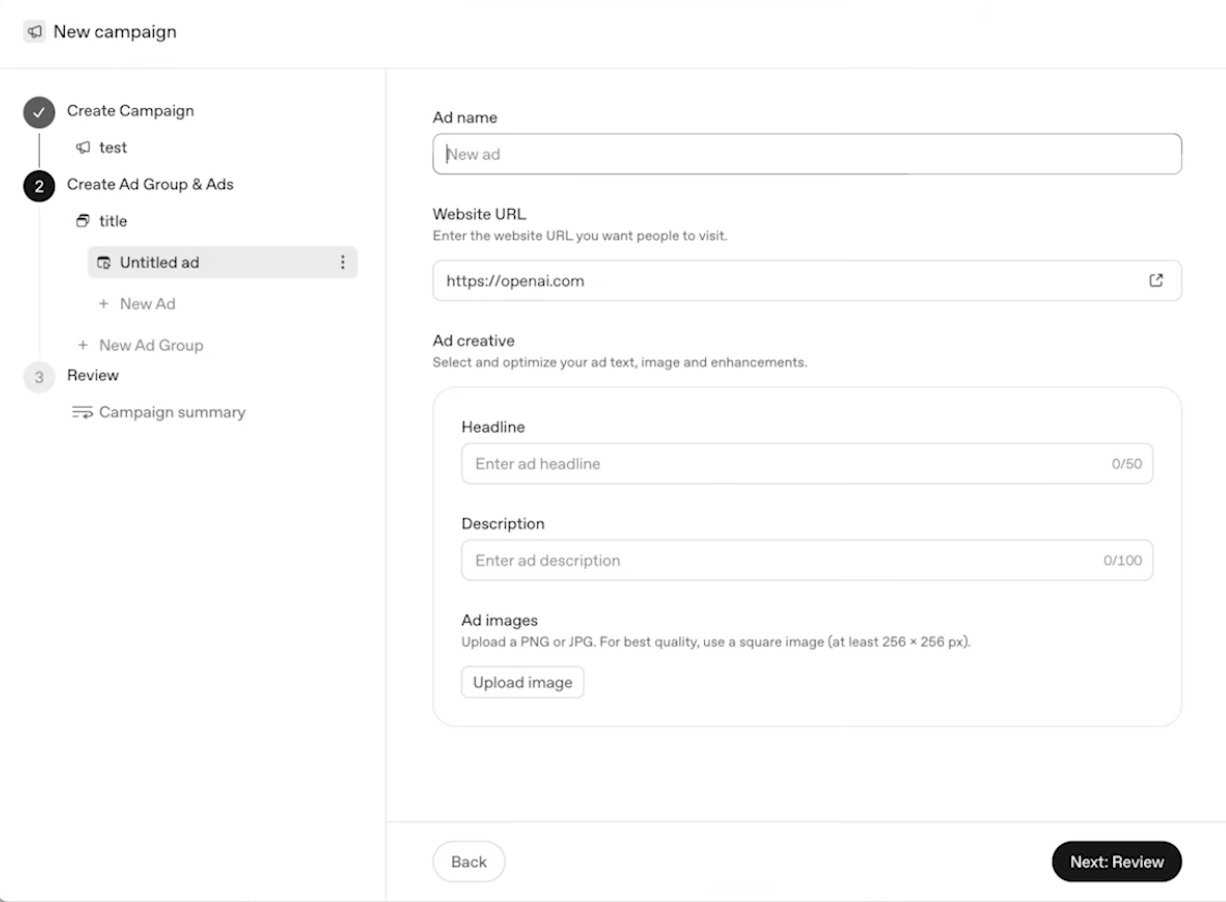
To improve campaign performance, focus on creating relevant ad content, directing users to the right landing page, and testing variations to identify what drives better engagement and conversions.
- Create the ad: Write a clear headline and description that highlight your product’s main benefit, supported by a relevant image.
- Choose the landing page: Direct users to a page that matches the ad’s message and helps them take the intended next step.
- Check consistency: Ensure the ad and landing page communicate the same value and provide a seamless user experience.
- Optimize performance: Test different ad creatives and landing pages to identify which combinations drive better engagement and conversions.
Conclusion
ChatGPT Ads offer businesses another way to reach potential customers during AI-assisted discovery and research. Their value will depend on audience relevance, campaign execution, available measurement, and the economics of each business.
For marketers, the best next step is to understand the platform, test a clear use case, and evaluate results against established channels. As the advertising platform evolves, keep checking OpenAI’s official documentation for changes to eligibility, pricing, targeting, and campaign features.
At SotaMedia, we help B2B SaaS and technology companies build data-driven marketing strategies that turn emerging channels into measurable growth opportunities. Explore our services to find the right approach for your business.
Frequently asked questions
ChatGPT Ads are clearly labeled sponsored placements that may appear below ChatGPT’s responses when relevant. Depending on the ad format, they can include an advertiser name, headline, description, image, and link to the advertiser’s website.
ChatGPT Ads can be matched to users based on the context of their conversation, the ad’s content, campaign targeting settings, and eligible personalization signals when enabled. Contextual relevance helps determine which ads may be suitable, but it does not guarantee that a particular ad will appear.
No. OpenAI states that ads are separate from ChatGPT’s responses and do not influence the answers the assistant provides. The goal is to keep advertising distinct from the conversational experience.
No. Advertisers do not receive users’ conversations, chat history, memories, or personal details through the advertising platform. They receive aggregated campaign performance data that does not identify individual users, allowing them to measure results without accessing private conversations.