



Omnichannel Digital Marketing
A B2B SEO strategy helps software and technology companies reach business decision-makers through organic search. It connects search visibility with complex buying journeys, high-intent queries, and a measurable sales pipeline.
This guide covers the key differences in B2B and B2C SEO strategy, a practical 5-pillar framework, a 90-day execution roadmap, and common mistakes to avoid.
What Is a B2B SEO Strategy?
A B2B SEO Strategy is a targeted organic growth model designed to attract, engage, and convert business decision-makers, including C-suite executives, VPs of Engineering, and procurement leads, during active software evaluation cycles.
Unlike consumer search engines that rely on impulse buying and high search volumes, a pipeline-driven B2B SEO Strategy prioritizes commercial intent over search volume.
What is the Difference Between B2B and B2C SEO Strategy?
B2B and B2C SEO may use the same search engines, but they serve very different buying journeys, so their content strategy, keyword targeting, and success metrics also differ.
| Dimension | B2B SEO Strategy | B2C SEO Strategy |
|---|---|---|
| Target Buyer | Multiple stakeholders across departments | Individual consumer |
| Buying Process | Complex, research-driven, multi-stage | Simple, faster purchase decision |
| Sales Cycle | Typically 3-9 months or longer | Instant to several days |
| Keyword Intent | Niche, specific, high-value commercial intent | Broad, high-volume consumer intent |
| Content Focus | Technical, financial, security, and business requirements | Product benefits, features, price, and convenience |
| Conversion Goal | Qualified leads and sales pipeline | Purchases and direct conversions |
| Success Metrics | Pipeline, revenue, CAC, and CAC payback | Traffic, conversions, and e-commerce sales |
For B2B technology companies, enterprise purchasing decisions involve an average of 6 to 10 stakeholders, each researching specific operational requirements. Your SEO content must cover technical, business, security, and procurement throughout the buying journey.
What Makes the Best B2B SEO Strategy?
The best B2B SEO strategy connects search intent, technical SEO, conversion-focused content, and authority building. Instead of focusing only on traffic, it helps businesses attract the right prospects, support the B2B buying journey, and turn organic search into a qualified pipeline.
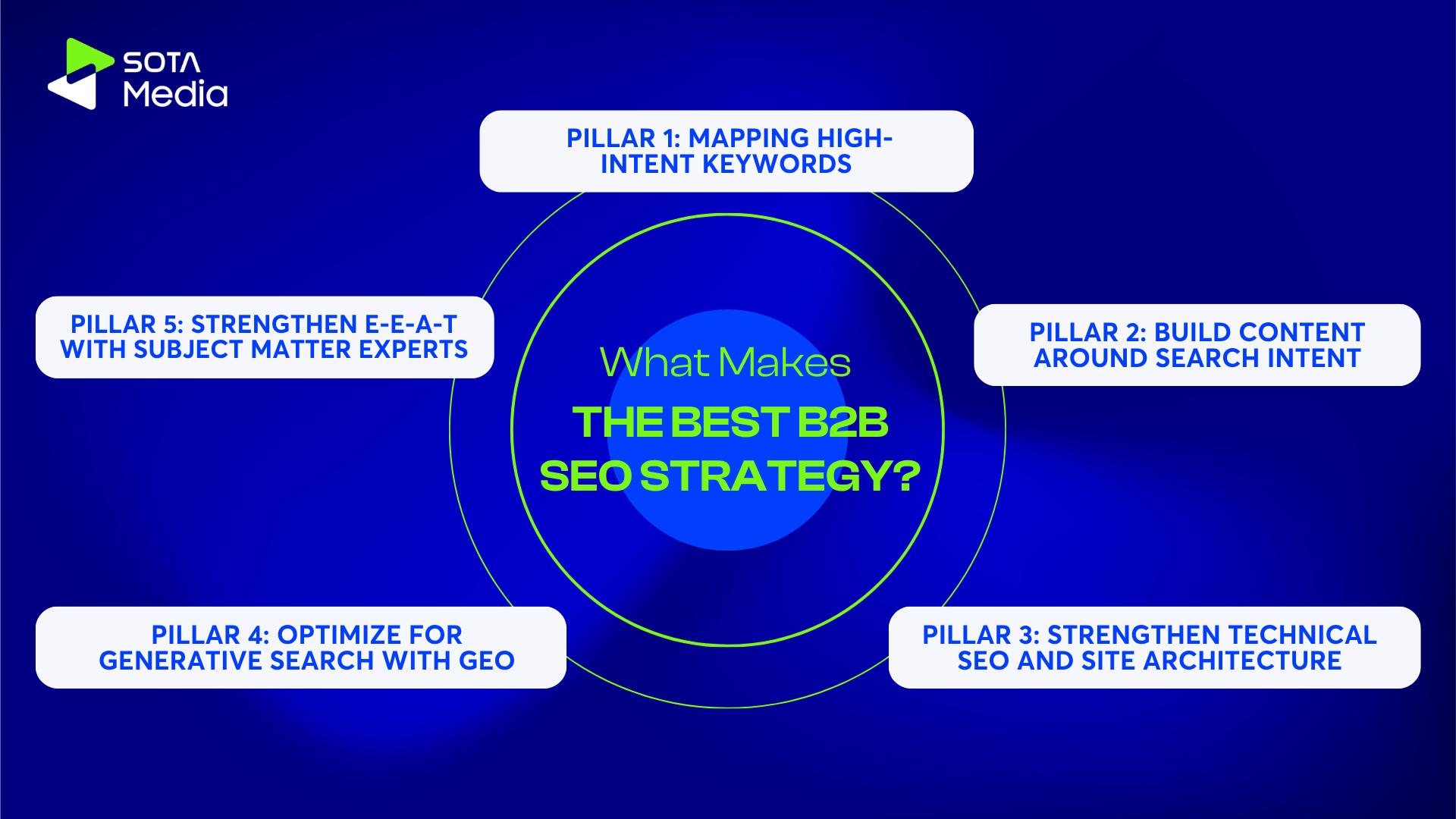
A practical B2B SEO strategy can be built around five key pillars:
Pillar 1: Mapping High-Intent Keywords
A strong B2B SEO strategy focuses on what prospects are searching for, why they are searching, and where they are in the buying journey. High-intent keywords may have lower search volume, but they can attract prospects who are closer to evaluating or purchasing a solution.
| Buying Stage | Search Intent | Example Keyword | SEO Goal |
|---|---|---|---|
| Top of Funnel (TOFU) | Problem Awareness | “Why is enterprise database scaling so slow” | Educate prospects on underlying operational bottlenecks |
| Middle of Funnel (MOFU) | Solution Evaluation | “Automated SOC 2 compliance platforms for SaaS” | Position platform capabilities against category standards |
| Bottom of Funnel (BOFU) | Vendor Selection | “Snowflake vs. Databricks security integrations” | Capture high-intent prospects comparing specific vendors |
Mapping keywords to the buying journey helps B2B companies create content that supports prospects from initial research to purchase consideration, rather than optimizing for traffic alone.
Pillar 2: Build Content Around Search Intent
Once high-intent keywords are mapped to the B2B buying journey, the next step is to create content that matches each search intent. Instead of publishing content based only on search volume, build pages that answer the specific questions prospects have at each stage of evaluation.
- Problem-Focused Content: Target the Top of Funnel by helping prospects understand their challenges and explore potential solutions.
- Solution & Feature Content: Target the Middle of Funnel by explaining how your product or service addresses specific business needs.
- Comparison & Alternative Content: Target the Bottom of Funnel by helping prospects compare solutions and evaluate vendors.
- Industry & Use-Case Content: Target the Middle to Bottom of Funnel by showing how your solution applies to specific industries and business needs.
Pillar 3: Strengthen Technical SEO and Site Architecture
After mapping search intent and building the right content, the next step is to make sure search engines can find, crawl, understand, and index that content effectively. This is especially important for large B2B technology websites with complex products, multiple page types, and large content libraries.
Focus on:
- Page Speed and Core Web Vitals: Improve loading performance and user experience across devices and regions.
- Crawlability and Indexing: Make sure important pages can be discovered, crawled, and indexed correctly.
- Information Architecture: Organize pages into clear topic and URL structures that help users and search engines understand site relationships.
- Internal Linking: Connect related content and direct authority toward important commercial pages.
- Structured Data: Use relevant schema markup to help search engines understand entities, products, organizations, and other page elements.
Technical SEO should support the content strategy rather than operate separately. A well-structured website makes it easier for search engines to discover valuable content and for users to move from informational content to commercial pages.
Pillar 4: Optimize for Generative Search With GEO
Search behavior is expanding beyond traditional search results. 45% of decision-makers increasingly rely on AI answer engines like ChatGPT, Perplexity, and Google AI Overviews to benchmark software vendors and understand complex topics.
Generative Engine Optimization (GEO) helps make B2B content easier for AI systems to understand, retrieve, and reference.
Key GEO tactics include:
- Publish Original Research: Share proprietary data, benchmarks, surveys, and industry insights.
- Answer Questions Clearly: Use concise definitions, direct answers, tables, and structured sections.
- Strengthen Topic Authority: Build comprehensive content around core topics instead of publishing disconnected articles.
- Earn Trusted Mentions: Build digital PR and third-party coverage across relevant industry publications and platforms.
- Keep Information Current: Regularly update statistics, product information, examples, and industry insights.
The goal is to create content that is useful for both traditional search engines and AI-powered search experiences.
Read more: 10 Best GEO Tools to Boost AI Search Visibility (2026)
Pillar 5: Strengthen E-E-A-T With Subject Matter Experts
For B2B technology companies, content quality is not just about covering keywords. Buyers need accurate, practical, and trustworthy information before making high-value decisions. That makes Experience, Expertise, Authoritativeness, and Trustworthiness (E-E-A-T) an important part of a strong B2B SEO strategy.
| E-E-A-T Element | How to Build It |
|---|---|
| Experience | Include real customer examples, use cases, and practical insights |
| Expertise | Add Subject Matter Expert (SME) interviews, expert commentary, and technical reviews |
| Authoritativeness | Highlight author credentials, industry experience, and original research |
| Trustworthiness | Support claims with credible sources, accurate data, and transparent information |
For complex B2B topics, combining SEO expertise with SME knowledge creates content that is more useful to buyers and better aligned with the expertise expected from trusted industry sources.
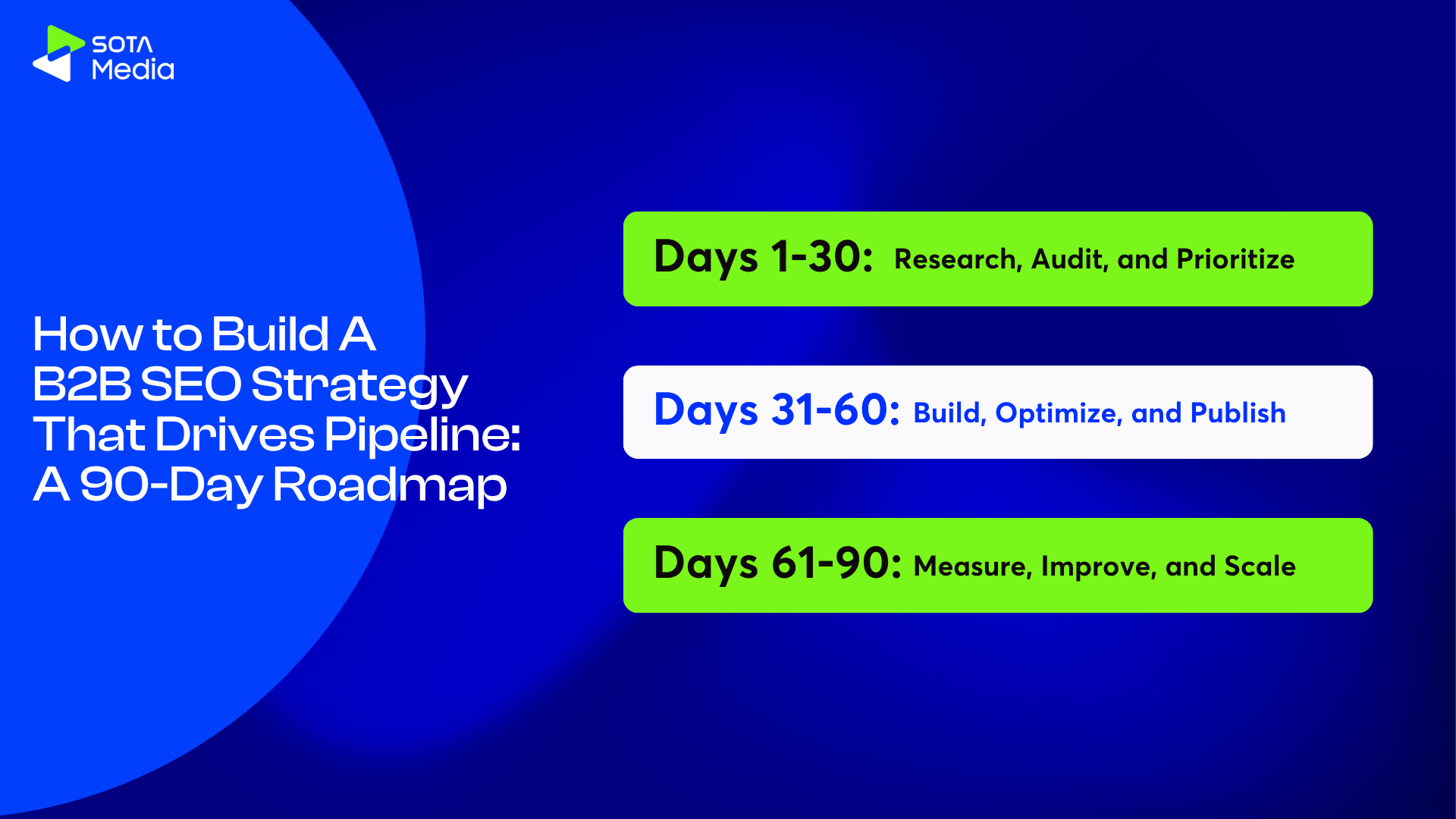
How to Build A B2B SEO Strategy That Drives Pipeline: A 90-Day Roadmap
Building a B2B SEO strategy takes time. Instead of trying to optimize everything at once, break the process into clear 30-day phases. Each phase has a specific goal, priority actions, and measurable outputs.
Days 1-30: Research, Audit, and Prioritize
The first 30 days should focus on understanding the current SEO performance and identifying the highest-impact opportunities.
Key actions:
- Audit technical SEO, crawlability, indexing, and site architecture.
- Define buyer personas and understand their pain points, search behavior, and buying criteria.
- Review existing rankings, organic traffic, conversions, and pipeline contribution.
- Map high-intent keywords to the B2B buying journey.
- Identify content gaps and high-value commercial opportunities.
- Prioritize opportunities based on business impact, search intent, and implementation effort.
30-day output: A clear SEO baseline, buyer persona framework, keyword map, and prioritized SEO roadmap.
Days 31-60: Build, Optimize, and Publish
The second phase focuses on turning the roadmap into actual SEO assets.
Key actions:
- Build or improve priority product, solution, industry, and comparison pages.
- Create content clusters around high-value topics.
- Add SME insights, customer examples, and original research.
- Fix critical technical SEO issues identified during the first phase.
- Strengthen internal linking between informational and commercial pages.
- Optimize important content for both traditional search and AI-powered search.
60-day output: A stronger technical foundation, priority commercial pages, and the first group of optimized content assets.
Days 61-90: Measure, Improve, and Scale
The final phase focuses on understanding what is working and turning early results into a repeatable growth process.
Key actions:
- Track keyword rankings, organic traffic, conversions, SQLs, and pipeline.
- Identify pages generating qualified traffic and commercial opportunities.
- Improve underperforming content based on search intent and engagement data.
- Update existing pages with new data, insights, and customer examples.
- Expand content around topics showing strong business potential.
- Connect SEO performance with CRM data to measure pipeline contribution.
90-day output: A performance report, list of winning opportunities, optimization priorities, and roadmap for the next quarter.
The goal of the first 90 days is not to complete every SEO task. It is to establish a repeatable process for identifying opportunities, building high-value content, measuring pipeline impact, and deciding where to invest next.
Read more: Top 10 Best SEO Agency in Vietnam for Your Brand (2026)
Why B2B SEO Strategy Fails to Drive Pipeline (and Common Mistakes to Avoid)
B2B SEO can generate traffic without generating a meaningful pipeline when the strategy is disconnected from buyer intent, content quality, technical performance, or revenue goals. Understanding the common mistakes helps teams identify what is limiting organic growth and where to improve.
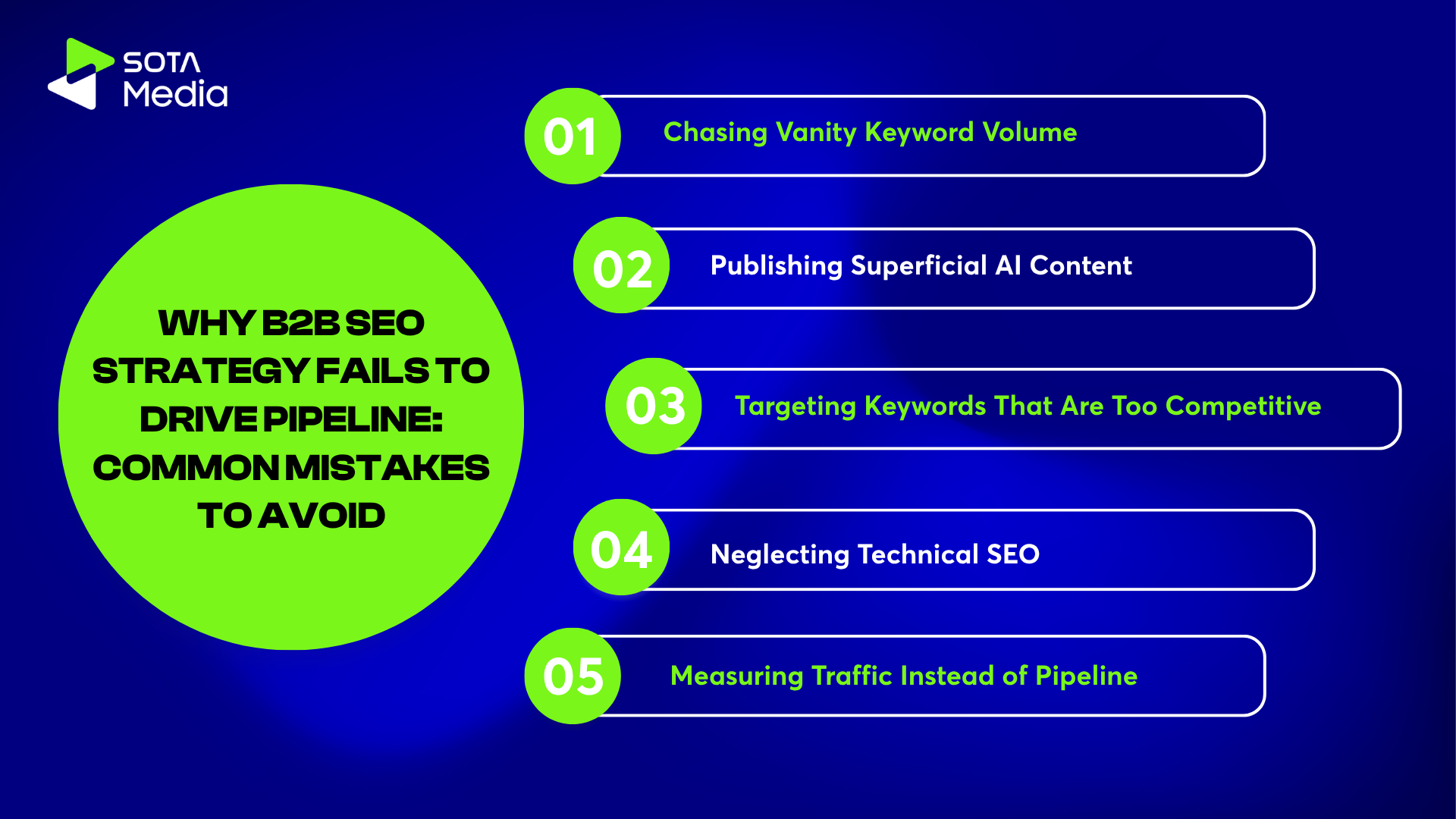
Chasing Vanity Keyword Volume
High search volume does not always mean high business value. Broad keywords can attract traffic from low-intent visitors, resulting in more traffic but fewer qualified leads and lower conversion rates.
Publishing Superficial AI Content
AI can speed up content production, but generic content often lacks original insights and practical expertise. This can result in low-value content that struggles to build trust or stand out in search results.
Targeting Keywords That Are Too Competitive
Competing for broad head terms against established websites can require significant time and resources. This can lead to slow ranking progress and limited pipeline impact. A more practical approach is to target long-tail keywords, niche use cases, industry-specific topics, and commercial queries where your expertise can create stronger relevance.
Neglecting Technical SEO
Issues such as slow page speed, poor internal linking, JavaScript rendering problems, duplicate pages, and incorrect redirects can limit how effectively search engines crawl and index your site. The result is lower visibility for important commercial pages and missed organic opportunities.
Measuring Traffic Instead of Pipeline
Traffic and rankings show visibility, but not necessarily business impact. Focusing only on these metrics can lead to more visits without more qualified opportunities. Connect SEO data with CRM metrics such as SQLs, opportunities, pipeline value, and revenue to measure real impact.
Conclusion
A strong B2B SEO strategy aligns buyer intent, content, technical SEO, GEO, and E-E-A-T to attract the right prospects and turn organic search into a qualified pipeline. To make SEO more effective, B2B technology companies need a structured approach that connects buyer personas, search opportunities, content execution, and SEO performance with real business outcomes.
At SotaMedia, we help B2B SaaS and technology companies build scalable SEO strategies that combine technical expertise, content, and performance marketing to drive measurable growth. If you’re looking for a partner to help turn organic growth into qualified pipelines, feel free to contact us to explore practical SEO approaches tailored to your business goals.
Frequently asked questions
A B2B SEO strategy is a long-term growth channel, but businesses can start seeing early performance signals within 60 to 90 days. Prioritizing high-intent commercial pages, fixing technical issues, and improving conversion paths can help generate qualified opportunities while broader content continues to build organic visibility.
An in-house team gives you direct control but may require multiple SEO, content, technical, and subject matter experts. A specialized B2B SEO agency can provide these capabilities as an integrated team, helping you launch and scale SEO without building the full function internally.
When evaluating SEO optimization companies, look beyond traffic and ranking reports. Consider their technical SEO capabilities, content expertise, GEO experience, CRM attribution, and ability to connect organic performance with qualified leads and pipeline. It is also important to review relevant case studies and understand how they work with internal SMEs.
Paid ads can generate immediate traffic, but performance is closely tied to ongoing ad spend. Investing in SEO services for website growth helps build organic visibility and reusable content assets that can continue attracting prospects over time. For B2B SaaS companies, SEO can also capture buyers who actively research problems, solutions, vendors, and alternatives before contacting sales.
Generative Engine Optimization (GEO) complements traditional SEO by making content easier for AI-powered search and answer engines to understand and use. Clear structures, original insights, concise answers, credible sources, and strong entity signals can help B2B content perform across both traditional search results and emerging AI-driven search experiences.