


Omnichannel Digital Marketing
As AI search platforms become a larger source of traffic, GEO tools have become part of many SEO and content workflows. They help analyze AI visibility, identify optimization opportunities, and measure how content performs across AI-generated search results.
This guide reviews the 10 best GEO tools for 2026, comparing their features, pricing, use cases, and limitations to help you choose the right platform.
Key Takeaways
- AI Search Engines (ChatGPT, Gemini, Perplexity, Google AI Overview) now shape a growing share of how people find brands, and rank trackers cannot see any of it.
- GEO tools in 2026 are led by platforms such as Profound, Semrush, Ahrefs Brand Radar, and Athena HQ, each with a different depth and price point.
- A GEO Tool measures citation rate: how often a brand gets named across ChatGPT, Gemini, and Perplexity for a defined set of prompts.
- Pricing spans a wide range, from free entry tiers to four-figure monthly enterprise plans, so the right pick depends on team size and budget.
- Most tools on the market are still monitoring dashboards. Only a handful pair tracking with real content or structured data recommendations.
What Is GEO (Generative Engine Optimization)?
What Does GEO Mean?
Generative Engine Optimization (GEO) is the practice of shaping a brand’s content and online presence so AI systems such as ChatGPT, Gemini, and Perplexity cite or recommend it when answering a user’s question. SEO targets a ranked list of links; GEO targets a mention inside one synthesized answer. The two share groundwork, like structured data and credible sourcing, but GEO adds a layer SEO never needed: measuring how often and how accurately an AI engine names a brand, then adjusting content to close the gap.
How Is GEO Tools Different from Traditional AI SEO Tools?
A rank tracker reports a position on a results page. GEO Tools report whether a brand appeared inside an AI-generated answer at all and, if so, in what context, alongside which competitors, and with what sentiment. Traditional SEO tools optimize for crawlability and backlinks; GEO software adds citation tracking, prompt-level monitoring, and answer-share metrics that did not exist as a category before 2024.
Why Do Businesses Need GEO Tools in 2026?
AI-powered search already carries real revenue. Half of US consumers use AI-powered search today, and McKinsey projects it will carry $750 billion in US revenue by 2028. Brands unprepared for the shift could see traditional search traffic fall 20 to 50%. A business with no visibility into that layer is optimizing for a search engine that a growing number of buyers no longer open first.
How Do AI Search Engines Rank and Cite Content?
How Do ChatGPT, Gemini, and Perplexity Choose Sources to Cite?
Most AI engines run a version of retrieval-augmented generation: the model breaks a prompt into sub-queries, pulls candidate pages from its own index or a live web search, then ranks and synthesizes an answer from the sources it judges most relevant and trustworthy. Coverage differs by engine. Perplexity leans heavily on live web results; Google AI Overview draws on Google’s existing index; ChatGPT blends browsing with its training data. That is why a GEO platform tracking only one engine misses most of the picture.
What Factors Affect AI Visibility?
- E-E-A-T signals: clear authorship, cited sources, and demonstrated first-hand experience.
- Structured data and schema markup that let an AI crawler parse a page’s facts without guesswork.
- Brand mentions across the open web, including forums like Reddit and Quora that AI engines cite often.
- Content that answers a specific question directly in the first few sentences, rather than building up to it.
What Are the Key Criteria for Choosing the Best GEO Tools?
Can It Track AI Visibility Across Multiple Engines?
A tool that only checks Google AI Overview covers one slice of AI-driven discovery. Look for coverage across ChatGPT, Gemini, Perplexity, and Copilot at minimum.
Does It Analyze Citations and Brand Mentions?
Mention tracking alone tells you whether your name showed up. Citation analysis tells you which page got linked, in what context, and against which competitors.
Does It Help Optimize Content for Generative Engines?
Some GEO software stops at the dashboard. The stronger platforms turn a visibility gap into a specific content or schema recommendation.
Does It Integrate with Existing SEO and Analytics Stacks?
GEO does not replace SEO data; it extends it. Tools that connect citation data to your existing backlink index, rank tracker, or GA4 property save a team from stitching two dashboards together by hand.
Is the Pricing Scalable for Your Team?
Entry tiers run from free to around $40 a month. Mid-market tools sit near $200 to $300 a month. Enterprise platforms move into four figures. Match the tier to how many prompts and how many engines you actually need tracked, not to the longest feature list.
10 Best GEO Tools in 2026
Disclaimer: This list is ordered by engine coverage and feature depth, not by paid placement. Pricing, features, and named customers below reflect publicly available information as of August 2026. Vendors update pricing often, so confirm current terms directly on each provider’s site.
1. Profound
Website: tryprofound.com
Profound is an enterprise-grade AI visibility platform that captures real, user-facing interaction data across 10+ AI engines, including ChatGPT, Claude, Perplexity, Gemini, Copilot, DeepSeek, Grok, Meta AI, Google AI Mode, and Google AI Overview.
Key Features:
- Real conversation data rather than simulated visibility scores
- Competitor benchmarking across every tracked engine
- Self-serve Starter and Growth plans, plus a custom enterprise tier
Pros: Wide engine coverage on the market and data pulled from real interactions, not synthetic prompts.
Cons: Enterprise tier pricing reaches mid four figures per month.
Pricing: Self-serve plans are now published; enterprise plans are quoted individually.
Best For: Enterprise brands and agencies that need the widest possible AI engine coverage.
2. Semrush AI Visibility Toolkit
Website: semrush.com
Built into Semrush’s existing suite, the AI Visibility Toolkit tracks brand mentions, citations, sentiment, and share of voice across ChatGPT, Google AI Mode, Google AI Overview, Gemini, and Perplexity.
Key Features:
- A prompt database, Semrush, reports at more than 289 million prompts
- A 43-trillion-link backlink index tying AI visibility to existing organic authority
- One dashboard for both SEO and GEO metrics
Pros: Connects GEO data to SEO signals a team is likely tracking already.
Cons: Less prompt-level and citation depth than dedicated GEO-only platforms.
Pricing: From $117.33/month (SEO plan, billed annually).
Best For: Teams already running Semrush who want GEO folded into one existing workflow.
3. Ahrefs Brand Radar
Website: ahrefs.com/brand-radar
Ahrefs Brand Radar is an add-on inside the Ahrefs ecosystem that monitors brand mentions across six AI platforms: ChatGPT, Perplexity, Gemini, Copilot, Google AI Mode, and Google AI Overview, backed by a database of Ahrefs’ 405+ million search-backed prompts.
Key Features:
- Linked and unlinked mention crawling across news, blogs, and forums
- Share-of-voice benchmarking against named competitors
- Sits on top of Ahrefs’ backlink, keyword, and site audit data
Pros: Strong unlinked-mention detection and deep integration with an SEO suite many teams already own.
Cons: Priced per AI engine index at $199/month each, or $699/month bundled, layered on top of a base Ahrefs plan starting at $129/month. Independent reviews put the full monthly cost between $828 and $1,148.
Pricing: $199/mo per engine or $699/mo bundled, plus an Ahrefs base plan from $129/mo.
Best For: Existing Ahrefs customers who want AI visibility layered onto a stack they already pay for.
4. Athena HQ
Website: athenahq.ai
Athena HQ was built by a team with backgrounds at Google and DeepMind and tracks 8+ LLMs using a credit system where one credit equals one AI response.
Key Features:
- A free Essential tier with 300 credits to start
- Coverage of ChatGPT, Perplexity, Google AI Overview, Gemini, and Claude
- Enterprise clients including ZoomInfo, SoFi, and Volkswagen, per Athena HQ’s public case studies
Pros: Broad model coverage plus a free entry point for testing the category.
Cons: Costs rise quickly once response volume grows past the free tier.
Pricing: Essential: free (300 credits). Starter: $295/mo (3,600 credits, 9 models). Enterprise: custom.
Best For: Teams that want the wide platform coverage and are prepared to pay for it at scale.
5. Scrunch AI
Website: scrunch.com
Scrunch AI positions itself as an “Agent Experience Platform,” tracking ChatGPT, Perplexity, Google AI Overview, and Copilot on its Core plan, expanding to up to nine LLMs on Enterprise.
Key Features:
- Citation insights showing which sources shape an AI answer
- Misinformation and brand-inaccuracy alerting
- GA4 integration for tracking actual AI referral traffic
Pros: SOC 2 Type II compliance and accuracy alerting built for regulated or enterprise brands.
Cons: Monitoring-focused; content generation and optimization tools remain limited.
Pricing: Core: around $250/mo for 125 prompts. Enterprise: custom.
Best For: Enterprise brands and agencies that need compliance credentials and accuracy alerts.
6. Peec AI
Website: peec.ai
Peec AI is a mid-market GEO tracker recognized as a top enterprise AI search visibility platform in industry roundups, built around prompt-based monitoring.
Key Features:
- Prompt-based tracking across major AI engines
- Competitor and share-of-answer comparisons
- A pricing tier built for mid-market teams rather than enterprise budgets
Pros: Straightforward setup at a price point between entry-level and enterprise tools.
Cons: Lighter on content-optimization tooling than platforms like Scrunch or Athena.
Pricing: Around $199/mo for 100 prompts.
Best For: Mid-market teams that want reliable prompt tracking without enterprise pricing.
7. Otterly AI
Website: otterly.ai
Otterly AI makes GEO approachable for beginners and small teams with simple mention tracking, intuitive dashboards, and minimal setup time.
Key Features:
- Fast time-to-value with little configuration
- Core mention and link tracking across major AI engines
- A budget-friendly path to start monitoring AI search visibility
Pros: The lowest-cost credible entry point into GEO on this list.
Cons: Less depth than enterprise tools; better suited to early-stage GEO work.
Pricing: Plans start at roughly $39/mo.
Best For: Small businesses and solo marketers running their first GEO test.
8. SE Ranking (SE Visible)
Website: visible.seranking.com
SE Visible is SE Ranking’s generative engine optimization product, connecting AI visibility scores to rankings, content performance, and authority signals in one place.
Key Features:
- Visibility scores and prompt-and-topic insights
- Competitor benchmarking and sentiment tracking
- A clean interface aimed at teams new to GEO
Pros: Ties AI visibility directly to existing SE Ranking SEO data.
Cons: Export formats are limited, and deeper optimization work may require pairing with SE Ranking’s core plan.
Pricing: Custom, based on the SE Ranking plan tier.
Best For: Startups and small marketing teams that want daily mention tracking without heavy setup.
9. LLMrefs
Website: llmrefs.com
LLMrefs tracks, analyzes, and optimizes visibility across ChatGPT, Gemini, and Claude, with automated audits and cited-source detection.
Key Features:
- Real-time mention monitoring with customizable alerts
- Automated SEO and GEO audits
- A free tier alongside paid upgrades for deeper tracking
Pros: A genuinely free tier makes it easy to test before committing a budget.
Cons: Advanced features, like agent-mode automation, sit behind a paid upgrade.
Pricing: Free tier available; paid plans unlock deeper tracking and automation.
Best For: Budget-conscious teams that want automated audits without a large monthly commitment.
10. Goodie AI
Website: higoodie.com
Goodie AI tracks brand visibility across ChatGPT, Gemini, Perplexity, Claude, Copilot, and DeepSeek, then pairs that data with optimization guidance rather than a dashboard alone.
Key Features:
- Visibility tracking across six major AI engines
- Guidance connected directly to each visibility gap
- Positioning built around action, not just reporting
Pros: Pairs monitoring with a clear next step instead of leaving interpretation to the user.
Cons: Starting price sits above several mid-market alternatives on this list.
Pricing: Starting at $495/mo.
Best For: Brands that want visibility data paired directly with what to do about it.
Comparison Table: Best GEO Tools at a Glance
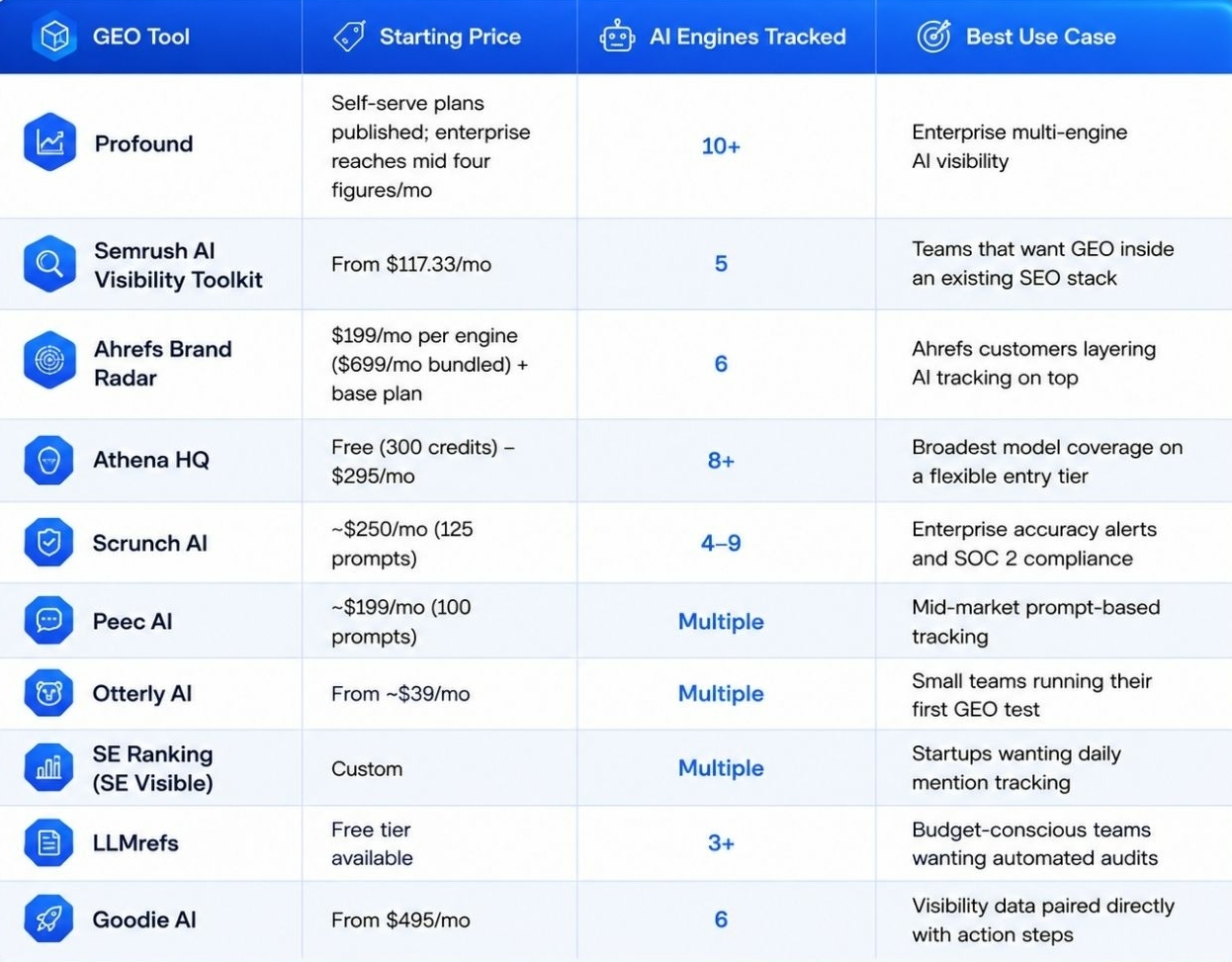
The table below lines up starting price against AI engine coverage for each GEO Tools reviewed above, so you can shortlist by budget before reading feature-by-feature detail.
How Do You Choose the Right GEO Tools for Your Business?
For enterprise SEO teams, agencies, and e-commerce brands with the budget for premium tools can consider Profound, Athena HQ, or Ahrefs Brand Radar, along with compliance features like SOC 2.
However, if you’re a smaller team primarily focused on ChatGPT and Perplexity visibility, alternatives like Peec AI offer similar core functionality at a lower price point. The right choice depends on your specific platform coverage needs and budget constraints.
What Common Mistakes Should You Avoid When Using GEO Tools?
Tracking Only One AI Engine
ChatGPT, Gemini, and Perplexity each pull from different sources and rank them differently. A brand visible on one engine can be invisible on another. Track at least three engines before drawing any conclusion about overall AI visibility.
Ignoring Structured Data and Schema Markup
AI crawlers parse structured data far more reliably than they parse prose. Skipping schema markup, FAQ markup, or clear headings makes it harder for a GEO Tools to find anything worth citing on a page, no matter how good the writing is.
Not Measuring Citations Regularly
AI models retrain and re-rank sources continuously. A citation rate checked once at launch and never again tells a team nothing about whether the strategy is working six months later. Monthly checks, even a lightweight 20 to 30 prompt test, catch a decline before it compounds.
GEO vs SEO: Should You Replace or Combine Them?
What Role Do AI SEO Tools Still Play?
Traditional AI SEO Tools still track the fundamentals an AI engine depends on: crawlability, page speed, backlink authority, and keyword coverage. GEO does not exist without that foundation. An AI engine cannot cite a page it cannot crawl or trust in the first place.
How Do You Combine GEO and SEO Effectively?
Keep the SEO fundamentals running, then layer GEO tracking on top rather than swapping one for the other. Use SEO data to fix technical and authority gaps. Use GEO data to see whether those fixes translate into actual AI citations and where a competitor is still winning the answer despite a weaker backlink profile.
Conclusion
The tools in this guide serve different needs, and the best choice depends on your workflow, budget, and AI search goals. Use the comparisons above to shortlist the platforms that best fit your requirements before making a decision.
If you’re looking for both GEO tools and implementation support, SotaMedia provides GEO strategy, AI search optimization, and technical SEO to content execution. Talk with SotaMedia and explore how we can boost your AI visibility.
Frequently asked questions
GEO Tools track and improve how often an AI engine cites a brand in generated answers. They are increasingly necessary as ChatGPT, Gemini, and Perplexity take a growing share of search-like queries that once went to Google.
Otterly AI, LLMrefs, and SE Visible fit smaller budgets and simpler setups. Each covers the core AI engines without the enterprise pricing of platforms like Profound or Athena HQ.
Traditional SEO tools track rankings on a results page. GEO tools tracks whether and how a brand gets cited inside a single AI-generated answer, a metric SEO tools were never built to measure.
Track citation rate against a fixed prompt set over time, then connect any lift to referral traffic in GA4 or a branded search increase. A rising citation rate with flat referral traffic usually points to a content gap on the pages being cited.
No. AI engines still depend on crawlable, well-structured, authoritative pages, the same foundation SEO tools have always measured. GEO adds a citation layer on top of that foundation rather than replacing it
Most platforms track ChatGPT, Gemini, Perplexity, and Google AI Overview at minimum. Broader tools add Claude, Copilot, DeepSeek, Grok, Meta AI, and Google AI Mode.
As soon as a meaningful share of prospective customers could plausibly ask an AI engine about the category. For most B2B and consumer brands in 2026, that threshold has already passed.
Yes. B2B buyers increasingly research vendors through AI-generated comparisons before ever visiting a website, which makes citation tracking as relevant to B2B as it is to consumer brands.