
Digital marketing
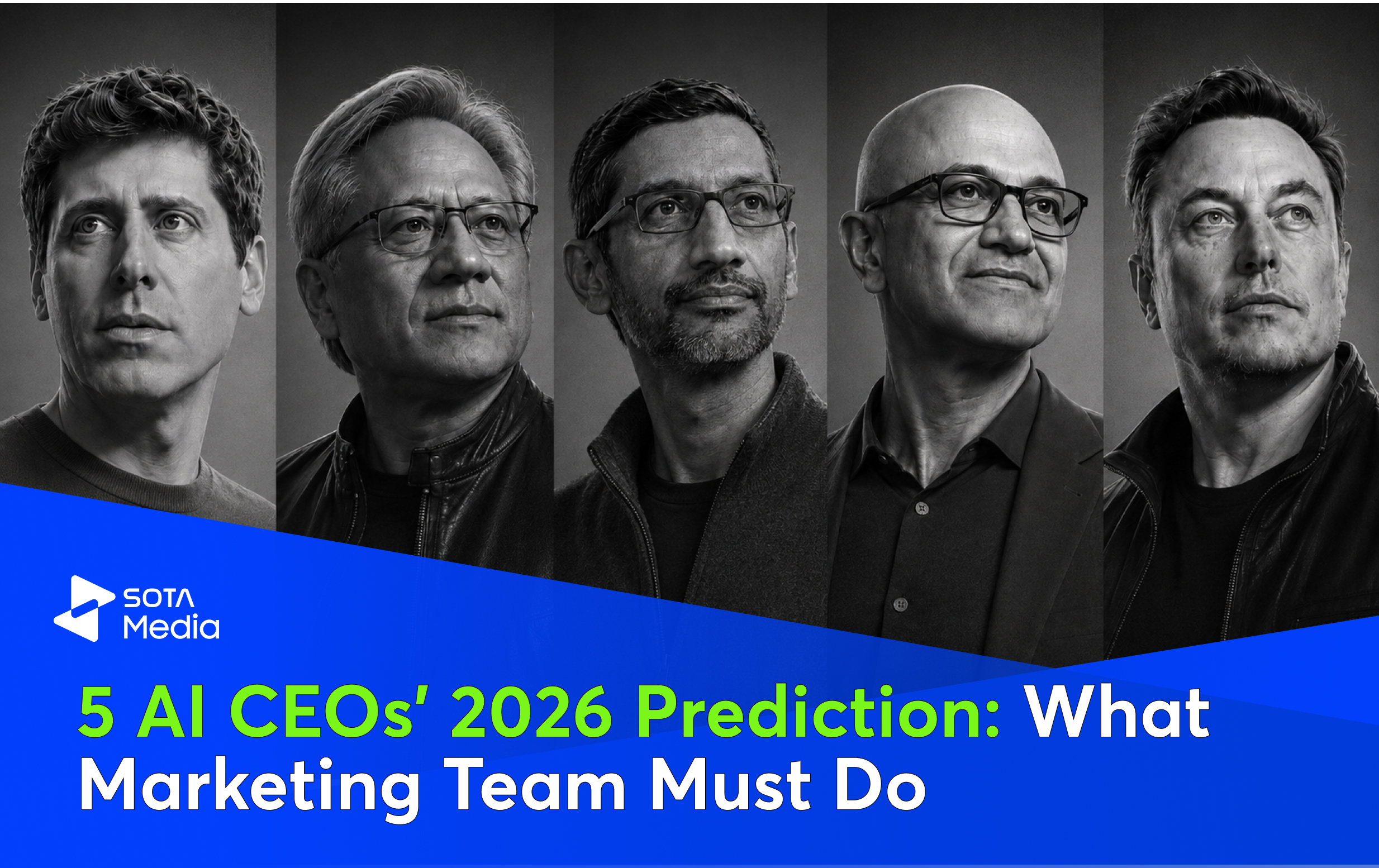
Five major AI CEOs have stopped talking about better models. They started talking about the same shift from different angles: Sam Altman has focused on systems that can do longer stretches of work, Jensen Huang on AI as infrastructure, Sundar Pichai on agentic functions inside Search, Satya Nadella on applications with memory and action space, and Elon Musk on the most aggressive version of the agent story.
That shift matters to marketers because the first reader of a page is no longer always a person. In more workflows, an AI system reads the page first, extracts the useful parts, and only then helps decide whether a brand belongs in the answer.
Key Takeaways
- Five major AI CEOs are describing the same 2026 shift: AI is moving from models to systems and agents.
- For marketers, AI systems now help decide which sources get cited, recommended, and seen.
- The first response is simple: make important content easier to extract, verify, and reuse.
What are AI CEOs saying about 2026?
An AI CEO is the chief executive of a company that shapes how artificial intelligence is built, deployed, or distributed. In 2026, the most watched AI CEOs sit across different layers of the stack: models, chips, search, enterprise software, and agent platforms.
Their public statements are not identical, yet they point in the same direction.
| AI CEOs | Main 2026 Signals | What It Means For Marketers |
|---|---|---|
| Sam Altman | AI systems will handle more real work over longer time spans | Agents will need trusted sources to use during research and planning |
| Jensen Huang | AI is becoming infrastructure, not a single app | AI use is moving from experiments to everyday workflows |
| Sundar Pichai | Search is becoming more agentic | Discovery is moving from links toward task completion |
| Satya Nadella | AI apps are becoming systems with memory and action space | Teams need workflows, not isolated tool use |
| Elon Musk | More white-collar work will move into agent systems | More first-pass research will happen before a person opens a page |
Sam Altman: AI becomes easier to use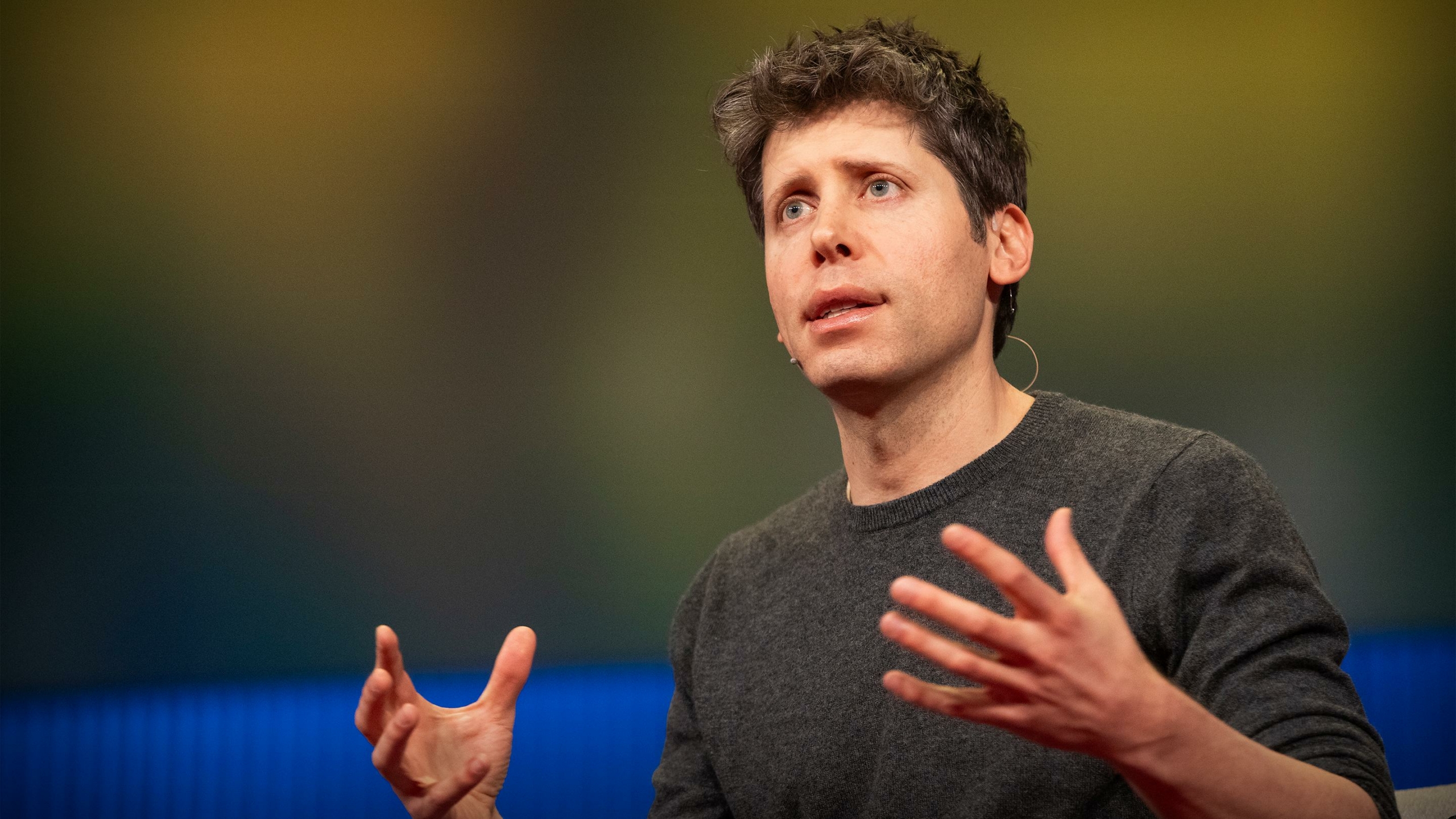

Sam Altman wrote in The Gentle Singularity that 2025 brought agents that can do real cognitive work and that 2026 may bring systems that can produce new insights. OpenAI has also spent the last year moving from chat alone toward AI agents that can use tools, browse websites, and complete multi-step work. OpenAI, July 2025
For marketers, the useful part is less the prediction than the behavior behind it. If agents spend more time doing research and planning, they need material they can read without guessing, and a page with a direct answer, named sources, and a clear structure gives the system less work to do before it can use the information.
Jensen Huang: AI becomes infrastructure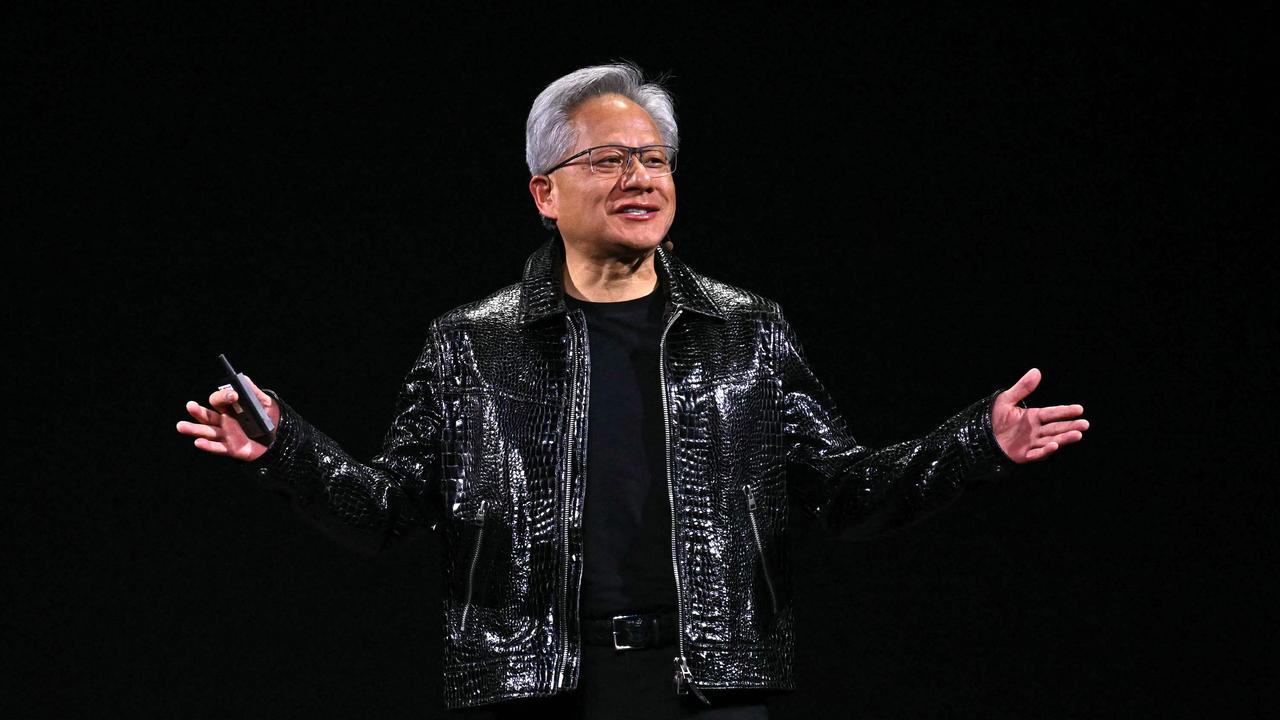
Jensen Huang framed the same shift from the infrastructure side. NVIDIA’s March 2026 GTC announcement described AI as “essential infrastructure” and said every company will use it. A later NVIDIA release said, “The agentic AI inflection point has arrived.” (Source: NVIDIA, March 2026)
This matters because infrastructure changes habits in a way tools often do not. A tool can remain optional, but infrastructure gets built into daily work; once AI sits inside planning, support, sales, and research flows, content is consumed not only by people looking for it but also by systems pulling what they need at the moment of a task.
Sundar Pichai: Search becomes more agentic
Google has been moving Search in the same direction. At Google I/O 2025, Sundar Pichai said Google was bringing agentic capabilities to Search. In August 2025, Google added agentic functions to AI Mode, including tasks such as restaurant reservations. In April 2026, Pichai said Search had shipped more agentic experiences and that users were returning to AI Mode and AI Overviews. (Source: Google I/O 2025; Google Search, August 2025; Google, April 2026)
Search is no longer only a list of pages. It is becoming a layer that can answer, compare, and sometimes act, which means ranking still matters but is no longer the only test; a page also needs to be selected by the system that builds the answer.
Satya Nadella: AI becomes a system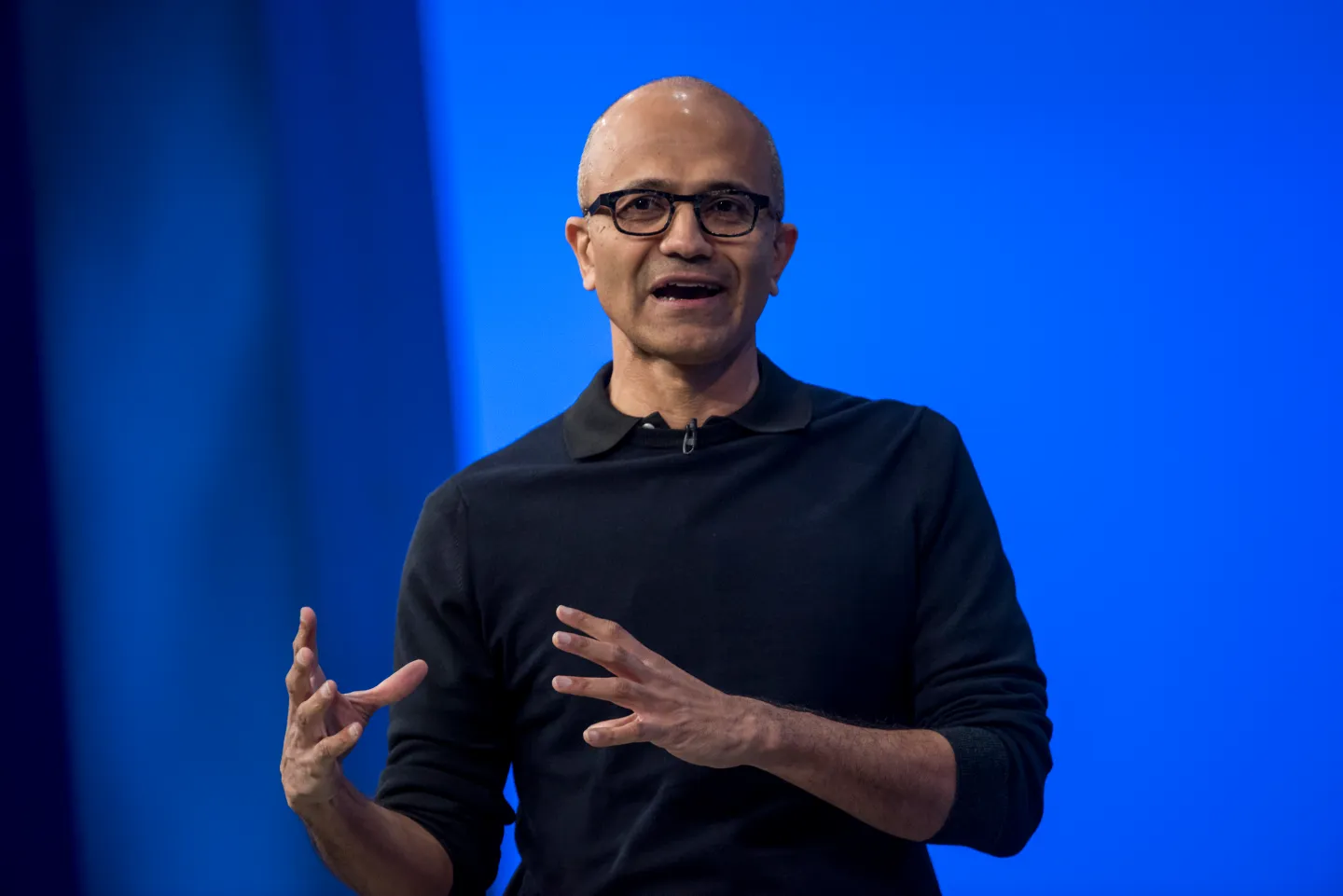

Satya Nadella made the operational version of the argument. In Microsoft’s January 2025 CoreAI note, he wrote that the company would build agentic applications with memory, entitlements, and action space. Microsoft has also described Copilot agents as software that can work on behalf of a person, a team, or a business function. (Source: Microsoft, January 2025; Microsoft, October 2024)
That language matters for marketing teams because using one AI tool to draft one blog post is still a tactic, while a system has inputs, memory, outputs, and feedback that let it publish, measure, compare, and improve across cycles. That is the gap between “using AI” and building a marketing process that keeps learning from its own results.
Elon Musk: More work moves into agents

Elon Musk gives the most aggressive version of the same argument, and his timelines are less useful than the direction he is pointing toward: more white-collar work will move into agent systems that can execute tasks on a computer with less human handling.
For marketers, the point is practical. If a manager once opened five pages to compare vendors, an agent can now do much of that first pass, so the page still matters, but the way it is written matters more.
Why does this matter for marketers?
The shared message across those AI CEOs is simple: AI is moving from a tool people prompt into a system that can retrieve, compare, decide, and act. That shift changes marketing in three ways:
Your content has a second audience now
People still read pages, but AI systems now read them too, and that second audience behaves differently. A person may skim the first screen, jump to a section, or stay for a story. An AI system looks for direct answers, named entities, clean headings, tables, and cited facts because it needs enough evidence to use the page with confidence.
Consider a buyer asking an assistant, “Which B2B SaaS agencies have experience with AI marketing automation?” The assistant may review agency pages, case studies, and outside mentions before the buyer sees one result. A page that says “we help brands grow” gives the system little to work with. A page that says “SotaMedia helped SotaTek lift website traffic by 70% after a rebrand” is much easier to use because the claim is concrete.
Your metrics need to change
Rankings and clicks still matter, but they no longer explain the whole path.
NP Digital 2025 agency data show that companies using GEO and AEO moved from a negative ROI of 28% in 2024 to a positive ROI of 144% in 2025. The research also found that AI-referred visits made up less than 1% of traffic in the dataset but produced 9.7% of B2B revenue and 11.4% of B2C revenue. It points to the fact that low-volume AI traffic can carry higher intent than you think.
Marketing dashboards should add measures that older SEO reports did not need:
| Old Measure | New Measure to Add |
|---|---|
| Keyword ranking | Citation frequency in AI answers |
| Organic click-through rate | Brand retrieval across AI platforms |
| Sessions | Revenue or qualified leads from AI-assisted discovery |
| Backlinks |
Mentions from trusted sources that AI systems can reuse |
This is not a replacement for older SEO reporting. It is an added GEO layer, because a page can rank and still be missing from AI answers, while a brand can appear in an answer before it gets a click.
Your moat is no longer only traffic
For years, many teams treated content as a volume game: publish more pages, win more rankings, and capture more visits.
That still works in some categories, but it is weaker once AI systems start compressing research for the user. The better advantage is becoming the source those systems return to because the page is easy to verify.
That usually comes from five habits:
- write the answer before the explanation
- use named sources instead of vague attribution
- keep entity details consistent across the site and third-party profiles
- structure comparison content so systems can parse it
- update pages when facts change
The page that wins is not always the longest one; often, it is the page that gives the cleanest answer with the least cleanup required.
What should marketers do now?
The work does not start with a new tool subscription; it starts with how pages are built.
Build for citation, not only ranking
Each important page should answer its main question early. The first 150 words should tell the reader what the page is about and give an answer worth quoting.
Question-led headings help because “Who are the AI CEOs?” is easier to extract than “AI CEOs’ Profiles/Backgrounds.” Named sources help for the same reason: “OpenAI’s July 2025 agent launch” is stronger than “recent research.”
Schema is useful when it matches the visible page. Article schema, FAQPage schema, HowTo schema, and organization schema can make the structure easier for systems to read. They do not rescue weak writing, but they help strong writing travel farther.
Own the research layer across platforms
Google still matters, but it is no longer the only place where research begins.
Buyers also search YouTube, LinkedIn, Reddit, product communities, review sites, and AI answer engines. Each of those places can influence what a system sees later. A strong article on a company site is useful. A strong article plus a named founder interview, a client case study, and consistent mentions elsewhere is easier for an AI system to trust.
This does not mean posting everywhere; it means placing useful proof where buyers already look.
For tech companies that need those signals to work together, SotaMedia’s omnichannel marketing service connects content, search, social, PR, and community activity into one plan instead of treating each channel as a separate task. See what we can do for you.
Build systems, not tactics
One-off AI use saves time, while a system compounds it. A simple content system can look like this:
- research a query cluster
- publish answer-first pages with named sources
- track rankings, citations, and revenue signals
- update pages based on what is missing
- feed those findings into the next content cycle
That loop is where teams start to learn, because without it, every article begins from zero.
How can a marketing team audit itself for the AI agent era?
It may sound overwhelming to you at the beginning, but actually the audit for GEO can be done in one afternoon with these following steps:
1. Test the brand in the major AI platforms
Search the main category terms in ChatGPT, Gemini, Perplexity, and Claude. Record whether the brand appears, which pages are cited, and which competitors show up instead.
2. Check the top pages for direct answers
Open the five pages that matter most to pipeline. Each one should state the subject clearly near the top and answer the main question before moving into detail.
3. Review the source quality
Replace weak phrases with named evidence. A sentence tied to OpenAI, Google, Microsoft, a client case study, or a dated report is easier to reuse than one tied to “industry research.”
4. Check the technical reading layer
Review title tags, H1s, FAQ sections, schema, internal links, and crawl settings. If the page is hard to read for a crawler, the writing has to work harder than it should.
5. Add AI visibility to the reporting cadence
Track which prompts mention the brand, which pages earn citations, and which topics stay invisible. Review that alongside rankings and pipeline, not as a separate vanity report.
If the audit shows that key pages rank but rarely appear in AI answers, SotaMedia can help rebuild them through SEO and GEO work that covers content structure, source quality, schema, and citation readiness. Contact SotaMedia to get a free SEO and GEO audit for your website.
Conclusion
The pattern across all five AI CEOs is the same: the infrastructure is mature, agents are executing real buyer research, and the path from “buyer has a question” to “buyer finds your brand” now runs through multiple AI platforms, not just Google.
The practical question for most marketing teams isn’t whether this is happening. It is about how fast to respond.
A first step that takes less than a day: run the 5-point audit above. Check whether your brand appears in ChatGPT and Perplexity answers to your core category queries. Check your robots.txt. Open your top three pages and see whether they start with a direct, extractable answer. Most teams find the results are different from what they assumed.
Frequently asked questions
The five most-cited AI CEOs shaping the technology landscape in 2026 are Sam Altman (OpenAI), Jensen Huang (NVIDIA), Sundar Pichai (Google/Alphabet), Satya Nadella (Microsoft), and Elon Musk (xAI). Each leads a company at a different layer of the AI infrastructure stack, from chip manufacturing to consumer-facing AI products.
The shared prediction is that AI is moving beyond standalone models into systems and agents that can do longer stretches of work. The details differ by company, but the direction is similar across OpenAI, NVIDIA, Google, Microsoft, and xAI.
AI agents will read more pages before a person does, compare more sources in less time, and decide which brands belong in an answer or shortlist. That pushes marketers to write clearer pages, use named proof, and measure citations in addition to rankings.
Yes. Search engines still feed many AI experiences, and strong SEO makes content easier to discover and understand. The added requirement is GEO, which makes the same content easier for answer engines to cite and reuse.
GEO (Generative Engine Optimization) is the practice of structuring content so AI search engines (ChatGPT, Perplexity, Gemini, Claude) cite it in their generated answers. It matters because AI agents are now the first stop in buyer research. If your content isn't structured to be cited by LLMs, you're invisible to those agents.
Run your target queries through ChatGPT, Perplexity, Claude, and Gemini manually weekly. Look for brand mentions and content citations. For scale, use tools like Ubersuggest's AI Visibility Report or Ahrefs Brand Radar to track citation frequency across platforms. Most companies discover they're being cited in zero to one platform even when their Google rankings are strong.