


AI Marketing
Search is changing. Users increasingly turn to ChatGPT, Gemini, Perplexity, and other AI tools to research, compare, and make decisions. For brands, a strong Google ranking no longer guarantees visibility in AI-generated answers.
In this post, SotaMedia will explain the definition and importance of AI visibility, and how brands can improve their presence across AI search.
Key takeaways
- AI Visibility measures how often and how prominently AI-generated answers mention, cite, or recommend your brand.
- AI is becoming a new discovery channel, so strong Google rankings alone do not guarantee that customers will find your brand.
- Build multi-channel content, cover topics comprehensively, and strengthen consistent brand signals across trusted sources.
What Is AI Visibility?
AI visibility is about how a brand can be discovered, mentioned, cited or recommended in AI-generated answers by AI search engines like ChatGPT, Gemini or Google AI Overviews, etc.
What are the components of AI Visibility?
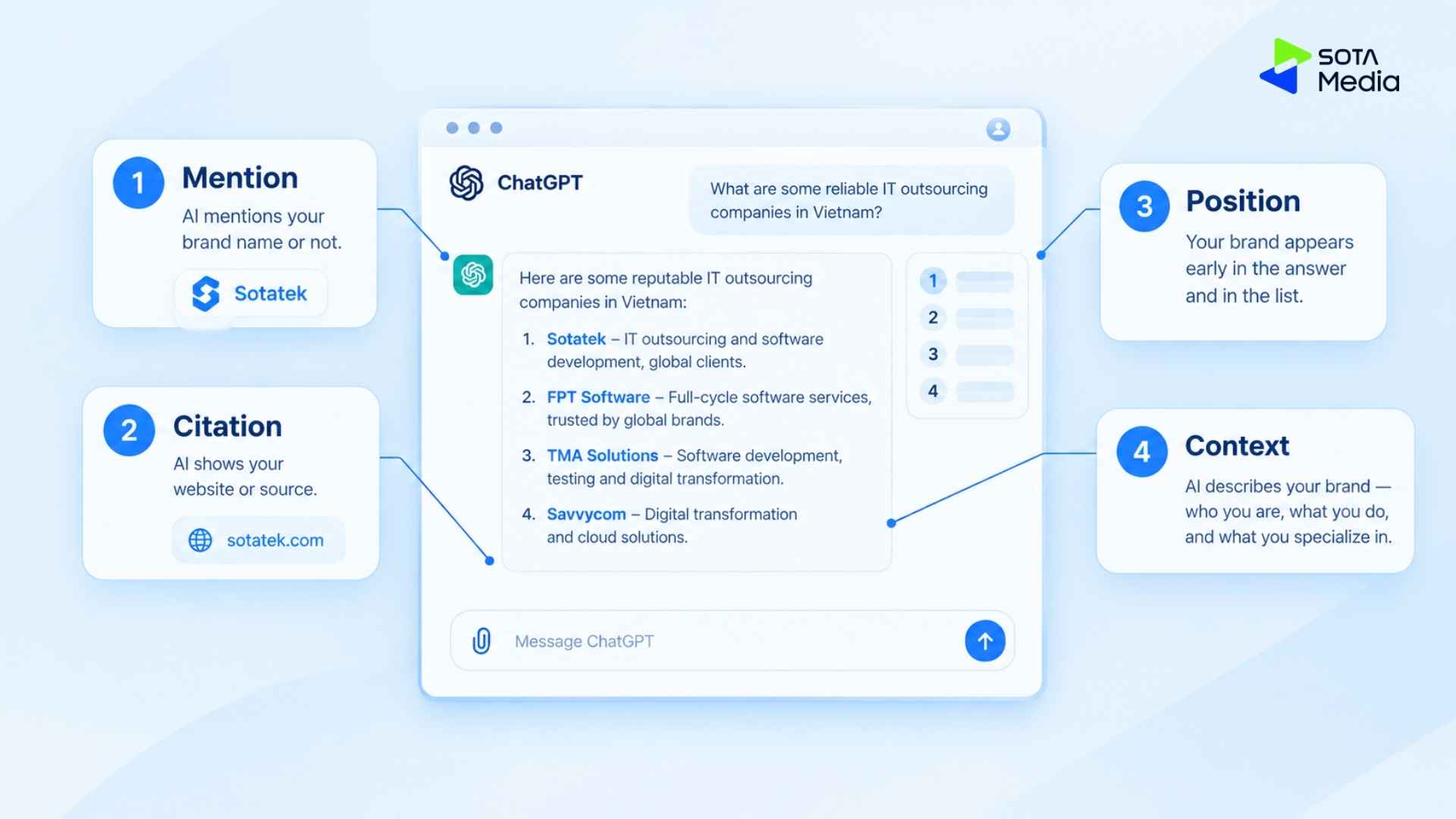
Example of the way AI cites, mentions, positions and describes a brand
AI visibility includes:
- Mention: Whether AI mentions the brand name or not.
- Citation: Whether AI extracts your website’s content or not.
- Position: Which position your brand name occurs in the answer. The earlier your brand appears in the answer or the higher its position in the list, the more visibility and attention it is likely to receive.
- Context: How AI describes your brand, including who your brand is, what your brand specializes in, whom it serves, and which topics it associates with the brand.
If an AI-powered answer contains all four signals, your brand has strong AI visibility in that answer.
Why does AI visibility matter for your brand?
AI is becoming a new discovery layer
AI platforms such as ChatGPT and Gemini are becoming another place where people discover information, products, and brands.
ChatGPT alone reached more than 900 million weekly users in 2026, giving AI a user base large enough to function as a meaningful discovery channel. Adobe also found that around one in four consumers use AI platforms such as ChatGPT to research information, make purchase decisions, or find recommendations.
AI visibility is therefore becoming part of brand discovery, not simply another SEO metric.
Your brand can lose visibility even when your SEO is strong
Google rankings and AI visibility measure two different layers of search visibility.
A page can rank in Google’s Top 10 without being selected as a source in an AI-generated answer. The reverse can happen too: a page that does not rank in Google’s Top 10 may still be retrieved and cited by AI. Semrush found that only 44.3% of Google Top 10 pages in its SaaS query sample appeared in at least one AI-generated answer.
That is why brands need to track signals, including AI mentions, citations, position, or share of voice, instead of focusing only on SEO performance.
AI visibility influences brand consideration
Similarweb reported that brands recommended by AI were associated with 2.5× higher site-visit rates than brands not recommended by AI. Because AI shortens the time of researching and comparing by giving users recommendations and comparison table which provide detailed information and the reasons why customers should choose this brand
How to increase your brand AI visibility
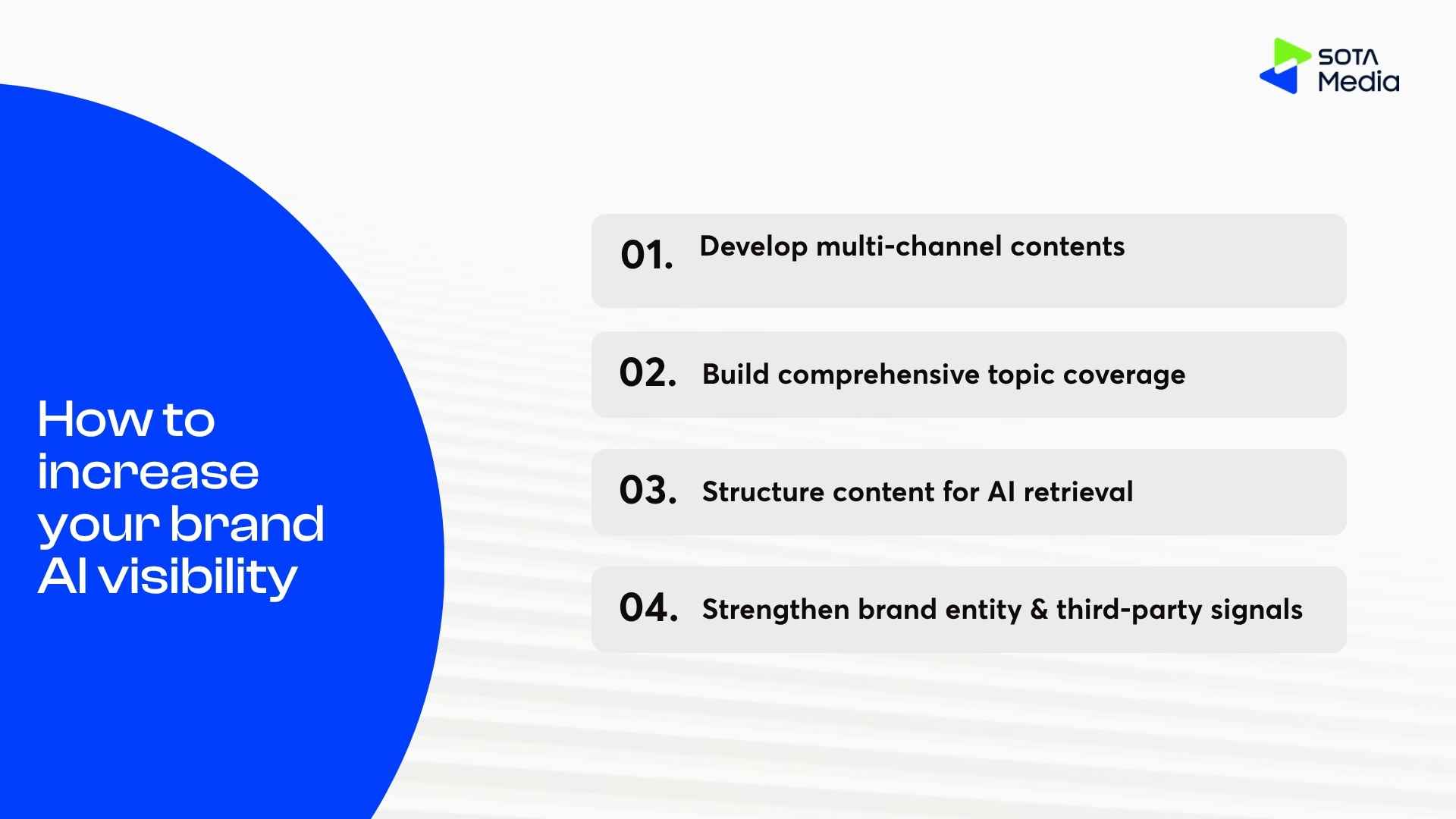
4 ways to increase your brand AI visibility
Develop multi-channel contents
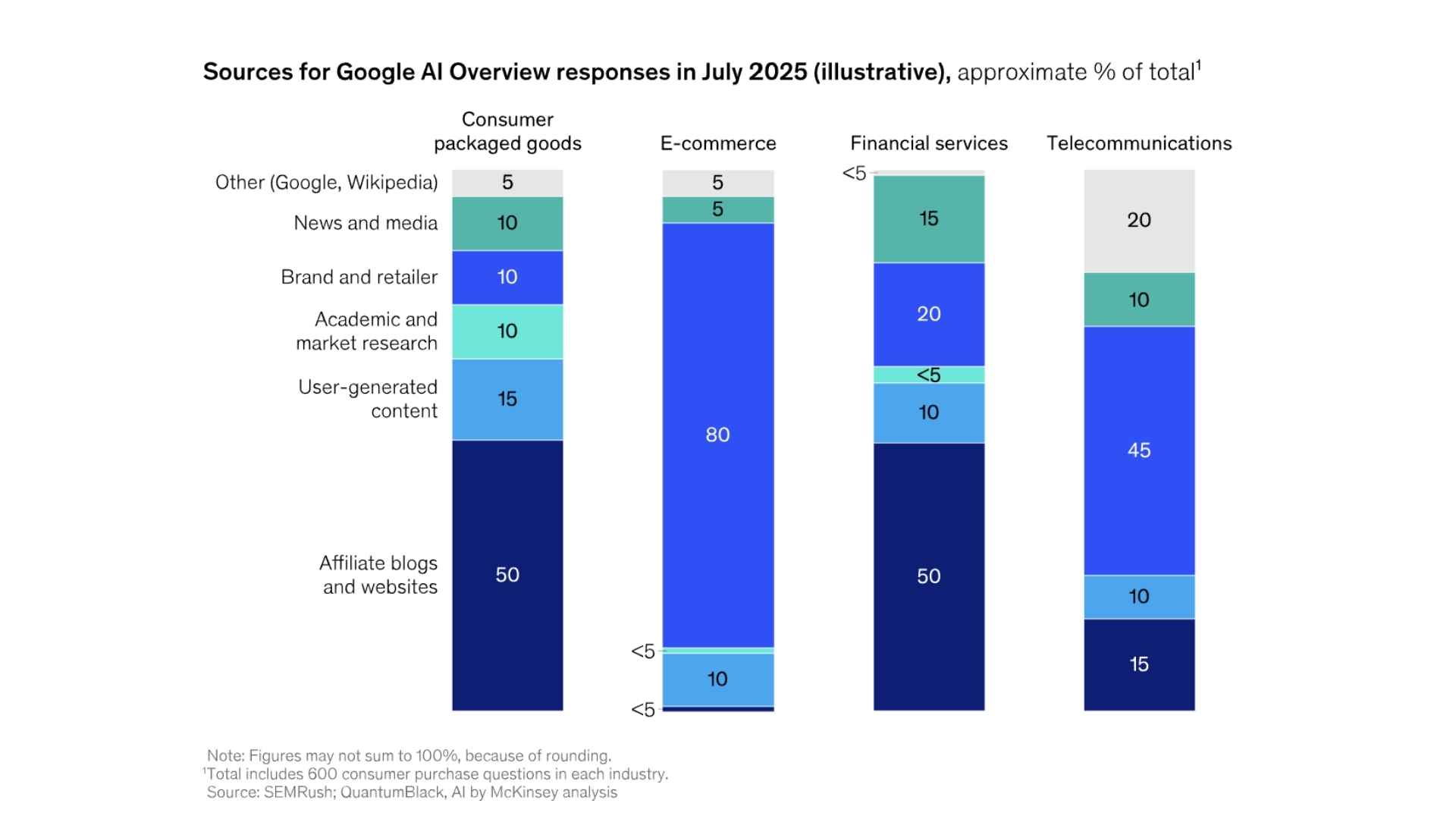
A high Google ranking does not guarantee that your brand will be cited by AI. According to McKinsey, a brand’s own website accounts for only 5-10% of the sources
In fact, AI cites many sources, ranging from UGC content, affiliate blogs, media, and brand websites. Therefore, you should build content on various channels instead of only ranking your blog posts on Google.
Build comprehensive topic coverage
AI uses semantic search and vector embeddings to find content that is related to a query. It does not need to find the exact keyword in the content. The closer the content is to the meaning of the query, the more likely AI is to retrieve it for related searches.
Therefore, you should build content around a topic, its related entities, and different search intents. Do not create separate pages for every keyword.
Here are some factors you need to consider when developing a comprehensive coverage topic.
| Factor | Short Description |
|---|---|
| Breadth | Covers multiple aspects and related subtopics of the main topic |
| Depth | Explores each aspect thoroughly with evidence and detailed analysis |
| Internal Linking | Connects related articles to create a cohesive topic ecosystem |
| Topic structure | Groups supporting content around a main pillar page |
| Semantic consistency | Uses consistent language, terminology, entities, and context across the content ecosystem |
| Content updates & expansion | Continuously adds new information, examples, and expert perspectives to maintain relevance and credibility |
Structure content for AI retrieval
Your content structure should be clear for AI to extract information. You should:
- Give the main answer early so AI can find the needed information quickly.
- Use clear H2 and H3 headings. Each section should answer a clear and useful question or cover one specific point
- Use comparison tables
- Use bullet points.
- Use simple sentences and words.
Strengthen brand entity & third-party signals
Build a consistent brand presence across different sources, including:
- Brand website
- Media and publications
- Review platforms
- Communities and Reddit
- Industry websites
- Knowledge bases
Keep key brand information consistent across these sources. This includes your:
- Brand identity
- Category
- Products and services
- Areas of expertise
- Key associations
Build third-party mentions through PR, reviews, expert references, and industry coverage. These sources give AI more information to use when checking your brand.
AI can compare information about a brand across multiple sources. It can use these sources to assess whether the information is consistent and reliable.
The more consistent your brand signals are across trusted sources, the more evidence AI has to confirm and cite your brand.
What makes it difficult to build AI visibility?
AI visibility can change across platforms and over time. Each AI platform has a different way to search and extract information. Brand cited on ChatGPT is not necessarily cited on Gemini or Perplexity.
The sources selected by AI can also change when:
- New content becomes available.
- Competitors publish more relevant content.
- AI changes how it searches for and evaluates sources.
- Users change how they phrase their queries.
Therefore, you should continuously track and optimize your content to adapt to the changes.
AI visibility vs traditional SEO
Traditional SEO and AI Visibility differ in how brands are discovered, evaluated, and measured. The table below outlines the key differences between the two approaches.
| Factor | Traditional SEO | AI Visibility |
|---|---|---|
| Goal | Rank in search results | Get mentioned or cited by AI |
| User behavior | Users search for information on search engines like Google and click on a high-ranking blog for information | Users ask AI for information and can click through to the sources cited in the answer. |
| Unit of optimization | Web pages | Content, entities and sources |
| Key signals | Relevance, authority, technical SEO | Relevance, extractability, entity signals. |
| KPIs | Rankings, traffic, CTR | Citations, mentions, AI share of voice |
| Stability | Relatively stable | Varies by platform and query |
Conclusion
AI Visibility is becoming another layer of search visibility. Ranking well on Google is no longer enough if your brand is missing from the AI answers customers use to research and compare options.
Focus on making your brand discoverable, understandable, citable, and recommendable across relevant AI platforms. This requires clear content, broad topic coverage, consistent brand signals, and ongoing monitoring as AI search continues to change.
Contact SotaMedia, if you want to improve your brand’s AI visibility
Frequently asked questions
No. AI Visibility can vary across ChatGPT, Gemini, Perplexity, and other AI platforms because each uses different retrieval and selection methods.
Common metrics include AI mentions, citations, position, share of voice, and the context in which your brand appears in AI-generated answers.
Yes. AI can retrieve and cite content that does not rank in Google's Top 10, so Google rankings alone do not determine AI Visibility.
Content that directly answers user questions, covers a topic in depth, uses clear structure, and provides consistent information across trusted sources can improve the chances of being retrieved by AI.
There is no fixed timeline. Results depend on your existing content, brand signals, third-party coverage, competitors, and how often AI platforms retrieve your information.