


Omnichannel Digital Marketing
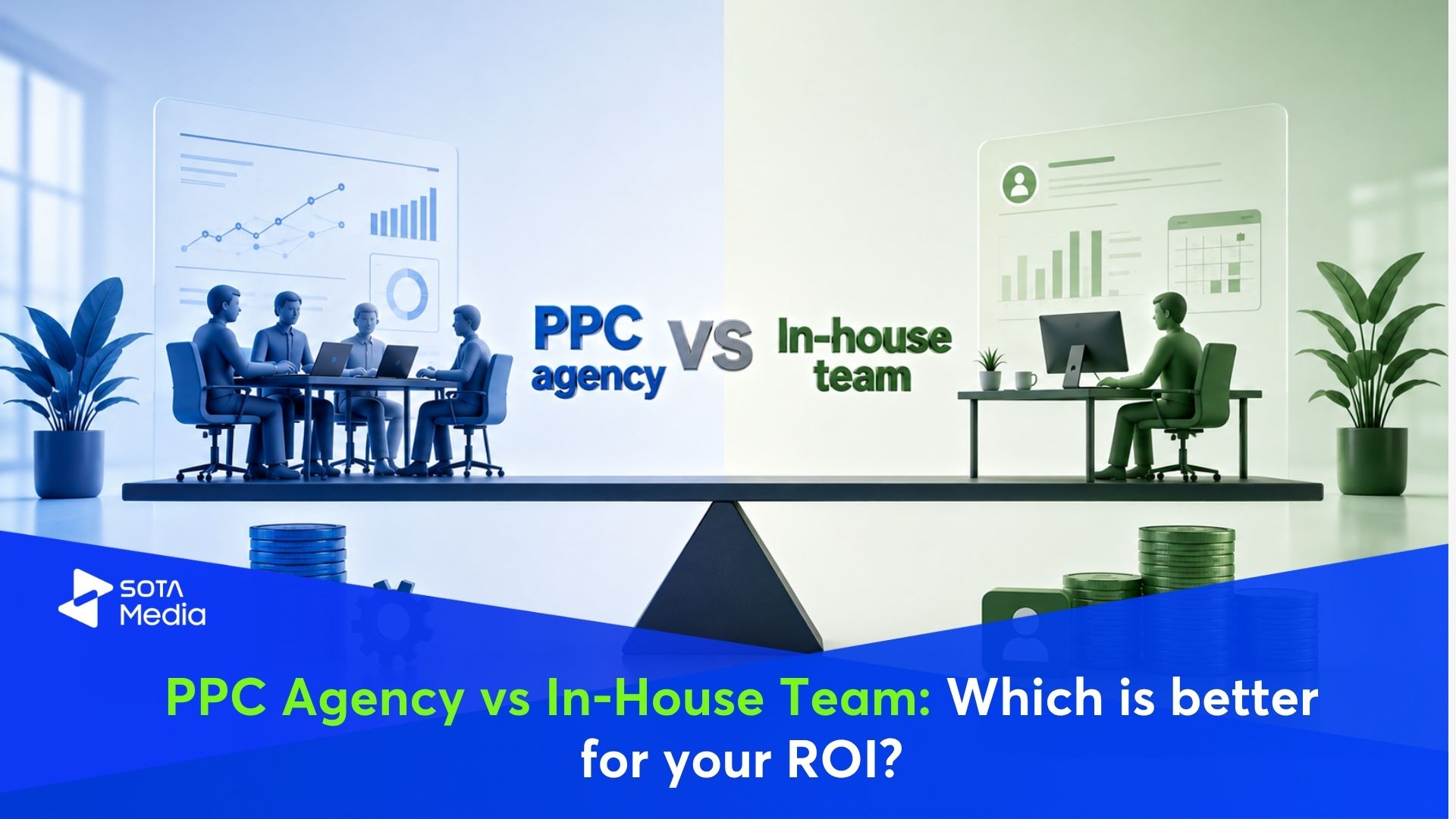
Every year, technical teams pick a PPC agency or make a first in-house hire based on which one a founder used at their last company, not on their own numbers. The two models do not differ in talent. A senior in-house hire and a senior agency lead can both build an account that converts. They differ in ramp-up time, cost structure, and how much product context a campaign needs before it works.
This article breaks down the real cost structure, the ramp-up math, the ROI numbers by model, and the break-even formula you can run against your own ad spend before you decide.
Key takeaways
- In-house PPC and a PPC agency differ in control and testing speed, not in who is “better.”
- The real cost is not the fee or the salary line. It is ramp-up time and how fast you can test.
- In-house wins on product knowledge. Agency wins on data velocity, because it runs many accounts in parallel.
- The break-even point depends on monthly ad spend, not company headcount.
- A hybrid model can suit technical teams that want external campaign execution while keeping product and customer knowledge in-house.
What’s the difference between in-house PPC and a PPC agency?
In-house PPC means you hire someone who sits inside your company, reports to your marketing lead, and manages campaigns as one part of a broader role. A PPC agency means an external team runs your campaigns alongside campaigns for other clients, which gives them pattern recognition across accounts that a solo hire cannot build alone.
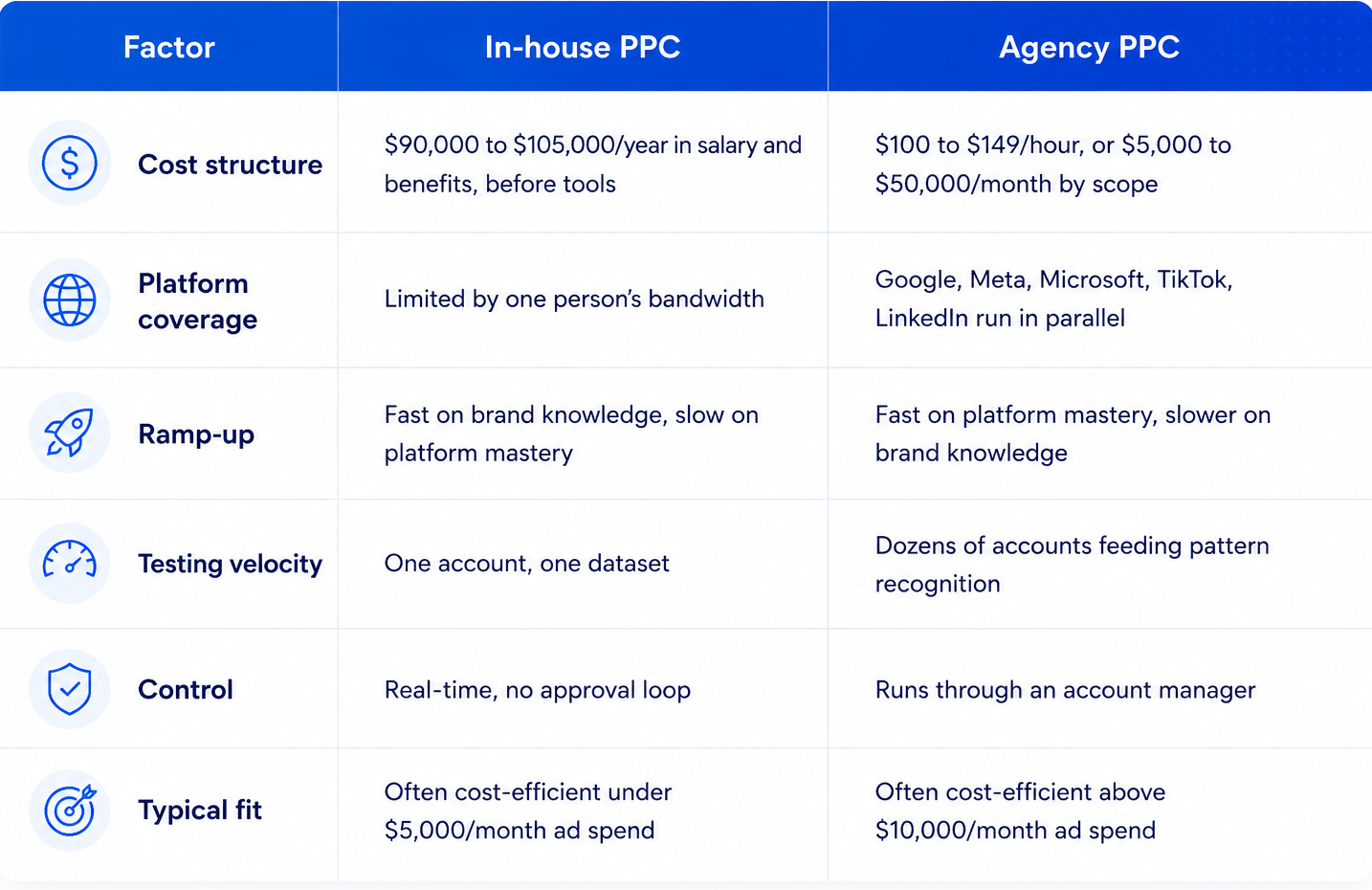
In-house PPC vs agency PPC at a glance
What ROI actually measures in a PPC decision
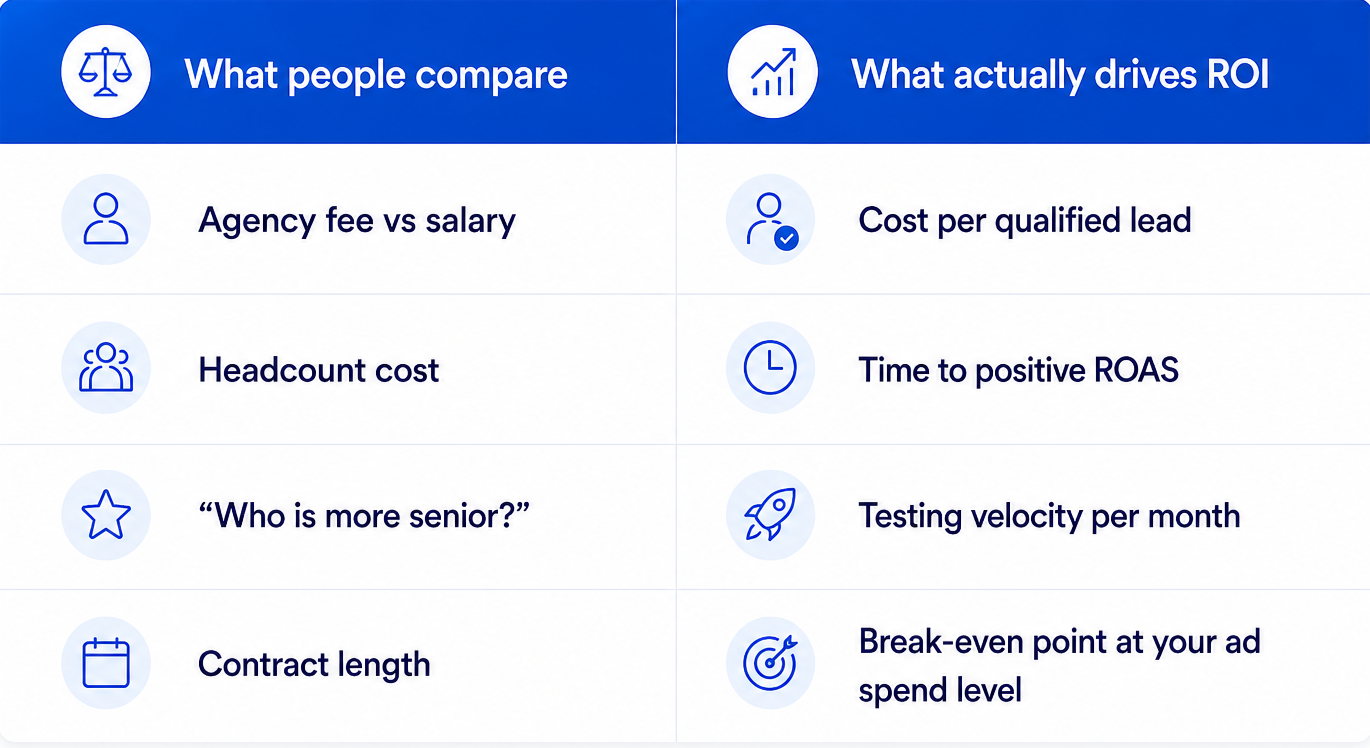
The most common mistake we see technical founders make is comparing the wrong numbers: agency retainer fees against in-house salaries. That comparison tells you almost nothing about ROI. What actually matters is cost per qualified lead and time to positive ROAS (return on ad spend), because those are the numbers that show up in your P&L, not your org chart.
Cost structure: agency retainer vs salary plus tool stack plus overhead
The salary line is never the full in-house bill. Glassdoor’s 2026 data puts a PPC Specialist’s average salary at $70,996 a year and a Senior PPC Specialist’s at $79,208, and benefits plus payroll tax typically add another 25 to 30% on top (Glassdoor). That puts fully loaded compensation at roughly $90,000 to $105,000 before a paid tool stack for bid management and attribution.
On the agency side, Clutch’s marketplace data shows PPC agencies typically billing $100 to $149 an hour, with broader digital marketing retainers ranging $5,000 to $50,000 a month depending on scope. For most businesses under six figures in annual ad spend, the agency line is usually cheaper before you factor in anything else.
Ramp-up time: weeks vs months
A PPC agency typically has traffic live within the first week because the platforms and playbooks already exist. What it does not have on day one is your product context, your buyer objections, or your pricing logic, and that gap closes over an onboarding period rather than instantly.
A new in-house hire runs the opposite curve: they know the product from day one, but building account-level fluency, testing history, and platform judgment on Google Ads, Meta, and whatever else you run typically takes a full quarter or more before performance stabilizes.
Quality ceiling: cross-vertical experience vs institutional product knowledge
A PPC agency team sees hundreds of accounts across verticals, so it recognizes a stalling ad set or a bidding strategy that stopped working two weeks before your account shows the same symptom. An in-house specialist sees one account but understands why a feature matters to your buyer without a weekly brief. Neither ceiling is higher. They are different ceilings.
When an in-house team wins a PPC agency
Product depth: no re-briefing every week
If your product has a long sales cycle, technical buyers, or pricing that depends on usage tiers, an in-house hire who sits in your Slack, joins your sales calls, and reads your support tickets will write sharper ad copy and pick better audiences than someone who only sees your product through a monthly call. They do not need to be re-briefed every time a feature ships.
Cost efficiency at scale
Once monthly ad spend climbs past the point where a percentage-of-spend fee outpaces a salary, in-house gets cheaper. Run your own numbers here: a 15% fee on $50,000/month in spend is $7,500/month, more than most senior in-house salaries on a monthly basis.
Full control and data ownership
An in-house team means your account, your data, and your history have no dependency on which account manager the agency assigns you this quarter. Agency account manager turnover is a real, if under-discussed, cost. Every handoff resets some of the context the previous manager built, and you rarely get to choose when that handoff happens.
When a PPC agency wins
Cross-account benchmarking
A PPC agency strategist sees patterns you cannot see from 1 account. They know what a good click-through rate looks like for B2B SaaS versus e-commerce, because they are running both right now. That benchmark knowledge shortens the guesswork on every new campaign you launch.
Testing velocity
More accounts running in parallel means more tests completing in the same calendar month. If an agency runs 10 accounts and tests 3 headline variants on each, that is 30 data points a month feeding their playbook, versus the 3 your in-house hire generates on your account alone. Velocity compounds.
No hiring risk
Recruiting a senior PPC specialist takes time, and getting it wrong costs more than the salary. Skip the 2 to 3 months of sourcing, interviewing, and onboarding, plus the risk of a bad hire that sends you back to month zero. An agency contract can start and stop on a shorter cycle, with far less downside if the fit is wrong.
The real ROI comparison: numbers, not opinions
Cost per qualified lead by industry
Across 13,474 US search campaigns run between April 2025 and March 2026, the all-industry average cost per lead was $66.69, down from $70.11 the year before and the first year-over-year decline in five years (WordStream/LocaliQ 2026 Google Ads Benchmarks).
The range by industry runs from roughly $26.84 to $131.63, so a single blended number is only a starting reference point, not a target. That benchmark measures cost per lead, not cost per qualified lead, and whether a PPC agency or an in-house team lands closer to the low end of your industry range depends on account-specific execution.
Time to have a positive ROAS
Agencies generally show faster performance in the first 30 to 60 days, since testing infrastructure and platform expertise already exist on day one. In-house teams typically close that gap by month 4 to 6, once the specialist has enough account history to make confident bidding and creative decisions.
Neither path is guaranteed. Product complexity, sales cycle length, and how competitive your keywords are all shift the timeline in either direction.
Break-even framework: When does an PPC agency cost less than hiring in-house?
You do not need a consultant to calculate this. Use your own numbers:
Break-even ad spend = in-house annual cost ÷ agency fee percentage
For example, if a senior in-house PPC hire costs you $70,000 a year fully loaded (salary, benefits, tools), and agencies in your space charge 15% of ad spend, your break-even point is $70,000 ÷ 15% = roughly $467,000 in annual ad spend, or about $39,000 a month.
Below that spend level, a PPC agency is structurally cheaper. Above it, in-house salary starts winning on pure cost, though ramp-up time and product depth still factor into the real decision.
The hybrid model most technical teams are moving to
The PPC agency handles execution and testing; in-house holds product context approves strategy
The model we see working best for technical founders is not agency or in-house. It is both, with clear lanes. The PPC agency runs execution, testing, and cross-account benchmarking. The in-house team, sometimes just 1 person, holds product context, approves messaging, and feeds the agency real customer language instead of a generic brief.
Why this solves both weaknesses at once
A PPC agency’s biggest weakness is not understanding your product deeply enough. An in-house team’s biggest weakness is not having enough data volume to test fast. Put them together, and each side compensates for the other’s blind spot. The PPC agency gets product truth it cannot get from a brief document. The in-house team gets testing velocity it cannot generate alone.
How to choose the right one for your business
Start with your monthly ad spend, not your headcount. Run the break-even formula above with your own numbers. If you are under the threshold, a PPC agency is the structurally cheaper option, and the ramp-up speed matters more than you think when every month of delay is a month of wasted spend. If you are well above it and your product has a long, technical sales cycle, an in-house hire earns their cost back through depth.
A few questions clarify the decision faster than a pros-and-cons list:
- What is our current monthly ad spend, and where does that land against the break-even formula?
- How long is our sales cycle, and how much product context does a campaign need to convert?
- Can we absorb 4 to 6 months of near-zero output if a first PPC hire does not work out?
- Do we have anyone in-house who can hold product context even if execution sits outside?
If neither answer feels clean, and for most technical companies growing past their first PPC hire, it will not, the hybrid model is worth a direct conversation. Tell us your monthly ad spend and your product’s sales cycle, and we will tell you honestly whether SotaMedia is the right fit or whether an in-house hire makes more sense at your stage.
Conclusion
Choosing between a PPC agency and an in-house hire is not about which model has better talent. Both can deliver strong results. The real difference is in cost, ramp-up time, and how much internal product knowledge your campaigns need to perform.
Use the numbers in this guide to calculate both models using your actual spend, staffing cost, and qualified-lead value before making your decision. If you need external expertise to plan and manage PPC around your business goals, SotaMedia is one option to consider.
Frequently asked questions
Not always. Agency fees are usually a percentage of ad spend (10-20%), while an in-house hire costs salary plus benefits plus tool licenses regardless of spend level. Below a certain ad spend threshold, agency fees run lower than a full-time salary.
Most in-house hires need 2 to 3 months to fully understand the product, account history, and conversion data before they can optimize with confidence.
It depends on the agency's background. Generic digital agencies market from the outside. Agencies with an engineering pedigree, like SotaMedia coming from SotaTek, write from inside the product logic instead of guessing at it.
It's calculated by comparing the agency's management fee (spend × fee %) against the fully loaded cost of an in-house hire (salary + benefits + tools). The exact number depends on your monthly ad spend, not your company size.
Not by default. In-house teams often win on long-term product context, but agencies typically iterate faster in the first few months because they've tested similar accounts before.
Yes, a hybrid in-house and agency PPC model works well for businesses that want brand-level control with agency-level execution speed.
For many technical teams, yes. In-house keeps product context and strategic control, while the agency handles execution speed and cross-account testing data.
Cost per qualified lead, time to positive ROAS, and testing velocity (number of experiments run per month) give a clearer picture than raw fee or salary comparisons.