

SEO vs GEO: Why Your SEO Dashboard Is Lying to You (2026)
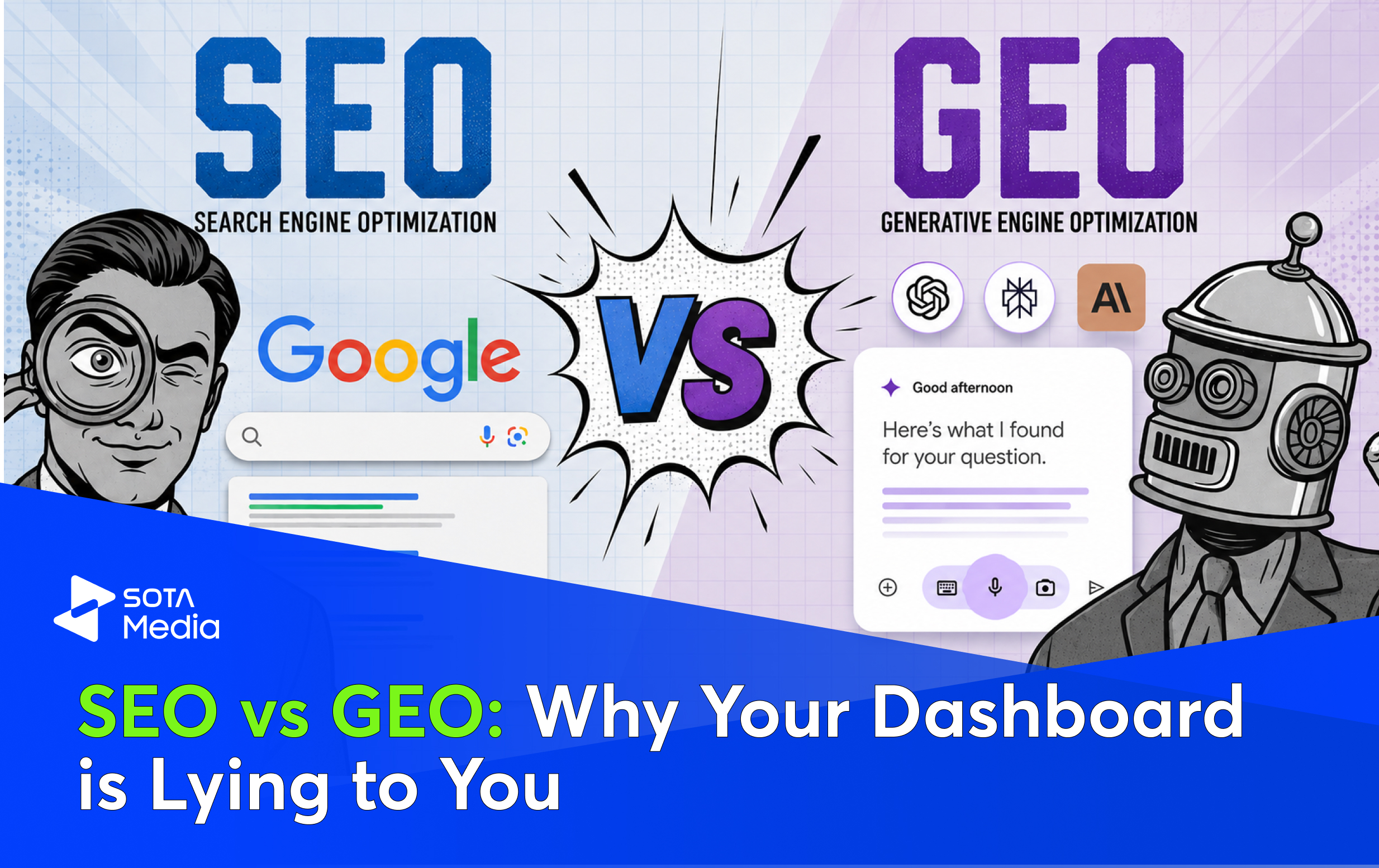


Table of Contents
Key takeaways
- GEO (Generative Engine Optimization) is the practice of optimizing content to get cited by AI platforms (ChatGPT, Perplexity, Gemini, Claude), not just ranked on Google
- Zero-click searches for news queries grew from 56% to 69% in a single year after Google’s AI Overviews rollout
- Most AI referral traffic arrives without referrer headers and is logged as Direct in GA4, making it invisible in standard reports
- AI-referred visitors tend to convert at far higher rates than organic search visitors, but most analytics dashboards never show them as a separate channel
- GEO is not a replacement for SEO. Whether you frame it as SEO vs GEO or GEO vs SEO, the answer is the same: GEO is a layer on top of SEO, not a substitute
In May 2024, 56% of news-related Google searches ended without a single click to any website. By May 2025, that number had climbed to 69%.
Your SEO dashboard did not show that. It showed rankings, impressions, and sessions. It probably showed a healthy-looking organic channel. What it did not show is the 13-point traffic shift that happened in twelve months, because the traffic went somewhere your analytics cannot track it.
That somewhere is AI. This article breaks down SEO vs GEO: what GEO is, why standard SEO tools cannot measure it, and what zero click search behavior means for your content strategy in 2026.
What is GEO?
Generative Engine Optimization (GEO) is the practice of structuring and optimizing content so that AI platforms (ChatGPT, Perplexity, Gemini, Claude, and others) cite it when generating answers to user queries.
The term was formalized in a 2024 paper from Princeton, Georgia Tech, and IIT Delhi and entered mainstream marketing use in 2025. By early 2026, most enterprise marketing teams have a GEO initiative. Most SMB and mid-market teams have not started.
The core shift behind the whole SEO vs GEO debate: SEO optimizes for a click from a ranked list. GEO optimizes for inclusion in a synthesized answer. A user asking ChatGPT “what is the best marketing agency in Vietnam” will never see a list of blue links. They will see a paragraph. Getting into that paragraph is what GEO optimizes for.
What is actually happening to search traffic in 2026?
Three things are happening at the same time, and standard SEO dashboards only show one of them.
Zero-click is accelerating
According to SimilarWeb’s 2025 data, in May 2024, 56% of news-related Google searches resolved without a single click to a website. By May 2025, that number had climbed to 69%, a 13-point jump in twelve months following Google’s AI Overviews rollout. Across all query types, several datasets estimate that roughly two‑thirds of searches now end without a click to any site. Zero click search behavior is not a news-specific problem. It is spreading across categories.
AI search volume is growing fast
The user base is scaling faster than search ever did. ChatGPT achieved over 2 billion prompts per day & reached 900 million weekly active users in February 2026, up from 400 million a year earlier. AI-referred website sessions are climbing with it: Previsible’s analysis of 19 GA4 properties found a 527% year-over-year jump in the first five months of 2025.
These users behave differently. The average ChatGPT query is 60 words, compared to 3.4 words for a Google search. The user asking in ChatGPT is more specific, more researched, and more likely to act.
AI traffic converts at a rate your organic channel never has
That intent shows up in conversion data. Seer Interactive’s June 2025 study put ChatGPT referral conversion at 15.9%, compared to 1.76% for Google organic. The pattern across other studies is the same direction: AI-referred visitors arrive with more intent and convert better than organic search.
Your SEO dashboard tracks the third of these badly and does not track the first two at all.
SEO vs GEO: how they actually differ
|
Factor |
SEO |
GEO |
|---|---|---|
|
Goal |
Rank in search results |
Get cited in AI answers |
|
Success metric |
Rankings, organic clicks |
Citation frequency, AI share of voice |
|
Content format |
Keyword coverage, long-form |
Definition-first, extractable answers, data tables |
|
Key signals |
Backlinks, technical health, keyword match |
E-E-A-T, named authors, inline citations, structured data |
|
Measurement tools |
Ahrefs, GSC, GA4 |
Ahrefs Brand Radar, manual AI query testing, server logs |
|
Traffic model |
Click-based |
Zero-click citation (brand impact without sessions) |
|
Update frequency needed |
Quarterly at most |
Every 13 weeks (50% of AI citations are under 13 weeks old) |
The most common mistake in any GEO vs SEO comparison is treating it as a choice. GEO is not a replacement for SEO. Strong SEO is the foundation AI systems rely on when deciding which brands to reference: a site that is technically accessible, has quality content, and shows credibility signals. What GEO adds is specific structural requirements that SEO does not address.
An Ahrefs study of 75,000 brands, published in May 2025, found branded web mentions correlate with AI Overview visibility at 0.664 against 0.218 for backlinks. Ahrefs is clear that this is correlation, not causation. Large, established brands tend to have both more mentions and more AI visibility, so mentions may be a proxy for brand strength rather than the cause of citations. The direction is still consistent enough to act on: when independent sources discuss your brand in editorial coverage, analyst reports, and review platforms, AI systems have more material to treat it as a known entity, with or without links.
Why your SEO dashboard does not show the full picture
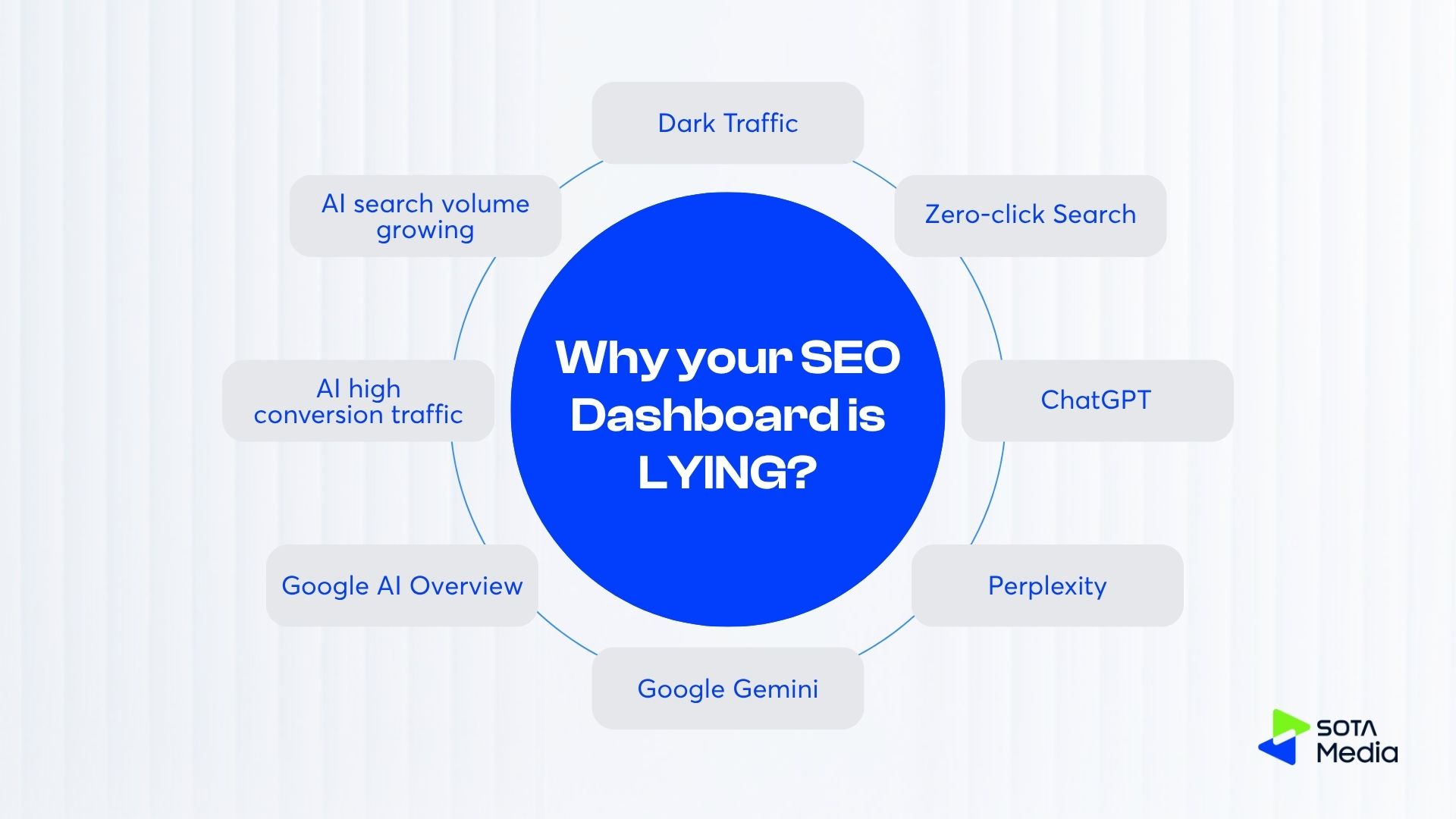
Standard SEO dashboards track three things: rankings, organic clicks, and sessions from Google. None of these capture what is happening in AI search.
The dark traffic problem
Dark traffic is any visit your analytics cannot trace back to a real source, so it gets dumped into the “Direct” channel by default. A large share of AI referral traffic ends up here. It lands in Direct, mixed in with bookmarks and typed-in URLs, with nothing to show it came from ChatGPT or Perplexity.
The mechanics: ChatGPT’s mobile app uses WKWebView on iOS and Chrome Custom Tabs on Android. Both strip referrer headers before the visit reaches your site. GA4 has no built-in AI channel. When a user clicks a link from ChatGPT, Perplexity, or Gemini, GA4 categorizes the visit as either “Referral” (if the platform passes a referrer header) or “Direct” (if it does not). Google added a custom channel group regex example for AI assistants to its GA4 documentation in July 2025, the first time the platform officially recognized AI tools as distinct traffic sources. But it is user-configurable, not a default.
The practical result: a share of your Direct traffic is AI-referred visits hiding inside the wrong channel, and those visits convert better than the bookmarks and type-ins sitting next to them.
The Google AI Overviews blind spot
Google AI Overviews and AI Mode appear in roughly 18% of Google searches, per Ahrefs, but AI Overview clicks pass through as standard Google/organic traffic in GA4. There is no referrer signal that distinguishes an AI Overview click from a traditional organic result. Google added an AI Mode filter to Search Console in June 2025, but this only shows citations, not traffic attribution.
The ranking signal is incomplete
A page can rank in position 3 on Google, get cited in ChatGPT’s answer, and show zero sessions in your analytics because the user never clicked through. Your ranking dashboard shows “position 3.” Your traffic dashboard shows nothing. Your brand still shaped the user’s decision.
Being cited in a generative AI answer is now the conversion event. The user’s journey no longer necessarily runs through your website.
What signals do AI engines use to cite content?
The Princeton/Georgia Tech GEO paper identified three content strategies that consistently outperform baseline in generative engine visibility:
- Statistics addition: adding specific numerical data with source and timeframe. Improves visibility by up to 40% in cited research.
- Quotation addition: adding attributed quotes from named experts. Improves visibility 15-30%.
- Citation density: inline citations to authoritative sources at the point of claim, not just in a bibliography at the bottom.
Beyond the research, the structural signals that AI engines weigh:
Definition-first content: AI systems retrieve from the opening of a page, not the middle. The first 200 words of any article should directly and completely answer the primary query, not build up to the answer. If your introduction spends three paragraphs establishing context before defining anything, AI tools will not extract from it.
Named authors with credentials: AI engines check E-E-A-T signals. An article bylined “Editorial Team” carries less weight than one bylined with a name, title, and external verification. Claude, in particular, weighs named authorship when deciding whether to trust a source.
FAQ sections with 10+ questions: FAQ schema pages get disproportionately more AI citations across most categories. The section must be labeled “Frequently Asked Questions.” AI recognition relies on the pattern, not just the content.
Data tables: AI systems treat comparison tables as high-signal content for queries asking “what is the difference between X and Y” or “which tool is best for X.” A table with clear headers is more tractable than the same information in prose.
Content freshness: 50% of content cited in AI answers is less than 13 weeks old. Content published in 2024 without updates will consistently lose ground to a 2026 article covering the same topic. Add a visible “Last Updated” timestamp and refresh cornerstone articles with new data every quarter.
Third-party mentions: 82% of AI citations come from earned media, not owned content or paid placements, per Muck Rack’s December 2025 research. Reddit, LinkedIn, and YouTube are among the most-cited sources by major LLMs. Mentions on these platforms give AI models additional material that validates your brand as a known entity.
Platform-by-platform: how each AI engine picks sources
|
Platform |
Primary sources |
What it weights |
Optimize with |
|---|---|---|---|
|
ChatGPT |
Bing index + training data |
Product pages (cites at 20x the rate of Perplexity), specific facts, named entities |
BLUF structure, product page content, entity mentions |
|
Perplexity |
Real-time web + Reddit |
Freshness, Reddit/Quora community mentions, comparison content |
Fresh content, community presence, comparison articles |
|
Gemini |
Google Search index |
Traditional SEO authority + schema markup |
Strong SEO fundamentals + Article/FAQ schema |
|
Claude |
Training data + Brave Search |
E-E-A-T, named authors, inline citations, ClaudeBot allowlisted |
Named authors and cited sources; allow ClaudeBot in robots.txt |
ChatGPT cites product pages at 20.1% of the time, compared to Perplexity at 0.4%. A brand that has invested heavily in blog content is not fully optimized for ChatGPT, which is responsible for the overwhelming majority of AI-driven visits.
The robots.txt implication: allowing GPTBot, OAI-SearchBot, ClaudeBot, Claude-SearchBot, PerplexityBot, and Google-Extended are prerequisites for AI citation eligibility. Blocking these bots removes your content from the pool.
How to run a GEO audit on your existing content
Step 1: Test your top 10 pages in each AI engine
Take your 10 highest-traffic pages. Query each AI platform with the primary keyword for each page. Record: Does the AI mention your brand? Does it cite your page? What does it say? This takes 30-60 minutes and tells you your current AI citation baseline.
Step 2: Check your definition-first structure
Open each page. Read the first 200 words. Ask: Does this paragraph directly answer the primary query? If the answer is not in the first 200 words, rewrite the introduction.
Step 3: Add or fix your FAQ section
If a page has no FAQ section, it is missing the highest-citation-rate content format. Write 10 questions your target buyer would type into ChatGPT or Perplexity. Answer each in 2-4 sentences, directly. Label the section “Frequently Asked Questions.”
Step 4: Add inline citations
Each factual claim in the article should have a named source and a link at the point of the claim, not just in a bibliography at the bottom. AI systems read inline attribution as a signal that the content is credible.
Step 5: Check robots.txt and schema
Confirm that GPTBot, ClaudeBot, PerplexityBot, and Google-Extended are not blocked. Then confirm Article schema and FAQPage schema are implemented on each target page.
How to measure GEO performance
The hardest part of running SEO vs GEO side by side is measurement. Standard SEO tools measure what is happening in Google. They do not measure what is happening in AI engines. You need both.
Step 1: Fix GA4 attribution first
Create a custom channel group in GA4 under Admin → Data display → Channel groups. Add a new channel named “AI Search” with a regex condition on session source:
chatgpt\.com|perplexity\.ai|claude\.ai|gemini\.google\.com|copilot\.microsoft\.com|deepseek\.com|grok\.com
This captures AI referral traffic where the platform passed a referrer header. It will not capture mobile app traffic, which strips headers. Treat it as a floor, not a ceiling.
Step 2: Run weekly AI citation queries
Every week, query ChatGPT, Perplexity, Claude, and Gemini with your 10 primary target queries. Check: is [your company] mentioned? Is it cited as a source? What position in the response? Log this in a spreadsheet. This is your GEO equivalent of rank tracking.
Step 3: Monitor server logs for AI bot activity
GA4 tracks browser sessions, not bot crawls. Server logs show when GPTBot, ClaudeBot, and PerplexityBot crawled your pages. High crawl frequency on a page correlates with citation probability. Low or zero crawls mean the engine has not indexed your content.
Step 4: Use Ahrefs Brand Radar for AI mention tracking
Ahrefs Brand Radar monitors when your brand is mentioned in AI-generated responses. For SotaMedia, set up tracking for “SotaMedia,” “SotaTek marketing,” and the primary service keywords.
Step 5: Track AI referral conversion separately
Once the GA4 channel group is configured, compare conversion rates between AI Search and Organic Search directly. Knowing your own multiplier gives you a real number to argue with, instead of a borrowed stat from someone else’s study.
What’s next?
The SEO vs GEO question is not which one wins. It is about whether your content is structured for both at the same time.
Google rankings still matter. They feed AI Overviews, they feed Gemini, and they remain the entry point for most discovery work. But ranking position 3 with no clicks is not a win. Being cited in the answer that replaced the click. The job in 2026 is to do both: keep the SEO foundations intact, then layer in the GEO requirements that AI engines actually read.
If you take one thing from this article, take this: open ChatGPT today, type the three queries you most want to win, and see what it says about your category. If your brand is not in the answer, you have a measurement problem and a content problem at the same time. Fix the measurement first by setting up the GA4 channel group above. Fix the content next by running the 5-step audit.
At SotaMedia, this is the work we do for B2B tech and SaaS companies looking to stay visible as search splits between Google and AI. If you want a second pair of eyes on where your website or content sits in both SEO and GEO, contact us for a free audit.