

Digital marketing
Vietnam’s tech event scene has changed fast. In 2023, Vietnam hosted over 500 B2B conferences and trade expos, up from roughly 300 in 2019. Salesforce, AWS, Google, and homegrown players like VNG and MoMo now run annual flagship events in the country. For any tech company trying to grow in Southeast Asia, event marketing in Vietnam is no longer optional it’s how you get taken seriously.
This guide covers what works, what doesn’t, and what you’re legally required to do before hosting a public event in Vietnam.
Key Takeaways
- Event marketing in Vietnam converts at a higher rate than digital channels because attendees self-select. Bizzabo’s 2024 report found 95% of marketers say in-person events directly impact primary business objectives. No other single channel scored that high.
- Vietnam’s B2B buyers close deals with people they’ve met. One event in the right city, with the right audience in the room, does work that 6 months of email nurturing can’t.
- City choice is a strategic call, not a logistical one. Ho Chi Minh City for fintech, startups, and consumer tech. Hanoi for government agencies, SOEs, and enterprise procurement. Getting this wrong means the right event in the wrong room.
- One strong Vietnamese speaker with a real title drives more registrations than three foreign keynote names. Vietnamese tech audiences trust practitioners who’ve done the work in SEA, not analysts talking about US market trends.
- Public events in Vietnam require permits from the local Department of Culture, Sports, and Tourism. Submit applications at least 30 days before your event date and 45–60 days for anything involving international participants.
- Post-event follow-up is where the pipeline is actually built. Most companies go dark for a week after the event. The ones that send a follow-up within 24 hours and publish a recap within 72 hours get 3-4x more meetings booked from the same event.
What Is Event Marketing
Event marketing is when a company creates or sponsors a live experience, such as a conference, a product demo day, a hackathon, or a roadshow stop, to connect with customers, partners, or press in person.
It’s different from digital marketing in one specific way: the people who show up are already interested. A LinkedIn ad goes to 10,000 people who may or may not care. A 300-person tech conference in Ho Chi Minh City puts your team in the same room as 300 people who registered, traveled, and blocked out their day for this.
The conversion rates reflect that difference. According to Bizzabo’s 2024 Event Marketing Report, 95% of marketers say in-person events have a measurable impact on achieving primary business objectives higher than any other single channel they measured.
Why It Works in Vietnam
Why It Works in Vietnam
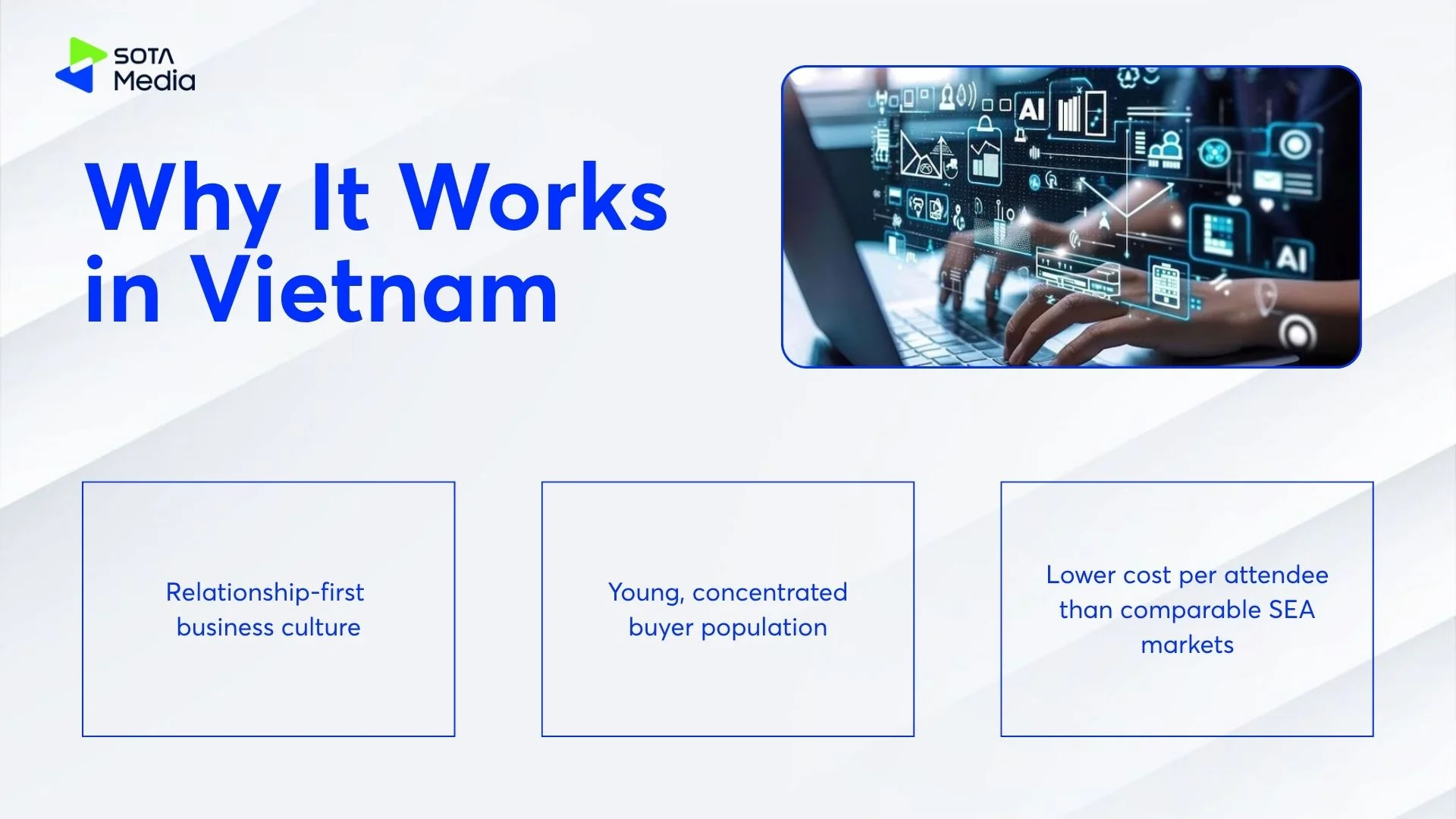
Three things make Vietnam a good event market for tech companies.
Relationship-first business culture. Vietnamese B2B buyers, whether enterprise procurement managers or startup founders, tend to close deals with people they’ve met. A 45-minute conversation at your booth does work that 6 email sequences can’t. This isn’t an observation about culture in the abstract: it’s something any foreign tech company in Vietnam figures out by Q2 of their first year.
Young, concentrated buyer population. Vietnam has a median age of 30.7 (World Bank, 2023). The tech buyer class, IT managers, CTOs at SMEs, and product managers at banks and fintechs is mostly in its 30s and heavily concentrated in two cities. You can reach a meaningful portion of your total addressable market by running 2 events a year, one per city.
Lower cost per attendee than comparable SEA markets. Running a 300-person full-day event in Ho Chi Minh City costs significantly less than the equivalent in Singapore or Bangkok, both in venue fees and vendor rates. That gap gives you room to invest in better production, a stronger speaker line-up, or more promotion without blowing your budget.
Types of Events Tech Companies Run in Vietnam
Different goals need different formats. Here’s what actually works by company stage and objective.
Conferences and summits (200–1,000 attendees)
Used for brand positioning and generating press coverage. AWS re:Invent Vietnam, Google Cloud Next Vietnam, and Vietnam Tech Summit are examples. Takes 3–4 months to plan properly.
Product launch events (50–300 attendees)
Invite-only, tight audience, high production. Used when you’re releasing something significant, a new enterprise product, or a major platform update. Salesforce runs this format when they release new CRM features to their Vietnamese customer base.
Roadshows (multiple cities, 50–150 people per stop)
Good for sales pipeline acceleration. You take the same deck to Hanoi, Ho Chi Minh City, and sometimes Da Nang in the same week. Keeps the message consistent, generates regional coverage, and forces your sales team to have real conversations outside HQ.
Hackathons and developer events
Useful for tech companies that need to build a developer community. Google, Microsoft, and local players like Zalo hold these regularly. Duration is typically 24–48 hours. Attendance is 100–500 developers.
Networking dinners and closed roundtables
20–40 people. Used for C-level relationship building or closing enterprise deals. These have no stage and no slides; the format is just dinner and a structured conversation. They work because your prospects talk to each other, not just to you.
How to Plan an Event in Vietnam Step by Step
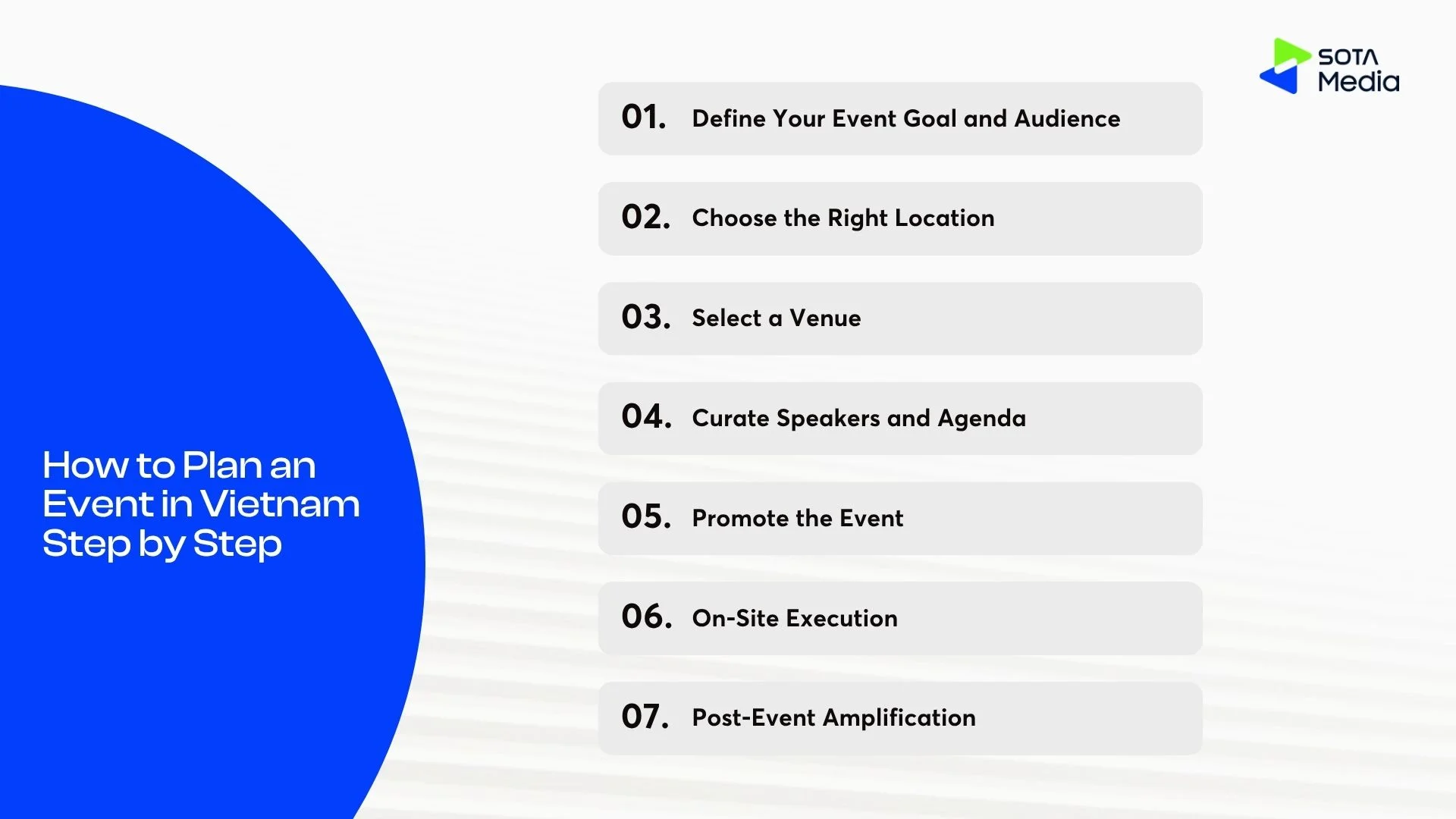
How to Plan an Event in Vietnam Step by Step
Step 1: Define Your Event Goal and Audience
Set one primary KPI before you book anything. “150 attendees and good vibes” is not a goal; “40 qualified sales conversations with IT managers at 200+ employee companies” is. Your goal determines the format, the speakers, the venue size, and every promotional decision after it. Specificity also applies to audience: “tech professionals in Vietnam” is too broad to plan around; “IT decision-makers at Vietnamese banks evaluating cloud migration” is not.
Step 2: Choose the Right Location
Match your event location to where your buyers actually are, not where it’s most convenient to organize. Vietnam’s tech buyer base is geographically concentrated, so the right city makes a significant difference in who shows up. Map your top prospects by location before you commit to a venue. Running a great event in the wrong city is one of the most common and avoidable mistakes in the market.
Step 3: Select a Venue
Book a venue that fits 80% of your target headcount; a full room reads as momentum, and a half-empty one doesn’t. In Ho Chi Minh City, Gem Center and White Palace work for mid-size events (150–400 people); SECC handles larger formats. In Hanoi, the National Convention Center is the standard for anything over 400. Before signing, confirm AV is included, load-in time, and catering terms, and test the WiFi bandwidth. Don’t take the brochure number at face value.
Step 4: Curate Speakers and Agenda
People register for speakers, not topics. One Vietnamese tech leader with a real title and a recognizable company will drive more registrations than three foreign keynote names. Keep the agenda to 4–5 hours maximum; Vietnamese B2B audiences lose focus after that. The format that works consistently: short keynotes (20 minutes), one panel, breakout sessions by track.
Step 5: Promote the Event
Start 6 weeks out for events under 500 people; 10–12 weeks for anything larger. Email your existing list first; it converts the highest. Layer LinkedIn for senior B2B buyers, Facebook Events for the developer community, and Zalo groups for warm network reach. Send 3 emails minimum: an announcement, a reminder at week 3, and a last call 48 hours before. Plan for a 35-40% no-show rate on free registrations; this is standard across SEA B2B events per Eventbrite Southeast Asia 2023.
Step 6: On-Site Execution
Staff one person per 50 attendees at registration. Assign someone from your team, not the venue’s technician, to own the AV the entire day. Have a photographer and videographer on-site with a pre-briefed shot list; without this, the event produces no reusable content. Your sales team should know the 20 highest-priority attendees before doors open.
Step 7: Post-Event Amplification
Send a follow-up email within 24 hours with bullet points of key takeaways, not a recap essay. Publish a written recap on your website within 72 hours and post the keynote video within a week. Follow up individually with every high-priority contact your team met. The metric that matters is pipeline generated within 30 days, not day-of satisfaction scores.
Event Marketing Regulations in Vietnam
Vietnam requires permits for public events. Skipping this step is not a calculated risk; it’s how events get shut down on the day.
The governing framework:
Public events and performances in Vietnam fall under Decree 79/2012/NĐ-CP on performing arts and public entertainment, and subsequent amendments under Decree 144/2020/NĐ-CP. The Ministry of Culture, Sports and Tourism (Bộ Văn hóa, Thể thao và Du lịch) oversees cultural and public event regulations at the national level.
What requires a permit:
- Public events with more than 200 attendees, or any event in a public space (parks, plazas, outdoor venues)
- Events featuring live performances, entertainment, or cultural programs
- Events involving foreign artists or international participants in a performing capacity
- Conferences organized by foreign-invested companies that include Vietnamese government officials as speakers
How to apply:
Applications go to the Department of Culture, Sports, and Tourism (Sở Văn hóa, Thể thao và Du lịch) in the city where the event is held, not the national ministry. The Hanoi department (Sở VH&TT Hà Nội) and Ho Chi Minh City department (Sở VH&TT TP.HCM) each have their own processing timelines.
Timeline: Submit permit applications at least 30 days before the event date. For larger events or those involving international elements, 45–60 days is safer.
Tax and invoicing: If you charge admission or receive sponsorship revenue, you need proper invoicing (hóa đơn) and VAT compliance. Foreign companies operating events in Vietnam should work with a local legal entity or partner. The General Department of Taxation provides guidance on event-related revenue treatment.
Practical note: Most professional venues in Ho Chi Minh City and Hanoi have permit liaisons who’ve done this process dozens of times. Ask your venue contact about their standard procedure before hiring a separate consultant.
Event Marketing Mistakes Tech Companies Make in Vietnam
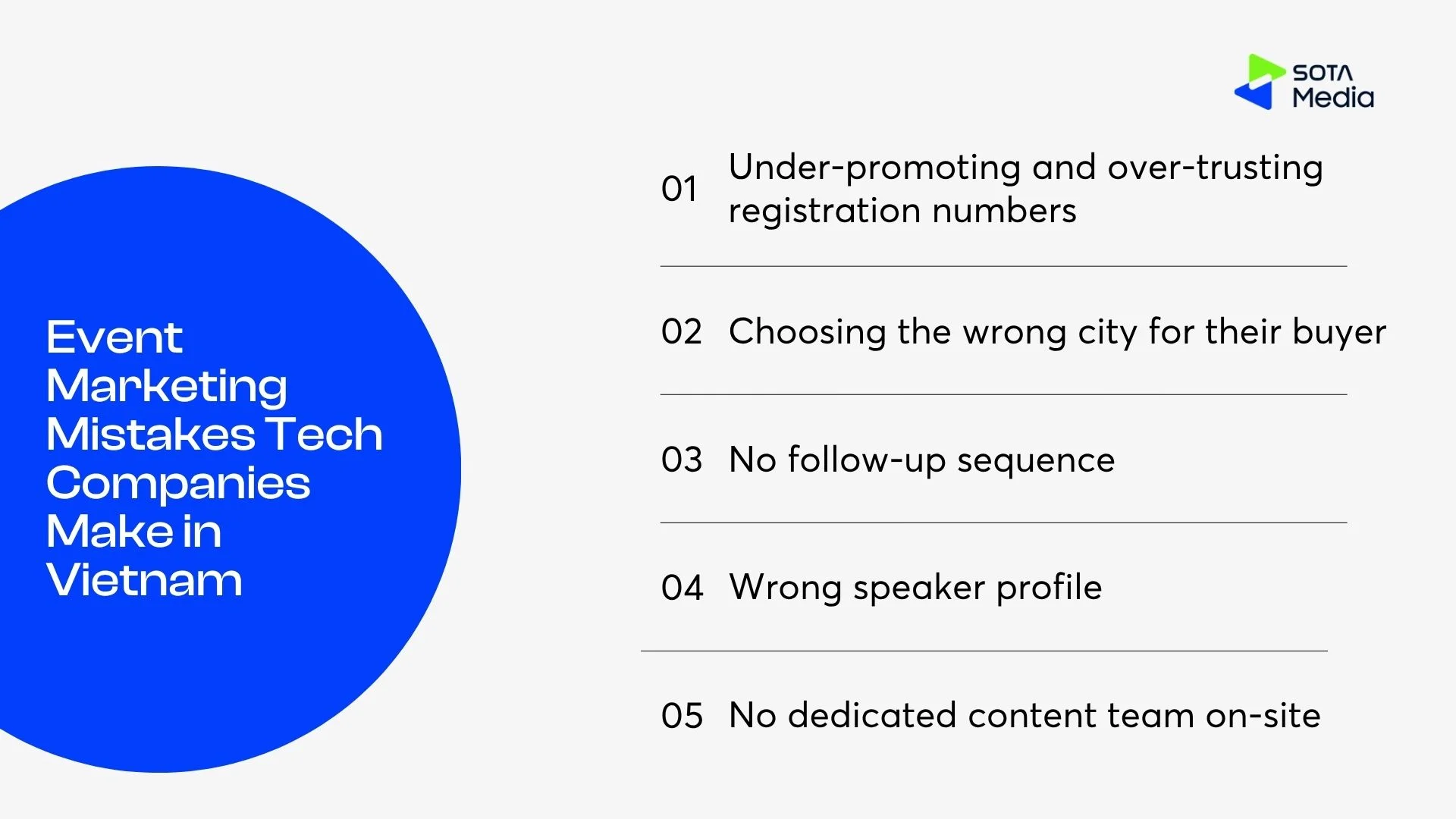
Event Marketing Mistakes Tech Companies Make in Vietnam
These are the five mistakes that show up most often, not in theory, but in events that underperformed.
- Under-promoting and over-trusting registration numbers
A company gets 400 registrations and books a venue for 400. On the day, 220 show up. The room looks half-empty. The team blames the event when the real issue was not accounting for Vietnam’s standard 35–40% no-show rate on free B2B events.
Fix: Always plan for a 35% drop-off. If you want 300 in the room, aim for 450–480 registrations. Run a last-call email 48 hours before the event.
- Choosing the wrong city for their buyer
A SaaS company selling to Vietnamese state-owned enterprises runs its launch event in Ho Chi Minh City because “that’s where tech events happen.” Their key accounts are government-adjacent organizations headquartered in Hanoi. Attendance from their actual target segment: 12 people.
Fix: Map where your top 50 prospects are physically located before picking a city.
- No follow-up sequence
The event ends. The sales team is exhausted. The content team is editing photos. A week passes with no follow-up. Two weeks later, someone sends a generic thank-you. By then, the conversations your team had are cold.
Fix: Write the follow-up emails before the event. They should be ready to send within 24 hours of close. Template them per audience segment: attendees who visited your booth, speakers, sponsors, and no-shows.
- Wrong speaker profile
A foreign keynote speaker with an impressive global title talks about trends in the US market for 30 minutes. The Vietnamese audience is polite. Nobody takes notes. Registrations for the next event drop.
Vietnamese tech audiences want practitioners who’ve done the work in Vietnam or in comparable SEA markets. A VP of Engineering at a Vietnamese unicorn talking about scaling from 10 to 100 engineers will outperform a US industry analyst talking about 2026 predictions.
- No dedicated content team on-site
The event runs. No one captures it properly. The photos are blurry booth shots from a phone. The video is 2 hours of unedited footage. Nothing is usable. The event produces zero content for any other marketing channel.
Fix: Budget for a dedicated photographer and a videographer at a minimum. Brief them with a shot list before the day. A proper content capture setup pays back in usable material across social media, websites, and sales decks for the next 6 months.
How SotaMedia Handles Event Production in Vietnam
SotaMedia is a Tech Marketing Agency from SotaTek, a global technology enterprise. The agency runs end-to-end event production across Southeast Asia as one of its core services, alongside Tech PR, omnichannel marketing, and AI marketing automation.
On the event side, SotaMedia handles the full scope: concept development, speaker curation, on-site execution, and post-event amplification. The positioning is specific to events designed to attract investors, partners, and enterprise customers and structured to produce content that keeps working after the event ends.
What makes this relevant for tech companies specifically is that SotaMedia operates at the intersection of marketing and product. Because the parent company (SotaTek) builds software and blockchain products, the marketing team understands how tech products work, which means speaker briefings, event messaging, and follow-up content are grounded in how the product actually functions, not just how the sales deck describes it.
If you’re planning a product launch, conference, or roadshow in Vietnam in 2026, contact SotaMedia to discuss scope and availability.
Frequently asked questions
Vietnam has a relationship-first B2B business culture, meaning in-person tech events build trust and close deals much faster than purely digital campaigns
Yes, all public events require a permit from the local Department of Culture, Sports, and Tourism, which must be submitted 30 to 60 days in advance.
Standard free B2B events in Southeast Asia experience a 35-40% no-show rate, so organizers should always overbook their registration targets.
Vietnamese audiences prefer local tech leaders and practitioners with hands-on experience in the Southeast Asian market over foreign industry analysts.