




Branding and Strategy
A brand audit measures the gap between what your company says about itself and what the market actually experiences. It compares three layers: positioning, visual identity, and the experience customers get on your website, in a sales call, or reading your content.
A brand audit is not a brand refresh. It does not touch your logo, your colors, or your name. A refresh changes the brand. An audit tells you whether the current brand is working and where it isn’t.
Run one before a rebrand, after a merger or acquisition, or when revenue stalls despite traffic holding steady. Also run one when your website, your sales deck, and your LinkedIn page describe the company three different ways.
Key Takeaways
- A brand audit measures three layers: positioning, visual identity, and the experience customers actually receive.
- The process runs in 8 steps, from scope to a prioritized action plan. It is not a checklist completed in isolation.
- The output is a ranked gap list, not a report that describes what already exists.
- Real-world case studies: Lessons from brands that successfully transformed their identity through a Brand Audit.
What is a Brand Audit?
A brand audit compares your brand promise with what buyers, employees, and customers actually experience across touchpoints. A company uses a brand audit to evaluate how its brands or products are positioned in its markets.
It measures gaps rather than redesigning the brand. The process is straightforward: collect the claims your company makes, compare them with real-world experiences, and record each mismatch as an issue to address.
Why Do Brand Gaps Happen?
Gaps rarely start as a single bad decision. They build up as a company grows, hires more people, and adds more channels than the original brand system was built to support.
Message drift across channels
A website states one value proposition. A sales deck states another. LinkedIn posts a third. Each was accurate when it was written, but nobody owns the job of keeping them aligned once the company scales past a handful of writers.
The cost is measurable. Gartner found that 69% of B2B buyers report inconsistencies between the information on a supplier’s website and what a sales rep tells them, and that the mismatch can put the deal at risk (Gartner, 2025).
Visual inconsistency after scaling
Logo, color, and typography rules get bent the first time a new hire builds a deck without the brand guideline open. By the time a company has three offices and ten writers, the drift compounds. Nobody decided to break the visual system. It happened one deck at a time.
Customer perception vs. internal narrative
The team inside a company describes the brand the way it hopes to be seen. Customers describe it the way they actually experienced it, and the two rarely match without a system that checks them against each other. Salesforce found that 69% of consumers expect consistent interactions across departments (Salesforce, 2024). When departments answer differently, that expectation breaks.
When to Run a Brand Audit
Before a rebrand or reposition
Redesigning a logo without first knowing what’s broken means guessing at the fix. The audit tells you which elements of the current brand to keep and which ones are actively costing you deals.
After M&A or expansion into a new market
Merging two companies usually means merging two brand systems that were never built to coexist. An audit maps both systems before anyone decides which elements survive.
When conversion drops despite steady traffic
Traffic measures whether people find you. Conversion measures whether they believe you once they arrive. A gap between the two often points to a mismatch between what your ads promise and what your landing page or sales team delivers.
The 8-step Brand Audit Process
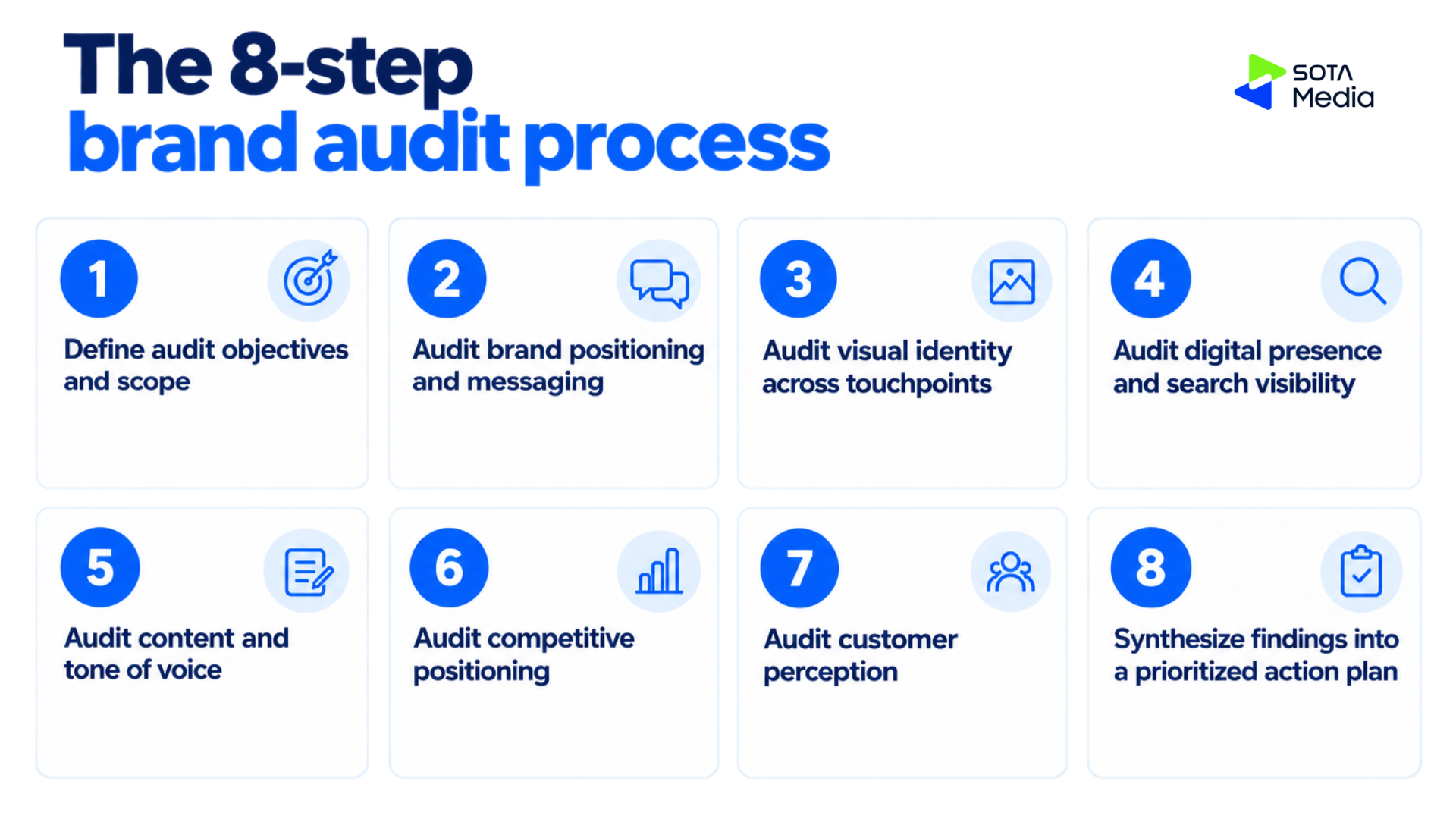
Step 1. Define audit objectives and scope
Decide what the audit is for. Preparing for a reposition needs a different scope than measuring the results of a rebrand you already shipped. Decide whether the audit covers the whole brand or one product line, one market, or one region.
Step 2. Audit brand positioning and messaging
Compare the value proposition in your official materials against what sales and support actually say on calls. Pull five recent sales call transcripts or support tickets and check the language against your positioning doc line by line.
Step 3. Audit visual identity across touchpoints
Check logo usage, color, typography, and UI across the website, social channels, the product itself, and sales collateral. List every place the guideline is not followed, not just the ones that are visually jarring.
Step 4. Audit digital presence and search visibility
Measure how the brand shows up in organic search, in AI answer engines, on social platforms, and on review sites. McKinsey’s 2026 Global B2B Pulse survey found that B2B buyers now use an average of 10 channels across the purchase journey, and that inconsistent information is now among the reasons buyers most often cite switching suppliers (McKinsey, 2026). A gap on any one of those channels is a gap a buyer will notice.
Step 5. Audit content and tone of voice
Check whether content across channels matches the brand voice guideline and whether it holds up across different writers. Voice drift is the fastest gap to spot and the easiest one to fix once you name it.
Step 6. Audit competitive positioning
Map where your brand sits against two or three direct competitors. Skip ranking frameworks. Describe the real difference in mechanism, not adjectives. Forrester’s 2025 B2B Brand and Communications Survey found that only 19% of B2B marketing leaders believe buyers have a clear vendor preference at the start of the purchase process (Forrester, 2025). A weak competitive position is one reason that number stays low.
Step 7. Audit customer perception
Collect real data: customer surveys, reviews, social listening, and win-loss interviews. Skip the internal guess about what customers think. The gap between assumption and reality is usually where the audit finds its biggest surprises.
Step 8. Synthesize findings into a prioritized action plan
Turn every gap into a ranked line item, sorted by how much it affects revenue or conversion, not by how easy it is to fix. A messaging gap on your highest-traffic page outranks a template inconsistency in an internal deck nobody outside the company sees.
Case Studies: Brand Audits that Worked
Domino’s Pizza: Finding the gap in customer perception
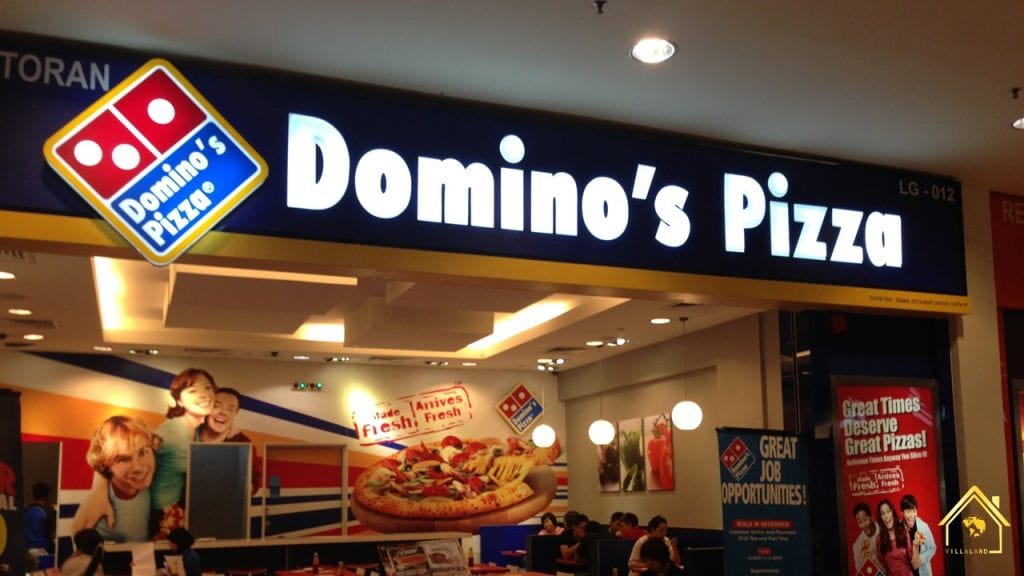
In 2009, Domino’s Pizza had a perception problem that ordinary marketing could not fix. Customer research found people rated the exact same pizza lower once they knew it came from Domino’s, and blind taste tests placed the brand behind the field. That is a customer perception audit finding, not a creative problem: the gap sat between what marketing kept promising and what customers actually believed about the product.
Domino’s reformulated the recipe, retrained store staff, and ran a campaign, called Pizza Turnaround, that showed the process in public instead of hiding it. Domestic same-store sales grew 14.3% in the first quarter of 2010, against 1.0% growth in the same quarter a year earlier.
Source: Domino’s Pizza investor relations, first quarter 2010 results.
The audit lesson: the gap was in customer perception, not execution, and the fix started with admitting what the audit found instead of running a new ad on top of the old problem.
Old Spice: Finding the gap between who the brand spoke to and who bought

Old Spice had the opposite problem: a brand losing relevance with younger buyers while overlooking who actually purchased the product. Research behind the 2010 relaunch, done by agency Wieden and Kennedy, found that women made most body wash purchases in the category, even though decades of Old Spice messaging spoke almost entirely to men.
That single finding reset the positioning. The campaign, The Man Your Man Could Smell Like, spoke to both audiences in the same 30 seconds. Old Spice Red Zone Body Wash sales rose 60% by May 2010 against an internal target of 15%, then doubled by July. (Source: Wieden+Kennedy case study.)
The audit lesson: the gap was between who the brand talked to and who actually decided to buy, and the campaign only worked because that gap was measured and named before anyone wrote a script.
How to Prioritize Brand Audit Findings
Sort every gap by revenue impact before anything else. A gap on a page that touches active deals moves first. Gaps that are purely about recognition, an old font on an internal template, and a slightly off color on an unused social profile go second.
| Gap type | Impact | Fix owner | Timeline |
|---|---|---|---|
| Positioning contradicts across the site and sales deck | Directly affects live deals | Marketing + sales lead | 2 to 4 weeks |
| Visual identity inconsistent on customer-facing collateral | Directly affects trust at the decision point | Design/brand owner | 4 to 6 weeks |
| Search and review listings to show outdated information | Indirectly affects discovery | Marketing ops | 2 to 4 weeks |
| Internal template and asset drift with no external exposure | Low recognition only | Brand owner | Next quarter |
SotaMedia runs brand audits as the first step before any repositioning or content system rebuild, not as a standalone deliverable in our branding and strategy service.
The findings feed straight into the next system: content calendar, SEO structure, and sales collateral, so the fix moves on the same timeline as the finding instead of waiting for a separate creative sprint.
Conclusion
A brand audit replaces guesswork about brand health with 8 measured steps and a ranked gap list. The pattern above points to the same conclusion: most companies already have brand guidelines, but enforcement is where they break down, and an audit is what shows exactly where that happens.
Use this process to scope your own audit and turn the findings into a prioritized action plan your team can actually execute.
If you need support running that audit or turning the findings into a content and positioning system, SotaMedia is one option to consider, with experience helping tech companies connect brand strategy, content, and execution.
Frequently asked questions
An audit measures the brand as it exists today. A refresh changes it. A refresh that skips the audit is a redesign based on opinion instead of evidence.
No. Step 3 checks whether the current visual identity is applied consistently. Any redesign decision comes after, and only for the elements the audit flags as broken.
Either can run the process. An outside partner is useful specifically for step 7, since customers and prospects tend to give more candid answers to someone outside the company than to the brand's own team.
Timeline depends on scope: a single product line audit moves faster than a full brand audit across every market and touchpoint.
Access to current brand guidelines, the last 6 to 12 months of published content across channels, customer support or CRM records, and contact information for a customer sample to interview or survey in step 7.
Run one whenever a trigger from the "when to run a brand audit" section applies. A fixed calendar cadence matters less than catching drift after a specific event: a reposition, an M&A, or a conversion drop.
What is the actual output of a brand audit? A prioritized gap list with each item tied to a likely impact, an owner, and a timeline, plus the underlying evidence for each finding. Not a descriptive report meant to be read once and filed.
Cost depends on scope: number of touchpoints, markets, and whether step 7 includes a full customer research program.