



AI Marketing
Vietnam is rapidly becoming one of the most important expansion markets for global technology companies in Southeast Asia. Once viewed primarily as an outsourcing destination, the country is now attracting SaaS companies, AI startups, fintech platforms, Web3 ecosystems, and enterprise software providers looking to establish long-term regional operations.
According to the World Bank, Vietnam’s GDP is projected to grow by 6.8% in 2025, placing it among the fastest-growing economies in Asia. At the same time, the digital economy continues to scale aggressively, supported by mobile-first consumers, strong government investment in digital transformation, and rising foreign direct investment (FDI) into the technology sector.
However, market entry success in Vietnam requires more than simply translating your website into Vietnamese. Companies that scale successfully localize operations, build trusted local partnerships, adapt marketing messaging, and understand Vietnam’s relationship-driven business culture.
This guide provides a detailed Vietnam Market Entry checklist specifically designed for technology companies entering Vietnam in 2026.
Key Takeaways
- Vietnam’s digital economy is projected to reach USD 39 billion in 2025, making it one of Southeast Asia’s highest-growth digital markets.
- Hanoi, Ho Chi Minh City, and Da Nang each serve different strategic purposes for market entry.
- Localization in Vietnam requires adapting messaging, community strategy, and customer experience — not just translating content.
- Facebook, Zalo, LinkedIn, TikTok, and local PR channels remain critical for market penetration.
- Foreign tech companies should carefully review data compliance requirements under Vietnam’s Cybersecurity Law.
- Local relationships and ecosystem partnerships strongly influence B2B success in Vietnam.
Why Tech Companies Are Entering Vietnam in 2026
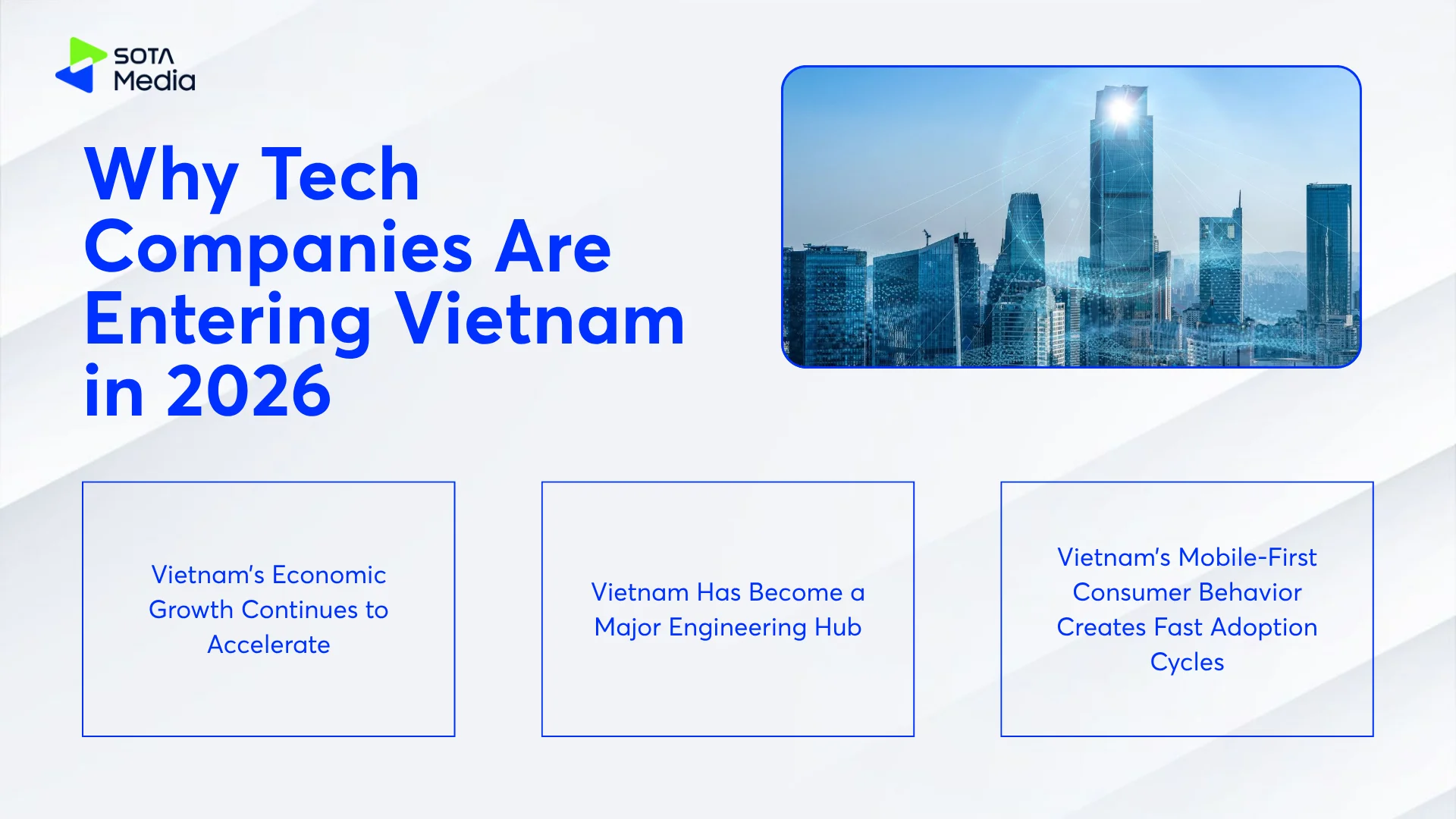
Vietnam’s Economic Growth Continues to Accelerate
Vietnam’s macroeconomic growth remains one of the biggest reasons why international technology companies are expanding into the country.
According to the World Bank, Vietnam continues to outperform many regional economies due to resilient exports, manufacturing growth, rising domestic consumption, and increasing technology investment. The country has also become a preferred diversification destination for global supply chains shifting away from overconcentration in China.
In parallel, Vietnam’s digital economy is expanding at one of the fastest rates in Southeast Asia. The Google, Temasek, and Bain e-Conomy SEA report estimates Vietnam’s digital economy will reach USD 39 billion by 2025, driven primarily by e-commerce, fintech, digital payments, online travel, and digital media.
Vietnam Has Become a Major Engineering Hub
Vietnam is no longer simply a low-cost outsourcing market. It has evolved into a mature software engineering ecosystem with strong technical talent and increasing specialization.
According to Vietnam’s Ministry of Information and Communications, the country currently has more than 1 million ICT workers and thousands of new IT graduates entering the market annually.
Vietnam’s Mobile-First Consumer Behavior Creates Fast Adoption Cycles
Vietnam has one of the most digitally engaged populations in Southeast Asia.
According to DataReportal, Vietnam recorded over 78 million internet users in 2025, representing nearly 79% of the population. Social media penetration also remains extremely high, especially among Gen Z and millennial audiences.
Vietnam Market Entry: 5 Strategic Decisions Before Launch
Before entering Vietnam, companies should define several strategic decisions that directly impact operational efficiency, budget allocation, and go-to-market execution.
1. Choosing the Right Market Entry Model
When planning a Vietnam market entry, technology companies must first address the foundational decision of operational structure: launching an independent local entity or leveraging established local partnerships. A Direct Entity Setup—typically structured as a Wholly Foreign-Owned Enterprise (WFOE) or a Limited Liability Company (LLC)—is the ideal path for businesses committed to long-term expansion. Establishing a physical legal presence significantly bolsters brand credibility among risk-averse Vietnamese conglomerates, facilitates direct local hiring of top-tier software engineers, and simplifies the processing of enterprise contracts. However, this model demands navigating complex administrative procedures, corporate tax registrations, and compliance obligations that can delay market entry by several months.
Conversely, a Partnership-Led Expansion offers an agile alternative for B2B SaaS, martech, and Web3 platforms looking to validate market demand before committing significant capital. By partnering with local distributors, marketing agencies, or system integrators, international tech brands can bypass initial regulatory bottlenecks and tap directly into pre-established sales networks. While this model minimizes upfront financial exposure and accelerates time-to-market, it limits direct operational control and long-term customer relationship ownership. Ultimately, the choice depends on whether a company’s priority is immediate market validation or building a permanent, high-credibility brand presence in Southeast Asia’s fastest-growing digital economy.
2. Defining Your Core Customer Segment
Successfully penetrating the Vietnamese tech ecosystem requires a deeply segmented approach, as enterprise, SMB, and consumer behaviors in the country are highly distinct. In the Enterprise Market, sales cycles are fundamentally relationship-driven and rely heavily on local networks, trust, and physical face-to-face engagements. Decision-makers at large Vietnamese corporations and state-owned enterprises rarely buy software purely based on online specifications; they require local case studies, trusted referrals, and localized technical support. For this reason, high-touch sales models and strategic local PR campaigns are critical to unlocking enterprise budgets.
On the other end of the spectrum, the SMB Segment is characterized by rapid digital adoption coupled with high price sensitivity. To capture Vietnam’s millions of highly active small-and-medium enterprises, tech providers must offer high-ROI, mobile-first SaaS tools with transparent pricing and low-friction onboarding, as heavy, long-term enterprise licensing models often fail here.
For Consumer Technology brands, the battleground is almost entirely digital, visual, and community-oriented. Vietnamese consumers are exceptionally receptive to creator-led marketing, social commerce, and short-form video content. To succeed in this space, platforms must integrate gamified user experiences, leverage localized influencer (KOL/KOC) campaigns, and embed social proof directly into their customer journeys to build immediate peer-to-peer trust.
3. Choosing the Right City for Expansion
A common misstep in a Vietnam market entry strategy is treating the nation as a monolithic market, whereas the country’s three key tech hubs—Hanoi, Ho Chi Minh City, and Da Nang—each demand different strategic focus.
-
Ho Chi Minh City (HCMC) serves as the undisputed commercial heart and startup capital of Vietnam. Characterized by a highly dynamic, consumer-centric population and a high density of venture capital firms, HCMC is the natural launchpad for consumer-facing apps, e-commerce giants, fintech platforms, and creative marketing campaigns.
-
Hanoi, the nation’s political and administrative center, offers a contrasting ecosystem that is highly strategic for B2B enterprise software, government-related contracts, and traditional corporate integrations. Tech companies looking to navigate regulatory frameworks or pitch to large-scale conglomerates often find Hanoi to be their critical operational base.
-
Da Nang has rapidly emerged as a highly competitive technology and software engineering hub. Offering lower operational overheads, a high quality of life, and strong support from local universities, Da Nang is increasingly favored by international companies looking to set up regional engineering centers, offshore development operations, and technical support teams.
4. Determining Your Localization Strategy
True localization in Vietnam goes far beyond translating software strings or website copy into Vietnamese; it requires a comprehensive adaptation of product design, user experience, and communication channels. Vietnamese users generally favor a warm, conversational, and highly interactive tone over dry, corporate English. This preference extends to customer service, where integrated chat ecosystems like Zalo and Facebook Messenger are preferred over traditional email ticketing systems. If a SaaS provider does not offer a seamless, instant-chat support channel in the local language, customer churn rates tend to rise quickly.
Furthermore, localization must be deeply integrated into the digital infrastructure. Many international platforms suffer from high latency in Vietnam because their hosting servers are located in Western markets or distant regional hubs. To ensure high conversion rates, companies must optimize mobile page speeds and leverage regional Content Delivery Networks (CDNs) or local cloud hosting solutions.
Equally critical is the payment infrastructure. With cash-on-delivery (COD) and mobile wallets dominating transactions, integrating local payment gateways such as MoMo, VNPay, and ZaloPay, alongside standard local bank transfers, is non-negotiable for any tech brand expecting frictionless user conversions.
5. Planning Budget & Expansion Timeline
A successful Vietnam market entry requires a carefully budgeted roadmap that balances aggressive marketing goals with the realistic timelines of local business administration. A phased-entry timeline is highly recommended for most technology startups.
-
Phase 1 (Months 1–3) should focus on market validation, setting up localized landing pages, running targeted digital pilot campaigns, and identifying key local partners.
-
Phase 2 (Months 4–9) typically transitions into formalizing the legal setup, initiating localization of the core software product, and hiring initial local marketing or sales representatives.
-
Phase 3 (Month 10 and beyond) marks the official GTM launch, backed by localized PR pushes, community building, and scaling local enterprise sales pipelines.
Budgets must account not only for paid user acquisition but also for the critical, long-term costs of relationship-building, offline networking events, local compliance audits, and specialized legal counsel to navigate the shifting regulatory landscape.
The Vietnam Market Entry Checklist
Legal & Entity Setup
Navigating the regulatory landscape is a vital prerequisite for a sustainable Vietnam market entry. Foreign tech companies generally choose between a Representative Office, which serves as an excellent low-risk tool for market research and partnership coordination but cannot engage in direct revenue-generating activities, or a Foreign-Invested Limited Liability Company (LLC), which allows for full commercial operations, direct local invoicing, and corporate hiring.
Tech investors must carefully align their business models with Vietnam’s World Trade Organization (WTO) commitments and local investment laws, paying close attention to foreign ownership caps in restricted sectors such as telecommunications, cybersecurity, and financial technology. Additionally, establishing robust corporate banking, aligning with Value Added Tax (VAT) regulations, and understanding local labor laws are critical to avoiding operational delays.
Local Partnerships & Distribution
Because Vietnam’s B2B and enterprise software markets are deeply rooted in trust and personal relationships (commonly referred to as Quan He), attempting to scale entirely through cold outreach or automated digital funnels is rarely effective. Strategic local partnerships act as a powerful catalyst, granting immediate access to established distribution channels, warm enterprise introductions, and critical government relationships.
When vetting potential local distributors or channel partners, international brands must conduct thorough due diligence that extends beyond financial health. It is essential to evaluate a partner’s existing enterprise client portfolio, their technical capability to support localized software products, and their overall reputation within the local tech ecosystem. Successful market entries often begin with a limited-scope joint pilot project, allowing both parties to align operational workflows before signing exclusive, long-term distribution agreements.
Digital Infrastructure & Marketing Localization
Marketing to Vietnamese consumers and businesses requires navigating a unique digital channel landscape where Western-centric strategies must be heavily adapted. While Google remains the standard search engine, social media platforms function as the primary engines for discovery, brand building, and customer acquisition.
-
Facebook remains an incredibly dominant platform for both B2C community building and B2B lead generation, acting as a virtual directory where businesses actively interact with customers.
-
Zalo, Vietnam’s leading homegrown messaging app, is an indispensable channel that tech companies must integrate as a CRM, marketing automation, and direct customer support tool.
-
LinkedIn is experiencing rapid adoption among urban professionals, founders, and enterprise decision-makers, making it a cornerstone for high-value B2B SaaS thought leadership.
-
Local PR & Media Relations through trusted business and tech publications like CafeBiz, VietnamNet, and GenK are absolutely vital for establishing market authority, building brand trust, and attracting high-caliber local talent.
Compliance & Cybersecurity
As Vietnam accelerates its digital transformation, the regulatory environment surrounding data privacy and cyber operations has become increasingly structured. Any technology company entering Vietnam must strictly align its operations with Vietnam’s Cybersecurity Law and Decree 13/2023/ND-CP on Personal Data Protection (PDPD). These regulations introduce stringent requirements regarding personal data processing, explicit user consent, and data localization.
For SaaS and cloud providers, this means that certain types of user-generated data, communication logs, and financial records must be stored on local servers within Vietnam’s borders. Conducting early-stage legal audits to map out data flows, system architectures, and user consent mechanisms is no longer optional—it is a critical step to prevent costly compliance penalties and protect brand reputation from day one.
Common Mistakes When Entering Vietnam’s Tech Market
-
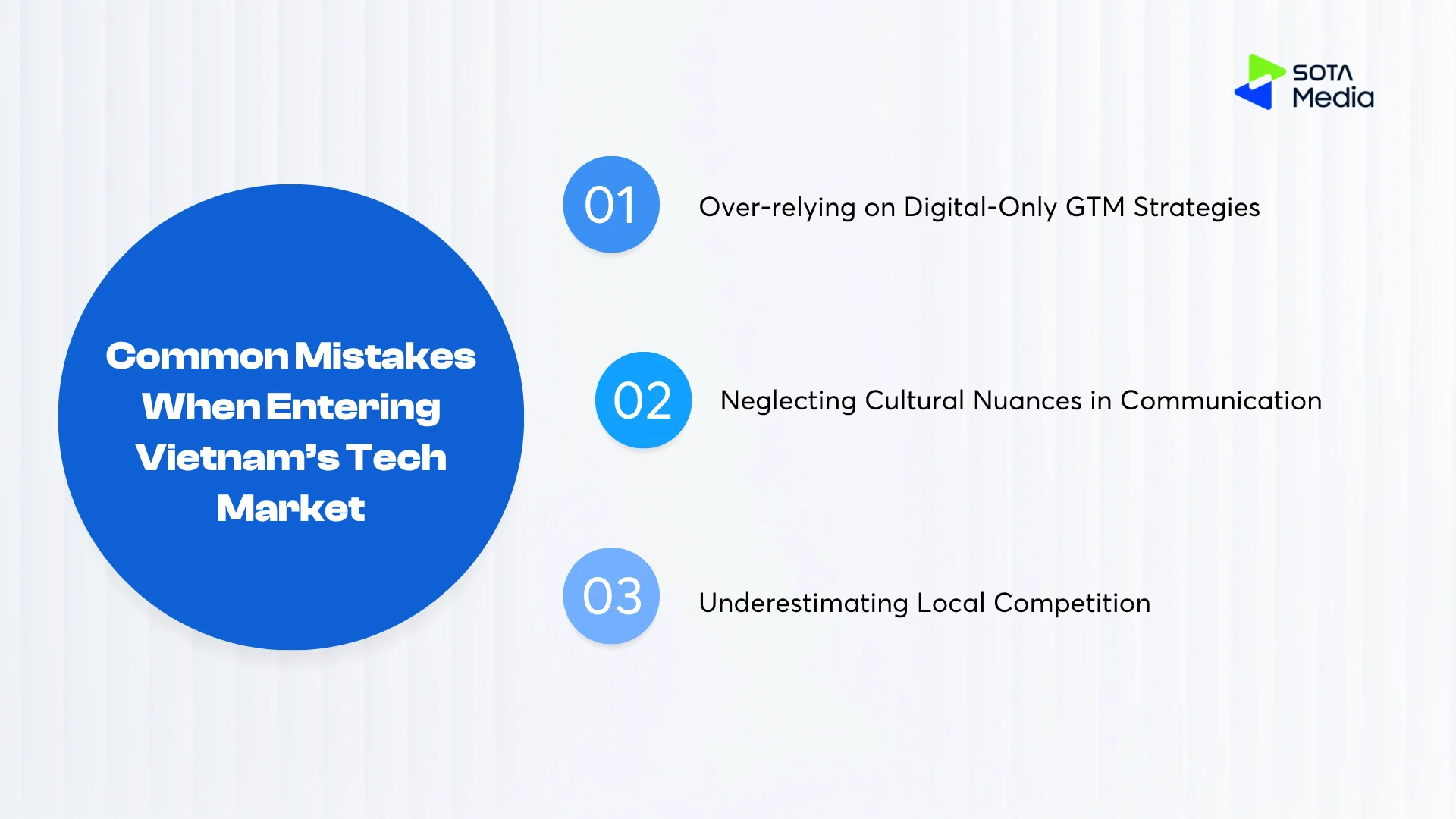
Over-relying on Digital-Only GTM Strategies: Many foreign SaaS companies assume that a highly optimized digital ad campaign is sufficient to capture market share. In Vietnam’s relationship-oriented culture, offline networking, local community engagement, and face-to-face trust building are often the true catalysts for long-term B2B growth.
-
Neglecting Cultural Nuances in Communication: Directly translating global marketing campaigns often results in unnatural, tone-deaf messaging that fails to connect with local audiences. Successful brands rebuild their messaging frameworks from the ground up to align with local values, humor, and digital consumption habits.
-
Underestimating Local Competition: Vietnam has a highly vibrant, fast-moving ecosystem of local tech startups and software houses that understand the local consumer intimately. Foreign entrants must clearly define their unique value proposition and localized pricing models to successfully compete against agile domestic players.
How SotaMedia Supports Vietnam Market Entry
At SotaMedia, we specialize in bridging the gap between global technology ambitions and local market adoption in Vietnam. As a core part of the SotaTek ecosystem which operates across more than 25 countries—we combine world-class execution standards with deep, on-the-ground Vietnamese market expertise. We provide end-to-end, localized go-to-market execution tailored specifically for SaaS, AI, Web3, and fintech brands by aligning global product value propositions with local market realities and regulatory landscapes. Partner with SotaMedia to transform your Vietnam market entry strategy into a seamless, high-growth reality.
Frequently asked questions
Vietnam offers one of Southeast Asia’s fastest-growing digital economies, a strong engineering workforce, and relatively competitive operational costs. Combined with rapid mobile adoption and increasing enterprise digital transformation investment, the country has become highly attractive for SaaS, AI, fintech, and Web3 companies seeking regional expansion.
The answer depends on business objectives. Hanoi is generally stronger for enterprise partnerships and government-related operations, while Ho Chi Minh City dominates startup ehttps://sota.media/wp-admin/post.php?post=1016&action=edit#cosystems, ecommerce, and consumer-tech growth. Da Nang is becoming increasingly attractive for engineering and outsourcing operations due to lower operational costs.
Not always during the early stages. Many companies begin through partnerships, distributors, or localized GTM campaigns before establishing a formal entity. However, long-term hiring, enterprise sales, and operational scaling often require legal presence within Vietnam.
The most common challenges include weak localization, misunderstanding local business culture, compliance complexity, and underinvesting in relationships. Companies that localize effectively and build trusted ecosystem partnerships generally scale much faster in the Vietnamese market.
Localization is critical for long-term success. Vietnamese users respond strongly to locally contextualized communication, trust-driven messaging, community engagement, and mobile-first customer experiences. Directly translating global campaigns without adapting tone and positioning usually leads to weaker performance.