

What Is an AI SEO Agency? Top 10 AI SEO Agencies in 2026


Table of Contents
In February 2024, Google started rolling out AI Overviews across search results. By early 2026, they appeared in over 84% of question-based searches (source: BrightEdge AI Search Report, 2026), and a growing chunk of product research now starts in ChatGPT or Perplexity before anyone opens a search engine.
That shift broke a core assumption most marketers had been working from: that ranking on Google was enough. It isn’t anymore.
An AI SEO agency uses AI tools to run faster, more precise SEO work and structures content to get picked up by large language models (LLMs), not just search crawlers. This guide covers what that actually means in practice, how to tell real AI capability from marketing copy, and the 10 agencies worth looking at in 2026.
Key Takeaways
- Google AI Overviews appear in most question-based searches. Ranking #1 no longer means you get the click.
- B2B buyers now start product research in ChatGPT or Perplexity before they open Google.
- An AI SEO agency handles both: ranking on Google and getting cited by LLMs like ChatGPT, Perplexity, and Gemini.
- GEO (Generative Engine Optimization) is not an add-on. In 2026, it should be built into every piece of content from day one.
- Monthly retainers run $2,000–$20,000 depending on scope. Project-based work runs $5,000–$30,000.
What Is an AI SEO Agency?
An AI SEO agency runs its core workflows (keyword research, content creation, technical audits, rank tracking) using AI tools rather than purely manual processes.
The practical difference is speed and scale. A keyword cluster that used to take 3 days now takes 2 to 4 hours with AI-assisted semantic analysis. Technical audits that used to require crawling pages one by one now process thousands of URLs and flag issues ranked by traffic impact in a single run.
Beyond traditional SEO, most AI SEO agencies also handle GEO (Generative Engine Optimization). GEO means structuring content so that AI tools like ChatGPT, Perplexity, Gemini, and Claude cite it when users ask relevant questions. It requires a different approach from standard SEO: clean definition blocks, FAQ schema, structured data, and entity relationships that LLMs can extract cleanly.
Services an AI SEO agency typically provides:
- Keyword research and topical clustering (AI-assisted)
- Content creation and optimization: AI-generated first drafts, human-edited for accuracy and voice
- Technical SEO audits and implementation
- GEO: structured content for LLM citation across ChatGPT, Perplexity, Gemini, and Google AI Overviews
- Link building and digital PR
- Rank tracking across Google, AI Overviews, and LLM surfaces
Why You Need an AI SEO Agency in 2026
Three shifts define what AI SEO agencies need to handle that traditional agencies weren’t built for.
Google AI Overviews changed what “ranking” means
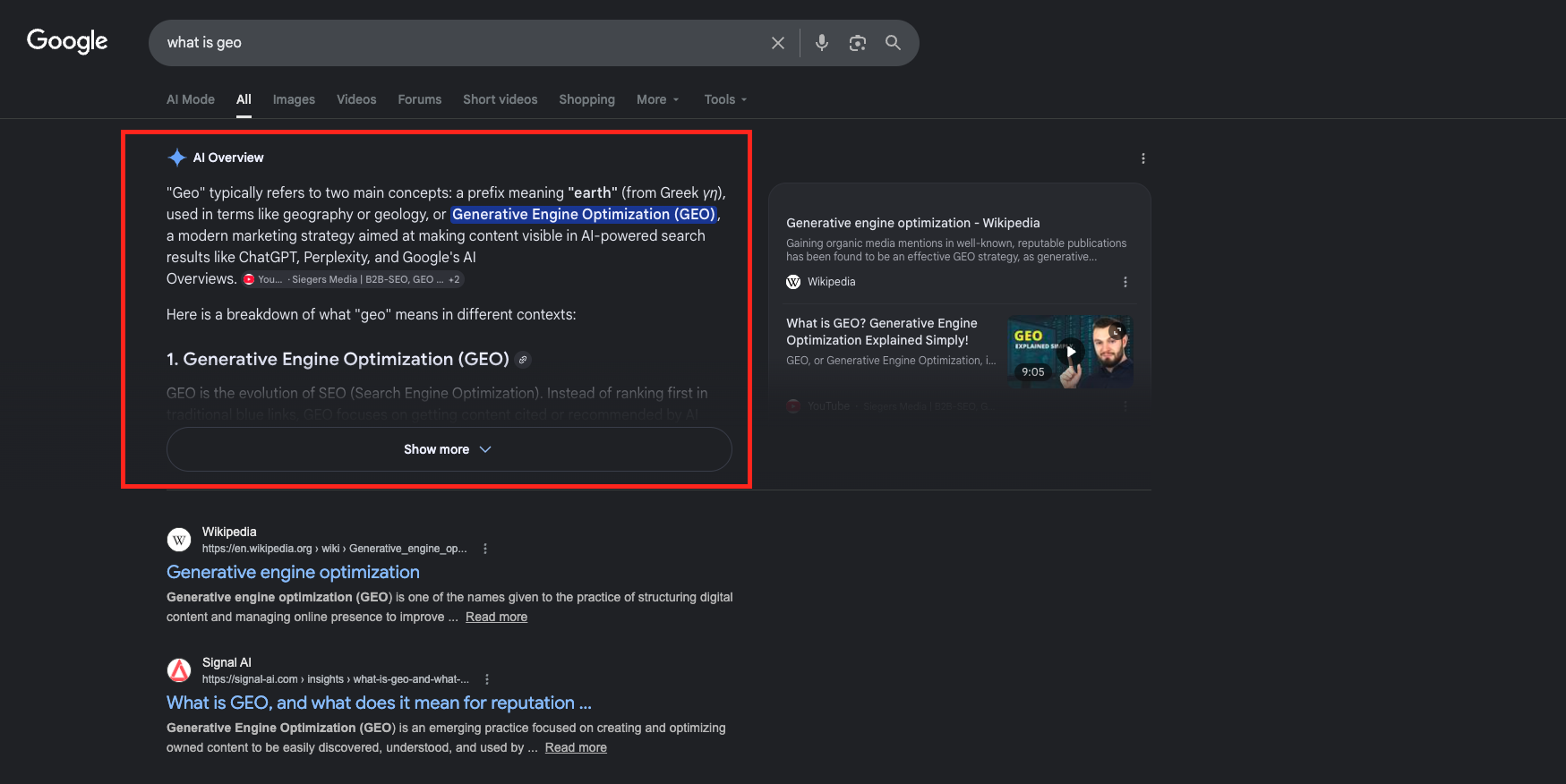 Google AI Overviews appear before organic results.
AI Overviews appear at the top of results for a large share of queries. A site can rank #3 organically and receive almost no clicks if an AI overview answers the same question above it. Pages that get cited inside AI overviews tend to have clear structure, specific data, and content Google’s model can summarize reliably. That’s a different bar than ranking #1 used to be.
LLM search is a parallel channel now
Perplexity, ChatGPT, and Gemini are now the main sources where a large portion of decision-makers do initial research. For B2B SaaS and tech companies, if your brand doesn’t appear in LLM answers to questions like “best [category] tools” or “what is [service],” you have no presence in that channel, regardless of your Google rankings.
Automation changes what’s economically possible
With AI automation, an AI SEO agency can produce more content of higher quality in a month than a traditional agency could in a quarter at a lower cost. Topical authority requires publishing volume that wasn’t economically feasible at traditional agency prices. AI changes that math.
How Do You Choose the Right AI SEO Agency?
“AI-powered SEO” appears on a lot of agency websites. Most of the time it means they use ChatGPT to write blog posts. Here’s how to separate agencies with real AI infrastructure from ones that added the label.
Their AI tooling is specific, not vague. Ask what AI tools they use for keyword research, content optimization, and rank tracking. Real AI SEO agencies name their stack: which tools for what and why. Vague answers about “proprietary AI systems” with nothing concrete behind them usually mean they’re using the same subscriptions everyone has.
They can explain GEO alongside SEO. A 2026 AI SEO agency should be able to tell you how they structure content for LLM citations: FAQPage schema, HowTo schema, clean definition blocks, entity relationships. If they can only talk about Google rankings and not Perplexity or ChatGPT citation rates, they’re working with last year’s playbook.
Content quality is not traded for volume. High-volume, low-quality content still gets produced at scale by agencies that use AI carelessly. Good AI SEO agencies have editorial processes where AI handles research and first drafts, and experienced editors review for accuracy and voice before anything goes live.
They measure business outcomes, not just activity. Organic traffic, keyword rankings, and backlink counts are inputs. Ask for case studies that show business results: leads generated, trial signups, and revenue from organic sources. Agencies that can’t connect their work to business metrics are optimizing for numbers that don’t pay salaries.
They have real experience in tech or SaaS. Agencies that primarily work with restaurants, e-commerce, or local services have different instincts than agencies built around software companies. SaaS sales cycles are longer, search intent is more specific, and competition in software categories involves established review sites and media outlets that require a different approach.
Top 10 AI SEO Agencies in 2026
1. SotaMedia
SotaMedia is the marketing arm of SotaTek, a software development company with 1,300+ in-house capabilities across Vietnam, Japan, Australia, Korea, and Singapore. Our SEO team works directly alongside developers who build internal AI tooling, not just AI tools we subscribe to. Our SEO and GEO work is built together from day one of each engagement. Articles are structured to rank on Google and get cited by LLMs: definition blocks, FAQ schema, and entity markup go into the content process, not get added afterward.
In practice, here’s what that looks like: For SotaTek’s 10th anniversary rebrand, we ran a full SEO and content campaign that drove a 70% increase in website traffic (40,000+ monthly visits), 60% organic traffic growth, and 24,000+ social followers with consistent engagement.
We work with tech companies and SaaS businesses in English-language global markets and with B2B clients across SEA.
Best for: SaaS companies and tech businesses that want SEO and GEO handled together, with a team that understands how software products actually work and has the dev resources to build what off-the-shelf tools can’t do.
2. Intero Digital
Intero Digital runs what they call the Intero GRO™ system, a structured approach to getting content to perform across AI assistants: ChatGPT, Gemini, and Microsoft Copilot specifically. The system addresses content structure, brand mentions across third-party sources, and media relationships.
They cover both SEO and digital PR as part of the same engagement. That matters for GEO because AI models weight brand mentions across many domains, not just the brand’s own site.
Best for: Established companies that want GEO coverage alongside traditional SEO, with budget for integrated content and PR.
3. Thrive Internet Marketing Agency
Thrive is one of the larger agencies on this list, with a broad service menu: technical SEO, content, web design, and social media. They operate without long-term contracts, which is unusual at their scale.
Their AI work covers keyword research, content briefs, and rank tracking. They’re less specialized in GEO than some smaller agencies, but for companies that want a full-service SEO relationship without a 12-month lock-in, Thrive is a reasonable fit.
Best for: Small to mid-size businesses that want full-service SEO with AI-assisted production and no long-term commitment.
4. Spicy Margarita
Spicy Margarita works with B2B tech and services companies with a specific angle: bottom-of-funnel content designed to generate revenue, not traffic. Their SEO and GEO work targets buyer-intent queries, specifically the searches and LLM questions people ask when close to a decision, not when learning about a topic.
They work with ChatGPT, Claude, and Gemini as citation targets, not just Google.
Best for: B2B services and tech companies that want SEO tied to pipeline, not page views.
5. Searchbloom
Searchbloom treats AI search as a separate performance channel, using their MERIT framework to map visibility across AI Overviews, answer engines, and classic SERPs. They tie AEO/GEO work to leads and revenue, not traffic, with reporting that shows where you’re gaining or losing AI citation share.
Best for: Ecommerce and multi-location brands that want ROI-tied AI search programs with hard attribution.
6. SeoProfy
SeoProfy works in high-competition niches (finance, legal, and e-commerce) and builds GEO programs around one specific question: where are AI engines citing your competitors instead of you? They prioritize fixes by commercial impact, restructuring content, schema, and internal links so LLMs can extract and favor your pages.
Best for: Finance, legal, and e-commerce companies already spending heavily on SEO that need GEO layered on top.
7. WebFX

WebFX has evolved from a classic SEO powerhouse into a full GEO and AI search optimization agency backed by proprietary tech like MarketingCloudFX and OmniSEO. Their GEO services combine AI visibility audits, technical SEO, content optimization, and AI brand visibility tracking across AI Overviews, ChatGPT, Gemini, and other engines, with clear starting prices and packages for SMBs and enterprises.
Best for: SMBs and mid-market brands that want an all-in-one digital marketing partner with mature GEO processes, transparent pricing, and strong reporting
8. Siege Media
Siege Media creates content designed to be hard to replicate: visual, data-driven pieces built to earn links and get cited as primary sources by AI models. Their editorial and design process is slower than most agencies by design. The output is the kind of content LLMs reference because it’s the best source on a topic, not just the most recent one.
Best for: Brands whose main growth lever is earned links and content that holds up as a primary source over time.
9. Amsive
Amsive, with Lily Ray leading much of the AI search thinking, is known for combining E‑E‑A‑T, technical SEO, and AEO research for complex sites. They are particularly strong at diagnosing quality and trust issues around core and AI-related updates, then building programs that improve both traditional SEO and AI answer visibility.
Best for: YMYL, e‑commerce, and other high‑risk verticals where quality, trust, and algorithm resilience are non‑negotiable
10. The SEO Works
The SEO Works is a UK agency with AI SEO and GEO services built into their core search offering. They handle technical SEO, content, and AI search visibility together, which suits companies that want one agency across UK and European markets rather than separate specialists.
Best for: UK and European companies that want an established SEO agency with GEO capability already built in.
AI SEO vs. Traditional SEO: A Quick Comparison
| AI SEO Agency | Traditional SEO Agency | |
|---|---|---|
|
Keyword research |
AI-assisted clustering in hours |
Manual research over days |
|
Content production |
AI-drafted, human-edited |
Entirely human-written |
|
GEO / LLM optimization |
Built in as standard |
Generally not available |
|
Technical audits |
AI-driven at scale |
Manual or limited tooling |
|
Reporting |
Includes AI surface tracking |
Google rankings only |
|
Cost |
Higher for specialist work |
Lower upfront, slower output |
Traditional SEO agencies still make sense for local businesses, small sites with narrow keyword targets, or industries where content volume isn’t a differentiating factor. If you’re competing in a category where competitors publish regularly, appear in Perplexity and ChatGPT, and show up in AI Overviews, a traditional agency is working with a narrower set of tools.
How Much Does an AI SEO Agency Cost?
Monthly retainers run from $2,000 on the low end to $20,000+ for full-service work with high content volume and GEO included. Project-based engagements typically run $5,000–$30,000 depending on scope.
Performance-based pricing exists. Some agencies take a percentage of traffic-attributed revenue, but this model requires extensive attribution setup and works better for e-commerce than SaaS.
Be cautious of unusually low prices. AI-assisted content production still requires experienced human editorial review to produce content worth publishing. Cheap AI content ranks poorly and reads worse.
Where SEO Is Going From Here
Zero-click search is real. Google’s AI Overviews answer a question and close the loop without a click for a large portion of queries. The response isn’t to panic about traffic numbers. The goal is to make sure your brand and content are what the AI cites.
For tech companies and SaaS, the near-term priority is this: build topical authority on your core subject, structure every article for LLM citation, and measure your presence in AI Overviews and LLM responses alongside Google rankings.
At SotaMedia, SEO and GEO are handled as one system from day one rather than two separate services added on top of each other. If you want to talk through what that looks like for your business, contact our team here.