

AI Marketing Automation: How It Works and How to Choose an Agency


Table of Contents
If you run marketing for a business at the moment, you’re probably already using AI in some form. According to Jasper’s State of AI Marketing in 2026 Report, 91% of marketers have used at least one AI tool in their works. However, most teams are still using AI as a one-off tool. Open a tab, write a prompt, copy the output, close it. The repetitive work like sending follow-up emails, scoring leads, updating CRM records, and running A/B tests still runs on someone’s calendar.
AI marketing automation is about closing that gap. Not just using AI when you think of it, but building it into your marketing workflow so the time-consuming, repeatable parts run on their own.
This article explains what AI marketing automation is, how it differs from traditional rule-based automation, shows 5 concrete examples of how companies use it today, and covers how to choose a marketing automation agency.
Key Takeaways
- AI marketing automation executes, personalizes, and optimizes campaigns without manual input
- The core difference from traditional automation: AI adjusts based on outcomes. Rules-based systems only do what you tell them to.
- AI automation runs a continuous loop: collect behavioral data, analyze patterns, execute actions, measure results, repeat.
- The highest-ROI use cases are lead follow-up (7x qualification rate within 1 hour), predictive scoring, and multi-touch attribution.
- Start with one automation, run it 30 days, measure before expanding. Most teams fail by automating five things at once.
- When choosing an AI marketing automation agency: stack compatibility and first-deliverable timeline matter more than portfolio logos
What Is AI Marketing Automation?
AI marketing automation is the use of artificial intelligence to execute, personalize, and optimize marketing tasks without manual intervention. Unlike rule-based automation, AI systems analyze behavioral signals, predict intent, and adjust outputs in real time based on what is working.
A basic drip sequence sends email #3 seven days after email #2, regardless of whether email #2 was opened. An AI-driven system watches click behavior, adjusts the wait window, swaps in a different subject line for contacts who ignored the first version, and automatically flags high-intent leads for sales handoff.
How Does Traditional Marketing Automation Differ from AI?
Before investing in AI-driven tools, it helps to understand what you are upgrading from. Traditional marketing automation (the kind most teams already have) is rule-based. The practical difference: rule-based automation executes what you planned. AI automation figures out what you should have planned and then executes in a self-optimizing loop, which reduces the needs of human oversight.
| Factor | Traditional (Rule-Based) | AI Marketing Automation |
|---|---|---|
| Logic | If X happens, do Y. Rules you write in advance | Watches outcomes, adjusts rules automatically based on what converts |
| Personalization | Segment-level: everyone tagged ‘lead’ gets the same email | Individual-level: send time, content, and sequence adapt per contact |
| Triggers | Fixed: form submit, date, tag added | Behavioral: intent signals, engagement patterns, scoring changes |
| Learning | Does not learn. Same output until you rewrite the rules | Improves over time: open rates and conversion patterns feed back into the model |
| Attribution | Last-click or single-touch only | Multi-touch: maps every touchpoint that influenced the conversion |
| Setup complexity | Low — most teams can self-serve in days | Higher and requires clean data and defined conversion goals upfront |
| Best for | Simple funnels, small lists, low-complexity sequences | Multi-channel, high-volume, or long sales-cycle B2B marketing |
How Does AI Marketing Automation Work?
Most marketing teams run a linear workflow: build a campaign, launch it, wait, measure, adjust. AI automation turns that into a loop that runs continuously without manual handoffs using machine learning.
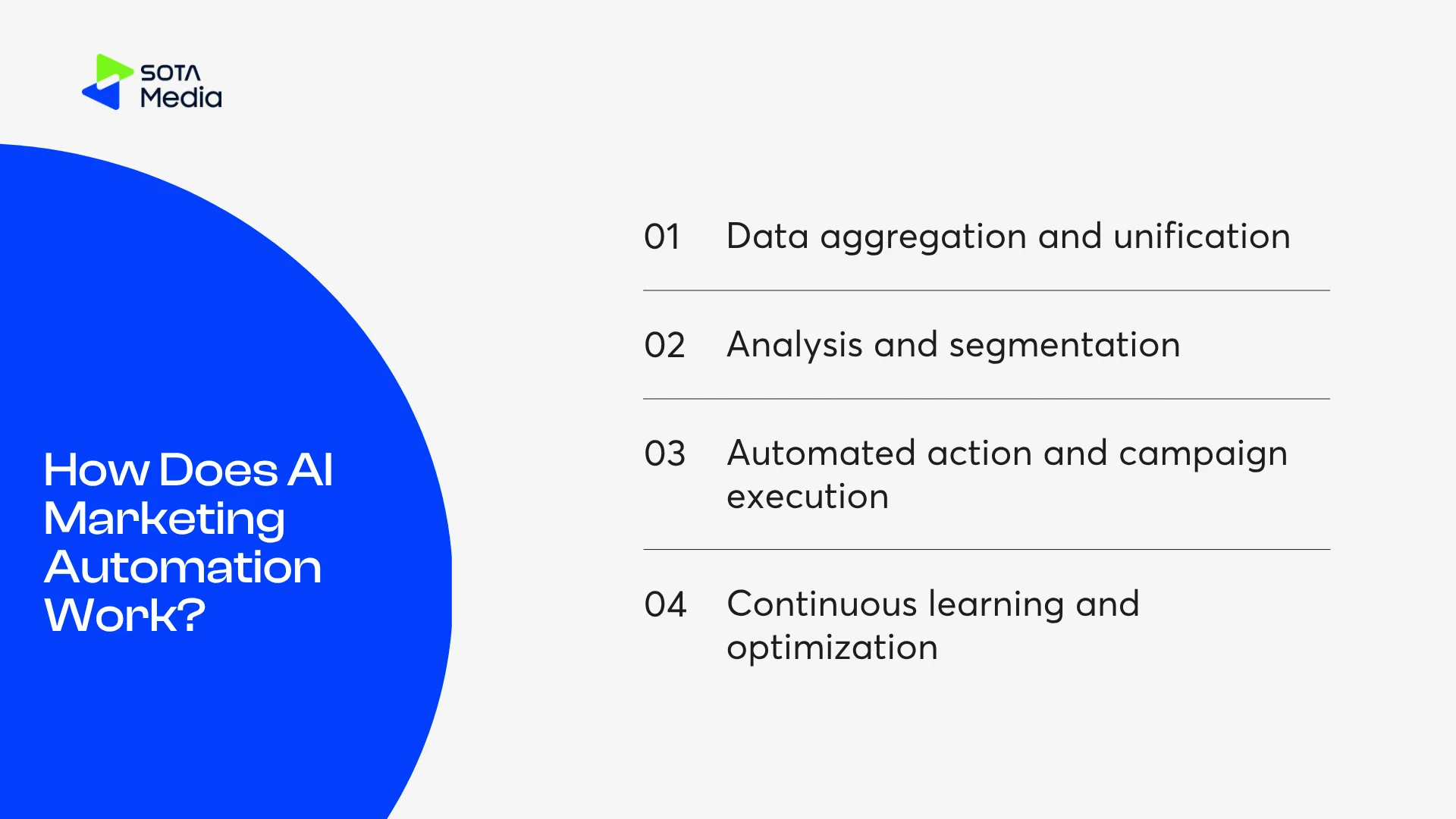
How AI Marketing Automation works
1. Data aggregation and unification
Everything starts with data pulled from every system your marketing team touches: CRM, ad platforms, email tools, web analytics, e-commerce, social. The AI needs all of it in one place. Without a unified data layer, the system is guessing.
This is also where most implementations slow down. Messy data, such as duplicate contacts, inconsistent field names, missing attribution can produce bad outputs. Clean data going in is not optional. It is the whole foundation.
2. Analysis and segmentation
Once data is unified, machine learning models run pattern recognition across it. Not the segment-by-job-title segmentation most teams already do. Behavioral and predictive segmentation: contacts likely to churn in the next 30 days, leads that match the firmographic and behavioral profile of your last 50 closed deals, users who respond to Tuesday morning emails vs. Thursday afternoon ones.
These are patterns a human analyst could theoretically find. The difference is that AI finds them across thousands of contacts simultaneously, updates them in real time, and acts on them without a weekly review meeting.
3. Automated action and campaign execution
Based on what the analysis surfaces, the automation layer acts. A lead’s score crosses a threshold: sales gets a Slack alert within minutes. A segment shows churn signals: a re-engagement sequence fires automatically. Ad performance data shows one creative outperforming others: budget shifts toward it without a manual campaign edit.
The specific actions vary by stack. Google Performance Max and Meta Advantage+ handle paid media reallocation natively. HubSpot, Salesforce Einstein, and 6sense handle lead scoring and CRM triggers. Third-party tools like Mutiny and Metadata.io extend this into website personalization and B2B ad targeting.
4. Continuous learning and optimization
This is the part that separates AI from rule-based automation. After every action, the system measures what happened. Did the re-engagement sequence reduce churn? Did the shifted ad budget improve ROAS? Did the new send time increase open rates?
That feedback goes back into the model. The system adjusts. Over time, it gets better at predicting what will work for your specific audience without anyone rewriting the rules.
What Are the Benefits of AI Marketing Automation?
The benefits are measurable. Here are the ones marketing teams actually report after 90 days of running automation.
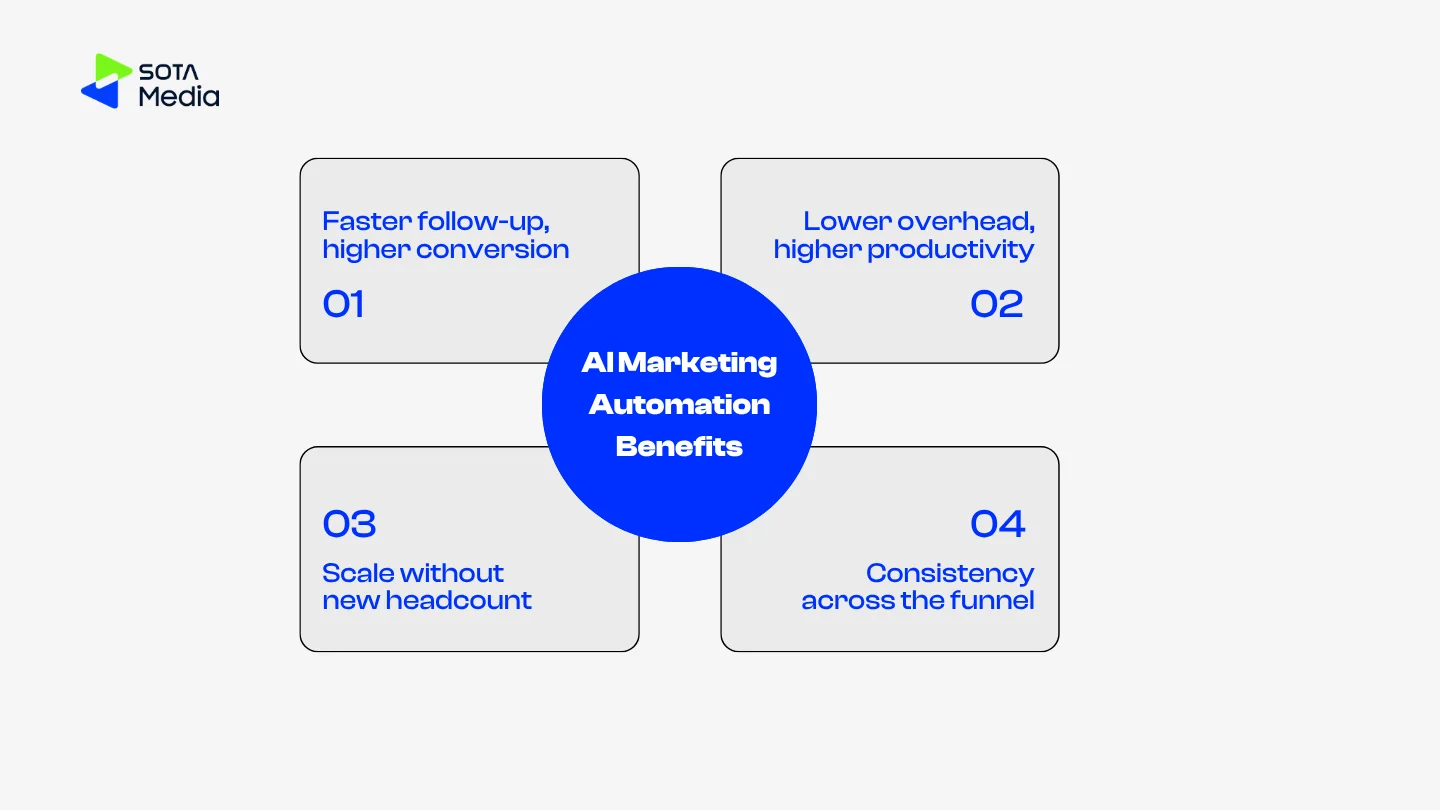
AI Marketing Automation Benefits
Faster follow-up, higher conversion rate
Response time is one of the highest-leverage variables in B2B marketing. A Harvard Business Review analysis found companies that follow up with web leads within an hour are 7x more likely to qualify them. The average team takes 46 hours. Automation closes that gap: a form fill at 2am gets a follow-up email in minutes, not Monday morning.
Lower overhead, higher productivity
According to Oracle, marketing automation drives a 14.5% increase in sales productivity and a 12.2% reduction in overhead. AI-driven marketing automation takes that further by removing the manual optimization layer entirely — the system adjusts targeting, timing, and spend allocation without someone rewriting the rules.
Scale without new headcount
A five-person marketing team running automated sequences can manage a pipeline that would otherwise require eight to ten people doing manual follow-up. The work that scales (email sends, lead scoring, social scheduling, report generation) runs in the background. The team handles what still needs judgment: messaging, creative direction, customer relationships.
Consistency across the funnel
Manual marketing has bad weeks. A lead that comes in during a product launch crunch, or when two team members are out, gets slower follow-up and less attention. Automated systems do not have off days. Every lead in the same segment gets the same sequence, the same timing, the same scoring logic, regardless of what else is happening internally. This matters most at the top of the funnel, where inconsistency kills the pipeline before sales ever sees it.
What Marketers Are Actually Automating With AI?
These are real applications, not feature lists from a vendor brochure. Each one is running inside marketing teams right now.
Example 1: Automated lead follow-up
A contact visits your pricing page twice in 48 hours. Without automation, they go into a queue. With AI automation, they get a personalized follow-up email within minutes, their lead score jumps, and a Slack alert fires to the assigned sales rep.
Why it matters: Research from Harvard Business Review (2011), replicated across B2B studies since, shows companies that follow up with web leads within an hour are 7x more likely to qualify them. Most teams take 24+ hours. Automation closes that gap without requiring a human to watch a dashboard.
Example 2: Paid ad optimization
AI monitors which creatives, audiences, and bid levels are producing the lowest cost-per-lead in real time, then shifts budget toward what is working. A campaign running across five ad sets at equal budget gets automatically reweighted: one ad set producing 60% of conversions absorbs more spend; underperformers get suppressed.
Why it matters: B2B teams that enable conversion-based bidding typically see meaningful CPL reductions within the first 60 days. The more conversion volume the algorithm has to learn from, the faster the gains compound. The caveat: the system needs volume. Under 50 conversions per month, the algorithm does not have enough signal to learn from.
Example 3: Social monitoring and scheduling
AI schedules posts at the time each platform’s algorithm favors for your specific audience, not a generic ‘Tuesday at 10am’ rule. Beyond scheduling: tools monitor brand mentions across platforms, flag sentiment shifts in comments, and surface competitor activity or trending topics in your niche before they peak.
Why it matters: Teams managing 3 or more social accounts report saving 4-6 hours per week in manual monitoring. The real value is catching a negative comment thread before it runs for 12 hours without a response, which happens regularly when monitoring is manual.
Example 4: AI content operations
AI generates keyword clusters from search intent data, produces content briefs with competitor gap analysis, and drafts section-by-section outlines. Writers start from a structured brief instead of a blank page. SEO teams use the same tools to catch content cannibalization (two pages targeting the same keyword and splitting traffic) before publishing.
Why it matters: Content teams report 40-60% faster time-to-first-draft when starting from an AI-generated brief. The two-hour research phase (finding top-ranking pages, extracting keywords, mapping competitor content) runs in under five minutes. Writers focus on the part that requires judgment.
How Do You Get Started with AI Marketing Automation?
Most companies overcomplicate the starting point. Three steps is enough.
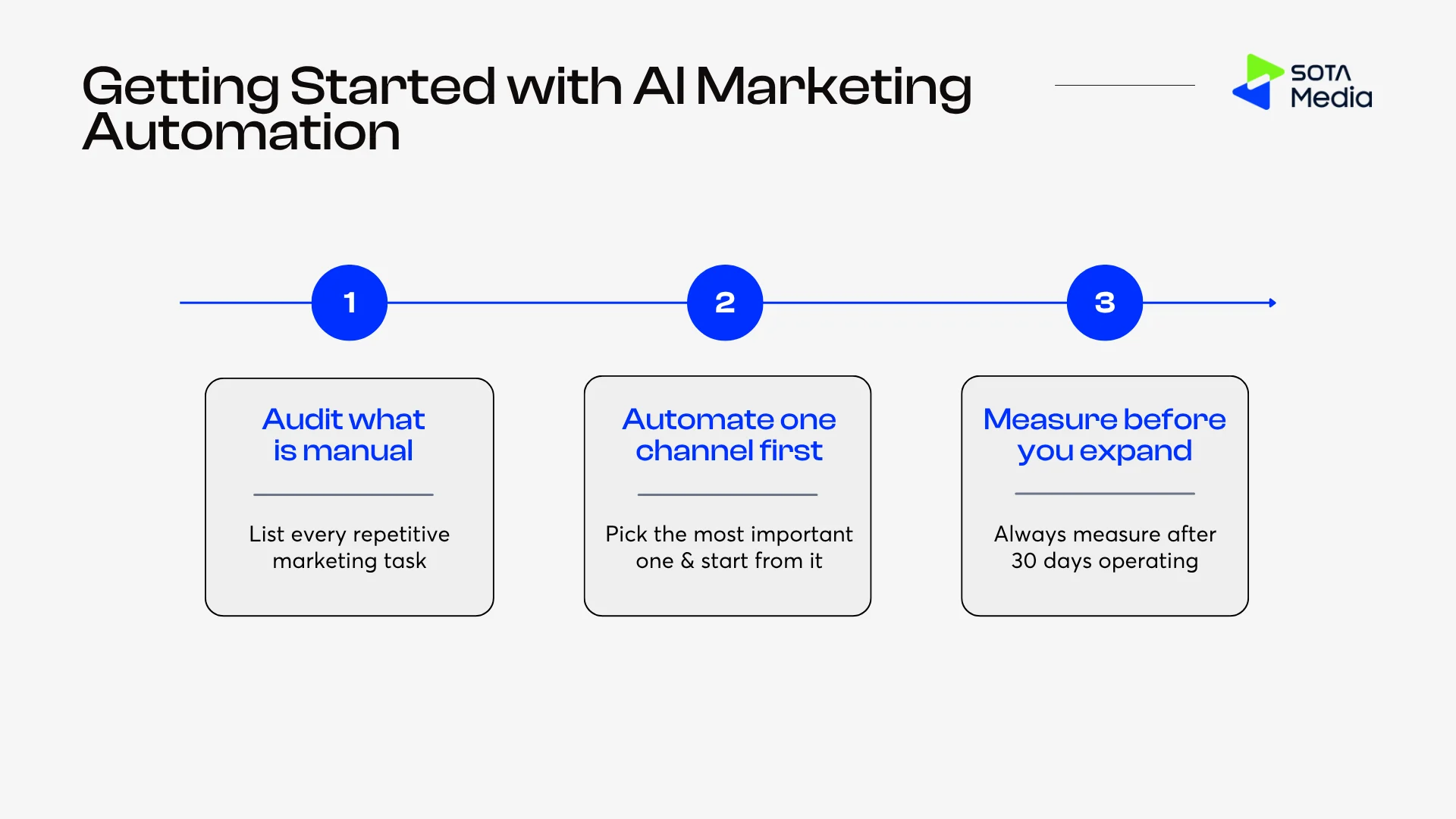
Getting Started with AI Marketing Automation
Step 1: Audit what is manual
List every repetitive marketing task your team does weekly. Email follow-ups, lead tagging, social scheduling, report pulling, contact list cleaning. Rank by time cost. The highest time-cost task that has a clear trigger (‘contact submits form,’ ‘lead visits pricing page’) is your starting point. Not the most exciting one. The most expensive one.
Step 2: Automate one channel first
Email is the lowest-friction entry point for most teams. Set up one automated sequence such as a welcome flow or post-demo follow-up, and run it for 30 days before touching anything else. The temptation to automate five things at once is strong and almost always results in half-finished setups across all five.
Step 3: Measure before you expand
At day 30, pull your open rate, click-to-open rate, reply rate, and lead-to-SQL conversion for anything that touches the automated flow. Set those numbers as your baseline. Expand to a second channel only after you can attribute business impact to the first one. This sounds obvious. Most teams skip it and end up unable to justify the spend six months later.
Do I Need to Buy Every Tools to Get Started?
No. Most of the tools referenced in this article are built for teams with dedicated marketing ops resources. If you’re a solo marketer or a small team, that’s not necessary.
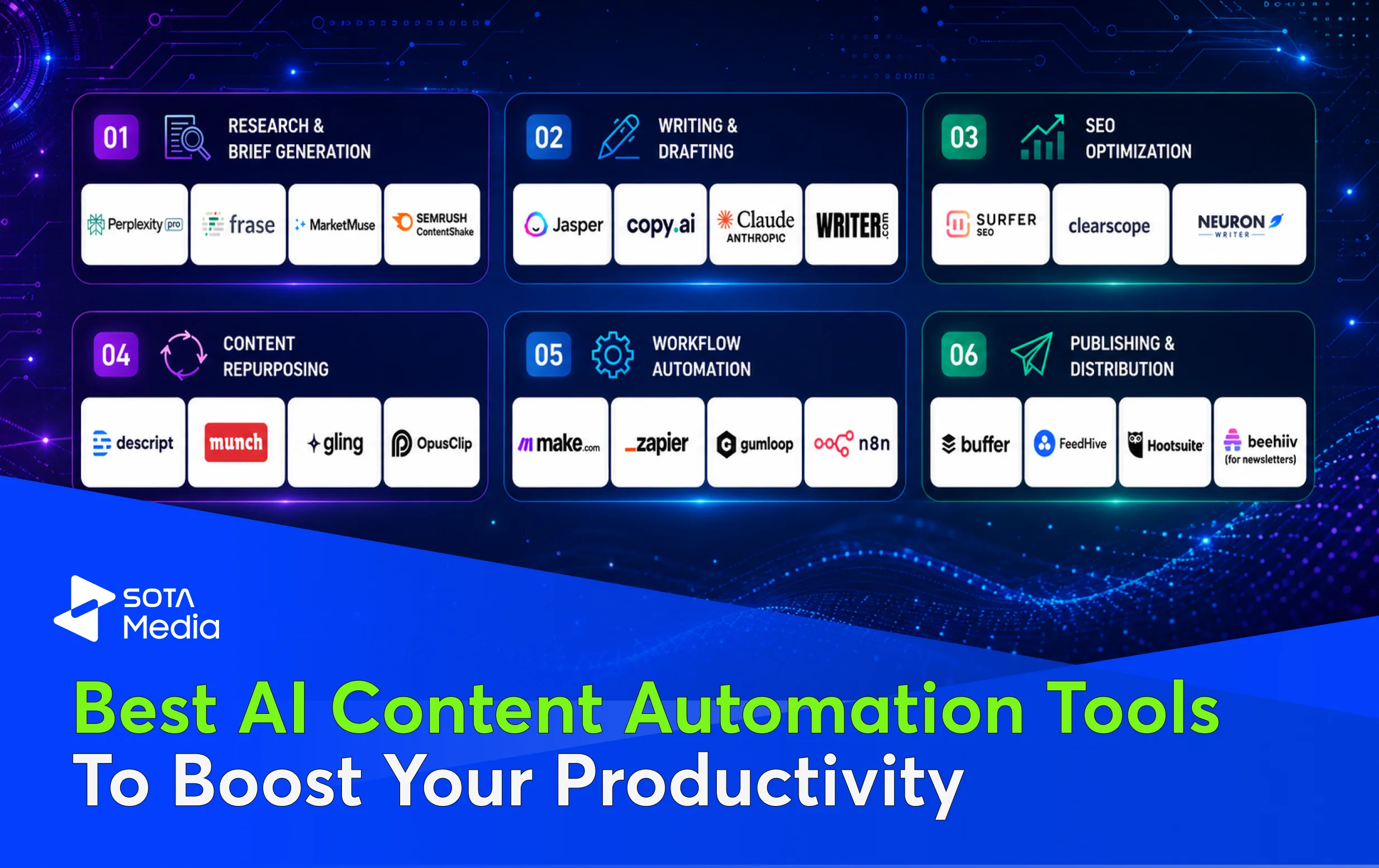
The more practical entry point is a no-code workflow builder: Make.com, Zapier, or n8n. These tools connect your existing stack and let you automate between them without writing code. A basic but functional AI marketing stack might look like:
- New lead fills form → Zapier sends data to OpenAI → generates personalized outreach draft → drops into Gmail as a draft for review
- Blog post published → Make triggers → sends to a repurposing workflow → posts LinkedIn summary automatically
- Weekly sales data → n8n pulls from Airtable → OpenAI writes performance summary → sends to Slack
None of this requires a platform contract, and the initial cost could start from zero. The tradeoff is that you’re stitching together tools manually, it takes setup time and breaks occasionally when APIs update. But for teams that want to test AI automation before committing to a full platform, it’s the fastest way to find out what actually moves the needle for your specific workflow.
For teams or companies that want faster results without building every workflow from scratch, or spending weeks learning AI, then working with an AI marketing automation agency is worth evaluating.
How Do You Choose the Right AI Marketing Automation Agency?
Five things to verify before you sign:
1. Does the Agency Work with Your Existing Stack?
The agency needs to work with what you already have. A HubSpot-native team trying to integrate your Salesforce CRM will slow everything down. Ask for a list of their certified platforms before the second call.
2. Does the Agency Know Your Industry?
‘We have worked with SaaS companies’ is not the same as ‘we have run lead nurturing for B2B SaaS with 6-18 month sales cycles.’ Ask for a client reference in your specific vertical and company size.
3. How Does the Agency Report on Results?
Ask to see an actual client report before you engage. If it is a PDF with traffic graphs and no attribution data, move on. Good agencies show pipeline impact: revenue influenced, SQL volume, CAC by channel. Not vanity metrics.
4. How Fast Will You See First Results?
What is their onboarding process? When do you see the first automation live? ‘We need three months to strategize” is a red flag. A 14-day first-deliverable timeline is realistic for any agency with working templates.
5. Who Will Actually Work on Your Account?
Are you getting a dedicated account lead or rotating junior staff? Will the same person who pitches you be building your campaigns? Get this in writing.
One agency checks all the boxes above is SotaMedia. We are the marketing arm of SotaTek (one of Vietnam’s largest IT firms with clients including VinFast, LG U+, and SK Telecom), which means our team understands your product, speaks your language and produces contents that resonate with enterprise buyers and technical founders, not just consumer audiences.
SotaMedia’s AI Marketing Automation service covers automated content publishing, 24/7 lead prospecting, influencer discovery, and community management. With 350+ clients across 25+ countries and experience across IT outsourcing, B2B SaaS, and Web3, we are one of the few agencies in Southeast Asia that has run automation campaigns across all three categories.
Conclusion
AI marketing automation is not a magic switch. It amplifies what is already working and exposes what is not. The companies getting consistent results share a few traits: they started with one automation and measured it properly before expanding, they chose tools that fit their existing stack instead of the most-hyped option, and they kept a human in the loop for every strategic decision.
If you are a tech company trying to scale & automate marketing without scaling headcount, SotaMedia can compress that learning curve significantly. Contact SotaMedia and start automating the marketing work that’s slowing you down.