

20 AI Marketing Tools to Get Ahead in 2026


Table of Contents
Marketing has transformed more in the last two years than in the previous decade. The emergence of generative AI and intelligent marketing automation has fundamentally reshaped how brands create content, target audiences, and measure success.
The data is undeniable. According to Jasper’s State of AI Marketing 2026 Report, 91% of marketers now actively use AI in their work, up from 63% in 2025. This represents near-universal adoption AI is no longer an experiment. It’s become core marketing infrastructure.
However, only 41% of marketers can confidently prove AI ROI, down from 49% last year, reflecting rising expectations rather than weaker performance. The challenge isn’t adoption anymore. It’s implementation choosing the right tools and integrating them strategically into your workflows.
This guide walks you through the 20 essential AI marketing tools for 2026, organized by function, with specific use cases and capabilities that give you a competitive advantage
Key Takeaways
- AI adoption among marketers is now near-universal (91%), but only 41% can prove ROI—the gap isn’t tool availability, it’s implementation discipline and clear measurement frameworks connecting AI outputs to business outcomes.
- The 20 AI marketing tools listed above serve different functions, but successful teams treat AI as marketing infrastructure, not a shortcut. This means integrating tools into your existing stack (CRM, CMS, analytics), building repeatable workflows, and establishing governance before scaling.
- Start with your single biggest bottleneck—whether that’s content production speed (Jasper AI, Surfer SEO), lead quality (HubSpot, ActiveCampaign), creative assets (Canva, Kling.ai), or email performance (Klaviyo, ActiveCampaign)—and master that tool before adding complexity.
- Free AI tools (ChatGPT, Claude, Gemini, Canva) handle 70% of what most marketing teams need; the real ROI multiplier comes from integration, team adoption, and measurement discipline, not premium pricing or feature count.
What Are AI Marketing Tools?
AI marketing tools are software platforms that use machine learning, natural language processing, or generative AI to automate or improve marketing tasks content creation, audience targeting, email sequencing, analytics, social scheduling, and more.
The practical difference from traditional tools: they adapt based on data. A traditional email tool sends at 9 AM because you scheduled it. An AI email tool sends when each individual contact is statistically most likely to open based on their own behavioral history.
According to Jasper’s 2026 data, idea generation (56%) remains the top use case, but multi-asset campaign creation (51%) is catching up fast. Marketing teams aren’t just asking AI to write a single blog post they’re building repeatable workflows that produce a blog post, three emails, and five social captions from a single input. The teams pulling ahead are the ones treating AI as infrastructure, not a one-off tool.
Quick Reference: 20 AI Marketing Tools by Category
| Category | Tools |
|---|---|
|
LLM & Marketing Assistants |
ChatGPT, Claude, Gemini |
|
AI Tools for Content Marketing |
Jasper AI, Grammarly, Copy.ai |
|
AI Tools for SEO |
Surfer SEO |
|
AI Marketing Automation Tools |
Gumloop, Zapier, Make.com |
|
Email Marketing |
ActiveCampaign, Klaviyo |
|
Generative AI Marketing Tools (Design & Video) |
Kling.ai, Higgsfield, Canva, Gamma |
|
AI Tools for B2B Marketing (CRM & Analytics) |
HubSpot, Salesforce |
|
AI Tools for Social Media Marketing |
FeedHive, Hootsuite |
Detailed Look at Each AI Marketing Tool
LLM & Marketing Assistants
Large language models are the base layer of modern AI marketing. They handle brainstorming, drafting, research synthesis, and strategy work anything that requires language understanding at scale.
ChatGPT

Best for: Versatile daily tasks briefs, scripts, email drafts, ad copy, HTML debugging
ChatGPT has the largest active user base of any AI assistant, with over 400 million weekly users as of early 2025. Its main strength is breadth. You can paste a spreadsheet of campaign data, attach a competitor’s landing page screenshot, and ask for a positioning brief all in one prompt.
For marketing teams new to AI tools for marketing, ChatGPT is usually the right starting point. The free tier covers most day-to-day tasks: writing first drafts, generating campaign concepts, building content calendars, and answering research questions quickly.
Claude
Best for: Long documents, brand voice consistency, complex writing tasks
Claude (Anthropic) handles large inputs well. Its extended context window on higher tiers can process a full brand guideline document, hundreds of pages of customer research, and competitor analysis all at once and synthesize them into coherent output.
Marketers managing complex brand documentation or long-form content strategies tend to prefer Claude for that reason. It produces writing that sounds less templated, which matters when you’re publishing under a distinct brand voice.
Claude also offers a capable free AI marketing tool tier for individuals and small teams exploring AI-assisted content work.
Google Gemini
Best for: Teams running on Google Workspace; real-time web research
Gemini’s advantage is native integration with Google Docs, Sheets, and Drive. If your team already lives inside Google’s ecosystem, Gemini works directly inside those tools without switching between apps. For campaign performance analysis, it can pull live Google Sheets data and generate trend summaries in seconds.
It’s also the strongest option for marketers who need current information Gemini pulls live results from Google Search by default, which neither ChatGPT nor Claude does natively without extensions.
AI Tools for Content Marketing
When you need to scale content production without sacrificing quality, these specialized platforms do the heavy lifting.
Jasper AI
Best for: Enterprise teams scaling branded content at volume
Jasper was built specifically for marketing content not general writing. You input your brand voice, tone guidelines, and product knowledge base once. After setup, every output applies those parameters automatically, whether it’s a Facebook ad or a 3,000-word whitepaper.
Jasper’s research shows teams using its platform cut content production time by an average of 40%. Its collaboration features review workflows, version history, multi-user access make it practical for marketing departments of five or more people rather than solo creators. For organizations that need the best AI marketing tools 2026 has for content at scale, Jasper remains the category leader.
Grammarly
Best for: Editing, tone adjustment, and consistency across distributed teams
Grammarly has expanded well past grammar checking. Its GrammarlyGO feature rewrites paragraphs for different tones; an internal Slack update becomes a polished LinkedIn post in one click. It also provides real-time coaching on clarity and engagement as you write.
For marketing teams where multiple writers produce content agencies, in-house teams with regional contributors Grammarly’s style guides keep output aligned without manual review of every piece. It works across browsers and desktop apps, making it effectively invisible in the workflow.
Copy.ai
Best for: High-volume copy across many formats quickly
Copy.ai’s Workflows feature is what sets it apart from other AI tools for content marketing. Feed it a URL, a recent webinar, a product page, a blog post and it generates a summary article, three promotional emails, and five social captions automatically. The whole process takes under two minutes.
It covers 90+ templates for specific marketing formats: cold outreach emails, real estate listings, product descriptions, Instagram captions. Output quality varies by template, but for volume production where a human editor reviews before publishing, the time savings are real.
AI Tools for SEO
Surfer SEO

Best for: SEO content that ranks, not just reads well
Surfer analyzes 500+ on-page signals from the top-ranking pages for any keyword, then tells you what your content needs: keyword density, word count, headings, internal links, semantic entities. It removes most of the guesswork from content briefs.
In 2026, its AI writing mode can generate a full draft built around those signals. The output isn’t publication-ready it needs a writer to shape it but the structure is grounded in what search engines are actually rewarding for a given query.
SEMrush’s 2025 State of Content Marketing report found that 55% of top-ranking articles were written with some form of SEO content tool assistance. For teams serious about organic traffic, using AI tools for SEO like Surfer is no longer optional it’s how the competition operates.
AI Marketing Automation Tools
Automation is where AI marketing delivers the clearest efficiency gains. These platforms eliminate manual data entry and repetitive execution tasks.
Gumloop
Best for: Custom AI pipelines without engineering support
Gumloop lets you visually connect AI models, APIs, and data sources into automated workflows. A practical example: scrape a competitor’s blog every Monday, run new posts through an LLM to extract their keyword strategy, and deliver a formatted summary to a Slack channel automatically.
It handles AI-native workflows where LLM calls are part of the logic better than Zapier or Make.com natively. Technical marketers who’ve hit the ceiling of standard automation tools tend to move here.
Zapier
Best for: Connecting your existing app stack with AI-enhanced decision steps
Zapier connects over 7,000 apps as of 2026. Its AI layer lets you add intelligent steps inside automations. When a new lead enters your CRM, Zapier can fetch their company website, identify their industry, score the lead, and route them to the right rep with a pre-drafted intro email all without human involvement.
For teams building their first AI marketing automation tools setup, Zapier is the lowest barrier to entry. It’s not built for complex AI logic, but for straightforward conditional flows that include an AI step, it’s reliable and fast to configure.
Make.com
Best for: Complex multi-step automations with branching logic
Make.com handles more intricate flows than Zapier. Its visual builder shows exactly where data moves at each step which matters when you’re troubleshooting why a specific automation breaks on edge cases.
A practical marketing use case: route customer support tickets through a sentiment analysis module, then trigger different retention campaigns depending on whether the tone is frustrated, neutral, or satisfied. That kind of conditional branching is where Make.com outperforms simpler AI marketing automation tools.
Email Marketing
Email remains one of the highest ROI marketing channels available. These platforms use AI to ensure your messages reach the right contact at the right moment.
ActiveCampaign
Best for: B2B marketing teams that need email, automation, and CRM in one place
ActiveCampaign’s predictive sending analyzes each contact’s historical open patterns and delivers emails when that individual is most likely to engage not when your campaign is scheduled. ActiveCampaign’s own benchmark data shows this increases open rates by an average of 20% compared to standard batch sends.
Its predictive content feature goes further, dynamically swapping email copy and images per user segment based on behavioral data. For AI tools for B2B marketing, where personalization at scale is a core challenge, ActiveCampaign covers both the email and CRM layer in one platform.
Klaviyo
Best for: E-commerce brands with large transactional datasets
Klaviyo is built around purchase data. It predicts when a customer is about to run out of a consumable product and triggers a reorder email before they look elsewhere. It calculates predicted customer lifetime value and churn probability per individual contact, letting marketers target high-value customers with retention offers and send win-back campaigns to those drifting toward inactivity.
For e-commerce brands sending hundreds of thousands of emails monthly, Klaviyo’s segmentation and predictive analytics justify the investment. It’s consistently cited as one of the best AI marketing tools 2026 for direct-to-consumer brands.
Generative AI Marketing Tools: Design & Video
Visual content determines whether people stop scrolling. These generative AI marketing tools let teams produce agency-quality visuals without a full production crew.
Kling.ai
Best for: Product demo videos and social media ads from text or images
Kling.ai generates video from text prompts or static images. Output quality in 2026 is good enough for B-roll footage, animated product demonstrations, and short social ads. For performance marketing teams that test 20–30 creative variations per campaign, being able to generate and iterate video assets in hours instead of weeks with a production crew changes the economics of creative testing entirely.
Higgsfield
Best for: Brand-consistent video editing and personalized video at scale
Where Kling.ai generates from scratch, Higgsfield gives precise control over existing video assets. You can update a product shoot’s background for different seasonal campaigns, or create personalized video messages for high-value B2B accounts same footage, different names and details per contact.
For enterprise brands where visual consistency is non-negotiable, this level of control is what separates Higgsfield from broader generative AI marketing tools that prioritize novelty over repeatability.
Canva
Best for: Marketing teams that produce high volumes of designed assets without a dedicated designer
Canva’s Magic Studio suite handles the mechanical work: resize a design for every platform simultaneously, remove backgrounds in one click, generate custom images from text prompts inside the design canvas, and draft copy directly in the layout editor.
Canva reports over 180 million monthly active users across 190 countries. The free tier includes most AI design features, making it one of the more accessible free AI marketing tools for small teams. For a one-person marketing team producing the asset volume that previously required a graphic designer, Canva closes most of that gap.
Gamma
Best for: Sales decks, marketing presentations, and digital brochures
Gamma generates complete presentations from a topic, outline, or raw document. You provide the structure; it handles formatting, layout, and visual design. The output is cleaner than default PowerPoint and takes a fraction of the time to produce.
For AI tools for B2B marketing teams that produce pitch decks and sales enablement materials regularly, Gamma cuts formatting time from hours to minutes. The content still needs a human review pass, but the structural foundation is solid.
AI Tools for B2B Marketing: CRM & Analytics
Managing customer data and extracting actionable insights is where AI delivers some of its clearest measurable gains.
HubSpot
Best for: Inbound marketing teams that want AI connected across the full customer lifecycle
HubSpot’s AI features sit natively across its CRM, CMS, and marketing hubs. It scores leads on their likelihood to close based on behavioral data, summarizes sales calls automatically, and drafts email responses based on conversation context.
HubSpot’s 2025 State of Marketing report found that teams using AI for lead scoring saw a 23% increase in sales-qualified leads passed to sales. The value compounds because marketing, sales, and service data all live in one system not spread across three disconnected platforms.
HubSpot also offers a capable free CRM tier, making it one of the most widely used free AI marketing tools for growing companies before they need enterprise features.
Salesforce
Best for: Large organizations managing complex, multi-region customer datasets
Salesforce’s Einstein AI runs on top of one of the largest CRM datasets in the world, which gives its predictions more signal than newer competitors. Its “Next Best Action” feature recommends content, channel, and timing for specific customer segments based on patterns across billions of historical interactions.
For organizations with large contact databases and complex sales cycles, the depth of Einstein’s analytics supports global campaign orchestration at a level smaller platforms can’t match. For everything else, HubSpot is typically the more practical choice.
AI Tools for Social Media Marketing
Maintaining a consistent presence across multiple networks is time-intensive. These platforms automate the distribution and scheduling work so teams focus on strategy.
FeedHive
Best for: Creators and smaller marketing teams who want AI-driven scheduling
FeedHive analyzes your specific audience’s engagement patterns and recommends posting times based on their actual behavior not industry averages. Its content recycling feature automatically resurfaces your top-performing evergreen posts on a set schedule, keeping accounts active during slow content production periods.
As an AI tool for social media marketing built specifically for smaller teams, FeedHive covers scheduling, AI writing assistance for captions and hooks, and performance analytics in one interface without the complexity of enterprise platforms.
Hootsuite
Best for: Enterprise teams managing multiple brands and accounts across many networks
Hootsuite handles dozens of accounts, team approval workflows, and social listening across millions of brand mentions simultaneously. Its Owly AI writer generates platform-specific captions adjusting tone and length automatically for LinkedIn versus Instagram versus X.
The social listening and sentiment analysis features are particularly relevant for brands where PR risk is real. Hootsuite’s 2025 Social Trends report found that 53% of brands increased their social listening budget in 2025, partly because AI made monitoring at scale significantly cheaper. For large organizations, Hootsuite is the comprehensive choice for AI tools for social media marketing.
AI Marketing Tools: Category Breakdown & Selection Matrix
| Function | Best for Speed | Best for Scale | Best for ROI |
|---|---|---|---|
|
Content Generation |
Copy.ai |
Jasper AI |
Surfer SEO |
|
Automation |
Zapier |
Gumloop |
Make.com |
|
Email Marketing |
ActiveCampaign |
Klaviyo |
ActiveCampaign |
|
Design |
Canva |
Kling.ai |
Higgsfield |
|
Analytics |
HubSpot |
Salesforce |
HubSpot |
|
Social Media |
FeedHive |
Hootsuite |
FeedHive |
|
Function |
Best for Speed |
Best for Scale |
Best for ROI |
|
Content Generation |
Copy.ai |
Jasper AI |
Surfer SEO |
|
Automation |
Zapier |
Gumloop |
Make.com |
|
Email Marketing |
ActiveCampaign |
Klaviyo |
ActiveCampaign |
|
Design |
Canva |
Kling.ai |
Higgsfield |
|
Analytics |
HubSpot |
Salesforce |
HubSpot |
|
Social Media |
FeedHive |
Hootsuite |
FeedHive |
How to Pick an AI Marketing Tool
How to Pick an AI Marketing Tool
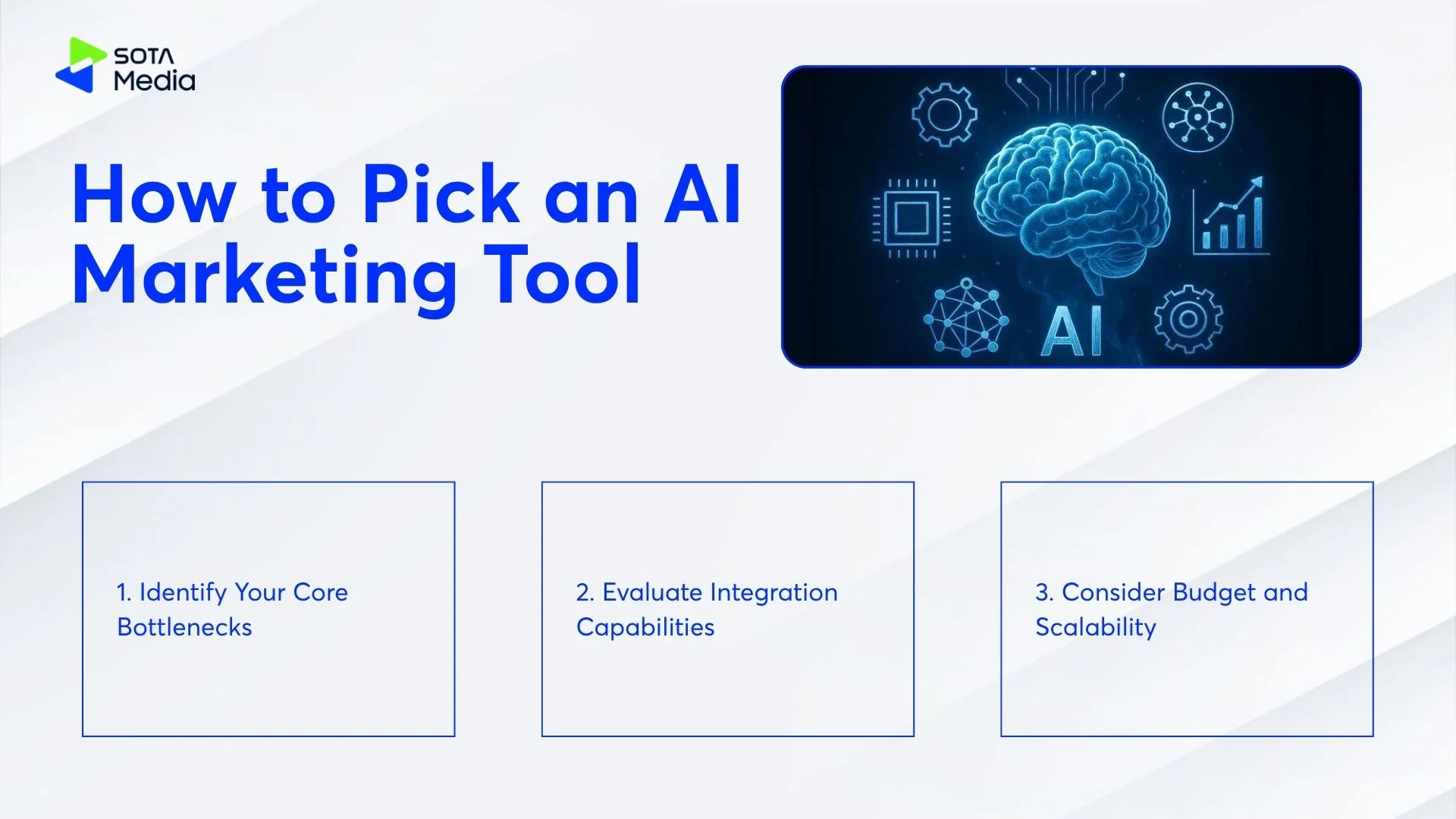
With so many powerful options available, selecting the right tools can feel overwhelming. Integrating every tool on this list is not the goal; the goal is to build a cohesive stack that solves your specific business bottlenecks. Here is a framework for how to pick an AI marketing tool effectively:
- Identify Your Core Bottlenecks: Do not buy software simply because it is trending. Start by auditing your marketing workflow. Are your writers spending too much time outlining content? Look into Jasper AI or Surfer SEO. Are your sales reps complaining about lead quality? You need predictive scoring from HubSpot or ActiveCampaign. Let your pain points dictate your purchases.
- Evaluate Integration Capabilities: An AI tool is only as powerful as the data it can access. If a new piece of AI marketing software cannot seamlessly integrate with your existing CRM or CMS, it will create data silos and manual workarounds that defeat the purpose of automation. Prioritize tools that feature robust native integrations or connect easily via Zapier or Make.com.
- Consider Budget and Scalability: There are many incredible free AI marketing tools available, particularly foundational LLMs like ChatGPT or Gemini. However, as you scale, you will require enterprise-grade security, team collaboration features, and dedicated support. Ensure the tool you select has a pricing model that aligns with your projected growth and won’t penalize you excessively as your usage scales.
Conclusion
The marketing industry of 2026 demands speed, personalization, and relentless optimization. By strategically deploying the best AI marketing tools 2026 has to offer, you can scale your operations exponentially without inflating your headcount. The tools listed above represent the cutting edge of what is possible, from predictive CRM analytics to generative video creation.
However, technology alone is not a strategy. The true power of these tools is unleashed when they are guided by experienced, strategic human oversight. If you are ready to modernize your marketing stack and drive unprecedented growth, the experts at SotaMedia are here to help. Contact SotaMedia today to build a custom, AI-driven marketing infrastructure designed specifically for your global business objectives.